
Introduction
Boards are increasingly responsible for cybersecurity oversight — yet most receive technical reports that describe activity rather than answer the question that actually matters: are our controls working?
SEC rules adopted in 2023 now require public companies to disclose board oversight of cybersecurity risks, with annual reporting obligations beginning for fiscal years ending December 15, 2023. That regulatory shift moved cyber governance from a management preference to a board obligation. The problem is that most organizations lack the structured evidence to back it up.
A Security Control Assessment Matrix (SCAM) gives that evidence a structure. It converts control testing results into a structured, auditable view that executives can act on — turning security reporting from an activity log into an inspectable program with clear ownership, measurable outcomes, and defensible evidence.
What follows is a practical breakdown: what a SCAM is, what belongs in it, how to build one that holds up under scrutiny, and what effective execution looks like.
Key Takeaways
- A SCAM maps security controls against structured evaluation criteria — design, operating effectiveness, and maturity — to show where your program is strong and where it has critical gaps.
- It differs from a risk matrix: a risk matrix scores what could go wrong; a SCAM assesses whether the controls meant to prevent it are actually working.
- Building one means scoping to a recognized framework, inventorying controls, scoring maturity, and mapping findings to business risk.
- The output becomes the foundation for board and audit committee reporting — and for defensible investment decisions.
What Is a Security Control Assessment Matrix and Why Does It Matter?
A Security Control Assessment Matrix is a structured grid that catalogs an organization's security controls alongside key evaluation criteria — control owner, framework mapping, design effectiveness, operating effectiveness, and maturity score. The result is a single, auditable record of what controls exist, who owns them, and whether they actually work.
This is not a risk likelihood-impact matrix. A risk matrix asks: what could go wrong? A SCAM asks: are our safeguards actually working? Both are necessary — and neither answers the other's question.
Primary Use Cases
Organizations use a SCAM across several high-stakes contexts:
- Regulatory compliance — mapping controls to NIST CSF 2.0, ISO 27001 Annex A, SOC 2 Trust Services Criteria, or NIST SP 800-53
- Board and audit committee reporting — providing structured, evidence-backed briefings directors can act on
- Gap analysis — identifying control failures before or after a security incident
- M&A due diligence — assessing the target's control environment before close
Regulated industries face the most acute need. Financial services, healthcare, and retail organizations must demonstrate control accountability to examiners, directors, and regulators — not just describe their security programs in general terms. Without a SCAM, those demonstrations rely on narrative rather than evidence — which creates real exposure when regulators start asking questions.
The Cost of Flying Blind
According to PwC's 2025 Global Digital Trust Insights — which surveyed 4,042 business and technology leaders across 77 countries — 67% of executives said cybersecurity is a top board priority for the coming year. Yet most boards still receive reports that confirm activity without confirming effectiveness.
That gap has direct consequences. SEC enforcement actions against R.R. Donnelley & Sons ($2.1M penalty) and First American Financial ($487,616 penalty) show that disclosure-control failures and inadequate cybersecurity oversight create regulatory exposure — not just reputational risk.
The Three Assessment Types
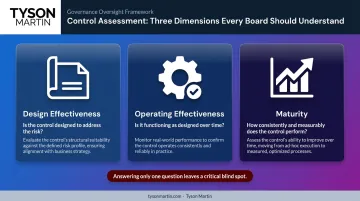
Every SCAM evaluates controls across three dimensions:
| Assessment Type | The Question It Answers |
|---|---|
| Design Effectiveness | Is the control designed to address the risk? |
| Operating Effectiveness | Is it functioning as designed over time? |
| Maturity | How consistently and measurably does the control perform? |
PCAOB AS 2201 draws a clear line between design and operating effectiveness: design asks whether a control, if operated as prescribed, satisfies its objectives; operating effectiveness asks whether it is actually running that way in practice. Answering only one question leaves a critical blind spot: a well-designed control that nobody runs is just documentation, and a control that's running without proper design is just activity.
Key Components of an Effective Security Control Assessment Matrix
Control Domains and Rows
The matrix is organized around control domains aligned to a recognized framework. Using NIST CSF 2.0 — published February 26, 2024 — those domains are Govern, Identify, Protect, Detect, Respond, and Recover. The Govern function was added in the 2024 update specifically to address board-facing oversight requirements.
Each domain contains individual controls — access management, patch management, encryption, incident response playbooks — that become the rows of the matrix.
Essential Column Fields
Every SCAM needs these columns to be auditable and useful for governance:
- Control ID and Description — unique identifier and plain-language description
- Control Owner — a named individual, not just a team
- Framework Mapping — which requirement this control satisfies
- Design Effectiveness — Yes / Partial / No
- Operating Effectiveness / Maturity Score — rated 1–5
- Last Assessment Date — when testing or evidence was last gathered
- Evidence Reference — logs, test results, audit samples
- Gap or Finding — what's missing or broken
- Remediation Status — owner, action, and target completion date
The evidence reference column is frequently underbuilt. Without it, the matrix is an assertion rather than an auditable artifact, and assertions don't hold up to examiner scrutiny.
Maturity Scoring Scale
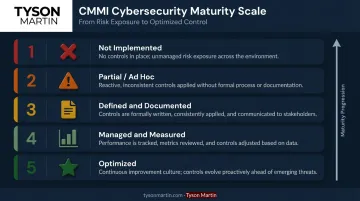
Operating effectiveness is rated on a 1–5 scale, grounded in CMMI-based maturity practice:
| Score | Level | What It Means |
|---|---|---|
| 1 | Not Implemented | Control doesn't exist |
| 2 | Partial / Ad Hoc | Inconsistently applied |
| 3 | Defined and Documented | Repeatable with documentation |
| 4 | Managed and Measured | Actively monitored with metrics |
| 5 | Optimized | Continuously improving |
Scoring on this scale avoids the binary pass/fail trap. A control that scores 2 three quarters in a row tells a different story than one that moved from 2 to 4. Leadership needs that trend line, not just a snapshot.
Risk Linkage and Escalation Thresholds
Each control row should trace back to one or more risks in the organization's risk register. This connection allows executives to see which unmitigated risks are exposed when a control scores low, enabling prioritization based on business impact rather than technical severity alone.
Escalation thresholds determine what reaches the board and what stays at the management level. Without them, boards either get too much noise or miss material exposures entirely. Define these thresholds explicitly:
- Any critical control rated 1 or 2 in a regulated domain triggers board-level escalation
- Controls rated 3 or below in non-critical domains are tracked at the management level
- Findings without remediation owners within 30 days auto-escalate one tier
How to Build a Security Control Assessment Matrix: Step by Step
Building a SCAM is a cross-functional governance exercise. Security, compliance, legal, and business unit owners all contribute — and the CISO or equivalent executive should formally accept the output before it reaches leadership.
Step 1 — Define Scope and Framework Alignment
Determine which parts of the organization are in scope: enterprise-wide, a specific business unit, or a defined compliance boundary. Select the primary framework — NIST CSF 2.0, ISO 27001, NIST SP 800-53, or a hybrid — and document scope decisions formally. Auditors and regulators will ask about scope boundaries; vague answers create problems in audits and regulatory reviews.
Step 2 — Inventory Existing Controls
Compile every control currently in place across all domains:
- Technical controls — firewalls, endpoint detection, MFA, encryption
- Administrative controls — policies, training programs, access reviews
- Physical controls — facility access, hardware security
Don't list only documented controls. Surface controls that exist in practice but are undocumented — these create audit risk even when they function correctly, because undocumented controls cannot be tested against any standard.
Step 3 — Map Controls to Risks and Framework Requirements
Align each control to the framework requirement(s) it satisfies and the risk(s) it mitigates. Note every framework requirement with no corresponding control — those are automatic gaps.
This mapping step is what makes the SCAM useful as a governance document. The output is concrete: a direct line from each identified risk to the control addressing it — and a clear list of risks with nothing covering them.
Step 4 — Assess Design and Operating Effectiveness
For each control, evaluate two things:
- Design adequacy — Is the control designed to actually address the associated risk?
- Operating effectiveness — Does evidence confirm it functions as designed in practice?
Evidence sources include logs, testing results, audit samples, and exception reports. Many organizations discover here that their best-documented controls have never been tested. A policy on paper with no evidence of operation tells you nothing about whether it actually works.
Step 5 — Score Maturity and Identify Gaps
Apply the 1–5 maturity scale based on evidence gathered. Identify gaps where controls are absent, partially implemented, or consistently scoring below 3.
Prioritize gaps by risk linkage, not just maturity score. A maturity-2 access management control tied to a critical data exfiltration risk outranks a maturity-2 control with minimal business impact — same score, very different urgency.
Step 6 — Assign Owners, Set Remediation Plans, Establish Review Cadence
- Assign a named individual (not a team) as remediation owner for each gap, with a target date and measurable outcome
- High-criticality controls: reassess quarterly or after material changes
- Lower-criticality controls: annual reassessment is acceptable
- Document the review cadence formally and get it approved
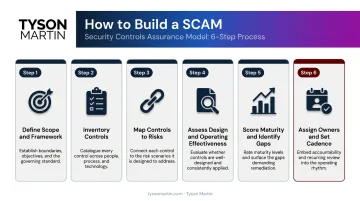
Without named owners and a review cadence, the matrix becomes a historical record rather than an active management tool. Named accountability and scheduled reassessment are what keep gap closure on track.
Security Control Assessment Matrix in Practice: A Walkthrough
The Setup
A mid-size retail organization undergoing a board-requested security program review uses a SCAM to prepare a defensible briefing for its audit committee. The team scopes the matrix to NIST CSF 2.0's six functions and inventories 40 controls across all domains.
During the mapping step, three critical findings surface immediately:
- No documented control for privileged access reviews — access management lacks a defined, recurring process
- An incident response plan that exists on paper but has never been tested — design effectiveness is Partial; operating effectiveness is unknown
- Third-party vendor access with no formal review process — third-party risk sits outside any structured oversight
Without the structured matrix format, these gaps would likely remain invisible. They're not obvious failures — they're silent ones.
Scoring and Risk Linkage
The team scores each finding on the maturity scale and traces each to its business risk:
| Finding | Maturity Score | Business Risk |
|---|---|---|
| No privileged access reviews | 1 | Data breach / insider threat |
| Untested incident response plan | 2 | Regulatory fine / extended recovery time |
| Vendor access without review | 1 | Third-party compromise |
Each gap gets a named remediation owner and a 90-day plan with a specific, measurable outcome — not "improve vendor oversight" but "complete vendor access inventory and assign review process owner by [date]."
The Board Briefing
The SCAM output translates directly into a plain-English board briefing: three high-priority findings, their business risk in non-technical language, the remediation owner, and the target date.
The board now has clear decisions to make and clear delegation to management — with named owners and deadlines, not a technical report requiring translation. According to Deloitte's 2024 Future of Cyber Survey, 41% of boards are already demanding cyber-related issues be addressed at least monthly. That cadence requires exactly this kind of structured, decision-ready output.
How Tyson Martin Can Help
Tyson Martin works directly with boards and executive teams as a board advisor and interim or fractional CISO — designing and implementing Security Control Assessment Matrices as the foundation of an inspectable, defensible security program.
His background includes security and technology leadership at AWS, Home Depot, and Best Buy, plus active roles on the National Retail Federation's CISO Executive Committee and the World Economic Forum's Centre for Cybersecurity. That combination of enterprise operational experience and board-level governance work is what makes a SCAM functional at both levels — not just rigorous on paper.
A SCAM engagement typically delivers:
- A scoped, framework-aligned matrix with stable metrics and trend visibility across reporting periods
- A plain-English board reporting cadence covering risk posture, what changed since the last briefing, and where management needs a decision
- Decision rights and escalation thresholds — documented clearly enough to hold under real incident conditions
- A 90-day remediation plan with named owners and measurable outcomes the board can inspect at the next briefing

The goal is always to reduce cyber risk without slowing the business. Organizations in transition — new CISO leadership, post-incident recovery, M&A integration, or active regulatory scrutiny — are particularly well-positioned to benefit from this structure.
If your organization is in one of those situations, connect with Tyson to discuss what a structured assessment engagement would look like.
Frequently Asked Questions
What are the 5 levels of a risk matrix?
A standard five-level risk matrix uses severity tiers — Very Low, Low, Moderate, High, and Very High — each paired with a corresponding likelihood scale. NIST SP 800-30 Rev. 1 supports this five-tier qualitative approach for both impact and likelihood, producing a risk score that drives prioritization decisions.
What is the difference between a risk assessment matrix and a security control assessment matrix?
A risk assessment matrix scores potential risks by likelihood and impact to prioritize what could go wrong. A Security Control Assessment Matrix evaluates the controls designed to prevent those risks — assessing whether each control is properly designed and actually functioning in practice. The first identifies exposure; the second tells you whether your defenses are holding.
What should a security control assessment matrix include?
At minimum, every row should capture:
- Control ID and description
- Control owner
- Framework mapping
- Design effectiveness rating
- Operating effectiveness and maturity score
- Last assessment date
- Evidence reference
- Identified gaps
- Remediation status with target dates
The evidence reference column is the most frequently omitted — and the most important for audit defensibility.
How often should a security control assessment matrix be reviewed?
High-criticality controls should be reviewed quarterly or after material business changes — M&A, new systems, regulatory updates, or security incidents. Lower-risk controls may follow an annual cadence. The review schedule itself should be formally documented and approved, not left to informal judgment.
How does a security control assessment matrix support board-level reporting?
The SCAM converts technical control testing into a structured, evidence-backed view boards can understand and act on — showing which controls are effective, which have gaps, what the business risk exposure is, and who owns remediation. It gives directors clear decisions to make rather than passive status updates to receive.
Which frameworks does a security control assessment matrix typically align with?
The most common are NIST CSF 2.0, NIST SP 800-53 Rev. 5, ISO/IEC 27001:2022, and the AICPA SOC 2 Trust Services Criteria. Regulated organizations frequently map a single SCAM to multiple frameworks at once, cutting redundant assessment work while satisfying several compliance obligations simultaneously.