Introduction
Most board conversations about cybersecurity follow a familiar pattern: a dense slide deck, some threat statistics, a compliance status update, and a vague sense that "we're working on it." That vagueness has a cost — and it shows up in decisions that get deferred, risks that go unowned, and boards left unable to ask the right questions. What's actually missing is a clear picture of where the organization stands, what changed since last quarter, and what decision is on the table.
That gap is expensive. The global average cost of a data breach reached USD $4.88M in 2024, up 10% from the prior year. Meanwhile, NACD data shows that 96% of directors rank cybersecurity as a top priority, yet only 69% believe their board actually understands the organization's cyber risk profile. That gap between concern and comprehension is where real exposure lives.
A cybersecurity assessment framework addresses that directly. It gives organizations a structured, repeatable way to measure where they actually stand — and gives boards the trend data needed to make informed decisions, not just receive briefings.
This guide covers what assessment frameworks are, the major ones worth knowing, how to run an assessment in practice, and how to turn findings into decisions that hold up under scrutiny.
Key Takeaways
- A cybersecurity assessment framework measures how well your security controls, governance, and risk practices align with a defined standard — and identifies the gaps.
- Major frameworks include NIST CSF 2.0, ISO 27001, SOC 2, and the NCSC's Cyber Assessment Framework (CAF), each suited to different regulatory contexts.
- Assessments follow five steps — from scoping and framework selection through control evaluation, gap prioritization, and a remediation roadmap.
- Framework selection starts with your regulators, then your insurer and board expectations.
- Assessment results are only valuable when they produce named owners, clear decisions, and a 90-day plan the board can inspect.
What Is a Cybersecurity Assessment Framework?
A cybersecurity assessment framework is a structured methodology for measuring how well an organization's security controls, governance, and risk practices align with a defined standard — and identifying where the gaps are.
That definition matters because "assessment" gets used loosely. An assessment isn't a penetration test, a compliance audit, or a vendor questionnaire. It's a structured comparison between your current security posture and a defined target state, across domains like governance, asset management, access control, detection, and incident response.
Frameworks vs. Standards
These terms get conflated, and the distinction matters for executives:
- Frameworks (like NIST CSF 2.0) are voluntary guidance structures. Organizations adapt them to their context without pursuing formal certification.
- Standards (like ISO/IEC 27001:2022) define specific requirements an information security management system must meet, verified through an external audit and certification process.
Both can serve as the basis for an assessment. In practice, most organizations use NIST CSF as their internal governance lens while mapping controls to a certifiable standard when clients or regulators require proof.
What an Assessment Actually Produces
The output isn't a checklist score. A well-run assessment produces:
- A current-state snapshot of security maturity across key domains
- A gap analysis comparing where you are to where you need to be
- A prioritized remediation list ranked by business risk, not technical severity
- A basis for board reporting that shows trend, not just point-in-time status
Many organizations treat assessments as annual events, which produces a snapshot that's stale within months. Mature programs use frameworks to maintain continuous visibility. Boards need to know whether risk is trending up or down — not just whether a box was checked last November.
Who Benefits
Frameworks are particularly valuable for:
- Regulated industries (financial services, healthcare, retail) with compliance obligations tied to specific frameworks
- Organizations in transition — new CISO, post-incident, M&A due diligence, or leadership change
- Any board that needs to demonstrate credible cyber risk oversight to regulators, insurers, or counterparties
The Major Cybersecurity Assessment Frameworks Compared
No single framework fits every organization. Here's what executives need to know about the major ones.
NIST Cybersecurity Framework (CSF) 2.0
Released February 26, 2024, NIST CSF 2.0 is the dominant governance framework for US organizations. Its six core functions are:
- Govern — new in CSF 2.0, this function addresses organizational context, risk strategy, roles, and accountability
- Identify — asset management, risk assessment, supply chain risk
- Protect — access control, awareness training, data security
- Detect — continuous monitoring, anomaly detection
- Respond — incident response planning and execution
- Recover — recovery planning and communications
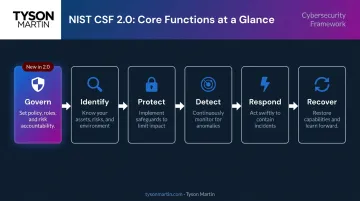
The addition of "Govern" in CSF 2.0 was deliberate. It places board-level accountability at the top of the framework — not as an afterthought. NIST CSF is voluntary, adaptable to any sector, and doesn't require certification, which makes it the most practical starting point for internal governance.
ISO/IEC 27001:2022
ISO 27001 is an internationally recognized standard for information security management systems (ISMS). Unlike NIST CSF, it defines specific requirements that must be met and is verified through an external audit by an accredited certification body.
Organizations pursue ISO 27001 certification primarily when clients, partners, or global regulators require demonstrable proof of compliance. It's more resource-intensive than NIST CSF but carries external credibility that a self-assessment cannot match.
NCSC Cyber Assessment Framework (CAF)
CAF 4.0, published April 18, 2024, is a UK government framework built around four objectives and 14 principles. Each contributing outcome is rated Achieved, Partially Achieved, or Not Achieved using Indicators of Good Practice (IGPs). It's primarily used by UK operators of essential services and organizations subject to NIS regulations.
Other Frameworks Worth Knowing
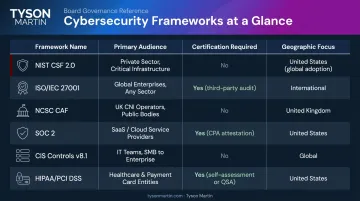
| Framework | Primary Use Case |
|---|---|
| SOC 2 | Service organizations and cloud providers demonstrating controls to customers |
| CIS Controls v8.1 | Prioritized, practical controls list; organized by Implementation Groups (IG1–IG3) |
| HIPAA Security Rule | Required for healthcare covered entities and business associates |
| PCI DSS v4.0.1 | Required for organizations handling payment card data |
The Right Selection Question
Each of the frameworks above answers to a different audience. The practical question is which one your regulators, insurers, and board expect to see — and whether your current assessment can prove it.
Most organizations maintain NIST CSF as their primary governance tool and map controls to sector-specific requirements, avoiding duplicative assessment effort while satisfying multiple audiences.
How to Run a Cybersecurity Assessment: Step-by-Step
Step 1 — Define Scope and Objectives
Identify which systems, business functions, and third-party dependencies are in scope. Clarify the purpose: regulatory compliance verification, risk quantification for the board, insurance renewal, post-incident gap analysis, or M&A due diligence. Scope decisions directly determine the depth and cost of the assessment.
Scope around your tier-1 business services and "crown jewels" first. Assessing everything at once produces a broad, shallow report that nobody acts on.
Step 2 — Select the Framework and Gather Documentation
Choose the framework appropriate to your regulatory context. Then collect:
- Existing security policies and procedures
- System and asset inventories
- Prior audit findings and incident logs
- Vendor contracts and third-party risk documentation
Documentation gaps discovered at this stage are findings in themselves. An organization that can't produce a current asset inventory has a governance problem, not just a paperwork gap.
Step 3 — Evaluate Controls Against the Framework
For each domain or principle, assess whether controls are:
- In place and effective — with evidence (artifacts, logs, tested outcomes)
- Partially implemented — present but incomplete or untested
- Absent — not addressed
Proof matters here, not self-attestation. Policy review, stakeholder interviews, and sample testing — log review, configuration checks — produce findings that hold up under scrutiny. Controls that exist only on paper aren't controls.
Step 4 — Gap Analysis and Risk Prioritization
Not all gaps carry equal risk. Prioritize based on:
- Likelihood of exploitation given your specific threat environment
- Business impact: revenue interruption, legal exposure, operational disruption
- Regulatory exposure — what a regulator or insurer would flag first
The gap analysis must distinguish between a compliance gap (a control that doesn't meet a documented requirement) and a material risk (a gap that could actually hurt the business). Boards need to understand the difference — otherwise every finding looks equally urgent, and nothing moves.
Step 5 — Build the Remediation Roadmap
Translate findings into a structured plan organized into four buckets:
- Within 30 days: identity gaps, obvious access sprawl, backup failures — fixes that ship fast
- 30–90 days: foundational controls that materially cut exposure
- 3–6 months: structural improvements that require planning and coordination
- 6–12 months: strategic investments tied to broader business objectives
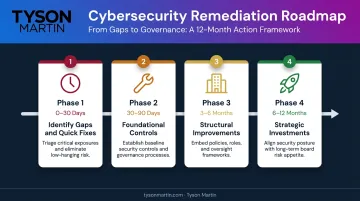
Each item needs a named owner, a due date, and a measurable outcome. A roadmap without owners is a wish list. The first improvements should be shipping within 30 days — if the entire plan is 90+ days out, reprioritize.
How to Choose the Right Cybersecurity Assessment Framework
Start With Regulatory Requirements
Your compliance obligations narrow the field quickly:
- HIPAA-regulated entities need to address the Security Rule's administrative, physical, and technical safeguard requirements — NIST provides a HIPAA Security Rule Crosswalk to NIST CSF for organizations mapping both
- PCI DSS v4.0.1 applies to payment card environments with specific control requirements
- NIS-regulated UK operators should assess against CAF
Beyond regulatory obligations, three additional stakeholders shape the decision:
- Cyber insurer: CIS Controls map directly to underwriting questions, particularly for mid-market organizations
- Audit committee: Boards increasingly expect a recognized framework as the basis for security reporting
- Acquirer due diligence: M&A buyers want to see maturity evidence tied to a standard they can benchmark against
Self-Assessment vs. External Assessor
Both have a legitimate role:
Self-assessments are appropriate for ongoing posture management, internal program tracking, and establishing a baseline before engaging external help. The limitation is credibility — a self-assessment is only as objective as the team conducting it.
External assessments add weight when the intended audience is a regulator, an insurance underwriter, a board recovering confidence after an incident, or an acquirer's due diligence team. When selecting an external assessor, prioritize:
- Framework-specific credentials relevant to your chosen standard
- Independence from your existing security vendors
- A methodology that demands documented evidence, not self-attestation
Running Multiple Frameworks in Parallel
Many organizations maintain NIST CSF as the primary internal governance framework while mapping controls to ISO 27001, HIPAA, or PCI DSS for external compliance purposes. When structured correctly, this creates a unified control environment where a single control satisfies multiple framework requirements — avoiding redundant assessment work. Pick one primary reporting lens and map to others only where external documentation is required.
Translating Assessment Results into Board-Level Decisions
Assessment findings are only useful if they produce decisions. That's where most programs fail: not at the assessment stage, but at the translation stage.
What Boards Actually Need
Board-level reporting shouldn't require a technical translator. A useful board deliverable answers five questions in order:
- What changed since last time?
- What does it mean for the business?
- What is management doing about it?
- What support or decision is needed from the board?
- What happens if action slips?
The format that works is a one-page summary that includes:
- Top risks written in business impact terms, not technical language
- Trend indicators showing whether exposure is improving or worsening
- Incident readiness status
- Exceptions requiring board-level decisions
- A visual snapshot, followed by a short appendix for those who want depth
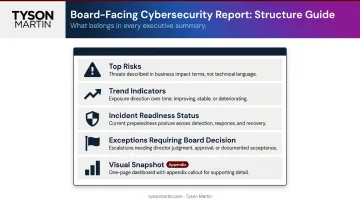
If a board can't tell whether risk is going up or down from the report they're receiving, the organization is reporting activity, not oversight.
The Governance Structure That Makes Assessments Actionable
Findings without owners don't move. A governance structure that works includes:
- A decision-rights map that answers five questions without debate: who accepts risk at what threshold, who approves security exceptions, who decides budget tradeoffs when security competes with delivery, who declares incident severity, and who owns critical vendor go/no-go decisions
- Named owners for each top risk — not a committee, one accountable leader
- Escalation thresholds defined in business terms: dollars, downtime, data sensitivity, or legal exposure
- Expiry dates on exceptions so "temporary" controls don't quietly become permanent
Sustaining this requires a minimum cadence: weekly 30-minute security execution check-ins, monthly risk management reviews, and quarterly board updates tied to trend metrics and decisions.
Where External Expertise Accelerates the Translation
Even with the right governance structure in place, many boards and executive teams lack an internal CISO — or need an independent perspective after an incident. That's when an outside advisor becomes the difference between findings that sit in a report and decisions that actually get made.
Tyson Martin works with boards and executive teams to build exactly this oversight layer, turning assessment outputs into a one-page risk narrative, a decision-rights map, a 90-day plan with named owners and measurable outcomes, and a metrics pack of 8–12 indicators that show trend rather than activity. The result: board conversations focused on decisions, not documentation.
Frequently Asked Questions
What is a Cyber Assessment Framework?
A Cyber Assessment Framework is a structured methodology for evaluating an organization's cybersecurity posture against defined standards or outcomes. It identifies gaps, prioritizes remediation, and supports credible reporting to boards and regulators. The result is a current-state view of risk, not a point-in-time audit finding.
What are the major cybersecurity assessment frameworks used in the US?
NIST CSF 2.0 is the most widely used US framework, applicable across industries and sectors. ISO 27001, SOC 2, and CIS Controls v8.1 are also common, alongside sector-specific requirements like HIPAA for healthcare and PCI DSS for payment card environments. Most organizations treat NIST CSF as their central governance layer and map to other frameworks only where external compliance proof is required.
How often should an organization conduct a cybersecurity assessment?
Formal assessments are typically conducted annually or following significant changes — new leadership, M&A activity, a material incident, or major system changes. Mature programs supplement formal assessments with continuous posture monitoring so boards receive trend data between assessment cycles, not just annual snapshots.
What is the difference between NIST CSF and ISO 27001?
NIST CSF is voluntary guidance that organizations adapt to their context without formal certification. ISO 27001 is a certifiable standard requiring an external audit by an accredited certification body. Organizations often use NIST CSF for internal governance and pursue ISO 27001 certification when clients or partners require external proof of compliance.
Who should lead a cybersecurity assessment — an internal team or an external advisor?
Internal teams can run self-assessments for ongoing posture management and internal tracking. External assessors add credibility when the intended audience is a regulator, insurer, or board recovering confidence after an incident. The right choice depends on who will rely on the findings and what level of independence they require.
How should cybersecurity assessment results be presented to a board?
Board-level reporting should cover current risk posture, trend since the last assessment, top residual risks in business impact terms, and the specific decisions the board is being asked to make. Technical detail belongs in an appendix — the board-facing summary should be scannable in three minutes and end with a clear ask.