Introduction
Cybersecurity risk assessment templates have moved well past the security team's desk. Today they're governance instruments reviewed by CISOs, audit committees, and boards — used to systematically identify threats, prioritize exposures, and justify resource allocation rather than satisfy a single audit cycle.
Most organizations already know they need a structured approach to cyber risk. The harder challenge is actually doing it well.
Selecting the right template, customizing it for a specific environment, and translating the outputs into decisions leadership can actually act on remains hard, particularly when frameworks conflict, compliance requirements add pressure, and the security team and the board speak different languages.
This guide covers the five major cybersecurity risk assessment templates in use today, what you need before selecting one, how to run the process step by step, and — most importantly — how to ensure results influence board-level decisions and resource allocation rather than aging in a shared drive.
Key Takeaways
- A cybersecurity risk assessment template is a structured framework for identifying threats, scoring vulnerabilities by likelihood and impact, and building a prioritized response plan.
- The five most widely adopted templates are NIST SP 800-30, CIS RAM, ISO/IEC 27005, OCTAVE, and FAIR — each suited to a different organizational profile.
- Before choosing a template, confirm three prerequisites: a validated asset inventory, a defined scope, and clear stakeholder decision rights.
- The assessment follows a repeatable sequence: scope → identify threats → score risk → build mitigation plan → report to leadership.
- The most common failure point is treating the assessment as a compliance document rather than a decision tool.
When Should You Use a Cybersecurity Risk Assessment Template?
A risk assessment template belongs in two places: on a fixed governance calendar, and on the desk whenever the threat landscape, organizational structure, or technology environment shifts materially. Using a template — rather than an ad hoc approach — keeps the output consistent, defensible, and repeatable.
Trigger Conditions That Should Prompt a Formal Assessment
- Regulatory audit cycles — scheduled compliance requirements with external scrutiny
- Major IT infrastructure changes — cloud migrations, new SaaS platforms, significant architecture shifts
- M&A activity — due diligence, integration planning, and divestitures each carry distinct risk profiles
- Leadership transitions — new CISOs, CEOs, or security team restructuring
- Post-incident reviews — discovering what the environment looked like before a breach occurred
- High-access vendor onboarding — third parties with privileged access to critical systems
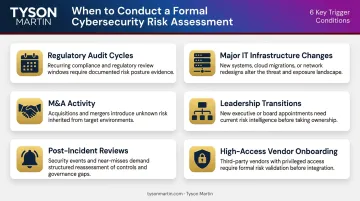
NIST SP 800-53 Rev. 5 RA-3 is explicit that risk assessments should be updated at an organization-defined frequency and when significant changes to the system or operating environment occur. That dual trigger — cadence plus event — is the right model.
The Compliance Trap
Knowing when to run an assessment matters less if the output goes nowhere. The most common failure: triggering a review in response to an audit, then filing the results without escalation.
Gartner data shows 90% of non-executive directors lack confidence that cybersecurity protection and cost are correctly balanced. An assessment that stops at the security team — never reaching board-level decision-making — does nothing to close that gap. The output needs to drive a governance conversation, update risk appetite statements, and produce owners with deadlines.
What You Need Before Choosing a Template
Jumping directly to template selection without these prerequisites produces findings that can't be prioritized, owned, or acted on.
Four Prerequisites
1. A current asset inventory You cannot assess risk to assets you haven't documented. A 2025 Ponemon-Sullivan report found only 42% of organizations include an asset inventory program in their vulnerability risk management — a gap that makes any assessment incomplete before it starts. Inventory must cover hardware, software, data classifications, and third-party integrations.
2. Defined crown jewels Before scoping, organizations need to identify the handful of systems, data sets, and business processes that would cause material harm if disrupted. Without this, assessments become generic rather than prioritized.
3. A defined assessment scope Scope determines everything: template structure, depth, and resource commitment. Too broad produces shallow findings; too narrow misses critical dependencies — cloud infrastructure, vendor access paths, shadow IT.
4. Stakeholder alignment and decision rights Establish decision rights, escalation paths, and ownership assignments before the process begins — not after findings land in a room with no clear accountability. Outputs must work for both technical teams and executive leadership.
Framework Alignment
If your organization already operates under NIST CSF, ISO 27001, or CIS Controls, the corresponding risk assessment template integrates more efficiently with existing controls documentation and reduces duplication. You're not required to align, but misalignment creates friction every time you map findings back to controls.
The Major Cybersecurity Risk Assessment Templates
Template selection should follow compliance requirements, organizational maturity, and how outputs will be used — not popularity.
NIST SP 800-30
Published by the National Institute of Standards and Technology, SP 800-30 Rev. 1 is the risk assessment methodology recommended within the NIST Risk Management Framework. It uses a three-tier model that moves findings from system-level analysis to senior decision-makers — structured to feed governance, not just document findings.
Best fit: Federal agencies, federal contractors, defense and aerospace organizations, and any organization already operating under NIST standards. Outside federal contexts, use is voluntary unless contractually required.
CIS Risk Assessment Method (CIS RAM)
Developed by HALOCK Security Labs and published through the Center for Internet Security, CIS RAM v2.1 (released in 2022 for CIS Controls v8) is built on the Duty of Care Risk Analysis (DoCRA) principle. It frames risk by weighing threat likelihood and impact against the burden of safeguards — a balance that translates naturally to board-level reasonableness discussions.
Best fit: Organizations using CIS Controls as their primary security baseline (IG1, IG2, or IG3). Its grounding in both NIST and ISO guidance makes it workable in multi-standard environments.
ISO/IEC 27005
The fourth edition of ISO/IEC 27005, published in October 2022, provides the risk management methodology for building or maintaining an ISMS under ISO 27001. The cycle covers risk identification, evaluation, treatment planning, communication, and ongoing monitoring.
Best fit: Global organizations pursuing or maintaining ISO 27001 certification, and industries where ISO standards carry direct regulatory weight. ISO 27005 itself is guidance, not a certifiable standard — ISO 27001 is the certification target.
OCTAVE
Developed at Carnegie Mellon University's Software Engineering Institute, OCTAVE is a self-directed assessment methodology focused on operational risk rather than purely technical vulnerability. Four variants exist:
| Variant | Best fit |
|---|---|
| OCTAVE Method | Large organizations (300+ employees) with layered hierarchy |
| OCTAVE-S | Smaller organizations (~100 employees or fewer) |
| OCTAVE Allegro | Teams needing a lighter, information-asset-focused method |
| OCTAVE FORTE (2020) | Enterprises aligning cyber risk with ERM governance |
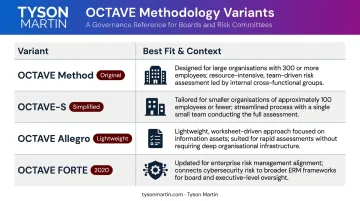
The organization-led structure makes OCTAVE well-suited for connecting cybersecurity risk to broader operational and business continuity risk management.
FAIR (Factor Analysis of Information Risk)
FAIR is a quantitative model that translates cyber risk into financial terms — estimating probable loss exposure based on threat event frequency and vulnerability. Maintained by the FAIR Institute (founded 2016) and published as an Open Group standard, FAIR has more than 18,000 members and representation from roughly 50% of Fortune 1000 companies.
Two data points from Gartner's 2024 cyber risk quantification research are worth noting for boards considering this approach:
- 52% of CRQ adopters say quantification increased board or leadership confidence
- 49% report stakeholders still struggle to understand CRQ analyses — the numbers are only as useful as the communication around them
Works best for boards and ERM teams that need to compare cyber risk against financial thresholds, justify budget allocation, or evaluate insurance decisions in financial terms.
How to Use a Cybersecurity Risk Assessment Template: Step-by-Step
Every framework has its own vocabulary, but the execution sequence is consistent. Each step builds on the last — shortcut one, and the findings that reach your board lose their credibility.
Step 1: Define Scope and Build Your Asset Inventory
Start by defining exactly which systems, data types, business units, and third-party relationships fall within scope. An undefined scope produces findings that can't be prioritized or assigned.
Conduct or validate your asset inventory at this stage, classifying assets by:
- Criticality to business operations
- Sensitivity of associated data
- Third-party access and dependencies
Common setup errors: scoping too broadly without resources to execute thoroughly, or scoping too narrowly and missing cloud infrastructure and vendor integrations.
Step 2: Identify Threats and Vulnerabilities
Threat identification involves cataloging internal and external threat sources relevant to your industry and operating environment:
- Human threats — insider risk, social engineering, nation-state actors
- Environmental threats — natural disasters, facility risks
- Technical vulnerabilities — software flaws, misconfigurations, process gaps
Map threats to specific assets and document existing controls. This mapping is what makes the next step defensible.
Step 3: Score and Prioritize Risks
Apply likelihood and impact ratings to each identified threat-vulnerability pairing. Most templates produce a risk matrix or heat map that drives a prioritized risk register.
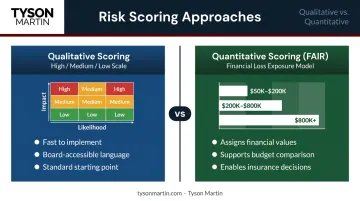
Two scoring approaches are in common use:
- Qualitative (High/Medium/Low): The standard starting point — practical, fast, and board-accessible
- Quantitative (as in FAIR): Assigns financial values; appropriate when boards need to compare risk against budget or insurance decisions
Scoring discipline matters here. Per NISTIR 8286, informal analysis and unstandardized measures directly reduce the quality of cybersecurity risk inputs to ERM. Define your scoring scales explicitly in the template — and apply them the same way every time.
Step 4: Build Your Risk Mitigation Plan
Each prioritized risk needs a treatment decision — accept, mitigate, transfer, or avoid — along with:
- A named owner
- A specific mitigation action
- A target completion date
- Measurable success criteria
The risk register is a living management document, not a static deliverable. The security team should track it and report to leadership on a defined cadence. A risk with no named owner has no path to resolution.
Step 5: Report Findings to Leadership and the Board
Translating assessment findings into a format the board can act on is the step most organizations handle poorly.
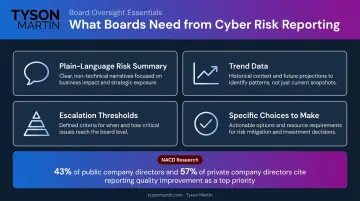
Boards are not well served by technical appendices. What they need:
- Plain-language risk posture summary — current state described in business terms
- Trend data — what has changed since the last assessment, and in which direction
- Clear escalation thresholds — which items require board action versus management delegation
- Specific choices to make — not open-ended findings that leave the board without a path forward
NACD's 2026 cyber-risk handbook reports that 43% of public-company directors and 57% of private-company directors rate improving cyber-risk reporting quality from management as very or extremely important. That gap doesn't close on its own — it closes when security teams structure findings around decisions, not discoveries.
Best Practices for Turning Risk Assessment Results into Boardroom Action
Running a solid assessment is step one. The governance failure usually happens after the findings are documented.
Treat the Risk Register as a Management Tool
Assign an owner to every open risk. Set review cadences tied to business cycles. Tie risk status to the metrics that appear in board reporting. When the same risk appears in the assessment and the board dashboard with the same owner and the same target date, the assessment becomes a continuous governance input rather than a one-time deliverable.
Watch for the "all green" dashboard problem. Status reporting drifts toward comfort because teams learn what gets praise. Boards should insist on trend lines, not just current-state snapshots.
Translate Technical Findings into Business Language
Boards make decisions in terms of financial exposure, operational continuity, and reputational risk — not CVSS scores or control gap lists.
In practice, this gap is the primary failure point: technical teams report activity ("MFA deployed," "patching on schedule") rather than risk reduction. Those activity metrics can all be accurate while hiding serious exposure.
A practical translation model maps each risk to five business impact lenses:
- Financial loss
- Operational disruption
- Legal and regulatory exposure
- Strategic delay
- Reputation harm
Show risk in ranges rather than false precision. Directional estimates that honestly reflect uncertainty are more credible to boards than single-point numbers that imply precision that doesn't exist.
Define Escalation Thresholds Before Pressure Hits
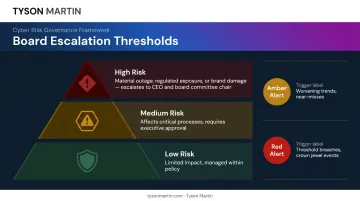
Board-level escalation criteria should be written into the governance structure before an incident occurs, not improvised during one. A functional tiered model includes:
- Low risk — limited impact, management handles within established policy
- Medium risk — affects critical processes or creates meaningful customer friction, requires executive approval
- High risk — could cause material outage, regulated exposure, or brand damage, escalates to CEO and board committee chair
Pre-defined triggers — amber (worsening trends, near-misses) and red (threshold breaches, crown jewel system events) — paired with clear notification protocols and response timelines, prevent accidental risk acceptance by whoever is moving fastest.
Build for Repeatability
WEF's Global Cybersecurity Outlook data shows 62% of high-resilience organizations provide boards regular updates on incidents, trends, and risk predictions, compared with 29% of low-resilience organizations. The difference isn't sophistication — it's cadence and consistency over time.
and can challenge assessment outputs the same way a well-informed director would.
Conclusion
Selecting and using a cybersecurity risk assessment template correctly is less about picking the most sophisticated framework and more about disciplined execution and organizational commitment. A well-executed qualitative assessment with clear ownership and board visibility outperforms an abandoned quantitative model every time.
The organizations that get the most value from these templates treat them as a living governance foundation, not a filing exercise. Repeatable assessment cycles, maintained risk registers, and consistent board reporting cadences mean that when a threat materializes, the organization can act on current intelligence — and show regulators and directors exactly how it got there.
Frequently Asked Questions
What is a risk assessment template for cybersecurity?
A cybersecurity risk assessment template is a pre-structured framework that guides organizations through identifying threats, evaluating vulnerabilities, and scoring risk by likelihood and impact. It makes the assessment process consistent, repeatable, and auditable — so findings can support governance decisions rather than just document observations.
Which cybersecurity risk assessment framework should I choose?
Follow your compliance requirements first. NIST SP 800-30 fits federal and NIST-aligned organizations; ISO 27005 aligns with ISO 27001 certification; FAIR works when boards need financial risk quantification. The template should integrate with whatever controls framework your security team already operates under.
What are the key components of a cybersecurity risk assessment template?
Core sections include: assessment scope and asset inventory, threat and vulnerability identification, risk scoring matrix, a risk register with treatment decisions, a mitigation plan with named owners and timelines, and a monitoring and reporting mechanism for ongoing governance.
How often should a cybersecurity risk assessment be conducted?
At minimum annually — but also triggered by significant changes: major infrastructure shifts, M&A activity, post-incident reviews, new regulatory requirements, or leadership transitions. Build both scheduled cadence and event triggers into your governance structure.
Who should be involved in a cybersecurity risk assessment?
Effective assessments require input from IT and security teams, business unit leaders, legal and compliance, and executive leadership or the board. Each group brings a distinct perspective — technical findings, operational impact, regulatory exposure, and risk appetite. Assign roles before the process starts.
How do I present cybersecurity risk assessment results to the board?
Translate technical findings into business impact language — financial exposure, operational disruption, regulatory risk. Show trend data against a stable baseline, and include clear escalation thresholds that define what requires board action versus management delegation. The goal is a briefing where the board can make a decision, not just follow a report.