
Introduction
There's a meaningful difference between a CISO presenting metrics to a board and a board advisor enabling defensible decisions. Most organizations have the first. Few have the second.
Security reports describe what the security team did. Security advisories tell the board what to decide. That distinction changes everything about how risk gets governed — and how boards fulfill their fiduciary duty when an incident eventually arrives.
A 2022 MIT CAMS/Proofpoint survey of 600 directors found that 76% discussed cybersecurity at least monthly, yet 47% still said their organization was unprepared for a cyber attack. Frequency isn't the problem — content and framing are.
This article is for board members, risk committee chairs, audit committee members, CEOs, and General Counsel who want to know what good looks like — not just what to sit through. It covers what a board-ready security advisory actually contains, how to translate cyber risk into business language, and what governance structures make oversight substantive rather than a compliance checkbox.
Key Takeaways
- Most board security briefings create compliance theater — activity metrics dressed up as risk oversight
- A board-ready advisory answers three questions: current exposure, whether the trend is improving, and what decision or funding is needed
- Frame threats as business scenarios, not technical attack vectors
- The most-skipped section is also the most critical: decisions and delegations required
- Escalation thresholds defined in advance turn a report into a governance document
Why Most Board Security Briefings Miss the Mark
The Compliance Theater Problem
Boards are routinely presented with heat maps, patch rates, vulnerability counts, and phishing click statistics. These metrics measure activity, not exposure. The result is a briefing designed to demonstrate effort rather than inform decisions — and boards end up rubber-stamping reports they cannot meaningfully evaluate.
The NACD's 2026 Cyber-Risk Oversight guidance identifies this directly: board updates are often too technical, inconsistent across business units, or disconnected from business objectives — which limits directors' ability to gauge risk exposure in financial or operational terms.
A few patterns show up repeatedly in ineffective briefings:
- "98% patch compliance" that hides a 30-day lag on crown jewel systems
- "All employees trained" that says nothing about phishing reporting rates or privileged access hygiene
- "Threats blocked: 47,000" presented as a win, when high block counts often just mean attackers are scanning you
Bad metrics lead to bad funding decisions. Organizations keep paying for more tools because the dashboard looks busy, while underfunding identity hardening, logging coverage, and recovery testing.
The Signal-to-Noise Failure
When everything is presented as important, nothing is. Boards disengage when briefings bury material risk inside operational trivia. Directors lose the ability to separate trend from noise, and genuinely material risks end up getting the same 45 seconds of attention as patch deployment statistics.
The Regulatory Stakes Have Changed
That communication failure now carries legal consequences. SEC 2023 rules require Form 8-K disclosure within four business days after a registrant determines a cybersecurity incident is material, and annual disclosures describing board oversight structures and management's role. Boards that cannot demonstrate genuine oversight — not just regular briefings — face governance and liability exposure they may not anticipate until an incident forces the question.
What Board Members and Risk Committees Actually Need
The Board's Actual Job
Boards are not operational. Their role is oversight, escalation, and decision authority. A security advisory should tell them what to decide or delegate — not what the security team accomplished last quarter.
Three questions sit behind almost every board member's silence during a security briefing:
- How exposed are we?
- Is the trend improving or worsening?
- What do we need to decide or fund?
A good advisory answers all three without requiring the board to ask.
Risk Committee vs. Full Board
These two audiences need different things, and treating them the same is a common structural error.
| Audience | Cadence | Depth | Focus |
|---|---|---|---|
| Risk Committee | Monthly pulse + quarterly deep review | 8–12 metrics, control trends, exceptions | Ongoing oversight, threshold monitoring, vendor risk |
| Full Board | Quarterly | Strategic posture, 3–5 key metrics | Material risks, major funding, risk appetite decisions |
| Audit Committee | Quarterly | Controls assurance, compliance posture | Financial reporting integrity, third-party risk review |
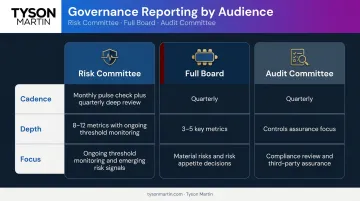
Risk committees hold ongoing cyber oversight responsibility and need more technical depth and cadence. The full board needs strategic posture and material risk summaries. Audit committees focus on controls assurance and compliance verification — not operational security governance.
The Fiduciary Dimension
The Harvard Law School Forum's 2022 analysis of Delaware Caremark cyber oversight cases makes clear that boards should identify mission-critical risks, assign committee oversight, establish management reporting, and seek additional reports when appropriate. The documented oversight process protects directors when incidents become litigation.
Most organizations lack internal capacity to build this structure cleanly. The deeper problem is structural: the CISO both executes security and reports on its own effectiveness, which creates an inherent credibility gap at the board level. An independent advisor establishes the governance framework, reporting cadence, and decision rights documentation from the outside. Tyson Martin's work addresses exactly this gap — putting the format, cadence, and escalation thresholds in place before an incident forces the question.
The Anatomy of a Board-Ready Security Advisory
Section 1 — Risk Posture Summary in Plain English
The opening section states the organization's current risk exposure and what has materially changed since the last briefing. This is not a technical summary. It's a business-level statement of direction: exposure is rising, stable, or improving — and here's why.
Section 2 — Material Threats and Their Business Impact
Identify two to three current threats most relevant to the organization's sector and operations. Each threat should be expressed in business terms:
- Scenario: What could happen (one sentence)
- Impact: Downtime, revenue disruption, legal cost, customer trust
- Likelihood: High, medium, or low, with plain-language reasoning
- Controls in place: What's currently reducing the risk
- Residual risk: What remains despite controls
- Decision ask: Specific funding, policy, or priority need
Framing ransomware as "five days of billing disruption, delayed shipments, contract penalties, and missed quarterly targets" gives a board something to reason about. Framing it as a malware event does not.
Section 3 — Program Progress Against Committed Priorities
Boards should see whether the 90-day or quarterly plan is on track, which owners are accountable, and what measurable outcomes have been achieved. The emphasis here is inspectable execution, not stated intent.
A one-page risk register with named owners and due dates — one the board revisits until items actually move — is more useful than a slide declaring strategic alignment.
Section 4 — Decisions and Delegations Required
This is the most important section and the one most commonly omitted. Every advisory should close with a clear, explicit list:
- Board decisions required: Budget approval, risk acceptance, policy exception, major vendor authorization
- Delegated to management: Items below threshold with defined owners and expiry dates
- Escalation triggers: Conditions under which management must notify the board, not after the fact
A typical 45-minute board briefing runs 15 minutes on top risks and board questions, 10 minutes reviewing the dashboard, 10 minutes on posture changes, and 10 minutes on decisions and decision rights. If that last block doesn't exist, the other 35 minutes are informational — not governance.
Section 5 — Escalation Triggers as Standing Governance
Pre-defining escalation conditions transforms a report into a governance document. Escalation triggers should specify:
- Incident type and data exposure volume
- Regulatory notification thresholds
- Financial impact estimates that require board-level involvement
- Timeframe for notification after trigger conditions are met
Without pre-defined triggers, a live incident produces an undocumented approval chain, delayed disclosure decisions, and a board receiving news after the window to act has closed. Boards should also pre-decide:
- Who can approve containment actions
- When to engage outside counsel
- When to contact cyber insurance
- What the board chair needs in the first update
Translating Cyber Risk Into Business Language That Drives Decisions
The Core Translation Principle
Cyber risk must be expressed in the same terms the board uses for all enterprise risk: financial exposure, operational continuity, regulatory consequence, and reputational impact. A board overseeing hundreds of millions in revenue thinks in those terms. CVE scores and mean time to detect are not those terms.
The WEF's 2021 Principles for Board Governance of Cyber Risk are explicit: boards should understand the economic drivers and impact of cyber risk and align cyber-risk management with business needs.
Five Business Impact Lenses That Work
Map every material risk to one of these five categories — and keep them stable across every briefing:
- Financial loss: direct costs, recovery costs, and gaps in insurance coverage
- Operational disruption: downtime, supply chain impact, service degradation
- Legal and regulatory exposure: disclosure obligations, fines, litigation risk
- Strategic delay: product timelines, M&A integration, market entry setbacks
- Reputation harm: customer trust erosion, brand exposure, media coverage
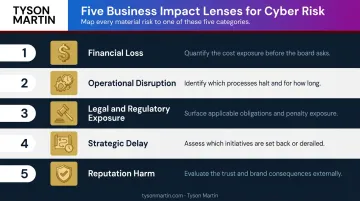
This framework lets directors compare risks, rank them, and act on them using the same decision-making processes they apply to other enterprise risks.
Scenario Over Statistics
Raw metrics don't create understanding — business scenarios do. Frame every material risk with directional ranges rather than false precision. For example:
"Based on what we know today, the likely impact is limited to one business unit. A plausible scenario is two to three days of disruption. The worst case is extended outage if recovery testing doesn't reflect actual system dependencies."
Exact dollar estimates often create false comfort. Ranges with stated assumptions give directors something to reason about — and something to challenge.
Calibrating Depth to the Audience
Risk committee presentations can carry more technical substance — 8 to 12 metrics, control-level detail, vendor exceptions. Full board presentations should lead with business implications and push supporting data to appendices. The formula that translates across audiences: "Because we improved X, we reduced the chance of Y, which protects Z."
The Metrics That Build Credibility — Not Noise
The Case for a Stable Dashboard
Boards should see the same set of metrics every quarter. Constantly changing dashboards signal instability and prevent directors from building the context needed to ask good questions. The goal is trend visibility — whether exposure is shrinking, response is faster than last quarter, and recovery plans have actually been tested.
What Belongs at the Board Level
Five core outcome metrics belong in front of the full board:
| Metric | What It Shows |
|---|---|
| Risk exposure trend | Are the top material risk scenarios improving or worsening? |
| Incident count & response effectiveness | Detection, containment, and recovery times on significant events |
| Compliance posture against material obligations | Status against SEC, HIPAA, PCI-DSS, or sector-specific requirements |
| Third-party risk status | Percent of critical vendors with current risk reviews |
| Security investment execution | Are committed priorities on track with accountable owners? |
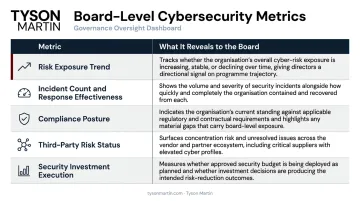
Operational metrics — patch rates, alert volumes, phishing click rates — belong in committee-level briefings. They measure system activity, not business exposure.
The "Compared to What?" Requirement
Once the right metrics are in place, they still need context to mean anything. Every dashboard item should answer one question: compared to what?
Prior period trends are more reliable than external benchmarks because industry comparisons mislead — tech stacks and risk profiles vary too much to make peer comparisons meaningful. Track your own outcome trends against your stated risk appetite. Set baselines in the first month, then commit to showing direction.
Establishing Decision Rights and Escalation Thresholds That Hold in Real Incidents
Why This Breaks Down Under Pressure
Boards and management frequently operate without a clear map of who owns which cyber decisions. Who can accept risk below a certain threshold? Who must escalate a breach? What dollar or reputational value triggers board-level involvement? Without written answers, governance breaks down exactly when it's needed most.
The fastest incidents are the ones where decision rights were settled before the crisis. Under stress, good intentions disappear. Pre-approved decision rights let teams spend incident time solving the problem, not negotiating authority.
What a Working Decision Rights Map Looks Like
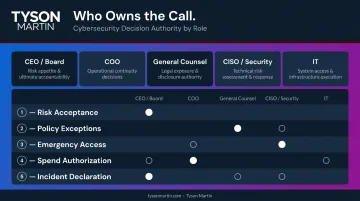
A practical decision rights map uses plain-language RACI logic across key roles:
- CEO/Board: Sets risk appetite, breaks ties on material tradeoffs
- COO: Owns operational continuity and cross-team execution
- General Counsel: Owns legal exposure, privilege strategy, regulatory notifications
- CISO/Security: Owns risk clarity, control design, and independent challenge
- IT: Owns endpoint, identity operations, and core service reliability
The map should answer five specific questions:
- Who accepts risk when something can't be fixed now?
- Who approves policy exceptions and with what expiry date?
- Who can approve emergency access or containment actions?
- Who authorizes spend above defined thresholds?
- Who declares an incident and activates the response plan?
Escalation Thresholds in Practice
Decision rights define who owns the call. Escalation thresholds define when that call goes up the chain. The two work together — and both need to be written down before an incident, not reconstructed during one.
Escalation triggers should tie to impact, not fear. A working threshold specifies four criteria that together require board notification within a defined timeframe:
- Incident type — ransomware, data exfiltration, third-party breach, insider threat
- Data exposure volume — number of records or PII categories affected
- Regulatory notification requirement — whether a mandatory disclosure deadline applies
- Financial impact estimate — direct costs, business interruption, and reputational exposure
Temporary risk exceptions require expiry dates. "We can't do this now" is an acceptable decision — as long as it has an owner and a deadline. Without that, temporary controls become policy.
Governance gaps surface most often during organizational transitions — M&A, leadership changes, and post-incident reviews. The gap isn't usually technical. It's a missing sentence: "When this condition is met, this person notifies the board chair within this timeframe." Writing that sentence is the work. Getting it agreed to and documented before a crisis is what separates boards that govern through an incident from boards that get governed by one.
Frequently Asked Questions
How do I present a security advisory to the board and risk committee?
Lead with risk posture and what changed since the last briefing. Frame threats as business scenarios — operational disruption, financial exposure, regulatory consequence — not technical findings. Close with a specific list of decisions the board needs to make, not a retrospective of security activities.
What are the five steps of a security risk assessment?
Identify assets and scope, assess threats and vulnerabilities, evaluate likelihood and business impact, prioritize findings, then define mitigation or acceptance decisions with named owners. Board advisories should reflect the output of this process — the prioritized risks and decisions — not the process itself.
What are the key pillars of risk management?
The classic pillars — identify, assess, respond, monitor — apply to cyber as to any enterprise risk. For boards, the critical pillar is often the one least documented: oversight and escalation. Knowing when to act, delegate, or accept risk at the enterprise level is the difference between real governance and checkbox oversight.
How often should cyber risk be presented to the board?
Governance frameworks recommend quarterly full board updates, with more frequent risk committee engagement — typically monthly pulse updates plus quarterly deep reviews. Cadence should increase during transitions, major incidents, or elevated threat periods, with event-driven briefings added for defined triggers.
What is the difference between a risk committee and an audit committee for cybersecurity?
Risk committees hold primary ongoing cyber oversight responsibility with deeper engagement and more frequent updates on exposure trends and decisions. Audit committees focus on controls assurance, compliance verification, and third-party risk review. Separating the two prevents audit from being overloaded with operational security governance.
What metrics should a board actually track for cybersecurity?
Four categories: overall risk exposure trend, major incident frequency and response effectiveness, compliance status against material regulatory obligations, and progress on committed security investments. Keep the dashboard stable so trends are visible over time — a changing dashboard hides direction.