That scenario plays out constantly. The disconnect isn't a knowledge problem—it's a translation problem. Most cyber briefings are built for security teams, not governing bodies. Boards aren't asking for technical fluency. They're asking whether the organization is making the right risk decisions.
Tyson Martin has sat on both sides of this table. As a CISO at enterprises including Home Depot and AWS—where he personally advised over 2,000 C-suite executives and board members—he's seen what happens when security leaders lead with data instead of decisions. As an NACD contributor and board advisor, he's also heard directly from directors what they actually need. That dual vantage point is what makes this advice different.
Key Takeaways
- Boards govern risk—they need decisions, not data dumps.
- Translate cyber risk into business impact: financial exposure, operational disruption, and reputational harm.
- Use a stable, trend-based dashboard—not a new format every quarter.
- Define decision rights: what the board decides, what management handles, and when escalation is required.
- Cadence and consistency matter more than any single perfect presentation.
What the Board Actually Needs From You
Boards don't need to become cybersecurity experts. They already expect the CISO to carry that expertise. What they need is confidence that risk is being managed within the organization's risk appetite—and that they can exercise meaningful oversight when it counts.
The challenge is that the knowledge gap is real. According to ISS-Corporate's 2025 analysis, more than 40% of Russell 3000 companies do not disclose any directors with information security expertise. That means the burden of translation falls entirely on whoever is standing at the front of the room.
The Three Questions Every Briefing Must Answer
Every board briefing—regardless of format or length—should clearly answer these three questions:
- What is our current risk exposure?
- Are we making progress?
- Do we need to make any decisions today?
If a briefing can't answer all three, it hasn't served the governance function.
Oversight vs. Management
There's a distinction that gets blurred constantly: boards own risk at the strategic level. They set risk appetite, approve significant investments, and hold leadership accountable. They don't run security programs.
When a briefing asks for operational approvals or drowns directors in technical detail, it conflates these roles. The board starts feeling like a rubber stamp rather than a governing body—and credibility erodes on both sides.
Getting that role distinction right is foundational. But clarity about what the board should decide doesn't help if the person in the room can't communicate in terms the board actually understands.
The Emotional Dimension
Boards want to trust the person in the room. Deloitte frames it directly: effective board engagement requires emotional intelligence as much as technical expertise. CISOs should meet board members at their level of technical fluency, fostering understanding and trust.
NACD's 2026 guidance puts it plainly: the goal is cyber literacy, modeled on financial literacy. Not every director is an auditor, but every director can read a financial statement. Narrative and concrete analogies get boards there faster than dashboards alone.
Building a Board-Ready Risk Communication Framework
Start With Plain-English Risk Posture
Every briefing should open with a one-paragraph summary:
- Where does the organization stand today?
- What changed since the last briefing?
- What does that change mean for business operations?
Don't lead with compliance checklists, tool counts, or control frameworks. Lead with context that connects to business outcomes.
Translate Technical Findings Into Business Terms
This is where most briefings break down. The translation isn't optional—it's the whole job.
Instead of: "We detected 47 high-severity vulnerabilities."
Say: "We have three unpatched systems that, if exploited, could disrupt payment processing for an estimated 6–12 hours during peak transaction periods."
NACD's 2026 cyber-risk reporting guidance recommends board reports include top risk scenarios with quantified potential financial impacts, risk exposure across third-party and supply chain risks, and regulatory compliance status. That structure works because it mirrors how directors already think about business risk — in terms of exposure, consequence, and accountability.
Define Decision Rights Explicitly
Every board briefing should include a clear section that separates:
- Board action required: Investment approvals above a threshold, risk acceptance decisions, significant policy changes
- Management handling: Operational responses, tactical remediation, day-to-day program execution
This removes ambiguity and keeps the board in its governance lane — not the operational one.
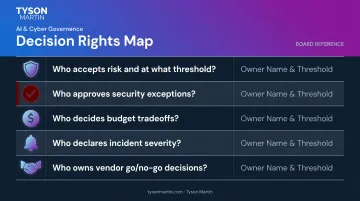
A working decision-rights map answers five questions without debate:
- Who accepts risk, and at what threshold?
- Who approves security exceptions?
- Who decides budget tradeoffs?
- Who declares incident severity?
- Who owns vendor go/no-go decisions for critical suppliers?
Establish Escalation Thresholds Before You Need Them
Escalation protocols must be defined, approved, and tested before a crisis—not written during one. CISA recommends that reporting thresholds not be set too high, and that boards be briefed on near-misses as well as confirmed incidents.
Thresholds should define:
- Maximum tolerable downtime for critical services
- Dollar loss bands that trigger board notification
- Data types that carry automatic escalation regardless of scope
- Who makes the call, and within what timeframe
Boards that skip this step before a crisis tend to debate process while the incident is still unfolding — a costly place to learn governance gaps.
Send the Pre-Read One Week in Advance
Boards cannot engage strategically on information they received 10 minutes before the meeting. A strong pre-read contains:
- Risk posture summary (one page)
- What changed since the last briefing
- Any decisions required, with options and tradeoffs
- Supporting data appendix for directors who want to go deeper
The Metrics That Matter—And the Ones That Don't
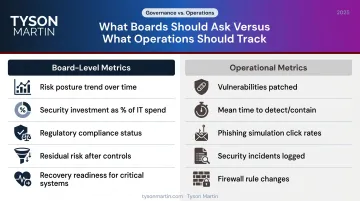
Board-Level vs. Operational Metrics
Patch rates, mean time to detect, phishing email counts—these are operational metrics. Useful for the security team, yes. But they don't tell a governance story.
Board-level metrics look different:
| Board-Level Metrics | Operational Metrics |
|---|---|
| Risk posture trend over time | Number of vulnerabilities patched |
| Security investment as % of IT spend | Mean time to detect/contain |
| Regulatory compliance status | Phishing simulation click rates |
| Residual risk after controls | Number of security incidents logged |
| Recovery readiness for critical systems | Firewall rule changes |
Build a Stable Dashboard—Then Leave It Alone
A consistent set of 4–6 metrics, measured the same way each quarter, allows boards to track trends rather than decode a new framework every meeting. Consistency is itself a trust signal. It shows the program is mature and managed.
Tyson Martin's board advisory model centers on a one-page dashboard with five board-level outcome metrics tied to what the business actually runs on—point-of-sale systems, online checkout, claims processing, or whatever the critical services are. Each metric includes a trend indicator (improving, stable, worsening) and a short reason why.
If the page doesn't show trends, owners, and exceptions at a glance, it's a status report. Boards need a dashboard.
Use Outcome-Driven Metrics
Gartner's work on outcome-driven metrics draws a clear line: instead of measuring activity, measure protection-level outcomes. The question isn't "how many scans ran?" It's "what percentage of critical systems can we recover within 24 hours of an incident?"
NACD's 2026 Director's Handbook reinforces this with concrete examples: recovery time objectives (RTOs) for critical systems, quantified financial impact of top risk scenarios, and year-over-year trends showing improvement or deterioration. These are the metrics that resonate with audit and risk committees.
Common Mistakes That Undermine Board Credibility
The Data Dump
Presenting every metric the security team tracks, using technical shorthand, and building a new slide deck from scratch each quarter signals program immaturity—and burns through board attention before the important issues surface. If the most critical risk is buried on slide 32, the briefing has already failed.
The "All Green" Trap
Boards are skeptical of presentations where everything appears on track with no material risks surfaced. A polished, nothing-to-see-here briefing strains credibility rather than building it.
HITRUST is direct: when you detect that your organization is missing core cybersecurity hygiene, inform the board immediately. Honest, calibrated reporting—including what isn't fixed yet and why—builds more trust than a clean-looking slide that directors sense isn't the whole picture.
The demand for better is measurable. NACD data shows 43% of public company directors and 57% of private company directors say improving the quality of management's cyber-risk reporting is very or extremely important.
No Clear Call to Action
Ending a briefing with no decision required leaves boards feeling like passive observers. Every board interaction should include at least one item that requires a decision, a resource allocation, or an acknowledged risk acceptance. Without that, the oversight function hasn't been exercised — it's been performed.
Before each briefing, confirm it includes at least one of the following:
- A decision the board needs to make (budget, risk appetite, policy)
- A resource allocation request with a clear recommendation
- A formal risk acceptance the board is being asked to acknowledge
- An escalation threshold being set or reviewed
Cadence and Format: Structuring Board Engagement Over Time
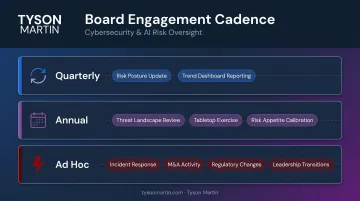
Frequency matters less than consistency. A recommended structure:
- Quarterly: Standing risk posture updates and trend reporting against the stable dashboard
- Annual: Deep-dive threat landscape review, program assessment, risk appetite calibration, and a tabletop exercise
- Ad hoc: Tied to material events—significant incidents, regulatory changes, M&A activity, major product launches, or leadership transitions
The Annual Education Session
Deloitte recommends a structured annual session separate from the regular reporting cycle—focused on emerging threat trends, shifts in attack vectors, and new regulatory requirements. This is especially valuable for boards without a dedicated cybersecurity committee or a director with security background.
Getting there doesn't have to take years. Tyson Martin's 30/60/90-day engagement model delivers a board-ready reporting baseline and decision rights framework in the first month, with stable trend reporting operational by day 90—giving boards without existing structure a credible, repeatable cadence fast.
Format: Lead With the Executive Summary
The most effective board presentations:
- Lead with the executive summary—not an agenda slide
- Keep supporting data in appendices
- Are designed to prompt conversation, not to be read aloud
- Leave adequate discussion time (a briefing with no discussion time isn't a governance conversation)
Communicating During a Crisis or Active Incident
The worst time to figure out how to talk to the board is during an incident. Pre-established protocols — covering what triggers board notification, who makes the call, and what the initial communication looks like — must be documented, tested, and approved before an event occurs.
CISA recommends keeping notification thresholds low — boards should be briefed on near-misses, not just confirmed breaches.
What Good Crisis Communication Looks Like
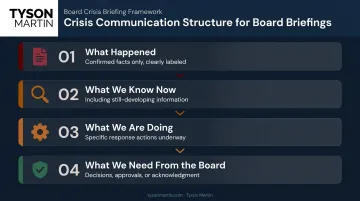
A strong initial board communication covers four things:
- What happened — confirmed facts only, clearly labeled
- What we know now — including what is still developing
- What we are doing — specific actions underway
- What we need from the board — decisions, approvals, or acknowledgment
Keep confirmed facts and developing information clearly separated. And never let the board learn about a material incident from a press report before they hear it internally. That failure is almost impossible to recover from.
That communication failure also creates regulatory exposure for public companies. The SEC's 2023 cybersecurity disclosure rules require Form 8-K disclosure of material incidents within four business days of a materiality determination. Boards that haven't rehearsed this process don't just lose credibility — they risk liability.
Frequently Asked Questions
How often should a CISO present to the board?
Quarterly reporting is the standard cadence for standing risk posture updates, with ad hoc briefings for material events and an annual strategic review or education session. Consistency matters more than frequency. Irregular briefings signal that cybersecurity is reactive rather than governed.
What metrics should a CISO include in a board report?
Stick to 4–6 stable, board-level outcome metrics: risk posture trend, residual risk after controls, regulatory compliance status, and recovery readiness for critical systems. Operational metrics like patch rates and phishing click counts belong in internal security team reporting, not the boardroom.
How do you explain cyber risk to a non-technical board?
Translate technical findings into business impact: financial exposure ranges, operational disruption scenarios, and reputational consequences. If a director can't repeat the key point to a colleague, the translation didn't work.
What should a board-level cybersecurity report include?
A strong board report covers five elements:
- Current risk posture and what changed since the last briefing
- Trend metrics against a stable dashboard
- Decisions required, with options and tradeoffs
- Appendix with supporting data for directors who want to go deeper
What questions does the board typically ask about cybersecurity?
Boards consistently return to the same core questions: What is our current risk exposure? Are we making progress against it? And what decisions need to be made today? Walking in with clear, direct answers to all three will anchor any briefing.
When should the board be notified about a cybersecurity incident?
Notification thresholds should be defined and board-approved before an incident occurs. Near-misses should be reported, not just confirmed breaches. The board should never learn about a material incident—or an impending public disclosure—from an external source before hearing it internally.