This isn't an anomaly. It's a pattern — documented across PCI DSS, ISO 27001, HIPAA, and NIST-certified organizations at scale. The certificate was real. The audit was legitimate. The breach happened anyway.
The reason is structural: compliance reports answer auditors' questions. Attackers ask entirely different ones. Passing an audit cycle and surviving a real-world incident require different capabilities — and boards that conflate the two are carrying more risk than their dashboards show.
Key Takeaways
- Compliance frameworks define a minimum baseline at a point in time and say nothing about your live risk posture
- Certified companies get breached when compliance becomes a destination rather than a continuous discipline
- Periodic, sample-based audits create exposure windows between reviews that threat actors actively exploit
- Boards relying on compliance status alone are asking the wrong question — the right one is whether the organization can detect, respond to, and recover from a real incident
- Closing the gap between compliant and secure requires governance you can verify — not a certificate you can frame
What Compliance Certifications Actually Measure
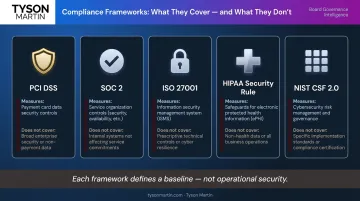
Every major framework was built with a specific, bounded purpose.
- PCI DSS is a "baseline of technical and operational requirements" for protecting payment account data — the PCI SSC is explicit that it applies to entities within the cardholder data environment, not the entire organization
- SOC 2 provides reasonable assurance, using test-based sampling — it does not certify that every control works, everywhere, all the time
- ISO 27001 defines requirements an information security management system must meet — not whether it performs under real attack conditions
- HIPAA Security Rule requires "reasonable and appropriate" safeguards — flexible, scalable, and technology-neutral, which also means it doesn't mandate specific technical controls
- NIST CSF 2.0 provides a taxonomy of high-level outcomes — guidance, not a certification that confers protection
The Sampling Problem
Auditors review a representative subset of systems and controls. That's by design — a full exhaustive audit of every system in a large enterprise isn't feasible within an engagement timeline. The result: gaps in un-sampled areas can exist, and often do, while the organization receives a clean report.
The distinction that matters for boards: compliance asks whether a policy exists; security asks whether that policy holds under pressure, at 2 AM, with a distracted employee executing it.
Incident response plans that exist on paper but have never been tested under simulated conditions are a common example. The plan satisfies the auditor. It fails in the incident.
The Rate-of-Change Problem
Compliance cycles run on annual or biannual rhythms. Threat actors don't. The CVE database logged 40,077 published vulnerabilities in 2024 — up from 28,961 in 2023, and climbing to 48,244 in 2025, according to CVE metrics.
A certification issued in January reflects the state of controls at that moment. By April, cloud environments have been provisioned, personnel have turned over, and new attack techniques are in active use. The certification reflects a point in time. The exposure keeps moving.
Why Certified Companies Keep Getting Breached
The Evidence Is Not Subtle
Target was certified as PCI DSS compliant in September 2013, according to the congressional hearing record. The breach began in November of the same year. Attackers used vendor credentials to gain initial access — vendor access management was not a gap the certification surfaced. Target's security tools generated automated alerts before data exfiltration began. The Senate Commerce Committee's kill chain analysis found the company missed multiple opportunities to stop the attack.
Heartland Payment Systems held PCI compliance certifications validated by qualified security assessors on several consecutive occasions. According to a Federal Reserve Bank of Philadelphia discussion paper, the company was actively certified at the time the breach was discovered. The vulnerability persisted through multiple audit cycles undetected.
Compliance Degrades Between Audits
Organizations concentrate resources on passing the certification cycle. After the report is filed, vigilance drops — and it drops fast.
The Verizon 2024 Payment Security Report found that only 14.3% of organizations achieved 100% PCI DSS compliance during interim validation assessments in 2023. Two of the most critical requirements showed especially low rates:
| PCI DSS Requirement | Full Compliance Rate |
|---|---|
| Requirement 10: Logging & monitoring | 60.3% |
| Requirement 11: Regular testing of systems | 47.6% |
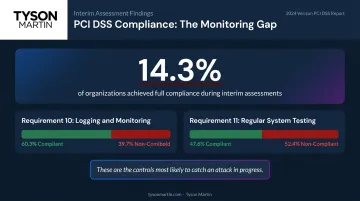
These aren't obscure requirements. They're the controls most likely to catch an attack in progress.
The Detective Control Gap
Those low detection rates reflect a broader pattern. Many certified organizations invest heavily in preventive controls while underinvesting in the systems that catch attacks already underway.
The imbalance typically looks like this:
- Preventive controls (firewalls, encryption, access restrictions) are well-documented and audit-friendly
- Detective controls (log review, anomaly alerting, response workflows) require active human attention — which audits rarely verify
- Target's breach is the clearest case: alerts fired, nobody acted on them. The framework confirmed logging existed. It said nothing about whether anyone was watching.
Certification documents what was built. It doesn't confirm what's working.
The Human Layer
Compliance does not measure organizational culture, employee fatigue, or how people behave under pressure. The Verizon 2025 Data Breach Investigations Report found the human element remained involved in roughly 60% of breaches — across organizations that had formal security programs in place. A policy filed with an auditor doesn't change how employees respond under pressure. That gap is a governance problem, not just an operational one.
The Board's Blind Spot
Why Compliance Reports Feel Like Oversight
Compliance produces something boards can hold: a report, a certificate, a pass/fail verdict that fits cleanly into quarterly reporting cadence. Security posture is probabilistic, directional, and resistant to simple summarization. Boards default to what's legible and auditable. That's understandable — and it's a problem.
The WEF Global Cybersecurity Outlook 2025 found that 62% of high-resilience organizations provide regular board updates on cyber incidents and risks, compared with only 29% of low-resilience organizations. The difference isn't access to better tools. It's governance structure.
The Questions Compliance Reports Cannot Answer
A compliance scorecard tells you whether documented controls matched the framework on the date of the audit. It doesn't tell you:
- Can we detect a breach currently in progress?
- How long would it take to contain a ransomware event?
- Which third-party vendors have access to our most sensitive data, and what governs that access?
- What would 48 hours of operational downtime cost this business?
- Who is accountable for ensuring these controls remain effective between audits?
These are the questions that reveal operational resilience. Boards that can't answer them aren't governing cyber risk — they're receiving status theater.
The Accountability Gap
Compliance frameworks specify what controls to implement. They rarely clarify who is accountable for ensuring those controls stay effective between audits. Without defined decision rights and escalation thresholds, compliance becomes a documentation exercise rather than an operational discipline.
A board-level risk dashboard built around trend-based signals — where each metric has a threshold, a trend, and a time-to-fix — answers different questions than a compliance scorecard. One shows direction of travel; the other is a snapshot accurate on a single day.
The Legal Dimension
Directors should not treat a compliance certificate as a legal shield. Regulators and courts are increasingly holding directors accountable for whether governance structures provided meaningful oversight — not simply whether the organization was technically certified.
Three cases illustrate the pattern:
- SEC Regulation S-K Item 106 (2023): Boards must now disclose how they oversee cybersecurity risk — not merely whether the organization holds a certification
- FTC v. Wyndham: The Third Circuit upheld the FTC's authority to challenge data-security failures after repeated breaches, regardless of compliance status
- FTC v. Drizly: The order extended personal accountability to the CEO, requiring him to implement security programs at future companies where he holds leadership roles
In none of these cases did a compliance certificate provide meaningful legal protection. The question regulators and courts are asking is whether governance was substantive — not whether a checkbox was checked.
What Compliance Frameworks Cannot Protect Against
Attack Categories That Fall Outside Compliance Scope
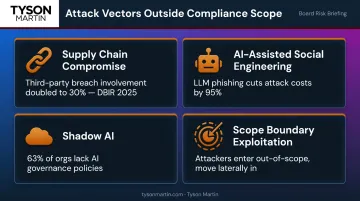
Most frameworks were finalized before the current threat landscape took shape. For boards and audit committees, that gap is where liability lives. The categories below sit outside standard audit scope — and attackers know it.
Supply chain compromise. Third-party involvement in breaches doubled from 15% to 30%, per the Verizon 2025 DBIR. The SolarWinds attack — where an advanced persistent threat actor infected legitimate software updates to penetrate federal, critical infrastructure, and private-sector networks — was documented by CISA. None of the affected organizations failed their compliance audits.
AI-assisted social engineering. The FBI's IC3 warned in December 2024 that criminals use generative AI to produce targeted phishing content, voice clones, and synthetic identification documents at scale. WEF research found that LLM-automated phishing can cut attack costs by more than 95% while maintaining or exceeding previous success rates — yet no framework addresses this at the operational control level.
Shadow AI. IBM's Cost of a Data Breach 2025 report found that 63% of organizations lacked AI governance policies and 97% of organizations reporting an AI-related security incident lacked proper AI access controls. Neither gap shows up in a standard audit.
Scope boundary exploitation. Compliance perimeters are administrative constructs — they cover systems in-scope for the relevant standard. Attackers enter through out-of-scope systems and move laterally into protected environments. The audit boundary doesn't move with them.
Moving from Compliance Theater to Inspectable Security Governance
What "Inspectable Execution" Means
Inspectable execution isn't about more documentation. It's about governance structures where security commitments can be verified between audits — because metrics, owners, and escalation thresholds are embedded into operational rhythms, not filed in a binder.
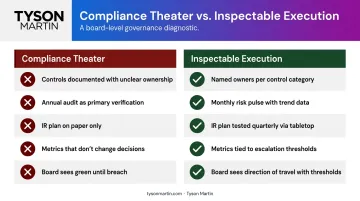
The practical difference:
| Compliance Theater | Inspectable Execution |
|---|---|
| Controls documented; ownership unclear | Named owners for every control category |
| Annual audit as the primary verification | Monthly risk pulse with trend data |
| Incident response plan on paper | IR plan tested quarterly via tabletop |
| Metrics that don't change decisions | Metrics tied to defined escalation thresholds |
| Board sees green dashboards until breach | Board sees direction of travel with thresholds |
The Governance Shifts That Actually Reduce Risk
Moving from compliance-first to security-first governance requires three concrete shifts:
Continuous monitoring over annual snapshots. NIST SP 800-137 defines information security continuous monitoring as maintaining ongoing awareness of information security, vulnerabilities, and threats to support real-time risk decisions — not audit cycles.
Clear decision rights. Who can accept risk? Who escalates at what threshold? Who approves a containment action that disrupts operations at 2 AM? These need to be defined in advance, in writing, not negotiated during an incident.
90-day planning discipline. Open-ended remediation backlogs without named owners and measurable outcomes are how compliance tasks become permanent deferrals. A 90-day plan with due dates and defined "done" criteria creates accountability that an audit finding never will.
IBM's Cost of a Data Breach 2025 found that extensive use of security AI and automation produced $1.9M in cost savings compared with organizations that did not use those solutions. The ROI of operational security investment is measurable — but only if governance structures ensure it's executed.
When Independent Advisory Expertise Matters
Boards and executive teams navigating leadership transitions, M&A integration, or post-incident recovery often discover that their existing compliance posture tells them almost nothing about their actual readiness.
The gaps Tyson Martin most commonly encounters in these situations:
- Unclear decision rights and risk ownership
- No documented escalation thresholds
- Incident response plans that haven't been tested
- Board reporting that shows everything green until it suddenly doesn't
Translating compliance documentation into operational governance — trend-based dashboards, defined escalation triggers, tabletop exercises that expose real decision-making gaps — is the work boards need to fulfill their oversight responsibilities. A compliance certificate satisfies the auditor. Inspectable security governance is what protects the organization.
Frequently Asked Questions
What is the difference between secure and compliant?
Compliance measures whether documented controls meet a defined framework at a point in time. Security reflects an organization's actual ability to prevent, detect, and respond to real-world threats on an ongoing basis. Security subsumes compliance but extends far beyond it — and the two can diverge significantly after an audit cycle closes.
Can a company be compliant but not secure?
Yes, and it's well-documented. Target and Heartland Payment Systems both held valid PCI DSS compliance certifications at or near the time of their breaches. Certification validates what was documented on the day of the audit — not whether controls continue to function under actual attack conditions.
Why do compliance audits miss real security gaps?
Audits are time-limited, sample-based assessments scoped to a defined perimeter. They cannot test every system, validate every employee's behavior under pressure, or anticipate attack vectors that post-date the framework's last revision. Gaps in un-sampled areas simply go undetected.
What questions should a board ask beyond compliance status?
Compliance reports don't surface operational resilience. Boards should press on:
- How quickly can we detect and contain a breach?
- Which vendors have privileged access to our most sensitive data?
- What would 48 hours of downtime cost the business?
- Who is accountable for ensuring controls work between audits?
Does achieving compliance reduce focus on real security?
Often, it does. Compliance consumes budget, staff time, and leadership attention — creating a false sense of adequacy that crowds out investment in continuous monitoring, threat detection, and genuine incident response capability. The audit becomes the goal rather than the baseline.
How often should security posture be assessed beyond annual audits?
Continuous monitoring of key risk indicators is the baseline. Boards should receive formal quarterly updates with monthly pulse reports between meetings, and escalation triggers tied to defined thresholds — not the calendar — should drive any out-of-cycle reviews. M&A activity, new AI deployments, or material vendor changes each warrant an immediate posture reassessment.