Introduction
Most boards are expected to provide strategic oversight. Few have a documented plan for developing the people responsible for it. That gap — between governance expectations and governance reality — is where board risk accumulates unchecked.
A board development action plan is a written, strategic document governing how an organization recruits, onboards, trains, evaluates, and retains effective directors. The plan applies equally to nonprofits, enterprise organizations, regulated industries, and any board navigating leadership transitions, technology risk, or heightened stakeholder accountability.
The need is real. According to PwC's 2025 Annual Corporate Directors Survey, 55% of directors believe at least one fellow board member should be replaced — and 41% cite lack of meaningful contribution as the primary reason. Yet most boards have no formal mechanism to prevent or address that problem.
This guide walks through how to build one — covering the five core stages, skills matrix construction, and how to make the plan executable with clear owners and measurable outcomes.
TLDR
- A board development action plan governs the full director lifecycle — from candidate identification to succession planning
- Five core stages drive the plan: assessment, recruitment, onboarding, ongoing education, and evaluation
- The skills matrix is the most important diagnostic tool — it makes composition gaps visible and defensible
- Technology and cybersecurity oversight represent the sharpest competency gaps in enterprise boards today
- Plans only work when they assign owners, deadlines, and measurable outcomes to each activity
What Is a Board Development Action Plan?
A board development action plan is a written, strategic document that governs how an organization recruits, onboards, trains, evaluates, and retains effective board directors. It turns ad hoc governance into a managed, inspectable process.
More Than Just "Board Training"
Training is a single activity. A board development action plan is the governing framework that encompasses the full director lifecycle — from candidate identification through succession planning. Training sits inside the plan — it doesn't replace it.
What Makes It an "Action" Plan
The word "action" is doing real work here. An action plan:
- Assigns a named owner to each development activity
- Sets a deadline for completion
- Defines measurable outcomes so progress can be verified
- Creates an inspectable record that regulators, auditors, and shareholders can review
Strip out any one of those elements and you're left with a governance document that describes intent but can't demonstrate accountability.
Why Boards Fail Without a Development Action Plan
Most board failures don't start with misconduct. They start with skill gaps, unclear roles, and directors who were never properly oriented or supported. PwC found that 78% of directors don't believe their board assessment process gives a complete picture of performance, and 51% say boards are insufficiently invested in assessments — meaning the feedback loops that could catch and correct these gaps often don't exist.
The Cost of Reactive Composition
Boards that fill vacancies based on availability rather than strategic need end up with uneven competency coverage. Strong finance representation, weak technology oversight. Deep legal expertise, no cybersecurity fluency. In regulated sectors, these imbalances expose boards to enforcement action, shareholder litigation, or both.
Reasons boards fail to address underperformance are telling:
- 25% cite collegiality or personal relationships
- 21% find the process awkward or time-consuming
- 19% simply wait for mandatory retirement
No Feedback Loop, No Accountability
Those patterns persist because there's no structural pressure to change. Without a documented plan, underperforming directors get retained, critical competencies stay unaddressed, and when regulators or shareholders ask for evidence of defensible governance, there's nothing to show.
A formal development plan closes that loop. It establishes a documented baseline, a corrective pathway, and accountability mechanisms that make governance inspectable — not just aspirational.
The Five Core Stages of a Board Development Action Plan
These five stages form the structural backbone of any board development action plan (applicable to both nonprofit and corporate boards). They're sequential but cyclical: evaluation feeds directly back into the next assessment.
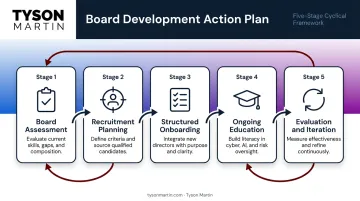
Stage 1: Board Assessment
Start with an honest current-state audit:
- Map who's on the board, what they contribute, and when terms expire
- Cross-reference existing expertise against the competencies the organization actually needs
- Review attendance patterns, committee participation, and contribution quality
- Gather director input through a structured self-assessment survey on board effectiveness
The goal is a documented baseline — not a flattering portrait, but a factual one. Every subsequent decision in the plan should trace back to this evidence.
Stage 2: Recruitment Planning
Assessment findings drive a prioritized recruitment profile. Effective recruitment planning means:
- Identifying 3–5 specific competency gaps to address in the next cycle
- Setting diversity and background targets alongside skill targets
- Building a candidate pipeline before vacancies open, not after
Spencer Stuart's 2024 US Board Index found S&P 500 board turnover at roughly 7.7% annually, with 58% of boards appointing at least one new independent director in the 2024 proxy year. That's a narrow window — and boards that wait for vacancies to recruit strategically miss most of it.
Stage 3: Structured Onboarding
Effective onboarding isn't a welcome packet and a handshake. A complete onboarding program includes:
- Written orientation kit: bylaws, strategic plan, financials, committee structure
- 1:1 with the board chair within 30 days
- Board mentor pairing (only 12% of new directors currently have one, per Spencer Stuart)
- Conflict-of-interest disclosure before the first meeting
- Risk profile briefing and CISO introduction for boards in regulated sectors
Directors without structured onboarding take substantially longer to reach full effectiveness — worth noting that 34% of the 2024 incoming director class were serving on a public-company board for the first time.
Stage 4: Ongoing Education and Development
Board education shouldn't be an annual checkbox. Build continuous development into the board calendar:
- Embed short education segments in regular board meetings
- Schedule an annual retreat for strategy alignment and relationship-building
- Brief the board when context shifts: new regulations, leadership transitions, significant technology changes
- Offer formal certification programs for directors seeking cyber and AI governance literacy
That last point matters more than most boards acknowledge. Tyson Martin's Board Clarity Certification Program, a four-to-six-week cohort for directors and senior executives, is built for exactly this gap: giving directors the questions and frameworks to exercise real oversight without requiring deep technical expertise.
Stage 5: Evaluation and Iteration
Evaluation closes the loop and should include:
- Annual individual director reviews: attendance, committee participation, strategic contribution, governance compliance
- Annual plan review: update recruitment targets and training priorities based on what the data shows
- External facilitation where appropriate — boards that use external facilitators find the process more effective (81% say so, per PwC)
Spencer Stuart research found 72% of boards took specific action after their last assessment: adding expertise (40%), changing committee composition (32%), and increasing diversity (21%). Evaluation only creates value when it produces owned action items.
How to Write a Board Development Action Plan: Step by Step
The five stages describe what happens. This section describes how to put it on paper in executable form.
Step 1 — Current Board Audit
Document the baseline:
- Who currently serves, what expertise they bring, when terms expire
- Results of the skills matrix and self-assessment survey
- Identified gaps, concentration risks, and engagement concerns
This section is the evidentiary foundation — every subsequent decision should trace back to it.
Step 2 — Define the Ideal Board Profile
The profile must be anchored to the strategic plan, not aspirational language. If the next three years involve technology modernization, regulatory scrutiny, or M&A activity, name those as explicit recruitment priorities — not "we value diverse perspectives," but "we need a director with enterprise technology risk and cybersecurity governance experience by Q3."
Step 3 — Recruitment and Pipeline Management
The recruitment section should document:
- A live candidate pipeline maintained by the governance committee
- Structured interview criteria mapped to the ideal profile
- Diversity and skill targets side by side, not competing
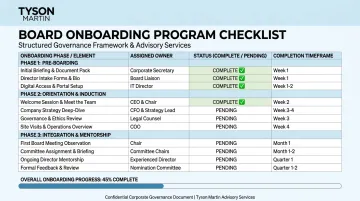
Step 4 — Onboarding Checklist and Training Calendar
Replace good intentions with scheduled commitments:
| Element | Owner | Completion Timeframe |
|---|---|---|
| Orientation kit delivered | Corporate Secretary | Day 1 |
| Conflict-of-interest disclosure | New Director | Before first meeting |
| 1:1 with Board Chair | Board Chair | Within 30 days |
| Mentor pairing | Governance Committee | Within 30 days |
| Risk briefing / CISO introduction | CEO or CLO | Within 60 days |
| Annual education calendar | Governance Committee | Q1 each year |
Step 5 — Evaluation Criteria and Review Cadence
Define what good looks like before you assess it. Document:
- Specific performance criteria for individual directors
- Process for the board chair to conduct annual private reviews
- Schedule for reviewing the plan itself
Plans without defined review cycles become outdated compliance documents within 18 months. Build the review date into the plan before you publish it.
Building the Skills Matrix: Finding the Gaps That Put Your Board at Risk
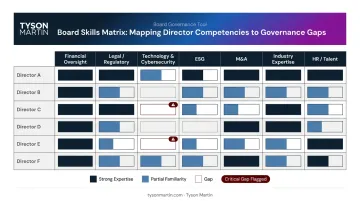
A skills matrix is a table mapping each director's areas of expertise against the competencies the organization actually needs. It's the most important single tool in the development action plan: it makes composition gaps visible and makes board composition decisions defensible.
How to Build One
- List required competency categories across the top: financial oversight, legal/regulatory, industry expertise, HR/talent, technology and cybersecurity, fundraising or business development, ESG, M&A, and any sector-specific requirements
- List current directors down the side
- Map expertise honestly: distinguish strong expertise from partial familiarity or developing capability
- Identify the gaps: cells that are empty or thin across multiple directors
The matrix only works if it reflects what's actually there. Be unsentimental about it.
The Technology and Cybersecurity Gap
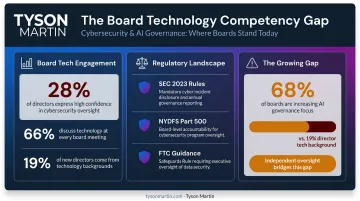
This is where most enterprise boards are genuinely exposed. NACD's 2024 survey found that while 66% of public company boards discuss technology at every meeting, only 28% express high confidence in the board's collective grasp of transformative technology implications. A topic gets discussed; that doesn't mean it gets overseen.
The regulatory consequences of this gap are concrete:
- SEC rules (2023) require public companies to disclose annually how the board oversees cybersecurity risk
- NYDFS Part 500 requires financial services boards to demonstrate sufficient understanding of cybersecurity matters and review management reporting on it
- FTC guidance explicitly states that board-level oversight ensures cybersecurity threats receive appropriate executive attention
Only 19% of new directors in 2024 came from technology or telecommunications backgrounds — even as 68% of boards increased focus on emerging technology and AI.
Closing the Gap
Identifying a gap and closing it are different problems. Boards can address technology and cybersecurity competency gaps through:
- Targeted recruitment of a director with enterprise technology risk experience
- Advisory relationships that provide expertise without a formal director seat
- Board education programs that improve all directors' literacy on specific risk areas
For the technology and cyber gap specifically, engaging an advisor like Tyson Martin, who works with enterprise boards in financial services, healthcare, and retail, can help boards understand precisely what they're missing before they begin recruiting for it. That diagnostic step typically reveals expertise gaps different from what boards assumed going in.
Making the Plan Executable: Owners, Timelines, and Measurable Outcomes
A development plan that describes intentions is a policy document. Assign owners, deadlines, and measurable outcomes, and it becomes a governance tool — one that actually survives contact with a busy board calendar.
The Goal-Action-Owner-Deadline Structure
Convert every section of the plan into this format:
"Close cybersecurity competency gap → recruit one director with enterprise technology risk background → Governance Committee Chair → Q3"
Compare that to "improve technology literacy" — which assigns nothing to anyone.
The difference isn't stylistic. One creates accountability. The other creates the appearance of it.
Building in 90-Day Accountability Checkpoints
Annual plans reviewed annually are annual problems. Breaking the plan into 90-day blocks with defined owners and outcomes creates inspection points throughout the year.
In practice, a 90-day governance cadence works in three phases:
- Days 1–30 (Stabilize): Establish the baseline, surface gaps, assign owners to the top risks and open action items
- Days 31–60 (Build Cadence): Implement the governance rhythm — regular reviews, decision-rights documentation, reporting that ties to actual decisions
- Days 61–90 (Deliver): Produce stable, board-ready outputs: a dashboard that shows trends, a roadmap with owners and milestones, an inspection-ready artifact
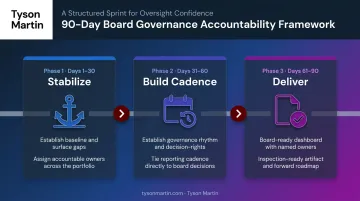
This is the framework Tyson Martin applies when working with boards on governance that can be inspected, not just described. The deliverable is a one-page scorecard where each row names the outcome, the evidence, and the owner with a due date.
What "Inspectable" Actually Means
Inspectable governance includes:
- Documents who accepts risk at what threshold, who approves exceptions, and who can shut systems down
- Ties every metric to a decision — if a metric can't trigger action, it's noise
- Assigns one accountable leader per top risk (not shared ownership, which means no ownership)
- Maintains a defined review cadence: weekly execution check-ins, monthly risk reviews, quarterly board updates
Together, these elements produce a governance structure that a regulator, auditor, or new director can walk into and verify is functioning — not just documented.
Frequently Asked Questions
What is a board development action plan?
A board development action plan is a written strategic document governing how a board recruits, onboards, trains, evaluates, and retains directors. It converts governance development from an ad hoc activity into a managed, accountable process — with assigned owners and measurable outcomes for each element.
What are the stages of a board development action plan?
The five core stages are: board assessment, recruitment planning, structured onboarding, ongoing education and development, and evaluation and iteration. These stages run sequentially but are cyclical — evaluation feeds back into the next assessment cycle.
How do you write a board development action plan?
Start with a skills audit, define the ideal board profile anchored to the strategic plan, build a recruitment pipeline, create a concrete onboarding checklist and annual training calendar, then establish evaluation criteria. Assign owners and deadlines to each element — that's what separates an action plan from a policy document.
What are some examples of board development action plans?
A nonprofit board identifies a fundraising competency gap and sets a Q3 recruitment target with named committee ownership. An enterprise board identifies a cybersecurity oversight gap and engages a board advisor to assess what expertise is actually needed before initiating a formal director search.
Who is responsible for board development?
The board development or governance committee owns the process; the board chair is accountable for individual director reviews. Where no standing committee exists, the board chair leads with support from the corporate secretary.
How often should a board development action plan be updated?
At minimum, annually. Interim updates should be triggered by significant board turnover, a strategic plan refresh, or a material change in the organization's regulatory environment or risk profile — for example, a new SEC cybersecurity disclosure obligation or a significant shift in AI-related regulatory exposure.