Introduction
Boards are accountable for a broader, faster-moving set of risks today. Financial risk still anchors the agenda, but it now shares space with cyber threats, AI governance, operational disruption, regulatory exposure, and reputational damage. Any of these can materialize faster than a quarterly review cycle allows.
The core tension is structural. Boards are responsible for risk outcomes they often can't directly interpret, especially as technology threats outpace boardroom expertise. Deloitte notes that the number and types of risks boards oversee are expanding, with expectations shifting toward more active strategic involvement.
What separates effective governance from reactive governance isn't risk elimination — it's structural clarity: who oversees what, how risks escalate, and which decisions belong to the board versus management. This guide covers the committee structures, decision rights, and escalation frameworks that make that clarity operational.
Key Takeaways
- The board's job is risk oversight, not risk management — the distinction shapes every governance decision downstream.
- Effective oversight starts with setting risk appetite, then building committee structure and reporting cadence around it.
- Cyber and technology risk require board-level attention equal to financial risk, yet most boards remain structurally underprepared.
- Decision rights and escalation thresholds are the most commonly missing piece in board risk governance.
- Board composition and reporting clarity determine whether oversight is real or performative.
What Board Risk Oversight Actually Means
Board risk oversight has a precise definition: the board's responsibility to ensure the organization identifies, prioritizes, and manages risks within an approved tolerance — without the board executing risk management itself. Most governance breakdowns trace back to exactly that line being crossed.
Oversight vs. Management: The Line That Gets Blurred
The board sets risk appetite and monitors adherence. Management — through the CRO, CISO, and their teams — owns execution. Blurring this line is one of the most consistent governance failures in practice.
It shows up two ways:
- Boards over-deferring — accepting management framing without challenge, treating CISO briefings as status updates rather than accountability checkpoints
- Executives underreporting — filtering what reaches the board to avoid uncomfortable conversations or protect operational momentum
Both failures produce the same outcome: the board learns about material risks after the window for proactive action has closed.
What Oversight Looks Like in Practice
In practice, board risk oversight runs on a structured cycle:
- Quarterly risk reviews with dashboard briefings from the CRO or CISO
- Committee reports (audit or risk committee) escalating findings to the full board
- Annual review and reaffirmation of risk appetite
- Strategic discussion of emerging risk categories tied to the business plan
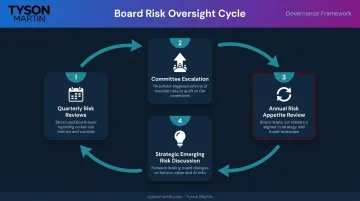
Each cycle, the audit or risk committee reviews heat maps, trend data, and mitigation progress — then surfaces the three to five issues requiring full board attention. The full board doesn't rehash the committee's technical work; it makes decisions on what the committee escalates.
Why Technology Risk Strains This Boundary
That escalation model works cleanly for financial or operational risk. Cyber and technology risk make the oversight-management line harder to hold.
Subject matter complexity tempts boards to either over-defer entirely ("the CISO says we're fine") or drop into operational detail that belongs to management. The goal is informed oversight, not technical mastery. A board doesn't need to understand firewall architecture to ask whether the organization has defined an acceptable data breach response timeline — and tested it.
The Board's Three Core Responsibilities in Risk Oversight
1. Setting Risk Appetite and Tolerance
Risk appetite is the board's foundational contribution: defining the level and type of risk the organization will accept in pursuit of its objectives. The Institute of Risk Management describes risk appetite as the amount and type of risk an organization is willing to take to meet strategic objectives, with the board holding direct accountability for setting it.
A measurable risk appetite statement includes:
- Specific thresholds tied to business outcomes: hours of acceptable downtime, maximum data loss windows, financial loss tolerance per period
- Decision rights defining who can accept risk at each level and what requires board escalation
- Exception rules with expiry dates, named owners, and compensating controls
- Direct linkage to strategic objectives (uptime for revenue, privacy for trust, integrity for reporting)
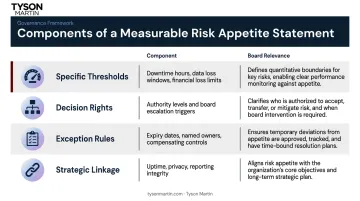
The most common weakness in existing statements is vague language — "low," "moderate," "strong." Replace those with hours, dollars, and coverage percentages. An appetite statement that can't be tested against a real incident isn't a governance tool; it's a placeholder.
Risk appetite also requires revisiting when strategy changes. Build in a formal review trigger: any material acquisition, new product line, or regulatory change should prompt a reassessment, not just the annual calendar cycle.
2. Approving and Monitoring the ERM Framework
The board doesn't design the enterprise risk management framework; management does. The board approves it, challenges it, and holds management accountable for executing within it. In practice, that accountability shows up in how the board engages with what management presents.
Regular monitoring looks like:
- Reviewing heat maps and top-risk rankings, not just accepting them
- Tracking whether mitigation plans are progressing or stalling
- Challenging management when risk ratings stay static for multiple cycles without clear explanation
- Confirming the framework covers categories that match the actual business environment
The OCC's Corporate and Risk Governance handbook requires the board to review and approve risk appetite and risk limits, including concentration limits, at least annually — a useful floor for organizations outside regulated industries.
3. Overseeing Risk Culture and Internal Controls
Culture is a risk variable. An organization that punishes transparency or rewards short-term results at the expense of risk discipline will produce governance failures regardless of how sound the framework looks on paper.
Boeing makes this concrete. A Delaware court found it reasonably conceivable that directors failed to establish a board-level monitoring process for airplane safety. The failure was cultural and structural, not just technical.
The board sets tone at the top by:
- Modeling intellectual honesty over consensus in risk discussions
- Ensuring incentive structures reinforce appropriate risk-taking, not just short-term results
- Confirming escalation paths are defined and tested, not improvised during a crisis
Boards should also verify that management has clear accountability and capability to execute, and that decision rights are documented before pressure hits.
Audit Committee vs. Dedicated Risk Committee: Which Structure Works?
Only 12% of S&P 500 companies had a standing risk committee as of a 2023 Spencer Stuart survey — meaning the vast majority rely on the audit committee to carry risk oversight responsibilities. The right structure depends on how dynamic your risk profile is and how much bandwidth your committees actually have.
The Case for Keeping Risk Within the Audit Committee
This structure works when:
- Risks are primarily strategic or operational and change relatively slowly
- The organization doesn't have complex, dynamic risk-taking at the core of its business model
- Committee capacity is a practical constraint
Keeping risk within the audit committee preserves unified oversight of internal controls and avoids committee overlap. The downside is real, though — audit agendas are already packed with quarterly reporting deadlines, and risk topics get displaced when earnings pressures run high.
The Case for a Dedicated Risk Committee
Where the audit-only model strains most is in organizations where risk-taking is fast-moving and central to the business model. Financial services, healthcare, and technology-intensive businesses fit that description — and for the largest of them, a separate committee isn't just advisable.
For large bank holding companies, separation isn't optional. Federal Reserve Regulation YY requires that bank holding companies with $50 billion or more in total consolidated assets maintain a dedicated risk committee that approves risk-management policies and oversees the risk-management framework.
A dedicated committee can:
- Meet more frequently without competing with traditional audit priorities
- Develop deeper expertise in the organization's specific risk categories
- Give emerging risks — cyber, AI, climate — structured time that audit agendas rarely accommodate
Solving the Overlap Problem
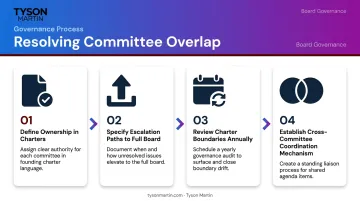
When two committees exist, explicit boundaries are essential. Without them, risks fall through the cracks — each committee assumes the other is watching.
Practical steps:
- Define which risks each committee owns in the committee charters
- Specify how findings escalate from committees to the full board
- Review charter boundaries annually — risk profiles shift, and charters need to keep pace
- Establish a coordination mechanism when a risk spans both committees (a cyber incident that triggers SEC disclosure, for example)
Cyber and Technology Risk: The Board's Fastest-Growing Blind Spot
Cyber risk is categorically different from most risks boards oversee. It evolves continuously, the terminology is specialized, and consequences — financial, regulatory, reputational — can materialize within days of an incident. The 2025 Verizon Data Breach Investigations Report analyzed more than 22,000 security incidents and found ransomware present in 44% of reviewed breaches, a 37% increase year over year.
Despite this, only 13% of directors say their boards added someone with cybersecurity expertise in the prior 12 months, according to PwC's 2024 Annual Corporate Directors Survey.
What Structured Cyber Oversight Actually Looks Like
Effective board-level cyber oversight isn't about technical fluency — it's about asking the right questions and holding management accountable for the answers.
A structured oversight approach includes:
- Regular CISO briefings focused on posture trend and material risks — what changed, what it means, what decision is needed
- Defined escalation thresholds for incident reporting, established before an incident occurs
- Clear ownership of cyber risk at both the board and management level
- Evidence of testing — tabletop exercises, incident response rehearsals, and third-party assessments
The briefing format matters. Boards receive either too much technical noise or too little substance. Tyson Martin's approach uses a compact structure built around four elements:
- One-page executive summary: what changed and what the board needs to decide
- Three to five metrics with trend direction (not snapshots)
- Top risks mapped to business scenarios — revenue loss, downtime, legal exposure
- A 90-day plan with named owners and measurable outcomes
What's explicitly excluded: blocked attack counts, patch totals, alert volume, and technical jargon without business context. Those metrics tell more about system activity than board-level exposure.
That framing problem — who shapes what the board sees — is where governance structure itself becomes the issue.
The Independent Advisor Advantage
Boards that rely entirely on management to frame cyber risk have a structural blind spot.
When the CISO reports up through management, organizational dynamics can shape what gets reported and how it's framed. An independent board advisor — someone with both technical credibility and governance experience — provides a different function: evaluating management's framing, asking questions that internal CISOs may not be positioned to raise, and ensuring the board gets decision-quality clarity rather than optimized messaging.
Tyson Martin's board advisory work — drawing on CISSP certification and active contributions to NACD and the World Economic Forum Centre for Cybersecurity — provides exactly this translation and accountability function. The goal is helping boards govern technology risk without requiring technical mastery.

What Good Risk Escalation and Decision Rights Look Like
Decision rights are the most commonly missing layer in board risk governance. Organizations often have a risk framework and a committee structure, but no clear articulation of which decisions the board makes, which it delegates to committees, and which belong entirely to management.
Without that clarity, escalation fails in real incidents. Things either wait for board approval that no one has defined a process to obtain, or they never reach the board at all.
The Four-Level Escalation Structure
A functional escalation framework uses triggers tied to impact, not fear:
| Level | Owner | Trigger |
|---|---|---|
| Low | Security operations | Routine issues within standard SLAs |
| Moderate | Security leadership | Cross-team coordination required |
| High | Executive leadership | Critical systems or sensitive data at risk |
| Critical | Board/Risk Committee | Material business impact, regulatory exposure, or public disclosure |
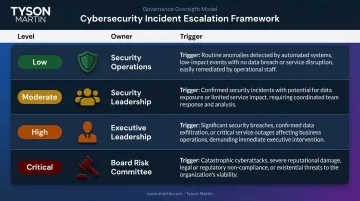
Board-level escalation is triggered by specific, pre-defined thresholds — dollars, downtime, data sensitivity, or legal exposure. Those criteria need to be documented before an incident, not assembled under pressure.
Two Common Escalation Failures
From Tyson Martin's advisory experience, escalation typically breaks down in recognizable patterns:
- Ownership blur — IT, security, legal, and business leaders each assume someone else is deciding. Risk acceptance happens informally, often in an email thread with no record of who owned the call.
- Late arrival — boards get pulled in after key containment choices are already made, when options are constrained and the cost of delay is already accumulating.
Both failures share the same root cause: the escalation structure wasn't documented and tested before the incident occurred.
What Good Reporting Looks Like
Effective risk reporting shows trend over time, not just point-in-time status. A board dashboard should surface the three to five risks requiring board attention — with impact, owner, and next decision clearly identified — rather than cataloging everything management is monitoring.
Every metric on a board dashboard should answer three questions:
- What decision does it support?
- Who owns it?
- What happens if it moves?
Metrics without that structure aren't governance tools — they're history reports.
The SEC's enforcement action against R.R. Donnelley found that the company's internal policies failed to identify lines of responsibility, establish clear criteria for incident prioritization, or define workflows for alert review and reporting. Undefined escalation structures produce exactly that outcome.
Frequently Asked Questions
What are the three main roles of the board in risk oversight?
The board's three core roles are setting risk appetite and tolerance, approving and monitoring the enterprise risk management framework, and overseeing the risk culture and internal controls that govern how management operates within those parameters. All three are necessary for oversight to be substantive rather than nominal.
What is the difference between the board's oversight role and management's risk management role?
The board oversees risk at a strategic level — setting appetite, approving frameworks, and holding management accountable for results. Management, through the CRO, CISO, and their teams, executes day-to-day risk identification, mitigation, and monitoring. The board asks questions and reviews outcomes; management does the operational work.
Should risk oversight sit with the audit committee or a dedicated risk committee?
The right structure depends on the organization's risk complexity and committee capacity. Audit committees work well when risks are stable and predictable. Dedicated risk committees are better suited to organizations where risk-taking is dynamic, regulated, or central to the business model — and in financial services, separation may be legally required.
How often should the board review the organization's risk profile?
Most effective boards conduct formal risk reviews at least quarterly, with additional reviews triggered by strategic changes, incidents, or material shifts in the external environment. That cadence should be defined in committee charters — ad hoc scheduling consistently produces gaps.
What skills should board members have to support effective risk oversight?
Boards need a mix of industry expertise, financial literacy, and outside perspective. Technology or cyber competency — through at least one board member or independent advisor — is now a baseline governance requirement across every sector, not a specialty addition.
How should the board specifically oversee cybersecurity risk?
Effective cyber oversight requires regular CISO briefings focused on posture trends and material risks rather than technical detail, clearly defined escalation thresholds for incidents, and at least one independent voice at the board level with enough technology literacy to evaluate — not just accept — management's framing.