Introduction
The SEC's 2023 cybersecurity disclosure rules now require companies to describe, on the record, exactly how their board oversees cyber risk. That's a new standard — and most committee structures weren't built to meet it. Cyber threats, generative AI, geopolitical instability, and supply chain exposure have all moved from management briefing topics to board-level accountability items.
The problem: most board committee structures were built for a different era. They were designed for retrospective financial review and incremental risk categories, not for the velocity and volume of risk that boards now inherit.
This creates a structural problem boards can't paper over. Committees are being asked to oversee more risk categories, with greater depth, across a wider perimeter that now includes third parties and supply chains — while bandwidth, meeting time, and director expertise have not kept pace.
This guide is for boards asking the honest question: is our current structure actually fit for purpose?
It covers three things directors can act on:
- How to diagnose whether your committee structure has kept pace with the current risk perimeter
- Where the most common accountability gaps appear — and why they persist
- What structural adjustments boards are making to close those gaps without adding committees
Key Takeaways
- Most boards still rely on their audit committee to carry cyber, AI, ESG, and enterprise risk — a load it was never designed for.
- Only ~12% of S&P 500 boards have a standalone risk committee; outside financial services, that drops to 3%.
- Committees most often fail not because of structure, but because they lack the right information, decision rights, and escalation thresholds to hold under pressure.
- Only 34% of directors say their board's cybersecurity expertise is sufficient — even as director cyber knowledge has nearly doubled since 2020.
- Restructuring committees without fixing reporting and decision rights produces documentation, not oversight.
Why the Structure That Got You Here Won't Get You There
Risk oversight has expanded across three dimensions simultaneously — and most committee structures were not designed to absorb all three at once.
Breadth — the number of risk categories boards are expected to oversee has grown sharply. Cybersecurity, AI governance, climate risk, third-party exposure, geopolitical disruption: these are now board-level topics, not operational footnotes.
Depth — boards are no longer expected to receive summary updates. Regulators, investors, and proxy advisors want evidence of substantive engagement — understanding how risks aggregate, interconnect, and escalate.
Perimeter — the risk boundary now extends well beyond company walls. Risks inherited from vendors, cloud providers, and supply chain partners are board-level concerns, not just procurement ones.
The Audit Committee Default Problem
Most boards historically delegated the bulk of enterprise risk oversight to the audit committee. That approach made sense when risk was primarily financial and compliance-oriented. It does not hold when the same committee is also expected to own cybersecurity, AI governance, ESG, and ERM simultaneously.
According to EY's 2024 S&P 500 committee structure analysis, audit committee descriptions mentioning cybersecurity rose from 70% in 2021 to 77% in 2024 — and in 2019, only about one-quarter of audit committees had cybersecurity responsibility at all. ESG mentions in audit committee charters jumped from 6% in 2021 to 22% by 2024. The audit committee's mandate has expanded dramatically; its capacity has not.
Expanded scope isn't the only pressure. Cyber and technology risks evolve faster than quarterly board meetings. A committee structure built for retrospective financial review is poorly matched to forward-looking technology risk. The SEC's 2023 cyber disclosure rules formalized what was already becoming apparent: board-level accountability for cyber risk is no longer optional or informal.
The Risk Interdependency Problem
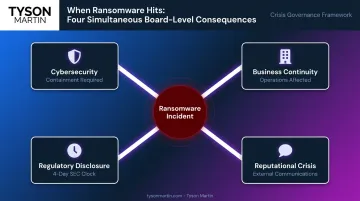
Today's risks don't stay in their designated lanes. A ransomware incident is simultaneously:
- A cybersecurity event requiring containment
- A business continuity failure affecting operations
- A regulatory disclosure obligation with a four-day clock
- A reputational crisis requiring external communications
Siloed committee charters create blind spots exactly where risk intersects. When no single committee owns the full picture, the full board rarely sees it either.
This leads to what is the central challenge in board risk governance: form versus substance. Many boards respond to pressure by creating new committees — adding structure without fixing whether those committees have the right information, decision rights, and escalation thresholds to function under real incident conditions.
The Three Models: How Boards Currently Allocate Risk Oversight
Understanding the tradeoffs of each model is what separates a deliberate structural choice from one the board simply inherited.
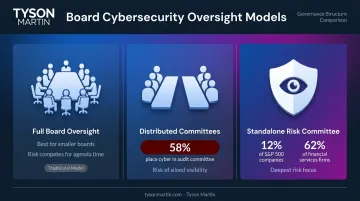
Model 1: Full Board Oversight
The entire board carries risk oversight without a dedicated committee. This works reasonably well for smaller boards with less complex risk profiles — the full board can engage directly without committee filtering.
The weakness: risk topics compete with strategy, M&A, and compensation for agenda time. Without dedicated ownership, they get compressed or deferred — and when everything owns risk, nothing does.
Model 2: Distributed Across Existing Committees
This is by far the most common model. Typically:
- Audit committee — cybersecurity, financial risk, ERM, internal controls
- Compensation committee — talent and human capital risk
- Nominating/governance committee — ESG, ethics, board composition
The Deloitte and CAQ's 2024 Audit Committee Practices Report found that 58% of respondents said the audit committee has primary cybersecurity oversight, while 25% said the full board does.
Where this model breaks down: overlapping jurisdictions, inconsistent reporting standards across committees, and the full board never receiving a consolidated view of aggregate risk exposure. Coordination between committee chairs is rarely formalized, so cross-cutting risks — AI liability, vendor concentration, geopolitical exposure — get owned by no one.
Model 3: Standalone Risk Committee
A dedicated risk committee with its own charter and membership. Spencer Stuart's 2024 U.S. Board Index reports that approximately 12% of S&P 500 boards have a standalone risk committee — with 62% of financial services firms having one, compared to just 3% of non-financial S&P 500 companies.
Dodd-Frank Section 165(h) mandates standalone risk committees for publicly traded bank holding companies and covered savings and loan holding companies with $50 billion or more in total consolidated assets. Congress drew the line clearly: complexity demands dedicated ownership.
Conditions that most justify a standalone risk committee:
- Complex technology environments or significant cyber exposure
- Regulated industries (financial services, healthcare)
- Material third-party or supply chain dependency
- Audit committee already carrying a full mandate
- A recent incident that revealed structural gaps
The Hidden Failure Points in Committee Risk Oversight
Structure is necessary but not sufficient. Boards that get the model right but skip the substance work are still producing paper governance.
The Information Quality Problem
Boards cannot oversee what they cannot see clearly. The difference between useful risk reporting and noise is not volume — it's translation.
A board that receives a dashboard of vulnerability counts, patch rates, and training completion percentages is reviewing activity, not risk. These metrics tell you what the security team has been doing. They do not tell you whether the business's actual exposure changed.
Effective reporting answers four questions: What is the current risk posture? What changed since the last briefing? What actions are underway? What decisions does the board need to make?
NACD's 2024 board-packs research found that only 13% of directors rated their board packs as extremely effective, and 72% of public-company board packs exceed 200 pages. Receiving more information is not the same as receiving better oversight.
The Decision Rights Gap
Effective oversight requires both the board and management to know, in advance, which decisions belong at each level. Without documented decision rights and escalation thresholds, two failure modes emerge: boards micromanage operational details they shouldn't touch, or they stay uninformed about emerging risks until those risks become crises.
Either way, the board is reacting rather than governing.
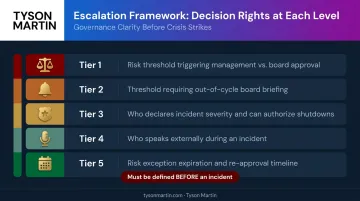
A well-defined escalation framework specifies:
- What risk level triggers a management decision versus a board-level approval
- What threshold requires an out-of-cycle board briefing
- Who declares incident severity and can authorize system shutdowns
- Who speaks externally during an incident
- How long a risk exception can remain open before re-approval is required
These thresholds need to be documented before an incident, not negotiated during one.
The Coordination Failure Between Committees
Decision rights clarify who acts — but they don't solve the visibility problem that emerges when risk is distributed across multiple committees. When audit owns cyber, governance owns ESG, and compensation owns talent risk, the full board rarely sees a unified picture. Committee chairs typically present their own committee's work — cyber goes to audit, ESG goes to governance, talent risk goes to compensation — with no one synthesizing the aggregate view.
Practical coordination mechanisms that work:
- Regular briefings between committee chairs before and after board meetings
- A documented risk agenda calendar that sequences topics across the full year
- At least one full-board session annually presenting aggregated risk exposure across all categories
Coordination requires deliberate design. Reorganizing committees reassigns the problem; it does not eliminate the gap between what each committee sees and what the full board needs to know.
Director Expertise and the Skill Gap Problem
Expertise is now a structural issue, not just a talent preference. A board that lacks directors with meaningful technology or cybersecurity literacy cannot exercise substantive oversight in those areas — it can only ratify what management presents.
The Conference Board and ESGAUGE reported that the share of S&P 500 directors with cybersecurity experience rose from 13% in 2020 to 25% in 2024 — nearly double in four years. That's real progress. But NACD's 2026 cyber-risk oversight guidance reports that only 34% of directors say their board's cybersecurity expertise is sufficient, and just 40% see improving committee oversight of cyber as important.
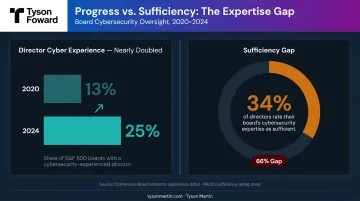
The gap between experience claimed and oversight actually delivered is real.
Three Pathways to Close the Expertise Gap
1. Add directors with specific risk expertise. Spencer Stuart 2024 reports that 19% of new S&P 500 independent directors came from technology or telecommunications backgrounds — the most common industry background among new appointments. A director with direct cyber-risk governance experience and formal credentials like CISSP brings technical fluency. Active involvement with governance bodies such as NACD adds the oversight framing to use it.
2. Engage third-party advisors or subject matter experts. An independent advisor — someone without a commercial stake in the company's security vendors or tools — can brief committees, translate management reporting, and surface questions that generalist directors cannot formulate on their own. Independence is not a formality here. An advisor who also sells security products has a conflict that shapes what they choose to emphasize.
3. Create a formal advisory panel for emerging risk domains. This works well for AI governance and other rapidly evolving risk categories where no single director can carry the full context.
The tradeoff to be honest about: expertise without appropriate reporting infrastructure is not oversight. A director with deep cybersecurity knowledge cannot exercise that expertise if management's reporting cadence and format are not designed to surface the right information.
Making Oversight Functional: Reporting, Coordination, and Decision Rights
Structure and expertise only matter if the underlying processes are built to support them.
Reporting That Enables Decisions
Board risk reporting should show trend, not trivia. A well-designed update answers five questions:
- What changed since the last meeting?
- What does it mean in business terms — downtime, revenue, regulatory exposure?
- What actions are underway?
- What decisions or approvals does the board need to make?
- What happens if action slips?
Boards that receive 80-page technical briefings without this structure are not getting oversight — they are receiving documentation.
During organizational transitions or when capability gaps exist, engaging an interim CISO who reports into the board's oversight structure sharpens reporting quality considerably.
The interim role works best when decision rights are explicitly defined upfront: who can authorize containment actions, who speaks externally, who owns customer communications. That clarity is what gives the board genuine oversight rather than another management voice.
Decision Rights and Escalation Thresholds
A risk governance framework that has never been tested is untested governance — and untested governance fails at the worst possible moment.
Tabletop exercises serve a specific purpose here: they validate whether the oversight structure actually functions under pressure. Not whether policies exist on paper, but whether the right people know their roles, whether escalation thresholds are clear and actionable, and whether the board chair would receive a coherent first update within the first hour of a real incident.
The World Economic Forum's 2026 cyber resilience guidance frames tabletop exercises for extreme scenarios as a way to test decision-making discipline and coordination under pressure — including legal teams on regulatory exposure and executives making high-stakes calls with incomplete information.
That standard applies directly to what comes after the exercise. Every tabletop should end with an action list: owners, due dates, and the business consequence if it slips. Without that, the exercise becomes theater — the same failure mode as a well-formatted risk committee charter that never translates into actual oversight.
Frequently Asked Questions
What is a risk oversight structure and what are its key components?
Risk oversight structure is the formal arrangement of board and committee responsibilities for identifying, monitoring, and governing enterprise risk. Key components include a defined risk appetite, explicit committee charters with ownership and escalation thresholds, decision-ready risk reporting, and director expertise aligned to the company's primary risk categories.
When should a board create a separate risk committee?
The strongest cases are complex or regulated industries (financial services, healthcare), significant technology or cyber exposure, audit committee overload, or a material incident that exposed structural gaps in existing oversight. Dodd-Frank mandates standalone risk committees for certain large financial institutions, setting a clear regulatory precedent.
How should cyber and technology risk be assigned across board committees?
Cyber and technology risk can sit within the audit committee, a dedicated risk committee, or a standalone technology committee — but the assignment must be explicit in the charter. The committee receiving it needs directors with sufficient fluency to ask substantive questions, and escalation paths to the full board must be defined before an incident occurs.
What skills should board directors have to oversee technology and cyber risk effectively?
Directors do not need to be technologists. They need enough fluency to distinguish credible reporting from noise, ask informed questions about risk posture and trends, and recognize when a briefing is missing material information. Experience in regulated technology environments or formal cyber-risk governance credentials strengthens this capacity considerably.
How do board committees coordinate oversight of risks that span multiple domains?
Coordination requires explicit process design — documented reporting protocols between committees, regular briefings between committee chairs, and an annual full-board session that presents an aggregated enterprise risk view rather than siloed committee updates.
How often should a board reassess its risk oversight structure?
Boards should conduct a structural review whenever there is a material change in risk profile — a significant acquisition, a major incident, a new regulatory requirement, or the introduction of transformative technology. A structural review should occur every two to three years as part of a broader governance assessment — more frequently if risk conditions change materially.