Introduction
Directors are increasingly named in enforcement actions, shareholder suits, and SEC disclosure reviews — not because a breach occurred, but because the board couldn't demonstrate it governed the risk. The NACD released its fifth edition Director's Handbook on Cyber-Risk Oversight in April 2026, and regulators across the US, EU, UK, and Australia are now holding directors personally accountable for oversight quality.
The scale is hard to ignore. Microsoft reported roughly 600 million cyberattacks daily against customers in 2024. Disclosed vulnerabilities grew from 40,077 in 2024 to 48,244 in 2025 — a 20.4% jump in a single year. These are enterprise risk metrics, not IT statistics.
This article gives directors and risk committee members what they need to ask sharper questions, set clearer expectations, and build governance structures that hold when an incident actually happens.
TLDR
- AI-powered attacks, deepfake fraud, and supply chain exploitation define the 2026 threat landscape
- Boards govern — they set expectations, verify accountability, and approve risk appetite; management executes
- NIST CSF 2.0 and the NACD 2026 Handbook provide the primary governance frameworks
- Quarterly committee briefings plus annual full-board sessions are the baseline cadence
- Ransom position, escalation triggers, and outside counsel must be decided before an incident, not during one
The 2026 Cyber-Risk Landscape: What Boards Must Understand
AI Is Changing Attack Speed, Not Just Attack Volume
Threat actors are now using large language models for reconnaissance, phishing content, scripting, and malware development. The WEF Global Cybersecurity Outlook 2025 found that 47% of organizations cite AI-powered adversarial advances as a primary concern. Google's Mandiant has documented a shift from experimental AI use to active deployment, including purpose-built tools like PROMPTFLUX and PROMPTSTEAL.
The governance implication is speed. Boards should ask management: how has AI-enabled threat acceleration changed your detection and containment timelines — and what does that mean for your incident response plan?
Personal Liability Is No Longer Theoretical
The SEC charged SolarWinds and CISO Timothy Brown in 2023 for allegedly misleading investors about cybersecurity risks. That case was ultimately dismissed in late 2025 — but the enforcement pattern held. The SEC separately charged R.R. Donnelley ($2.125M settlement) and four other companies over SolarWinds-related disclosure failures.
Faster AI-enabled incidents mean faster disclosure deadlines, and that acceleration is landing directly on directors. Regulators across multiple jurisdictions have made oversight accountability explicit:
- EU NIS2 requires management bodies to approve cybersecurity measures and accept personal liability for compliance failures
- UK's Cyber Governance Code of Practice (2025) places explicit responsibility on boards and directors
- Australia's ASIC states that managing cyber risk is a core director duty
The question for every board is whether your current oversight process produces a documented, defensible record — or just meeting minutes.
Third-Party Breach Involvement Has Doubled
Verizon's 2025 Data Breach Investigations Report found third-party involvement in 30% of breaches — up from roughly 15% the prior year. A single compromised vendor can cascade across multiple enterprises simultaneously.
Boards are liable for data lost through third parties, not just internal failures. Regulations including DORA and NIST SP 800-161 now require organizations to audit vendor security posture, not just their own controls.
Emerging-Horizon Risks: Deepfakes and Quantum
Two threats require board-level attention even without immediate operational urgency:
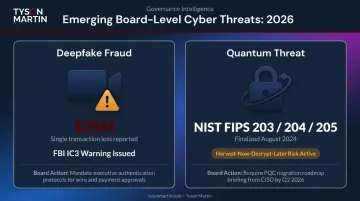
- A finance worker paid $25M after a video call using deepfake recreations of a CFO and colleagues. The FBI's IC3 warned in 2025 that AI-generated voice and video are actively impersonating senior officials — deepfake fraud is no longer theoretical
- NIST finalized post-quantum encryption standards (FIPS 203, 204, 205) in August 2024. Adversaries are already harvesting encrypted data today for future decryption. Boards should be asking about transition timelines, not just whether current encryption is adequate
The Board's Role: Oversight vs. Management
Two Governance Failures — and Why They're Equally Dangerous
Most boards fall into one of two traps.
The first is staying too passive. Boards accept vague reassurances without demanding evidence. Cyber becomes a five-minute agenda item. Directors receive status without movement, activity without effect.
The result is governance theater: no real accountability, no documented decisions, no ability to demonstrate informed oversight to a regulator or plaintiff's attorney.
The second trap is dropping into operational detail. When the business risk picture never becomes clear, directors compensate by diving into technical controls they shouldn't be managing. Meetings become speeches about patch counts and vulnerability dashboards. The board starts second-guessing management rather than governing it.
Both failures stem from the same root cause: reporting that doesn't translate cyber risk into business decisions the board can actually govern.
What "Inspectable Execution" Means in Practice
The board's job isn't to accept internal reporting at face value — it's to verify it. Effective oversight includes:
- Requesting proof artifacts: tabletop exercise reports, third-party assessment summaries, patch exception registers with business owners and expiration dates, backup restore test results
- Requiring independent signals: internal audit reviews of specific controls, periodic external assessments, post-incident learning reviews
- Applying a three-part truth test to every cyber report: Does it ask for a decision? Could the team produce evidence for one key claim within a week? Is any input coming from outside the team being measured?
All three checks present means reporting stays grounded. Without them, dashboards become theater.
Governance During Transitions
Organizations in the middle of leadership changes, M&A events, or post-incident recovery face a specific vulnerability: accountability gaps between outgoing and incoming leadership. Boards in these windows need to ensure oversight continuity, not just reporting continuity.
An interim CISO who reports to both management and the board can bridge this gap. In practice, that means:
- Establishing clear decision authority from day one
- Delivering a ranked risk view within 30 days
- Moving incident readiness from documentation to active capability
- Shifting board reporting from activity description to decision support
This model provides experienced leadership while the organization avoids the 4–6 month lag of a permanent hire search.
The Fiduciary Framing
The standard regulators and courts apply isn't technical mastery. It's whether directors applied a disciplined, documented, and consistent oversight process. Delaware Caremark precedent sets a high bar — claims are dismissed where directors had a monitoring system in place. But that protection only exists if the monitoring system was real, not real in name only.
Six Principles for Effective Cyber-Risk Oversight in 2026
These principles come directly from the NACD 2026 Director's Handbook — the current authoritative standard for how boards govern cyber risk. Each one addresses a distinct oversight gap that directors commonly face.
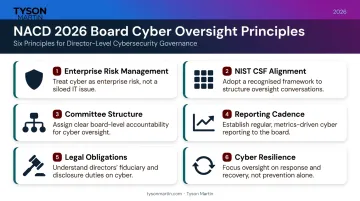
Principle 1 — Treat cybersecurity as a strategic enterprise risk Cyber risk belongs alongside financial, operational, and strategic risks — with a defined risk appetite, identification of material threats, and board-level decisions about whether to mitigate, transfer through insurance, or accept specific risks. In plain English: risk appetite means defining what "not ok" looks like in business terms — "if our checkout system is down more than 4 hours, we lose revenue we can't recover."
Principle 2 — Adopt a recognized framework Boards should expect management to operate against NIST CSF 2.0, which added a Govern function in its February 2024 update. Directors don't need to understand every control — they need to know which framework is in place, where the gaps are, and what those gaps mean in business terms.
Principle 3 — Establish clear oversight structures and access to expertise Delegate primary responsibility to an audit or risk committee with explicit charter language. The committee should receive quarterly briefings; the full board at minimum annually. The CISO should have direct board access outside formal meeting cycles — not just through prepared presentations.
Principle 4 — Guide risk measurement and reporting Require a consistent scorecard that shows trend over time, not just point-in-time status. Core elements include top enterprise cyber risks in business terms, key defense status with trend arrows, incident readiness health, and third-party exposure summary. Supplement with rotating deep-dives — ransomware readiness one quarter, vendor risk the next, insurance adequacy another.
Principle 5 — Monitor legal and regulatory obligations Boards need to understand what data the organization holds, what the SEC's 4-business-day Form 8-K materiality clock means operationally, and what the ransom payment decision-making process looks like before an incident occurs. That last point matters more than most boards realize — the time to discuss ransom payment decisions is not during an active incident. Participation in annual tabletop exercises is a board-level responsibility, not a management exercise.
Principle 6 — Encourage systemic resilience Prevention will eventually fail. Boards should be approving investment in detection speed, backup redundancy, and recovery capability — not just perimeter defense. The 2026 NACD Handbook is direct on this point: resilience is the governance goal, not zero incidents.
Taken together, these six principles define what "good" looks like for board cyber oversight in 2026:
- Cyber risk governed at the same level as financial and operational risk
- A named framework with visible gap tracking
- Committee structure with real CISO access — not just annual briefings
- Trend-based reporting tied to business impact
- Legal and regulatory readiness before an incident, not during
- Investment in recovery, not just in defense
Building the Right Governance Structure
Committee Assignment and Charter Language
Cybersecurity oversight must be explicitly assigned in committee charters — most commonly audit, risk, or technology committees — with language that defines responsibilities, prevents gaps, and avoids duplicative coverage. The audit or risk committee owns controls, risk process, and reporting; the full board retains accountability for strategy, risk appetite, and major decisions.
Charter language should specify:
- Which committee owns cyber oversight
- Reporting cadence requirements (quarterly minimum)
- CISO direct access provisions
- Escalation thresholds and what triggers full-board notification
The full board never fully delegates accountability — it delegates mechanics while retaining the authority to set direction and hold management accountable.
Addressing the Expertise Gap
Not every board includes a director with cybersecurity expertise. The real problem is having no access to independent expertise — not the gap itself, but leaving it unaddressed.
Independent advisors serve a specific function internal CISOs cannot: they validate whether the board's picture of risk reflects actual posture rather than curated assurance. They challenge assumptions without career risk and surface the hard parts that live in exceptions and workarounds.
That independence changes the questions on the table. "What are the three residual risks we're accepting right now, and why?" is a different conversation than reviewing patch completion rates.
For boards that want to build director-level capability from within, a structured certification program — focused on governance frameworks, decision-making processes, and the right questions to ask — can close the expertise gap without requiring directors to become technical experts.
Escalation Thresholds Before an Incident
Define these in advance, not during a live event:
- What event types trigger immediate board notification (and within what timeframe)
- Who can declare an incident and activate full response
- Who can authorize network isolation or system shutdown
- What the default ransom position is and who can approve exceptions
- Which outside counsel, forensics firm, and insurance carrier are pre-approved
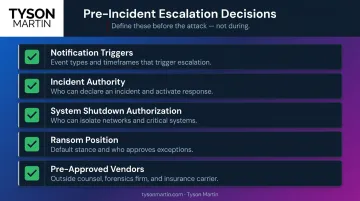
Boards that establish these thresholds before an attack make significantly better decisions under pressure. Pre-defined authorities mean no one is improvising who can approve a network shutdown at 2 a.m. — or discovering mid-incident that no one was authorized to.
Frequently Asked Questions
What are the latest trends and emerging threats in cybersecurity?
The highest-priority 2026 developments are AI-powered autonomous attack tools, real-time deepfake identity fraud targeting executives during financial transactions, supply chain exploitation (now involved in 30% of breaches), and accelerating personal director liability for governance failures. All four require board-level awareness, not just a management response.
What are the best practices for mitigating cybersecurity risks at the board level?
Adopt NIST CSF 2.0 as the management framework, establish a clear risk appetite with measurable thresholds, and require independent verification of management's control claims. Resource allocation should match stated risk appetite — sized to actual exposure, not to executive comfort or last quarter's headlines.
What is the difference between the board's role in cybersecurity and management's role?
The board sets expectations, approves risk appetite, and verifies that an appropriate framework is in place — oversight. Management selects controls, operates the security program, and executes incident response — execution. The board should challenge, approve, and guide. It should not run the response plan or manage the security backlog.
How often should a board receive cybersecurity briefings?
Current guidance supports committee-level briefings at least quarterly with monthly risk-pulse updates, and full board briefings at minimum annually. During active incidents, major regulatory changes, or organizational transitions, frequency should increase — often to monthly formal reporting or twice-daily updates during a live incident.
What should a board do before a ransomware or major cyber incident occurs?
Establish a default ransom position before an attack occurs and document who can authorize exceptions. Pre-approve outside counsel, confirm insurance carrier protocols, and maintain a vendor list for forensics and PR. Run a tabletop exercise that tests board-level decision-making specifically, and document all escalation thresholds and decision rights before they're needed.