Why Vendor Cybersecurity Governance Keeps Failing Boards
Most organizations have some form of vendor risk management. They run questionnaires, collect SOC 2 reports, track findings in spreadsheets. What they don't have is governance — and that gap only becomes visible when something breaks.
During an incident, a regulatory review, or a board audit, the question isn't "did you assess your vendors?" It's "who owned that decision, when were they notified, what authority did they have, and where's the documentation?" Organizations with VRM processes but no governance framework can't answer those questions — and that's when regulators write orders and boards lose confidence.
This guide is for boards and executive teams who need more than a security checklist. It covers:
- The five core components of a vendor cybersecurity governance framework
- How to separate board oversight from management execution
- What inspectable governance looks like to a regulator
- What's changed in 2026 across DORA, the SEC's cybersecurity rules, and NYDFS 23 NYCRR 500
What to Know Before You Read Further
- A vendor cybersecurity governance framework defines who owns decisions — not just what controls exist
- Boards need oversight, not operational detail — the framework separates those lanes explicitly
- Vendor tiering determines governance intensity, not just assessment depth
- DORA, SEC disclosure rules, and NYDFS 23 NYCRR 500 now make documented governance a compliance requirement
- Regulators expect inspectable execution: documented proof of how governance decisions were made, not just that controls exist
What a Vendor Cybersecurity Governance Framework Actually Is (and Why It Differs from VRM)
Vendor risk management is the operational process: assessing vendors, tracking findings, running questionnaires, reviewing SOC reports. A governance framework answers different questions entirely — who makes decisions about third-party cyber risk, who has authority to escalate or waive, and how the organization proves oversight when asked.
VRM is the what. Governance is the who decides and how.
A Concrete Example of the Gap
A vendor risk management program identifies that a Tier 1 cloud provider has a critical unpatched vulnerability. The VRM process found it. But without a governance framework, the organization still can't answer:
- Who must be notified, and within what timeframe?
- Who has authority to pause the relationship?
- Does this trigger board notification?
- What documentation proves the decision was made and by whom?
Without governance, that finding stalls in a spreadsheet while the exposure continues.
Why This Gap Is Growing in 2026
According to Verizon's 2025 Data Breach Investigations Report, third-party involvement now appears in 30% of breaches analyzed — roughly double the prior year's rate. Vendor ecosystems are also expanding beyond direct suppliers into fourth parties, AI subprocessors, and cloud-embedded tools that most organizations haven't formally inventoried.
No security team manages that complexity through operational processes alone. Clear decision rights, defined escalation thresholds, and board-level visibility are what keep a vendor program functioning when the ecosystem runs into the dozens or hundreds of relationships.
The 5 Core Components of a Vendor Cybersecurity Governance Framework
Vendor Inventory and Tiering Policy
Governance cannot function without a maintained vendor inventory and a tiering policy that classifies vendors by business impact, not just data sensitivity.
A practical three-tier structure uses plain business criteria:
| Tier | Classification | Criteria |
|---|---|---|
| Tier 1 — Critical | Failure could materially disrupt core services, expose sensitive data, or create major compliance/financial impact | Production access, payment processing, cloud hosting, EHR systems, payroll |
| Tier 2 — Important | Meaningful operational role; requires regular oversight | Customer support platforms, SaaS with data integrations |
| Tier 3 — Routine | Minimal data access; low business dependency | Team-level tools, no sensitive data exports |
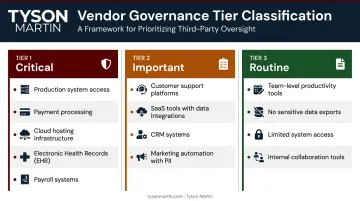
Keep the critical tier small — typically 10 to 30 vendors — so board reporting stays focused. Tiering is a governance document, not just an operational tool: it determines what level of oversight applies to each relationship.
Decision Rights and Accountability Structure
A decision rights structure defines who can:
- Approve new high-risk vendor relationships
- Waive security requirements, and under what conditions
- Suspend or terminate a vendor during an incident
- Accept ongoing monitoring gaps and for how long
The most common reason vendor governance breaks down during real incidents is ambiguous ownership. "Shared responsibility" becomes "shared confusion" when nobody can name a single accountable executive.
A functional RACI structure assigns ownership across procurement (purchase decisions), legal (contract terms), security (risk controls), privacy (data use), and business units (relationship outcomes) — with explicit documentation of who approves exceptions and what time limits apply.
Risk Acceptance and Escalation Thresholds
A governance framework must define which findings can be accepted at each level of authority. Without this, every finding gets "escalated" to create a paper trail — which trains leadership to ignore the signal.
Three-tier escalation structure:
- Security team authority — Low-impact findings, limited scope, no production access involved; documented management acceptance within established policy
- CISO/executive authority — Findings that impact a critical process or create meaningful customer or compliance exposure; time-limited exceptions with named owners
- Board notification — Tier 1 vendor breach, potential material outage, regulated data exposure, or concentration risk that could cascade; rapid escalation to CEO and board committee chair
These thresholds must be written, tested, and reviewed annually. "We'll know it when we see it" is not a governance threshold.
Contractual Security Standards and Enforcement
Governance requires minimum security standards mapped to vendor tier and embedded in contracts. For Tier 1 vendors, essential contract elements include:
- Data protection obligations: ownership, use limits, and deletion on termination
- Breach notification timelines: specific hours, not "reasonable time" — align to DORA, NYDFS, and SEC requirements
- Audit rights: not just reserved, but exercised — specify evidence requests, cooperation timelines, and dispute resolution
- Subcontractor flow-down: approval required for material changes to subprocessors
- Termination triggers: explicit right to exit if risk becomes unacceptable
Contractual standards without an enforcement mechanism are not governance. Audit rights that are reserved but never exercised won't satisfy a regulator — and won't surface problems before they become incidents.
That enforcement posture extends beyond contracts. When a Tier 1 vendor is involved in a security event, the response framework needs to be as ready as the paperwork.
Vendor Incident Response Integration
The governance framework must connect vendor incident response to the organization's own IR plan — not just at the operational level, but at the governance level.
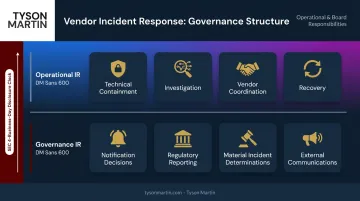
Two distinct layers:
- Operational IR — Security team's job: technical containment, investigation, vendor coordination, recovery
- Governance IR — Executive and board responsibility: notification decisions, regulatory reporting, material incident determinations, and external communications
The board cannot delegate accountability for oversight of material risk and disclosure posture.
Before an incident, the framework needs pre-defined communication protocols with Tier 1 and Tier 2 vendors, clear internal escalation chains, and documented criteria for board notification. The SEC's 4-business-day disclosure clock starts running from the moment an incident is determined material — not from when the board is finally briefed.
Decision Rights: What the Board Oversees vs. What Management Executes
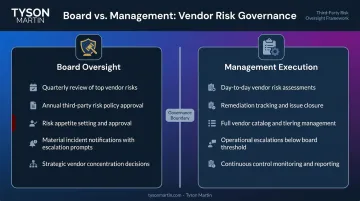
The board's role is oversight, not operations. That distinction has to be written into the framework explicitly — because both failure modes are common.
What board-level oversight looks like in practice:
- Reviewing the 5–10 highest-risk vendor relationships quarterly, in plain-language posture terms
- Approving the vendor cybersecurity governance policy annually
- Approving risk appetite for third-party relationships, expressed as specific thresholds tied to data exposure, operational dependency, and regulatory impact
- Receiving material incident notifications with clear decision prompts — not raw technical findings
What stays in management's lane:
- Day-to-day vendor assessments and questionnaire management
- Remediation tracking and continuous monitoring
- The full vendor catalog — boards review the critical tier, not the entire inventory
- Operational escalation decisions below the board notification threshold
Structuring Board Reporting
The right board report fits in one page or two to four slides. It includes:
- Risk posture by tier — how many critical vendors are out of tolerance, and what changed since last quarter
- Trend direction — improving, stable, or deteriorating, with brief reasoning
- Concentration risk — top vendors by business impact and dependency
- Decisions requested — one to three items, with options, cost ranges, and a recommended path
A 40-slide deck of security metrics that produces no decision isn't governance reporting — it's compliance theater that trains boards to disengage.
The cost of poor reporting structure isn't theoretical. The NYDFS consent order against OneMain Financial resulted in a $4.25M penalty for failures that included inadequate written policies and due diligence over third-party service provider cybersecurity. The SEC order against Morgan Stanley Smith Barney resulted in a $35M penalty tied to vendor oversight and data disposal governance failures. Neither was primarily a technical failure — both were governance failures.
Getting the Framework Built Quickly
Organizations in transition — new leadership, post-incident recovery, or mid-M&A — often lack the internal bandwidth to design board-management boundaries on a compressed timeline. A board advisor or interim CISO engagement can establish decision rights, escalation thresholds, and reporting formats within a defined 30-to-90-day window.
Owners and formats can be in place before the next board cycle. Regulatory reviews and board audits don't pause for 18-month program builds.
Building the Framework: A Practical Step-by-Step Approach
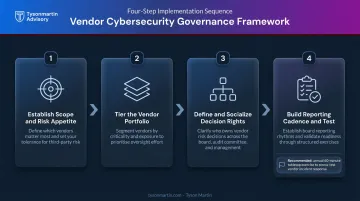
Step 1: Establish Governance Scope and Risk Appetite
Start by defining scope and risk appetite — not by building controls. The scope question is: which vendor relationships fall under formal governance? The risk appetite question is: what will the organization tolerate for third-party cyber exposure?
Risk appetite must be expressed in business terms. Not abstract risk scores — thresholds tied to downtime hours, data exposure types, financial impact, and regulatory consequences. One useful definition to anchor the discussion: "A critical vendor is any third party whose failure could materially disrupt a core business service, expose sensitive data, or create a major compliance or financial impact."
Risk appetite requires board approval to give the rest of the framework authority. One working session can produce a draft; refine from there.
Step 2: Tier the Vendor Portfolio and Assign Governance Intensity
Practical tiering requires:
- Inventory all vendor relationships — including shadow IT and fourth parties for Tier 1 vendors
- Apply documented criteria — production access, data sensitivity, concentration risk, regulatory exposure
- Map governance intensity to tier — Tier 1 vendors get frequent reassessments, contractual audit rights, and stricter escalation thresholds; Tier 3 vendors get automated scanning and lighter compliance checks
Tiering is a living document. Update it when vendor relationships change scope, when new business processes create dependency, or when a vendor acquisition alters their subprocessor chain.
Step 3: Define and Socialize Decision Rights Across Functions
Decision rights fail when they live only in the CISO's team. Procurement, legal, security, compliance, and business unit leadership all need to understand:
- What decisions they own
- What they must escalate and to whom
- What documentation is required for each decision type
A governance framework breaks down the moment procurement signs a vendor contract before security review, or a business unit onboards a SaaS tool outside the intake process. Cross-functional alignment is what makes governance real. Without it, the framework exists on paper only.
Step 4: Build Reporting Cadence and Test the Framework
Establish three reporting layers:
- Quarterly — board or committee view: top vendor risks, trends, and decisions needed
- Monthly — executive view: remediation progress, renewals, open exceptions
- Event-driven — immediate escalation for Tier 1 vendor incidents, material control failures, or critical vendor outages
Then test the framework before it's needed. A 60-minute tabletop exercise simulating a Tier 1 vendor incident reveals the same gaps: unclear shutdown authority, no pre-drafted customer communications, vague breach notification timelines in contracts, and confusion about who speaks to regulators. Document what the exercise exposes, assign owners to each gap, and update the framework before the next renewal cycle — not after an actual incident forces the issue.
Making the Framework Inspectable: Metrics and Reporting That Hold Up
"Inspectable" means a regulator or auditor can sit down with your documentation and see how decisions were made, risks were accepted, escalations were handled, and the board was kept informed — with evidence for each.
Three categories of evidence that make a framework inspectable:
- Governance documents — vendor tiering policy, decision rights structure, escalation thresholds, risk appetite statement
- Operational records — assessment logs, risk acceptance approvals with time limits and named owners, exception tracking, incident reports
- Board records — meeting minutes showing vendor risk was reviewed, approval of risk appetite statements, documentation of material decisions
The NYDFS OneMain order and the SEC's R.R. Donnelley order ($2.125M penalty) both cited governance and control failures: inadequate documentation, insufficient escalation, and deficient oversight of vendor-handled functions. Not just technical vulnerabilities. Regulators are examining the governance layer directly.
Board-Level Metrics vs. Operational Metrics
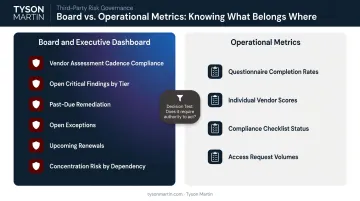
Board and executive dashboard (8–12 metrics maximum):
- Percentage of Tier 1 and Tier 2 vendors assessed within required cadence
- Number of open critical findings by tier, with trend over 3–4 quarters
- Vendors past due on remediation commitments
- Exceptions granted and still open (especially those without expiry dates)
- Critical vendor renewals within 90 days
- Concentration risk: top 5 vendors by business dependency
Operational metrics that belong in the security team's workflow:
- Raw questionnaire completion rates
- Individual vendor security scores without business context
- Granular compliance checklist status
- Vendor access request volumes
The test for any metric: if it goes red, does someone with authority have to act? If the answer is no, it belongs in operational reporting, not the board dashboard.
This is the inspectability gap most organizations discover under pressure: the documentation existed, but the architecture for demonstrating governance — plain-English posture briefings, clear decision prompts, traceable approval records — was never built. Regulators do not wait for you to reconstruct the paper trail. The time to build it is before the inquiry arrives.
2026 Regulatory and Threat Landscape
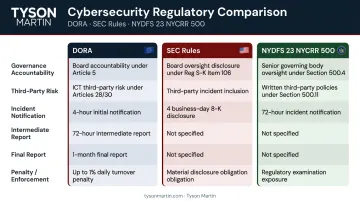
Three regulatory frameworks now impose documented vendor governance with board-level accountability:
DORA (EU financial institutions — effective January 2025):
- Article 5 requires the management body to define, approve, oversee, and be personally responsible for the ICT risk management framework
- Article 28 and 30 require sound management of ICT third-party risk, with contractual audit rights, exit strategies, and assistance obligations
- Incident reporting: initial notification within 4 hours of classifying a major ICT-related incident; intermediate report within 72 hours; final report within one month
- Penalties for critical ICT third-party providers: up to 1% of average daily worldwide turnover
SEC Cybersecurity Disclosure Rules (public companies):
- Item 1.05 Form 8-K requires disclosure within 4 business days of determining a cybersecurity incident is material — including incidents caused by third-party service providers
- Regulation S-K Item 106 requires disclosure of board oversight of cybersecurity risks and processes for managing risks from third-party providers
- The board notification process must be functional before an incident occurs — not assembled during one
NYDFS 23 NYCRR 500 (NY-regulated financial firms):
- Section 500.4 requires the senior governing body to exercise oversight of cybersecurity risk management; CISO must report in writing at least annually to the board
- Section 500.11 requires written policies and procedures for third-party due diligence and minimum cybersecurity practices
- DFS notification required within 72 hours of determining an incident occurred at the covered entity, affiliate, or third-party service provider
AI Vendors Require Explicit Governance Treatment
Traditional security questionnaires miss the governance-level risks that AI vendors introduce:
- Data governance — whether the vendor uses your data for model training beyond the contracted use case
- Model drift — AI systems can change behavior without a traditional "deployment," making point-in-time assessments insufficient
- Decision accountability — opaque model logic creates regulatory exposure when AI outputs affect customers
- Concentration risk — a single AI provider may support multiple critical workflows simultaneously
NIST AI 600-1 and the US Treasury's 2024 AI cybersecurity report both identify these risks explicitly. Default AI vendors to Tier 1 or Tier 2 classification until their risk profile is proven otherwise — and require contract terms that address AI-specific incident notice, model documentation, and data use limitations.
These AI-specific governance gaps don't exist in isolation. The broader supply-chain threat environment has shifted in ways that make every vendor relationship — AI or otherwise — a potential attack vector.
The Threat Landscape Is No Longer Static
Verizon's 2024 DBIR found supply-chain interconnection in 15% of breaches, representing a 68% year-over-year increase. Supply-chain attacks have shifted from opportunistic to deliberate — threat actors compromising vendors specifically to reach downstream organizations across multiple targets simultaneously (MOVEit, 3CX, the Snowflake credential campaign).
Vendor governance cannot run on a fixed calendar alone. Build trigger-based reassessment protocols that activate on any of the following:
- A vendor reports a breach or security incident
- External scanning identifies a new exposure in their environment
- Threat intelligence flags the vendor's software stack as actively targeted
Frequently Asked Questions
What should a vendor cybersecurity governance framework include?
A complete framework covers five components: vendor inventory and tiering policy, decision rights structure, risk acceptance and escalation thresholds, contractual security standards mapped to vendor tier, and vendor incident response integration. The distinguishing element is the governance layer — who owns decisions and how the organization demonstrates accountability to regulators.
How is vendor cybersecurity governance different from vendor risk management?
VRM is the operational process of assessing and monitoring vendors. A governance framework defines who owns risk decisions, what escalates to the board, and how the organization demonstrates accountability under regulatory scrutiny. Governance is what makes VRM defensible when an incident or audit actually tests it.
What role should the board play in vendor cybersecurity governance?
The board approves risk appetite for third-party relationships, receives plain-language posture reports on the highest-risk vendors, and makes material decisions such as approving time-bound exceptions or authorizing vendor exits. Meaningful oversight comes through clear information and explicit decision prompts — not operational involvement.
What regulations in 2026 require vendor cybersecurity governance?
DORA (EU financial institutions) requires board-level accountability for ICT third-party risk management. The SEC's cybersecurity disclosure rules (public companies) require disclosure of board oversight processes, including third-party risks. NYDFS 23 NYCRR 500 (NY-regulated financial firms) requires senior governing body oversight and written third-party due diligence policies.
How often should a vendor cybersecurity governance framework be reviewed?
Annual policy review is the minimum, with trigger-based updates when the vendor portfolio shifts materially, a significant incident occurs, new regulations take effect, or leadership changes. The framework should also be tested through tabletop exercises, not just reviewed on paper, at least once a year.
How do you tier vendors for governance purposes?
Tiering uses four criteria: business criticality, data sensitivity, operational dependency (how replaceable the vendor is), and regulatory exposure. Tier assignment drives governance intensity — assessment cadence, contractual requirements, and escalation thresholds — not just the depth of initial assessment.