Introduction
Threat actors increasingly target third parties as the path of least resistance into enterprise systems. According to the 2025 Verizon Data Breach Investigations Report, third-party involvement was identified in 30% of all analyzed breaches — roughly double the prior year's figure. Boards and security teams have reason to pay close attention.
The governance gap isn't awareness. Most organizations have vendor contracts. Few have a functioning framework that enforces security expectations beyond initial onboarding.
Signing a contract and having control over vendor security are two very different things. Regulators, examiners, and boards are increasingly examining that distinction when something goes wrong.
What follows covers what a vendor governance framework actually requires, how to build one that holds under pressure, and what meaningful board oversight looks like in practice.
Key Takeaways
- A vendor governance framework turns a signed contract into continuous security assurance across the full vendor lifecycle.
- Risk tiering is the foundation: concentrate intensive oversight on vendors with access to sensitive data or critical systems; keep low-risk processes proportionate.
- Security requirements (SOC 2 reviews, breach notification timelines, right-to-audit, data destruction) must be written into contracts, not left to verbal agreement.
- Boards need trend-based metrics showing what changed since last quarter, not raw technical findings.
What Is a Vendor Governance Framework (and Why It's Not Optional)
A vendor governance framework is the structured system of policies, processes, and controls that organizations use to manage third-party relationships from selection through exit — with continuous oversight of security posture, compliance obligations, and performance standards.
The security stakes are concrete. Vendors often carry broad access to enterprise systems, customer data, and financial infrastructure — frequently with weaker internal controls than the organizations they serve.
Research from Ponemon Institute found that 70% of third-party breaches resulted from giving too much privileged access to third parties, and 48% of organizations didn't have a comprehensive inventory of all third parties with network access.
Governance vs. Vendor Management
These two things get conflated constantly, and the distinction matters.
- Vendor management covers day-to-day relationship operations: renewals, service delivery, invoices, escalations.
- Vendor governance is the control architecture that determines whether security expectations are actually being met — continuously, not just at contract signing.
Governance is what regulators and boards examine when something goes wrong. FFIEC examination procedures specifically direct examiners to evaluate whether management oversees information security controls over outsourced operations. The OCC's Interagency Guidance on Third-Party Relationships (2023-17) formalizes this expectation across the relationship lifecycle.
That regulatory expectation points to a practical design question: what does effective governance actually require? The answer starts with decisions, not frameworks. Before designing any reporting or assessment process, organizations should identify what decisions the board owns — risk appetite thresholds, vendor exit decisions, exception approvals — then build governance around those decision points. Deploying a GRC template skips that step entirely.
Key Components of a Security-Focused Vendor Governance Framework
Vendor Risk Classification and Tiering
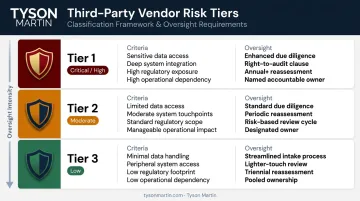
Not all vendors deserve the same oversight intensity. Risk tiering classifies vendors — typically into critical/high (Tier 1), moderate (Tier 2), and low (Tier 3) — based on:
- Access to sensitive data or regulated information
- Depth of system integration
- Regulatory exposure (HIPAA, PCI, SOX)
- Operational dependency — what stops if this vendor fails
Contract value alone is a poor proxy for risk. A small SaaS vendor with access to HR data and SSO integration can carry more risk than a large facilities provider.
Tier 1 oversight in practice:
- Enhanced due diligence before access is granted
- Formal security review sign-off as a prerequisite
- Right-to-audit provisions in contracts
- More frequent reassessments (annually at minimum, triggered by material changes)
- Named internal owner for the relationship
Tier 3 vendors follow a lighter-touch intake — proportionate, not absent. The goal is concentrating scrutiny where exposure is highest, not creating uniform maximum-effort reviews that exhaust the security team and dilute focus on what matters.
Security Due Diligence and Ongoing Assessment
A security-focused due diligence process must include:
- Vendor security questionnaires mapped to your risk tier requirements
- SOC 2 Type II reports (not just Type I)
- Penetration test summaries or evidence of regular testing
- Relevant certifications — ISO 27001
- Documented incident response plans
Regulatory guidance is direct here. FFIEC, HIPAA Business Associate requirements, and NIST SP 800-161 each specify due diligence obligations. PCI DSS v4.0.1 Requirement 12.8.4 sets a floor: monitor TPSP compliance status at least once every 12 months.
Due diligence is not a one-time gate. Assessments must repeat on a cadence appropriate to vendor tier and trigger automatically on material changes: new service scope, ownership changes, reported breaches, new subcontractors. Calendar-only review cycles miss the events that actually change a vendor's risk profile.
Contract Security Requirements and Enforcement
Contracts are the enforcement mechanism. If a security requirement isn't in the contract, it isn't enforceable. Organizations regularly discover that protections they assumed were in place simply aren't — or are too vague to enforce.
Common gaps include: notification timelines that say "reasonable time" instead of specific hours, missing audit rights, no subcontractor flow-down requirements, and data destruction obligations that are vague or absent.
Essential contract security provisions:
| Provision | What "Good" Looks Like |
|---|---|
| Breach notification | Specific SLA window — hours, not "promptly" |
| Right-to-audit | Explicit right or evidence-cooperation language |
| Data handling/destruction | Defined obligations at contract end |
| Required certifications | SOC 2, ISO 27001, or equivalent maintained throughout |
| Subcontractor controls | Approval requirements and flow-down provisions |
| Liability/indemnification | Tied to specific security failure scenarios |
The SEC's Regulation S-P final rule reinforces this: service providers must notify covered institutions no later than 72 hours after becoming aware of a breach. That standard belongs in contracts, not just in regulatory filings.
Continuous Monitoring and Escalation
Governance collapses when monitoring ends at contract signing. The numbers are stark: 59% of organizations do not monitor third parties with access to sensitive information, and 46% remain unaware for three to fourteen days or more when a critical vulnerability affects a vendor.
Continuous oversight means:
- Tracking certification currency and renewal status
- Monitoring for vendor-side security events or ownership changes
- Conducting scheduled reviews tied to risk tier
- Surfacing material changes before they become incidents
When a vendor security event occurs, the governance framework should answer these questions before an incident ever happens:
- Who gets notified, and within what timeframe?
- Who can approve containment actions that may disrupt operations?
- When does outside counsel get engaged?
- Who owns customer communications?
- What does the board chair need in the first update?
Pre-defined thresholds and communication protocols are what separate a four-hour response from a four-day one. Without them, every vendor event starts with a meeting to decide who's in charge.
Documentation and Audit Readiness
Governance evidence must be a continuous byproduct of normal operations, not a reconstruction before an audit.
What examiners and boards look for:
- Complete vendor inventory with risk tier, access type, data touched, and last review date
- Documented approval decisions and security review sign-offs
- Maintained contract versions with security provisions intact
- Exception log with dates, owners, and expiration terms
- Evidence that controls work — not just that policies exist
The most common failure isn't missing documentation — it's documentation that proves a process exists but can't show it produced a result. That distinction matters when examiners or the board ask whether a critical vendor can actually restore a database within your recovery window.
The Vendor Governance Process: A Step-by-Step Security Approach
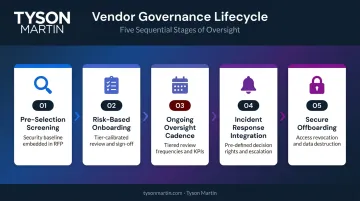
Step 1 — Pre-Selection Security Screening
Define minimum security baseline requirements before engaging any vendor. Security questionnaires belong in the RFP process, not after access has been discussed. Disqualifying vendors who can't demonstrate adequate controls before engagement begins is far less expensive than remediating access after.
Step 2 — Risk-Based Onboarding
Use tier classification to calibrate onboarding depth. Tier 1 vendors require documented security reviews, data flow mapping, and formal sign-off before any system access. Tier 3 vendors follow a streamlined workflow. The process should be proportionate, not uniform — uniform maximum scrutiny creates governance fatigue and makes the program unsustainable.
Step 3 — Establishing an Ongoing Oversight Cadence
Cadence is where most programs quietly collapse. Build the rhythm in from the start:
- Set review frequencies by risk tier, not convenience
- Assign a named internal owner for each vendor relationship
- Define security-specific KPIs — not just service delivery metrics
- Schedule monthly operating reviews for Tier 1 and Tier 2 vendors
- Feed quarterly board-ready reporting from those reviews, not ad hoc summaries
Step 4 — Incident Response Integration
Pre-defined decision rights determine whether organizations respond in hours or days. When a vendor event occurs, the governance framework should eliminate ambiguity: who can authorize containment, who speaks externally, and what the board chair receives in the first update. Every vendor contract should include breach notification windows measured in hours, not "reasonable time."
Step 5 — Secure Offboarding
Vendor exits are high-risk transition points. Document processes for access revocation, data return or destruction, and system deprovisioning. For critical vendors, test offboarding plans before they're needed. Exit provisions belong in every contract from day one. The organizations that get this wrong aren't caught off-guard by bad vendors — they're caught off-guard by their own missing paperwork.
Security Best Practices for Vendor Governance
Apply risk-tiered oversight proportionally. Uniform maximum scrutiny across all vendors creates governance fatigue, dilutes focus, and makes the program unsustainable. Concentrate intensive oversight where exposure is highest. A "critical vendor" list of 120 vendors isn't a tier — it's a catalog. Effective programs typically keep the Tier 1 list to 10–30 vendors for meaningful board visibility.
Align governance with applicable regulatory frameworks. Organizations in regulated industries must map vendor governance practices to relevant compliance regimes:
- HIPAA — vendors handling protected health information require Business Associate Agreements with specific safeguards, breach reporting, and PHI destruction obligations
- PCI DSS v4.0.1 — requires written acknowledgments of TPSP responsibility and annual compliance status monitoring
- FFIEC/OCC — examines third-party oversight practices as a direct examination issue, not just a policy topic
- SOX — vendors touching financial reporting systems carry disclosure implications
Enforcement data shows the stakes. HHS OCR's 2024 Annual Report includes actions tied directly to Business Associate Agreement failures — civil money penalties in the hundreds of thousands of dollars for organizations that lacked adequate vendor controls.
Integrate vendor governance into business continuity planning. Vendor failures are a leading cause of operational disruption. The July 2024 CrowdStrike event affected approximately 8.5 million Windows devices — a single technology vendor relationship creating broad operational impact. Governance frameworks should identify concentration risk — over-reliance on a single vendor for critical functions. Contracts should require business continuity provisions, and contingency plans for critical vendor outages should be tested, not just documented.

Build board-level visibility with trend-based metrics. Boards need to see what changed since the last briefing — not a point-in-time snapshot. Status reports can look clean while underlying risk accumulates.
Specific metrics that communicate trend rather than status:
- Open critical vendor issues over the past three to four quarters
- Vendors past due on remediation commitments
- Critical vendor renewals in the next 90 days
- Exceptions granted and still open (especially those without expiration dates)
- Concentration risk: which vendors could stop revenue or operations, and whether contingency plans are tested
For organizations building this capability, an independent board advisor can help establish clear decision rights, escalation thresholds, and a vendor risk dashboard structured for director-level inspection — not just management reporting.
Treat governance as a living system, not a compliance artifact. Build formal review cycles into governance policy. Establish triggers for off-cycle reassessment beyond calendar intervals:
- New integrations or expanded data access
- Privilege increases
- Vendor breach news or major outages
- Ownership or subcontractor changes
- New regulations affecting the vendor's service
- Contract renewals
Common Challenges and How to Address Them
Vendor sprawl and ungoverned relationships. According to SecurityScorecard's 2026 Supply Chain Cybersecurity Trends Report, 78% of organizations say their internal cybersecurity programs cover less than 50% of their total vendor ecosystem — including third, fourth, and fifth parties. Shadow procurement accelerates this problem: business units onboard vendors to hit operational goals without routing through IT or security.
The fix is a right-sized intake process, not a bottleneck. When shadow IT surfaces during a vendor inventory, lead with curiosity rather than blame. A simple intake path looks like this:
- Requester submits basic fields
- Security assigns a risk tier within two business days
- Approvals follow the tier — light for low-risk tools, strict for Tier 1 candidates
Keeping governance current as relationships evolve. Frameworks go stale when a low-risk vendor gains broader access to sensitive data without triggering a reassessment, or when a vendor is acquired by an entity with an unknown security posture. Calendar-only review cycles miss these changes. The solution is trigger-based reassessment — governance that adapts automatically when material changes occur, rather than waiting for the next scheduled review date.
Translating vendor risk into language boards can act on. The gap between detailed vendor findings and actionable executive reporting is where governance breaks down at the top. Directors need to see what could stop revenue or operations — not a vendor catalog with security scores.
Lead with business services, not vendor names. Then pair every out-of-tolerance vendor with a clear response path and an owner:
- Accept — document the risk and rationale
- Reduce — require remediation with a deadline
- Transfer — shift risk through contract or insurance
- Replace — exit the relationship with a timeline
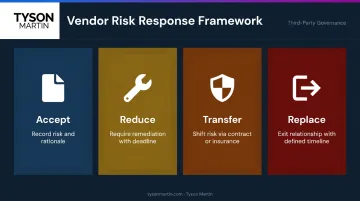
That structure turns vendor reporting from a status update into a decision tool.
Frequently Asked Questions
What are the key components of a vendor governance framework?
The core components are risk classification and tiering, security due diligence, contract enforcement, continuous monitoring, escalation protocols, and documentation. Effective frameworks apply these proportionally based on vendor risk level — intensive for Tier 1, streamlined for Tier 3.
What is the vendor governance process?
It runs from pre-selection security screening through risk-based onboarding, ongoing oversight at a cadence tied to vendor tier, incident response integration, and secure offboarding. Each stage is calibrated to vendor risk, not applied uniformly across every relationship.
How does vendor governance reduce cybersecurity risk?
Governance reduces risk by ensuring security expectations are contractually enforced, continuously monitored, and actively escalated — catching vulnerabilities before they become incidents. Without a functioning framework, vendor-related exposure typically surfaces during a breach investigation, not before it happens.
How often should vendor security assessments be conducted?
High-risk (Tier 1) vendors require annual formal reviews at minimum, with more frequent touchpoints for critical relationships. Any material change — new data access, ownership transfer, or reported breach — should trigger an off-cycle reassessment regardless of when the last review occurred.
What security requirements should be included in vendor contracts?
At minimum, contracts should specify breach notification timelines in hours (not "promptly"), right-to-audit provisions, data handling and destruction obligations, required certifications (SOC 2, ISO 27001 where applicable), subcontractor flow-down requirements, and liability language tied to security failures.
How should a board oversee vendor security governance?
Boards should receive trend-based, plain-language reporting that shows what changed since the last briefing and have defined escalation thresholds for when vendor issues require board-level decisions. The board's role is to confirm that management has a functioning governance process — not just a policy document on file.