Introduction
In March 2020, attackers injected malicious code into a routine software update from SolarWinds. By the time FireEye detected the intrusion in November 2020, the compromised update had reached nearly 18,000 customers — including nine federal agencies and approximately 100 private-sector companies. None of those downstream organizations were directly attacked. They were simply trusting a vendor.
Supply chain risk has one defining trait: the attack enters through a relationship, not through your perimeter.
This guide covers the full picture of Cyber Supply Chain Risk Management (C-SCRM):
- What it is and how it differs from related disciplines
- Why it has moved from the CISO's desk to the boardroom
- What a working program actually looks like
- How to manage vendor risk from initial vetting through offboarding
Key Takeaways
- C-SCRM = identifying and mitigating cybersecurity risks that enter through vendors, suppliers, and third-party services
- Distinct from TPRM (broader vendor risk) and ICT SCRM (technology products only)
- Supply chain attacks exploit trust relationships that bypass traditional security perimeters
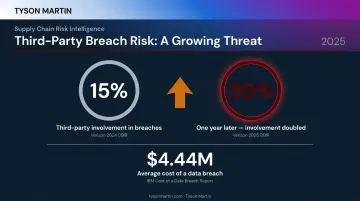
- Third-party involvement in breaches doubled from 15% to 30% in one year, per Verizon's 2025 DBIR
- NIST CSF 2.0, GDPR, HIPAA, PCI DSS, and federal law now extend cybersecurity obligations to the supply chain
- Under SEC disclosure rules, supply chain risk oversight is a board-level accountability — not just a CISO responsibility
What Is Cyber Supply Chain Risk Management (C-SCRM)?
NIST defines C-SCRM as "a systematic process for managing exposure to cybersecurity risk throughout supply chains and developing appropriate response strategies, policies, processes, and procedures." In practice, that means identifying, assessing, and mitigating the cyber risks that enter your organization through external relationships — suppliers, service providers, software vendors, hardware manufacturers — rather than through your own systems.
How C-SCRM Differs from TPRM and ICT SCRM
These three terms get conflated constantly — and conflating them leads to programs with the wrong scope and the wrong accountabilities.
| Discipline | Scope | Focus |
|---|---|---|
| TPRM (Third-Party Risk Management) | All vendor-related risks | Financial, operational, reputational, legal, and cyber |
| C-SCRM | Cyber risks from third-party relationships | Security posture, access, incident response, data handling |
| ICT SCRM | Technology products specifically | Hardware, firmware, software components |
C-SCRM sits inside the TPRM universe but narrows to cybersecurity. ICT SCRM sits inside C-SCRM, focused on technology products rather than the full supplier ecosystem. An organization managing its cloud providers, logistics software, and facilities vendors under a single program is practicing C-SCRM. A defense contractor evaluating the firmware in a hardware component is doing ICT SCRM work within that framework.
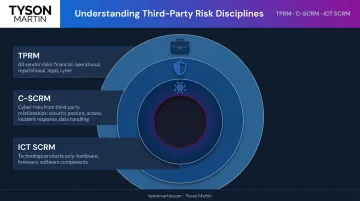
The practical implication: if your vendor risk program doesn't explicitly assess cybersecurity posture, incident response capability, and access controls, you have TPRM — not C-SCRM.
Why C-SCRM Has Become a Board-Level Priority
The Attack Logic Is Efficient
Threat actors target vendors because the math works in their favor. A mid-tier supplier often has privileged access to dozens of enterprise customer environments — with security controls that rarely match enterprise-grade hardening. One successful intrusion into that supplier can propagate downstream to hundreds of organizations simultaneously, with no direct attack required on any of them.
The SolarWinds incident illustrated this at scale. A single trojanized software update, distributed through normal update channels, compromised federal agencies including the Department of Homeland Security. The organizations that were breached had done nothing wrong. Their vendor had.
The Verizon 2025 Data Breach Investigations Report documents the trend in hard numbers: third-party involvement in breaches doubled from 15% to 30% in a single year. That is not a gradual drift. It is a structural shift in how attackers operate.
The Financial and Regulatory Stakes
The average cost of a data breach reached $4.44 million globally in 2025, according to IBM's Cost of a Data Breach Report. Supply chain breaches carry compounding costs that standard breaches do not: simultaneous downstream impact across multiple organizations, coordinated regulatory scrutiny, and contractual liability exposure that can extend for years.
Beyond direct financial damage, the governance accountability gap has become a legal exposure. The SEC's cybersecurity disclosure rules (effective September 5, 2023) now require public companies to:
Beyond direct financial damage, the governance accountability gap has become a legal exposure. The SEC's cybersecurity disclosure rules (effective September 5, 2023) now impose three concrete obligations on public companies:
- Disclose material cybersecurity incidents within four business days
- Describe board oversight of cybersecurity risk in annual filings
- Detail oversight processes under Regulation S-K Item 106(c)
That creates a concrete problem: most boards cannot describe their supply chain risk oversight because they have no structured visibility into it. Without stable metrics and clear reporting, directors are making attestations they cannot support.
The C-SCRM Lifecycle: Four Stages Every Organization Needs
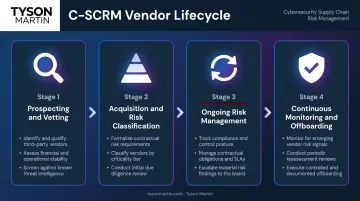
C-SCRM is not a one-time audit. It is a continuous process that covers a vendor relationship from initial vetting through offboarding. NIST CSF 2.0 subcategories GV.SC-07 and GV.SC-09 require that supplier risks be assessed and monitored across the full technology product and service lifecycle — not evaluated once and filed.
Stage 1: Prospecting and Vetting
Before a contract is signed, prospective suppliers should be screened against minimum security baselines. This is where most organizations skip crucial risk identification — and where problems become far more expensive to fix.
Pre-onboarding vetting should assess:
- Security certifications and audit reports (SOC 2, ISO 27001)
- Incident history and breach disclosure practices
- Sub-processor and fourth-party dependencies
- Alignment with applicable regulatory requirements
Stage 2: Acquisition and Risk Classification
Once onboarded, each supplier should be formally classified into a risk tier. The tier determines how much oversight that vendor receives going forward. Common classification factors include:
- Access to sensitive or regulated data
- Integration depth with critical systems
- Business impact if the vendor is unavailable
- Regulatory scope (does this vendor touch cardholder data, PHI, or federal systems?)
A practical model keeps the critical vendor list small — typically 10 to 30 vendors — so that oversight resources stay focused where exposure is highest.
Stage 3: Ongoing Risk Management
High-risk and critical vendors warrant regular formal assessments, not a single annual review. Each assessment should cover:
- Current security posture and any material changes
- Regulatory alignment and compliance status
- Incident response capability
- Changes to the vendor's own supply chain
A vendor that was low-risk at onboarding can become high-risk after an acquisition, a major breach, or a shift in the services they provide.
Stage 4: Continuous Monitoring and Offboarding
Real-time or near-real-time monitoring of vendor security posture is the operational backbone of a mature program for suppliers with access to sensitive systems.
Offboarding is just as critical, and routinely neglected. When a vendor relationship ends:
- Revoke all access credentials immediately
- Confirm data destruction or return per contractual terms
- Document the offboarding in your vendor inventory
- Verify no residual integrations remain active
NIST CSF 2.0 GV.SC-10 specifically requires that C-SCRM plans include provisions for activities after a partnership concludes.
Key Components of an Effective C-SCRM Program
An effective program requires several coordinated elements working together. The absence of any one creates gaps that can be exploited — or that will surface as audit findings.
Supply Chain Inventory and Mapping
You cannot manage risks you cannot see. Building a current, comprehensive vendor inventory is the foundation of everything else.
A complete inventory pulls from multiple sources: accounts payable, corporate card spend, SSO app catalogs, procurement contracts, IT tickets, and department-level tools. Each entry should capture:
- Vendor name and business owner
- Renewal date and access type
- Data types handled and hosting region
- Active integrations and known subcontractors
For large organizations, maintaining this inventory without automation or structured oversight processes is nearly impossible. Fourth-party visibility — knowing who your vendors' vendors are — matters too, particularly for critical service dependencies.
Risk Tiering and Supplier Classification
Three practical questions drive tiering:
- Does this vendor have production access or admin rights?
- Do they store or process sensitive, regulated, or payment data?
- Would their outage stop revenue, service delivery, or compliance?
Affirmative answers to any of these push a vendor into the critical or high tier. The goal is a manageable list of vendors receiving rigorous oversight — not a spreadsheet where every SaaS subscription receives the same treatment as a cloud infrastructure provider.
Contractual Security Controls
Contracts are an enforcement mechanism, not a formality. Supplier agreements for high-risk and critical vendors must include:
- Incident notification timelines — measured in hours, not "reasonable time"
- Right-to-audit provisions with defined evidence access
- Subprocessor transparency requirements
- Secure development and configuration standards
- Remediation deadlines for identified gaps
- Alignment with applicable regulatory standards
Without these terms, organizations have limited recourse when a vendor's security posture deteriorates between reviews.
Governance, Decision Rights, and Accountability
C-SCRM fails when no one clearly owns it. Effective programs define who has decision-making authority at the operational, CISO, and board levels — including escalation thresholds that trigger executive or board action.
A practical escalation structure uses two levels:
- Amber triggers: Worsening trend over two review cycles, a near miss, or a rising exception count
- Red triggers: Threshold breach, repeat breach, or an exception expiring without closure
For organizations in leadership transition or without a full-time CISO, interim CISO leadership can establish this governance structure quickly. Tyson Martin's interim CISO engagements typically deliver a third-party risk management process and board-ready vendor reporting within the first 60 days. That includes risk tiering, escalation thresholds, and a one-page vendor scorecard covering service criticality, data access, inherent risk, residual risk, and open actions with named owners.
Incident Response Integration for Supply Chain Events
Supply chain incidents differ from standard internal breaches. They may affect multiple organizations simultaneously and require coordinated disclosure across parties who may have conflicting interests.
That coordination requires planning well before an event occurs. Pre-defined joint incident response plans with critical vendors should address:
- Communication protocols and defined notification timelines
- Containment procedures that both parties can execute
- Recovery workflows and recovery time objectives
- Coordination with legal counsel and cyber insurance carriers
These plans should be tested through tabletop exercises before an incident occurs — not read for the first time during one.
Regulatory Requirements That Make C-SCRM Mandatory
Regulated organizations face supply chain cybersecurity obligations across multiple overlapping frameworks and laws — and the requirements are getting more specific, not less.
NIST Frameworks
NIST CSF 2.0 includes a dedicated "Govern" function with ten subcategories (GV.SC-01 through GV.SC-10) specifically addressing C-SCRM. These cover strategy, roles and responsibilities, supplier criticality, contractual requirements, pre-relationship due diligence, ongoing monitoring, incident integration, and post-relationship obligations.
NIST SP 800-161r1 (published May 2022) provides more detailed operational guidance, particularly for government agencies and federal contractors. Federal agencies are required to use NIST C-SCRM standards to protect non-national-security federal information infrastructure.
Those standards set the floor. Industry-specific regulations build further obligations on top of them.
Industry Regulations
| Regulation | Supply Chain Obligation |
|---|---|
| GDPR (Articles 28, 32) | Controllers must use only processors providing sufficient guarantees; sub-processing requires controller authorization; security measures must extend to the processing chain |
| HIPAA | Covered entities must obtain Business Associate Agreements before sharing PHI; the Security Rule applies to both covered entities and their business associates |
| PCI DSS v4.0.1 | Requirement 12.8 requires maintaining a TPSP inventory, conducting due diligence, monitoring compliance at least annually, and tracking which PCI DSS requirements are managed by each TPSP |
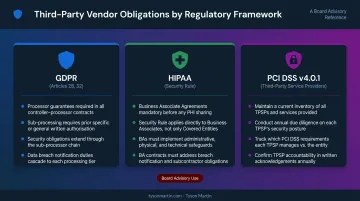
Federal law adds another layer of mandates, particularly for contractors and agencies handling sensitive government systems.
Federal and Legislative Mandates
- FASCSA (2018): Established the Federal Acquisition Security Council; FAR 52.204-30 requires contractors to review SAM.gov for exclusion orders before proposing covered articles or services
- Executive Order 13873: Authorizes action on ICTS transactions involving foreign adversaries posing risks to national security or critical infrastructure
- FISMA / OMB M-25-04: Federal agencies must report C-SCRM performance through quarterly and annual reporting; CISA's FY 2025 IG FISMA Metrics include a dedicated C-SCRM table
- CMMC 2.0 Level 3: Defense contractors must develop and annually update a supply chain risk management plan — and that plan must cover both organizational systems and components
How Executives and Boards Can Get C-SCRM Started
Step 1: Build Visibility Before Buying Tools
The first practical step is auditing what you have. Pull vendor names from accounts payable, IT procurement, corporate card spend, and SSO catalogs. Build a single consolidated list showing who has access to what — without that foundation, every subsequent governance decision operates with blind spots.
Prioritize the inventory by data access and service criticality. The goal isn't completeness on day one; it's identifying the 10 to 30 vendors whose failure or compromise would cause the most damage.
Step 2: Establish Governance Before Tools
Define who owns C-SCRM at the CISO and executive level before selecting any vendor management platform. Establish:
- What metrics will be reported to the board (trend, not trivia)
- What thresholds trigger escalation to executive or board level
- Who can approve exceptions, and for how long
A stable quarterly board view covering top vendor risks, key trends, and decisions needed — supported by monthly management reporting tracking remediation progress — gives leadership the visibility required for defensible decision-making under SEC disclosure requirements.
Step 3: Consider Interim CISO Support for Governance Gaps
When internal capacity is thin or leadership is in transition, a fractional or interim CISO can design and launch a C-SCRM program without waiting for a permanent hire.
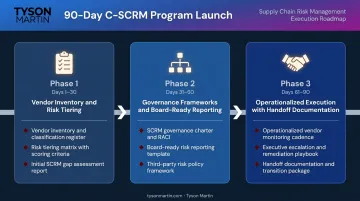
A typical 90-day engagement follows a structured sequence:
- Days 1–30: Vendor inventory and risk tiering
- Days 31–60: Governance frameworks and board-ready reporting
- Days 61–90: Operationalized execution with handoff documentation
The deliverable that matters is a working set of decision rights, escalation thresholds, and stable metrics — something the board can inspect and management can act on without constant oversight.
Frequently Asked Questions
What are the five elements of cyber risk management?
The traditional five-element framing maps to the pre-CSF-2.0 NIST functions: Identify, Protect, Detect, Respond, and Recover. NIST CSF 2.0 added a sixth — Govern — which addresses strategy, roles, and supply chain oversight. If your organization references the five-function model, note that governance is now a distinct, foundational layer.
What is the difference between C-SCRM and third-party risk management (TPRM)?
TPRM addresses the full range of vendor-related risks — financial, operational, reputational, legal, and cyber. C-SCRM is specifically focused on the cybersecurity risks introduced through third-party relationships, making it a specialized discipline within the broader TPRM framework.
Which regulations require a formal C-SCRM program?
NIST CSF 2.0, NIST SP 800-161, FISMA, GDPR, HIPAA, and PCI DSS all include supply chain cybersecurity obligations. Federal contractors and defense contractors face additional mandatory requirements under FASCSA, DFARS 252.204-7012, and CMMC 2.0 Level 3.
How do organizations determine which vendors are high-risk?
Organizations assign vendor risk tier based on data sensitivity, depth of system integration, regulatory scope, and business impact if the vendor were compromised. Vendors with production access, regulated data, or business-critical service dependencies belong in the critical or high tier.
What role should the board play in cyber supply chain risk management?
The board's role is oversight, not operations. Directors should review supply chain risk trends in board-ready reporting, approve risk appetite thresholds, and ensure the CISO has the authority and resources to act. SEC disclosure rules require boards to describe their oversight processes — which demands structured, consistent visibility, not one-time briefings.
How often should supply chain risk assessments be performed?
Assessment frequency should match vendor risk tier. Critical and high-risk vendors warrant quarterly reviews — or reassessment after major changes such as acquisitions, incidents, or service shifts — with continuous monitoring layered on top. Lower-risk vendors may be assessed annually.