Introduction
Picture this: a single-source microcontroller your product line depends on just received an end-of-life notice, and a key fabrication region is facing export restrictions. Procurement wants to expedite. Engineering says a redesign will take six months. Operations is absorbing the delay. Nobody owns the call.
This scenario plays out regularly in electronics companies — not because teams lack information, but because no one has defined who decides.
Supply chain risk in electronics has become a governance problem. Boards and executive teams face increasing accountability for supply chain resilience, yet most lack the structured frameworks to assess, escalate, and act on risks before they become production crises.
The technical complexity of electronics supply chains — layered supplier tiers, long component lead times, rapid obsolescence — gives leadership plausible cover to stay out of it. That cover disappears the moment a disruption halts revenue.
This playbook provides a practical framework for electronics executives and boards to identify concentrated risks, structure assessments, match mitigations to specific risk types, and close the governance gap that turns identified risks into delayed decisions.
Key Takeaways
- Electronics supply chains face concentrated, multi-layered risks that require governance fixes, not just operational ones
- Effective risk management requires mapping dependencies beyond tier-one suppliers to uncover hidden single points of failure
- Tiered supplier assessment (high/medium/low) focuses resources where failure would hurt most
- Mitigation strategies must match the risk type — dual sourcing, safety stock, contract controls, and scenario planning serve different purposes
- Clear escalation thresholds and defined decision rights turn risk data into board-level action
Why Electronics Supply Chains Are Uniquely Exposed
Electronics supply chains carry structural fragility that most other industries don't face. Three specific characteristics explain why.
Geographic Concentration Is Extreme
The numbers are stark. According to a USITC working paper, Taiwan held 92% of global manufacturing capacity for advanced semiconductors (sub-10nm nodes), while Taiwan, South Korea, China, and Japan collectively controlled 75% of global wafer fabrication capacity. Four Taiwanese firms alone accounted for nearly 69% of global foundry revenue.
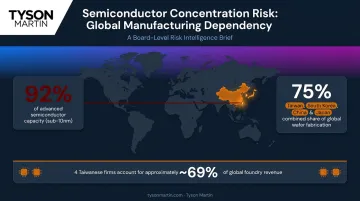
No other manufacturing sector has this level of single-region concentration for a critical input. When geopolitical risk, natural disaster, or export restrictions affect that region, there is no quick pivot.
Component Lifecycles Create Constant Pressure
Electronics moves fast. IHS Markit data shows the average electronic component lifecycle is roughly 10 years, with 15 end-of-life notices and 38 semiconductor product change notifications issued every single day. That cadence means product teams are perpetually managing obsolescence — and point-in-time risk assessments can't keep pace.
That obsolescence pressure feeds directly into counterfeiting risk. IHS Markit also reported that 71% of counterfeit component reports since 2013 involved discontinued, NRND, or EOL parts. When a component goes end-of-life, the counterfeit exposure rises sharply.
Cyber-Physical Risk Enters Through Procurement
Most organizations treat cybersecurity as an IT perimeter problem. In electronics, it enters through the supply chain itself. Between 2013 and 2022, a single operation trafficked tens of thousands of counterfeit Cisco networking devices generating over $100 million in fraudulent revenue, according to DOJ court records. Affected organizations included hospitals, schools, government agencies, and military users. Devices failed in production and posed direct safety and national security risks.
The attack surface here isn't a firewall. It's a purchase order. Counterfeit components, compromised firmware in supplier-sourced hardware, and software supply chain attacks all enter through procurement — not the IT perimeter.
Counterfeit components, compromised firmware in supplier-sourced hardware, and software supply chain attacks don't come through firewalls. They come through purchase orders.
The Five Risk Categories Every Electronics Executive Must Track
Without a shared taxonomy, risk conversations stall on terminology rather than action. Boards, procurement, and operations need consistent language to assess, prioritize, and escalate across the same framework.
Supply-Side and Component Risk
This covers unavailability, obsolescence, or quality degradation in critical components. Single-source concentration is the highest-severity variant — when one supplier makes one critical part and that supplier experiences any disruption, the impact is immediate and often uncorrectable in the short term.
Alternate qualification must happen before shortages occur, not during them. Component qualification testing under JEDEC standards can take 1,000+ hours of high-temperature operational life testing alone. Qualifying an alternate during an active shortage is almost always too slow to prevent production impact.
Geopolitical and Trade Risk
Tariffs, export controls, and sanctions can block supply or sharply raise landed costs with little notice. The scale of impact is not theoretical. Reuters reported that Lam Research warned of a $2.0–$2.5 billion revenue hit in 2023 from U.S. export curbs on high-end technology exports to China. Applied Materials estimated a separate $250–$550 million reduction in a single quarter.
BIS export controls expanded in October 2023, adding performance thresholds and extending controls to 43 additional countries beyond China and Macau. Trade policy risk requires pre-approved substitute sourcing and geographic diversification — contract flexibility alone is insufficient.
Operational and Logistics Risk
Port congestion, carrier capacity constraints, and route concentration can stop delivery even when components are available. Freight volatility data illustrates the magnitude: the composite World Container Index dropped from over $9,000 per 40-foot container in early 2022 to under $2,000 by February 2023, then spiked again with Red Sea diversions in 2024.
In regulated industries, single-carrier or single-route dependency now draws board-level disclosure scrutiny.
Cybersecurity and Integrity Risk
Counterfeit parts, tampered hardware, compromised supplier data systems, and software supply chain attacks introduced through third-party firmware or components all fall here. The counterfeit Cisco case is the clearest example: hardware failures caused customers tens of thousands of dollars in damages and created documented national security risks.
The threat entered through procurement channels, not the IT perimeter. Supplier security vetting belongs in the procurement process, not only in the IT security program.
Compliance and Environmental Risk
Two EU frameworks set the baseline for most electronics manufacturers:
- RoHS (2011/65/EU): Restricts ten substances; lead and most materials capped at 0.1% by weight, cadmium at 0.01%. Technical documentation must be retained for 10 years after market placement.
- REACH: Triggers SVHC communication duties when Candidate List substances exceed 0.1% w/w in articles.
Compliance failures routinely surface as supply chain crises. When certifications lapse or suppliers exit regulated markets without warning, shipments stop.
Building a Practical Supply Chain Risk Assessment Process
The core principle is straightforward: assess by impact and likelihood, not uniformly across every supplier and part. A tiered approach — high, medium, low — prevents organizations from exhausting resources on low-risk commodity suppliers while critical single-source components go unmonitored.
These four steps translate that principle into a repeatable process.
Step 1: Map Dependencies Beyond Tier One
Most organizations stop at their direct supplier relationships. That's a critical blind spot.
McKinsey's supply chain risk survey found that 95% of organizations had visibility into tier-one supplier risks — but only 42% had visibility into tier two or beyond. In electronics, that gap is where the real concentration risk hides. Your tier-one supplier may itself have single-source dependencies they've never disclosed.
Mapping requires asking tier-one suppliers to identify their critical sub-tier inputs, then validating that information with lifecycle monitoring tools and supplier disclosure requirements built into contracts.
Step 2: Score Risk Using Likelihood and Impact
Standard risk scoring: likelihood (probability of disruption in a 12-month window) multiplied by impact (cost, lead time, revenue, compliance consequence).
A practical illustration of why calibration matters:
| Supplier Profile | Likelihood | Impact | Score |
|---|---|---|---|
| Single-source semiconductor, Taiwan-based | High | Critical — production halt | Highest priority |
| Multi-source commodity resistor | Low | Minimal — days to substitute | Lowest priority |
| Single-source firmware vendor, no backup | Medium | High — security and redesign risk | Elevated priority |
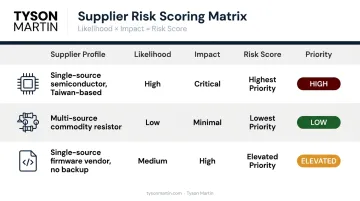
Once scored, assign a named mitigation owner to every elevated-priority supplier before moving to Step 3.
Step 3: Identify Decision Triggers and Escalation Thresholds
Risk assessment output must include pre-defined triggers: what conditions automatically escalate to senior leadership or the board, and what can be managed at the operational level.
This is where most organizations fail. Risk is identified, but decision authority is ambiguous, so action is delayed while teams debate the right level of escalation.
Define thresholds explicitly:
- Operational level: Risk identified, mitigation owner assigned, timeline set
- Executive escalation: Single-source supplier showing instability, no qualified alternate, lead times exceeding safety stock coverage
- Board escalation: Production halt risk within 90 days, regulatory exposure, or geopolitical disruption affecting >20% of component sourcing
Step 4: Reassess on a Defined Cadence
A supplier rated low-risk today can shift quickly — ownership changes, geopolitical moves, and security incidents don't wait for annual reviews.
- High-risk suppliers: Annual formal reassessment at minimum, with continuous monitoring (financial health signals, lifecycle alerts, news monitoring)
- Medium-risk suppliers: Annual assessment, triggered re-review on material change
- Low-risk suppliers: Biennial assessment unless trigger event occurs
- Trigger events: Ownership change, security incident, sanctions or export control news, EOL announcement
Mitigation Strategies That Hold When Disruption Hits
The most common failure is treating all supply chain risk as an inventory problem. Some risks require design changes, others require contract controls, and some require governance escalation. Matching mitigation to risk type is the operative principle.
Dual Sourcing and Geographic Diversification
Dual sourcing is the primary mitigation for supplier concentration risk. The requirement: approved alternates must be qualified before a disruption occurs. Qualification during a shortage is always too slow — JEDEC-based qualification testing alone can require 1,000+ hours of operational life testing, which means the timeline doesn't compress even under pressure.
Geographic diversification complements dual sourcing. Spreading critical component sourcing across two or more regions reduces exposure when one region faces disruption from trade restrictions, natural disaster, or conflict.
Strategic Safety Stock — Calibrated, Not Defaulted
Blanket safety stock across all parts is expensive and ineffective. The right approach targets deliberate buffer inventory at high-criticality, long-lead-time components.
Safety stock buys time (typically weeks to months, depending on buffer size), but it doesn't resolve the root risk. It must be paired with active alternate qualification. An organization holding 16 weeks of safety stock for a critical component while running zero alternate qualification work has delayed the problem, not solved it.
Executives should treat safety stock decisions as a risk financing choice: how much buffer is worth carrying, at what carrying cost, and for how long? That framing forces the tradeoff into the open rather than leaving it as an implicit assumption in procurement.
Contract Controls and Supplier Security Requirements
Contracts should embed supply chain risk terms that procurement can actually enforce:
- Minimum lead-time commitments with financial consequences for breach
- Dual-sourcing disclosure clauses requiring suppliers to disclose their own sub-tier dependencies
- Cybersecurity requirements for suppliers handling sensitive data, firmware, or embedded software
- Audit rights to verify component authenticity and security controls
- Software bills of materials (SBOMs) for hardware components containing firmware — NIST confirms SBOMs provide transparency, provenance, and faster vulnerability response
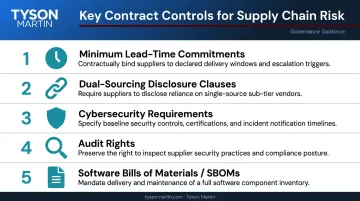
Contracts define what's expected. Scenario planning tests whether your team can actually execute when those expectations are stress-tested.
Scenario Planning and Incident Response Rehearsal
Scenario planning — simulating the loss of a key supplier or a regional disruption for four to six weeks — reveals gaps in response plans before a real event creates pressure. The goal is for the first hour of a real disruption to be execution, not deliberation.
An effective incident response protocol names:
- Decision owners for each phase of response
- Customer communication timelines and approved messaging
- Pre-approved fallback sourcing options with vendor contacts
- Escalation triggers and who gets called at each threshold
This is the structure Tyson Martin applies in tabletop exercises with boards and executive teams: cross-functional scenarios designed to surface decision gaps and stress-test escalation paths before a real event forces the issue.
Turning Risk Data Into Board-Level Decisions: Closing the Governance Gap
The governance gap in electronics supply chain risk is consistent and predictable: supply chain teams produce risk data that never reaches the board in a form that enables decisions. Boards receive status updates — "we're managing it" — rather than risk posture assessments with clear options and consequences. The technical complexity of electronics gives leadership plausible deniability to stay out of it.
What Effective Board Reporting Looks Like
Board-level supply chain risk reporting should include:
- A stable dashboard showing trend over time, not one-time snapshots — boards need to see whether risk is improving, deteriorating, or static across quarters
- A plain-English summary of the top three to five risks and what changed since the last briefing
- Clear decision items with defined options and consequences for each: not "we're monitoring," but a specific exposure summary, three options, and a direct ask for board authority
- Separation of management-owned items from board-level decisions: management handles the noise; the board sees only what requires their authority or triggers disclosure obligations
Assigning Ownership Across Functions
Clear ownership is the prerequisite for any governance structure to function. Without explicit assignment, risk data produces reports but not responses.
| Function | Owns |
|---|---|
| Procurement | Supplier base strategy, alternate sourcing qualification |
| Engineering | Design standardization, component alternate approval |
| CISO/Security | Supplier cybersecurity vetting, firmware integrity |
| CFO/Operations | Safety stock investment, logistics diversification |
| Board/Risk Committee | Risk tolerance thresholds, escalation authority, disclosure decisions |
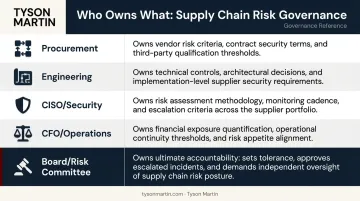
When ownership is this explicit, a disruption produces immediate escalation to the right person — not a committee debate about who should make the call.
Frequently Asked Questions
What are the biggest supply chain risks specific to electronics companies?
Component concentration (single-source suppliers for critical parts), geographic exposure in semiconductor manufacturing, rapid obsolescence pressure, and hardware-level cybersecurity risks are the primary categories. In electronics, a single missing component can halt an entire product line — a cascading failure most other industries simply don't face.
How should boards oversee supply chain risk in their organizations?
Boards should set risk tolerance thresholds, receive regular plain-English risk posture updates, and define escalation criteria that separate what management handles operationally from what requires board-level decisions or disclosure. Boards should see trend data over time, not one-time status reports.
What is the difference between supply chain risk management and third-party risk management?
Third-party risk management focuses on direct vendor relationships — data security, compliance, and contractual obligations. Supply chain risk management is broader: it covers multi-tier dependencies, component integrity, logistics fragility, and geopolitical exposure, including tier-two and tier-three suppliers the organization has no direct relationship with.
How do cybersecurity threats intersect with electronics supply chain risk?
Counterfeit components, compromised firmware, and hardware-level attacks are supply chain cyber risks that enter through procurement and engineering processes, not the IT perimeter. Supplier security vetting must be part of the procurement program — a firewall doesn't stop a counterfeit microcontroller.
What does a practical supply chain risk assessment look like for a mid-size electronics organization?
Map tier-one and tier-two dependencies, score risks by likelihood and impact, set escalation thresholds, and establish a reassessment cadence. A high/medium/low tiering model keeps attention on single-source and geopolitically exposed components without wasting resources on low-risk commodity suppliers.
How often should supply chain risk assessments be updated?
Annual formal reassessment for high-risk suppliers at minimum, supplemented by continuous monitoring signals — financial health, lifecycle alerts, geopolitical developments. Reassess immediately when a material change occurs: ownership transfer, security incident, or new export control action.