Introduction: Why Supply Chain Cyber Risk Is Now a Board-Level Problem
In 2013, attackers didn't breach Target directly. They stole credentials from Fazio Mechanical Services, a third-party HVAC vendor, and used that access to reach Target's payment systems. The result: 40 million credit and debit card accounts compromised, up to 110 million customers affected, and $264 million in cumulative breach-related expenses.
Then came SolarWinds. Nation-state actors from Russia's SVR injected malicious code directly into the Orion build environment, distributing it as a legitimate software update to up to 18,000 customers — including nine federal agencies. The 2025 Verizon Data Breach Investigations Report confirms this is accelerating: third-party involvement in breaches doubled from 15% in 2024 to 30% in 2025.
Threat actors have found the path of least resistance: vendors. It's far easier to compromise a poorly secured supplier than to attack a well-defended enterprise head-on.
That's the governance problem boards now own. This guide walks through the NIST Cybersecurity Supply Chain Risk Management (C-SCRM) framework — the key documents, the governance model, and the specific oversight questions directors and executives must be able to answer.
TL;DR: Key Takeaways
- NIST SP 800-161 Rev. 1 is the primary federal guidance for managing cyber supply chain risk across all organizational levels
- C-SCRM requires a three-tier governance structure (executive leadership, business management, and systems operations), not just a security team function
- Executive Order 14028 elevated supply chain security from guidance to regulatory imperative for federal agencies and their contractors
- CSF v2.0 placed supply chain risk inside the Govern function (GV.SC), making board and executive ownership an explicit expectation
- Without defined decision rights and measurable metrics, most C-SCRM programs produce policy documents without producing execution
What Is NIST Cybersecurity Supply Chain Risk Management?
NIST defines C-SCRM as "a systematic process for managing exposure to cybersecurity risks throughout the supply chain and developing appropriate response strategies, policies, processes, and procedures." That definition from SP 800-161 Rev. 1 is deliberately broad — and it needs to be.
Scope: Wider Than Most Executives Expect
C-SCRM covers hardware, software, firmware, and service providers across the full product and service lifecycle: design, development, distribution, deployment, acquisition, maintenance, and disposal.
The practical implication: a risk doesn't have to enter through a vendor's login credentials. It can be embedded in:
- A software update with malicious code injected at the build stage (SolarWinds)
- A counterfeit hardware component introduced during procurement
- A firmware vulnerability in a third-party device already deployed in your environment
- A subcontractor your vendor uses without your knowledge
The Visibility Problem
Most organizations can't see past their immediate vendor relationships. According to a 2026 State of Third-Party Risk Assessments report prepared with the Ponemon Institute, organizations assess an average of 36% of their total third-party population. Only 15% assess 76–100% of vendors. And when it comes to fourth-party risk — your vendors' vendors — 58% of organizations don't assess it at all.
That blind spot is exactly where C-SCRM diverges from conventional vendor management — and why the distinction matters to boards.
C-SCRM vs. Traditional Third-Party Risk Management
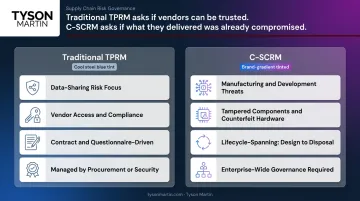
| Traditional TPRM | C-SCRM |
|---|---|
| Focuses on data-sharing risks | Covers threats introduced during manufacturing or development |
| Vendor access and compliance | Tampered components, malicious code, counterfeit hardware |
| Contract and questionnaire-driven | Lifecycle-spanning, from design through disposal |
| Usually managed by procurement or security | Requires enterprise-wide governance |
Traditional TPRM asks whether a vendor can be trusted with your data. C-SCRM asks whether what the vendor already delivered has been compromised before it arrived.
The NIST Framework Landscape: Key Documents Every Leader Should Know
Understanding C-SCRM requires knowing which NIST documents apply and how they relate to each other. Leaders don't need to read every page, but they do need to know which document governs what.
NIST SP 800-161 Rev. 1
Published in May 2022 (updated November 2024), this is the cornerstone C-SCRM guidance document. It provides a comprehensive, multi-level framework for identifying, assessing, and responding to supply chain cyber risks. NIST developed it in direct response to Executive Order 14028.
Executive Order 14028
The 2021 executive order on improving the nation's cybersecurity did something significant: it converted C-SCRM from optional guidance into a directive for federal agencies and their contractors. Sections 4(c) and 4(d) specifically directed NIST to publish software supply chain security guidelines within defined timelines. For any organization that contracts with the federal government, EO 14028 is not background reading — it defines compliance obligations.
How SP 800-161 and SP 800-53 Work Together
These two documents are complementary, not competing:
| Document | Role |
|---|---|
| SP 800-53 Rev. 5 | Broad catalog of security and privacy controls for federal information systems |
| SP 800-161 Rev. 1 | Applies and extends those controls to supply chain risk, with supplemental guidance mapped to existing control families |
Organizations already working with 800-53 can use Appendix B of 800-161 to find the crosswalk between supply chain risk considerations and their existing control baseline.
CSF v2.0: The Governance Signal
When NIST published CSF 2.0 in February 2024, it made a deliberate architectural choice: supply chain risk management moved from the Identify function (ID.SC in v1.1) into the new Govern function (GV.SC). The updated language reads: "Cyber supply chain risk management processes are identified, established, managed, monitored, and improved by organizational stakeholders."
NIST is explicitly placing C-SCRM at the leadership level. This is a governance mandate, not a technical one — and it belongs on the board's agenda, not only the security team's.
Regulated-Sector Implications
Organizations in defense, healthcare, and financial services face additional layers:
- DFARS 252.204-7012 requires defense contractors to implement SP 800-171, report cyber incidents within 72 hours, and flow requirements down to subcontractors
- FISMA requires federal agencies and contractor-operated systems to maintain agency-wide information security programs that include supply chain considerations
The Three-Tier C-SCRM Governance Model
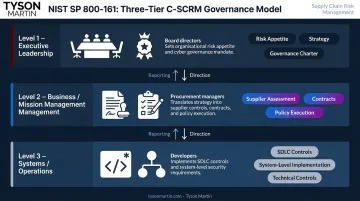
NIST SP 800-161 organizes C-SCRM across three interdependent tiers. Each tier has defined roles, responsibilities, and communication flows. The model only works when all three levels are functioning — a gap at any tier creates blind spots that threat actors can exploit.
Level 1 — Executive Leadership
The C-suite and board operate here. Their responsibilities:
- Set the enterprise risk appetite for supply chain exposure
- Define C-SCRM strategy and high-level policy
- Establish governance structures and charter a C-SCRM Program Management Office (PMO)
- Formalize risk tolerance thresholds and communicate them downward
This is where supply chain risk becomes a business decision, not a technical one. Risk appetite can't be delegated to the CISO.
Level 2 — Business and Mission Management
Program managers, engineering leaders, acquisition teams, and the C-SCRM PMO translate executive policy into operational procedures. Their responsibilities:
- Assess supplier criticality and tier vendors by risk level
- Manage supplier relationships and enforce procurement policies
- Report risk status upward to Level 1 while directing Level 3
- Embed cybersecurity requirements in contracts and procurement agreements
This is where the gap between policy and execution most often forms. Procurement decisions made without security input at this level directly undermine Level 1 intentions.
Level 3 — Systems and Operations
Architects, developers, system owners, and QA/QC personnel implement C-SCRM controls at the system level. Their responsibilities:
- Tailor controls to specific systems and development lifecycles
- Manage supply chain risk within the software development lifecycle (SDLC)
- Report risk status upward to Level 2
When all three tiers communicate consistently, risk decisions at Level 3 stay aligned with the appetite set at Level 1. That alignment depends as much on organizational structure as it does on policy — which is where operating model selection becomes critical.
Choosing an Operating Model
NIST SP 800-161 describes three structural options for C-SCRM programs:
| Model | How It Works | Best For |
|---|---|---|
| Centralized | PMO acts as hub for all C-SCRM activities | Smaller organizations, high regulatory exposure |
| Decentralized | Responsibility distributed across individual stakeholders | Large, complex enterprises with mature business units |
| Hybrid | Centralized policy with distributed execution | Most mid-market and enterprise organizations |
All three models require clear accountability at each tier. The operating model choice affects speed and consistency — centralized models move faster on policy; decentralized models scale better across complex business units. What kills programs in practice isn't the wrong model choice. It's launching any model without documented ownership at each level.
Building Your C-SCRM Program: Critical Success Factors
Embed C-SCRM into Acquisition and Procurement
Supply chain risk must enter the conversation before a contract is signed — not after a vendor is already deployed. Key requirements:
- Formal policy requiring supplier risk assessment as an onboarding prerequisite
- Cybersecurity clauses in contracts with specific, verifiable requirements (breach notice windows, audit rights, subprocessor transparency, patch timelines)
- Renewal gates that trigger reassessment when risk profile changes
A common gap Tyson Martin sees in board advisory engagements: contracts signed by procurement without security input, then handed to the security team after the vendor is already integrated. At that point, remediation is expensive and leverage is gone.
Tier Your Suppliers by Criticality
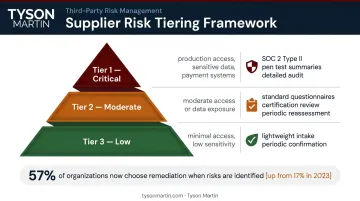
Not every vendor deserves the same scrutiny. A three-tier model works:
- Tier 1 — Vendors with production access, sensitive data, payment systems, or operational criticality. Full due diligence: SOC 2 Type II, penetration test summaries, onsite or detailed audit
- Tier 2 — Moderate access or data exposure. Standard questionnaires, certification review, periodic reassessment
- Tier 3 — Minimal access, low sensitivity. Lightweight intake, periodic confirmation
According to the EY 2025 Global Third-Party Risk Management Survey, when risks are identified during assessments, 57% of organizations now choose remediation — up from just 17% in 2023. Tiering is what makes that prioritization possible — without it, every vendor risk competes for the same limited remediation resources.
Define Cross-Functional Ownership
Tiering defines what to assess. Ownership defines who acts on it — and C-SCRM fails when that responsibility lives only in the security team. Each function has a distinct role:
- Business Owner — accountable for the vendor relationship and final risk decisions
- Procurement — drives the purchase process and signs off on contract execution
- Legal — owns contract terms and regulatory compliance language
- Security — sets risk controls, reviews evidence, assigns risk tier
- Privacy — accountable for data use agreements and processing obligations
Without a defined RACI across these groups, vendor risk falls into gaps between teams. The most common symptom: security flags a vendor risk that procurement has already locked into a multi-year contract.
What Boards and Executives Must Own in C-SCRM
CSF v2.0's decision to place GV.SC in the Govern function settles the governance question. Supply chain risk cannot be delegated entirely to the security team. The board must set risk appetite, demand consistent reporting, and make documented decisions about how risk is handled.
What Defensible C-SCRM Board Oversight Looks Like
A board with mature C-SCRM oversight can answer four questions at any time:
- What is our top supply chain risk exposure right now?
- Which critical suppliers have been assessed, and what did those assessments find?
- What would a major supply chain incident cost the organization?
- What decisions have been made to accept, mitigate, or transfer that risk — and who made them?
If those answers require a multi-week scramble, the governance structure isn't working.
What Boards Should Demand from Management
Boards should require three things from C-SCRM management reporting:
- Trend-based metrics — not one-time point-in-time scores. The percentage of Tier 1 vendors with completed assessments, average time to remediate high findings, and open risks by age tell a more honest story than a quarterly snapshot
- Defined escalation thresholds — specific criteria that determine when a supply chain event requires board notification versus staying at management level. These thresholds should be agreed before an incident, not debated during one
- Documented decision rights — a clear map of who can accept risk, who can approve exceptions, and at what level. When authority is ambiguous, decisions stall under pressure
In board advisory engagements, Tyson Martin helps establish these governance artifacts: supplier risk dashboards, risk appetite statements with measurable thresholds, and decision-rights maps. The goal is reporting the board can act on — not just a summary of what the security team did last quarter.
Common C-SCRM Pitfalls to Avoid
Treating It as a One-Time Compliance Exercise
Supply chain risk is not static. Suppliers change their own vendor relationships, software components receive updates, and threat actors adapt their methods. An assessment filed after vendor onboarding and never revisited creates false confidence.
The 2026 ProcessUnity/Ponemon report found that 27% of organizations receive only annual updates on vendor risk through continuous monitoring, and 18% don't supplement point-in-time assessments with continuous monitoring at all. Annual snapshots miss material changes between review cycles.
Operating in Silos
Even organizations with active monitoring can fail through internal fragmentation. When functions operate without shared accountability, the gaps between them become the exposure:
- Procurement signs contracts without security input on control requirements
- Legal drafts cybersecurity clauses without knowing which controls need verification
- Operations manages vendor relationships with no visibility into the security team's risk ratings
Defined ownership solves this faster than additional meetings. A monthly cross-functional review covering Tier 1 and Tier 2 vendors, with a quarterly board-ready summary showing trends and decisions, prevents silos from becoming exposures.
Failing to Measure Effectiveness
51% of organizations do not measure the effectiveness of their third-party assessments at all, according to the same 2026 ProcessUnity/Ponemon report. Without measurement, there's no basis for resource allocation decisions, no way to demonstrate improvement, and no early warning when the program is drifting.
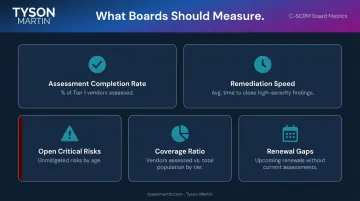
At minimum, boards should expect management to track:
- Assessment completion rate for Tier 1 vendors
- Average time to remediate high-severity findings
- Number of critical vendors with open unmitigated risks and aging
- Percentage of vendors assessed vs. total vendor population by tier
- Upcoming renewals without current assessments on file
Frequently Asked Questions
What is the difference between NIST SP 800-161 and NIST SP 800-53?
SP 800-53 is the broad catalog of security and privacy controls for federal information systems. SP 800-161 extends those controls specifically to supply chain risk scenarios. Organizations typically use both together — 800-53 as the control baseline and 800-161 as the C-SCRM overlay, with Appendix B of 800-161 providing the mapping between them.
Is NIST SP 800-161 compliance mandatory?
For federal agencies and their contractors, compliance is required — particularly under EO 14028 and FISMA. Private-sector organizations are not mandated but frequently adopt the framework voluntarily, or to qualify for federal contracting.
What are the three tiers of the NIST C-SCRM governance model?
The three tiers divide responsibility by organizational layer: Level 1 (Executive) sets risk appetite and C-SCRM strategy; Level 2 (Business/Mission) translates policy into operational procedures and manages supplier relationships; Level 3 (Systems) implements controls within specific systems and the software development lifecycle.
How does NIST CSF v2.0 change supply chain risk management?
CSF v2.0 moved supply chain risk from the Identify function (ID.SC) in v1.1 to the new Govern function (GV.SC) in v2.0. NIST now treats C-SCRM as a governance and leadership responsibility, not just an operational security task for the security team to manage alone.
What questions should a board ask about supply chain cyber risk?
Four questions worth putting on the agenda:
- Which critical suppliers have been assessed, and what did those assessments find?
- What is our defined risk tolerance for third-party exposure?
- What escalation threshold triggers board notification?
- What would a major supply chain incident cost the organization?
How is NIST SP 800-161 different from NIST SP 800-171?
SP 800-171 addresses how non-federal organizations protect Controlled Unclassified Information (CUI). SP 800-161 focuses on managing supply chain cybersecurity risk across the full procurement and deployment lifecycle. Defense contractors frequently work under both simultaneously.