Introduction
Many boards believe they have cyber risk governance covered. There's a CISO. Quarterly reports come in. The organization passed its last compliance audit. That's governance, right?
Not quite. Compliance confirms that certain controls exist at a point in time. Governance determines who decides, who is accountable, and what happens when something goes wrong. Those are very different things, and most organizations only discover the gap when pressure arrives.
According to PwC's 2024 Global Digital Trust Insights survey of nearly 3,900 executives, only 23% said cyber teams usually bring insights on changing cyber risk exposure directly to the CEO and board. The rest are operating with limited visibility at the top.
This guide covers what cyber risk governance is, why it belongs in the boardroom, the key components of a mature program, and the frameworks that support a structure built to hold under real pressure.
Key Takeaways
- Cyber risk governance is the decision structure behind security — not the technical controls themselves
- Compliance certifications are not governance; frameworks are tools, not the governance structure
- SEC, DORA, and NIS2 have made board-level cyber oversight a documented legal expectation
- Mature governance means written risk appetites, named decision owners, and tested escalation thresholds
- Untested governance almost always fails the moment a real incident hits
What Is Cyber Risk Governance?
Cyber risk governance is the system that determines how cybersecurity decisions get made, who is accountable for them, and how cyber risk connects to enterprise risk management. It is not a technical control and not a compliance framework — it is the decision structure that sits above all of those things.
Governance vs. Management
Organizations blur this distinction often, and the consequences are real:
- Governance sets direction — risk appetite, decision rights, accountability structures, oversight cadence
- Management executes within that direction — day-to-day security operations, controls, incident response
Governance asks: What are we willing to risk, and who decides? Management asks: How do we execute against that? When organizations confuse the two, they end up with technical teams making strategic risk decisions that should sit at the C-suite or board level.
Where Governance Sits in GRC
In the GRC model — Governance, Risk, and Compliance — governance is the "G." It establishes risk appetite and assigns accountability before any controls are implemented. Risk and compliance activities operate within the boundaries governance sets.
Frameworks like NIST CSF 2.0 and ISO 27001 are tools that support governance programs — they provide structure for organizing security work and measuring maturity. But the governance structure itself (who decides, who owns outcomes, what gets escalated) has to exist independently of any framework.
As Tyson Martin puts it: frameworks are lenses, not trophies. Organizations that treat NIST certification as governance have confused the tool for the outcome.
What Mature Governance Actually Produces
The practical outputs of a well-functioning governance program include:
- Written risk appetite statements with measurable thresholds in plain language
- Documented decision rights — who can approve vendor risk, accept a known vulnerability, or declare an incident
- Clear escalation paths with defined triggers, not improvised during a crisis
- A stable board reporting dashboard showing risk posture trends, not individual incident counts
- Policies that are reviewed on schedule and enforced — not filed and forgotten
- Accountability structures where every major risk has a named owner
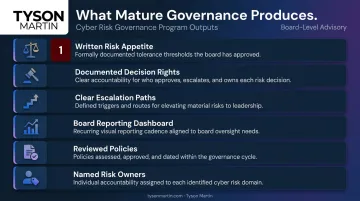
Without these outputs, there is no governance — only the assumption of it. The gap usually surfaces during an incident, not before.
Why Cyber Risk Governance Is a Board-Level Responsibility
Cyber risk became enterprise risk the moment it could take a company offline, trigger regulatory action, or move a stock price. The board is ultimately answerable for those outcomes — which means passive receipt of quarterly CISO reports is no longer sufficient oversight.
The Financial Reality
The July 2024 CrowdStrike outage illustrates the stakes clearly. According to Parametrix, the outage caused $5.4 billion in direct financial losses for US Fortune 500 companies (excluding Microsoft), with insured losses estimated at $540M to $1.08B for that group. A single technology failure — no malicious actor involved — produced board-level financial consequences across hundreds of organizations simultaneously.
That is a governance scenario, not just a technical one. It raises questions about concentration risk, vendor dependency, and operational resilience that belong in the boardroom.
Regulatory Expectations Are Explicit
Regulators have removed any ambiguity about whether board-level oversight is expected:
- SEC (2023): Public companies must disclose board oversight of cyber risks and management's role in assessing material cyber risks in annual filings, effective for fiscal years ending on or after December 15, 2023
- DORA (effective January 17, 2025): EU financial entity management bodies carry full and ultimate responsibility for ICT risk management — with personal accountability for governance failures
- NIS2 (transposition deadline October 17, 2024): Management bodies must approve cybersecurity measures, oversee implementation, and complete cybersecurity training — with potential personal liability for infringements
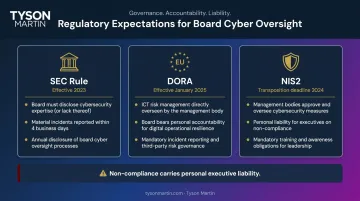
The enforcement signal is equally clear. In October 2023, the SEC charged SolarWinds and its CISO with fraud and internal control failures, alleging investors were misled about known cybersecurity risks. Cyber governance disclosures are now executive accountability documents.
The Knowledge Asymmetry Problem
Boards often receive cyber reports they cannot challenge. A slide deck full of patch percentages and alert volumes creates the appearance of oversight without the substance. Directors don't need to become technical experts, but they do need to understand risk in business terms and know which questions to ask.
Effective governance bridges this gap by translating cyber risk into revenue impact, operational disruption, legal exposure, and strategic delay. When boards can ask "what are our top three cyber risks, who owns them, and what would it cost if they materialized?" — and get a clear answer — the reporting structure is working. Most boards aren't there yet, which is precisely what the framework sections below address.
Key Components of an Effective Cyber Risk Governance Program
Executive and Board Engagement
Governance requires participation from the CISO, CEO, CFO, COO, and board — not just the security team. Cyber risk touches business strategy, financial planning, operational continuity, and legal exposure. Siloing it in IT creates blind spots across every one of those dimensions.
For many mid-market organizations or those navigating leadership transitions, a fractional or interim CISO (or an independent board advisor) fills the translation gap between technical teams and executive decision-makers. This matters most when the organization lacks a CISO with board-level communication experience.
Heidrick & Struggles' 2024 survey of 416 CISOs found that 48% still reported to a top technology executive such as a CIO or CTO. That reporting structure limits independent enterprise-risk escalation to the board.
Risk Appetite and Policy Development
Governance starts with a decision: how much cyber risk is the organization willing to accept in pursuit of its business goals? That answer needs to be written down, in measurable terms.
A well-formed risk appetite statement includes:
- Maximum acceptable downtime for each critical service (in hours, not "ASAP")
- Maximum acceptable data loss window (how many minutes or hours of transactions)
- Which data types can never leave organizational control
- Vulnerability remediation timelines by severity
- Third-party assurance requirements for critical vendors
Policies should reflect this appetite, be written in plain language, and have a defined review schedule. A policy that hasn't been reviewed in two years is not governance — it's shelf decoration.
Continuous Business Assessment
Cyber risk assessments are not annual events. A meaningful, ongoing assessment examines:
- Asset inventory and criticality: which systems are crown jewels and which are exposed
- Threat exposure trends: whether the attack surface is expanding, stable, or shrinking
- Third-party risk: which critical vendors haven't been reviewed recently
- Gap analysis: how far current posture sits from the defined risk appetite
KPIs track whether governance processes are running as intended (are risk reviews on schedule? are exceptions being closed?). KRIs signal whether risk exposure is moving outside appetite thresholds. Boards need both, separated by purpose. A stable dashboard showing directional trends over three-month periods is more useful than a monthly snapshot.
Decision Rights and Escalation Thresholds
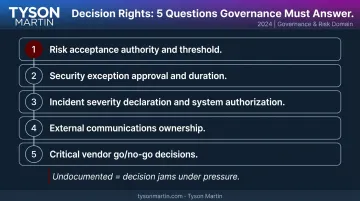
This is the component most governance programs lack. Decision rights answer five questions explicitly:
- Who can accept risk, and at what threshold?
- Who approves security exceptions, and for how long?
- Who declares incident severity and can authorize taking systems offline?
- Who speaks externally during an incident?
- Who owns go/no-go decisions for critical vendors?
These need to be documented and tested before an incident occurs. When decision rights are vague, organizations hit "decision jams": exceptions pile up, work stalls, and no one can break a tie when it matters most.
Enforcement, Measurement, and Review
Governance without enforcement is policy theater. The test for any metric: if this goes red, does someone have to act?
Metrics that mislead boards include:
- Training completion rates (completion is not effectiveness)
- Blocked attack counts (can reflect mis-tuned tools, not better security)
- Audit findings closed (without showing whether underlying risk reduced)
- Budget size (spending can rise while risk stays flat)
Metrics that demonstrate actual governance effectiveness:
- Tier 1 control coverage on crown-jewel systems, with trend
- Mean time to detect and contain high-severity incidents
- Risk acceptance aging (how long exceptions sit open past their approved window)
- Vendor remediation follow-through on critical suppliers
- Security debt burn-down rate on prioritized gaps
Cyber Risk Governance Frameworks: NIST CSF 2.0, ISO 27014, and the Three Lines Model
Frameworks operationalize a governance structure — they do not replace it. Three are most relevant at the board and executive level:
NIST CSF 2.0 — The Govern Function
NIST CSF 2.0 added a sixth function: Govern. It sits above and informs the other five functions (Identify, Protect, Detect, Respond, Recover). The Govern function covers organizational context, risk management strategy, roles and responsibilities, policies, oversight, and supply chain risk governance.
For boards, this is the most significant change in the framework. It explicitly connects cybersecurity to enterprise risk management rather than treating security as a standalone technical discipline.
NIST CSF 2.0 is a cybersecurity framework, not a GRC framework. COBIT is the more widely recognized framework for enterprise IT governance and GRC program design. Many organizations align to both — NIST for cyber risk outcomes, COBIT for operating model and accountability design.
ISO/IEC 27014 — Governance of Information Security
ISO 27014 defines the governance processes for information security: Evaluate, Direct, Monitor, Communicate, and Assure. It distinguishes the governing body's responsibilities (direction and oversight) from management's responsibilities (implementation). For boards that need a clear boundary between what they own and what the CISO owns, this is the most explicit model available.
The Three Lines Model — Accountability Mapping
The IIA's updated Three Lines Model (2020) maps accountability across the organization:
| Line | Who | What They Own |
|---|---|---|
| First | Business operations | Risk ownership and day-to-day controls |
| Second | Risk and compliance functions | Oversight, policy, risk management frameworks |
| Third | Internal audit | Independent assurance to the board |
| Governing body | Board and executive management | Strategic oversight, accountability to stakeholders |
The most common failure in practice: lines blur. Three patterns show up repeatedly:
- The CISO operates security controls (first line) and provides risk oversight (second line), which collapses independent assurance
- Internal audit lacks the technical fluency to challenge security reporting effectively
- The board receives passive status reports instead of exercising active, informed oversight
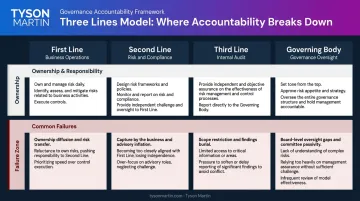
When accountability is unclear at the top, the entire model degrades below it.
Roles and Responsibilities: Who Owns What
| Role | Governance Responsibility |
|---|---|
| Board of Directors | Sets risk appetite, provides oversight, approves strategy, holds management accountable |
| CEO/CFO/COO | Integrates cyber into business strategy and enterprise risk management |
| CISO | Leads risk reduction strategy, translates cyber risk into business language, reports to board |
| Legal and Compliance | Manages regulatory obligations, disclosure readiness, incident reporting |
| Business Unit Leaders | Own operational risk within their domains |
| Internal Audit | Provides independent assurance that governance and controls function as documented |
Ambiguity about who owns what is one of the most consistent governance failures. "The security team handles it" and "we all share it" are red-flag answers. The RACI principle exists precisely to close that gap — every major risk decision needs a named owner, a defined escalation path, and a documented outcome.
For mid-market organizations and those in leadership transitions, the accountability structure often breaks down at the CISO-to-board communication layer. An interim CISO or independent board advisor can fill that gap without displacing existing teams — setting clear priorities, formalizing ownership, and establishing a repeatable reporting cadence.
Building a Governance Strategy That Holds Under Pressure
Governance on paper and governance that holds during an incident are different things. Most organizations discover the gap during a breach, ransomware event, or regulatory inquiry. Escalation thresholds are undefined. Decision rights are unclear. The board receives their first meaningful briefing days into the crisis.
What a 90-Day Governance Foundation Looks Like
Days 1–30: Establish clarity
- Current-state snapshot: what's solid, fragile, and unknown
- Top risks in plain language with named owners
- Decision rights and escalation thresholds documented
- Board-ready reporting baseline established
- Incident readiness check — roles and first-hour actions confirmed
Days 31–60: Build the cadence
- Operating rhythm implemented with owners, measures, and regular touchpoints
- Risk appetite statement drafted or validated
- Vendor risk tiering and access governance tightened
- 6–12 month roadmap with sequencing and cost ranges
Days 61–90: Test and hand off
- Executive tabletop exercise run with ransomware, data leak, or outage scenario
- Recovery and resilience tested for critical systems
- Stable trend reporting delivered to leadership and board
- Ownership assigned to internal leaders so execution continues
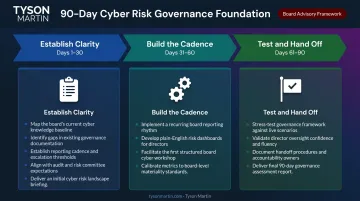
That 90-day arc is also where external perspective pays off. Boards and executive teams navigating leadership transitions, M&A, or post-incident recovery often benefit from an independent board advisor who can translate findings into business decisions, compress months of governance work into weeks, and keep internal alignment from stalling the process.
Measuring Governance Effectiveness
Governance effectiveness is measured by trend, not trivia. A stable dashboard showing:
- Whether risk posture is improving, flat, or declining over time
- Whether escalation processes are being used as designed
- Whether exceptions are closing within approved windows
- Whether policies are being reviewed on schedule
...is more valuable than a report packed with individual incident counts. One anomalous month proves nothing. Three months of consistent data tells leadership whether the governance structure is holding — or just producing paperwork.
Frequently Asked Questions
What is a cyber risk governance framework?
A cyber risk governance framework is a structured model that defines how an organization makes cybersecurity decisions, assigns accountability, and integrates cyber risk into enterprise strategy. NIST CSF 2.0's Govern function and ISO 27014 are the most relevant examples at the board level.
What is the difference between cyber risk governance and cyber risk management?
Governance defines the strategy, risk appetite, accountability structure, and oversight model. Management executes day-to-day security controls within that structure. Put simply: governance sets the rules of the road; management drives the car.
Who is responsible for cyber risk governance in an organization?
The board sets oversight and approves risk appetite. Executive management integrates cyber into enterprise risk, while the CISO leads risk reduction strategy and reporting. Legal, compliance, and business unit leaders each carry specific accountabilities — and every major risk decision needs a single named owner.
What are the steps of the NIST Risk Management Framework (RMF)?
NIST SP 800-37 Rev. 2 defines seven steps: Prepare, Categorize, Select, Implement, Assess, Authorize, Monitor. The RMF provides the procedural structure that a governance program uses to manage and document risk decisions systematically.
Is NIST a GRC framework?
NIST CSF 2.0 is a cybersecurity framework, not a GRC framework — but its Govern function directly supports governance programs. COBIT is the more widely recognized IT governance and GRC framework. Organizations typically use NIST CSF to shape security practice and COBIT to govern IT decision rights and accountability.
What are the core components of an ERM framework?
COSO ERM (2017) defines five components: Governance and Culture, Strategy and Objective-Setting, Performance, Review and Revision, and Information, Communication, and Reporting. Cyber risk governance should feed directly into this structure — treated as an input to enterprise risk, not a parallel program running alongside it.