That gap isn't a presentation problem. It's a governance problem. When risk is expressed in technical terms only, boards can't distinguish a material exposure from a minor operational nuisance. They can't approve investments with confidence, and they can't hold management accountable with precision.
This article explains what risk quantification actually means at the board level, how it changes the questions directors can ask, and what separates a report that enables real decisions from one that just fills agenda time.
Key Takeaways
- Qualitative dashboards describe security activity — they don't tell boards what a risk could cost or how likely it is to occur
- Risk quantification expresses cyber exposure in financial and probabilistic terms that boards can compare against risk appetite and other business risks
- SEC rules and NACD guidance now require boards to demonstrate informed oversight — not just receive briefings
- Effective board reporting is stable, trend-based, and decision-oriented — not a rotating set of technical metrics
- Rough financial ranges get boards moving — waiting for a perfect methodology keeps them stuck
Why Boards Struggle to Govern Cyber Risk Without Quantification
Most boards receive qualitative risk updates — threat counts, compliance percentages, patch rates. These describe activity. They don't communicate consequence.
A board cannot accept, transfer, or escalate a risk it cannot size. When everything is expressed in technical terms, directors can't tell whether a flagged issue represents a $200,000 operational problem or a $20 million exposure. Both might show up as "red" on a heat map.
The Accountability Gap
When risk language stays technical, accountability blurs. Management fills the vacuum — sometimes appropriately, sometimes not. Escalation decisions get made informally. The board ends up learning about threshold breaches after the fact rather than participating in decisions at the right level.
This isn't hypothetical. The SEC charged First American in 2021 after senior executives responsible for public disclosures were never informed of a material vulnerability their own security team had identified. Flagstar faced similar charges in 2024 for failing to maintain disclosure controls that would have ensured relevant cybersecurity information reached decision-makers.
Both cases share the same structural failure: risk information didn't travel up the governance chain in a form decision-makers could act on.
Regulatory Expectations Have Changed
The SEC's 2023 cybersecurity disclosure rules added explicit requirements for boards to describe their oversight of cybersecurity risk — and for companies to disclose material incidents within four business days of determining materiality. The NACD's Director's Handbook states directly that board-management discussions should include "identification and quantification of financial exposure to cyber risks" and which risks to accept, mitigate, or transfer.
Boards that cannot demonstrate that oversight — in financial terms — now face disclosure and liability exposure on top of the underlying cyber risk.
The Budget Governance Problem
Without a financial frame, security spending looks like cost rather than risk transfer. Boards have no basis to evaluate:
- Whether current spend is proportionate to actual exposure
- Whether the organization is under-protected, over-insured, or roughly calibrated
- Whether a proposed budget increase addresses a real gap or just adds headcount
Quantification creates the common unit that connects the spend to the exposure it's meant to address — and makes security a governance conversation, not just a technical one.
What Risk Quantification Actually Means at the Board Level
Risk quantification is the practice of expressing the likelihood and potential financial impact of a risk event in numeric terms — typically a range of expected loss — so a board can compare it against other business risks, risk appetite thresholds, and mitigation options.
That definition contains a critical word: range. Boards don't need a single precise number. They need a defensible range that is consistent over time and grounded in real data. A well-framed estimate — even one with wide bounds — gives directors something to act on. A color code does not.
A Spectrum, Not a Binary Switch
Quantification methods exist on a spectrum:
- Qualitative scoring — Low/Medium/High with defined criteria; not quantification in the strict sense, but a starting point for structured thinking
- Semi-quantitative models — Numeric scales where magnitude is proportional and meaningful
- FAIR (Factor Analysis of Information Risk) — An international standard that models probable frequency and financial magnitude for specific risk scenarios
- Monte Carlo simulation — Statistical modeling that generates a range of loss outcomes across thousands of scenarios, expressing results as a probability-weighted range of outcomes
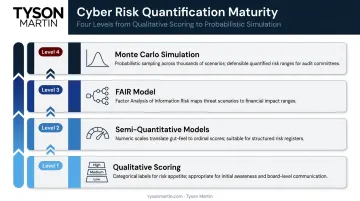
The point isn't to pick the most sophisticated method. It's to enter the spectrum at a maturity level you can sustain and improve from there.
The FAIR Institute's 2025 survey found that 31% of respondents primarily use a quantitative approach to cyber risk management — and every one of them quantifies risk in monetary terms. That means roughly two-thirds of organizations still haven't crossed that threshold. For boards, that gap is worth naming in the next governance review.
What Quantification Is Not
Boards should be clear that the following are not risk quantification:
- A single vendor security score
- A compliance percentage or audit finding count
- A maturity assessment rating
- A red/yellow/green indicator without financial backing
Each of these has operational value. None of them answers the board's core question: how much could this cost us, and how likely is it?
Translating Technical Risk into the Language Boards Actually Use
Boards think in terms of financial exposure, probability, trade-offs, and business impact. That's how they evaluate market risk, operational risk, and legal liability. Cyber risk quantification works when it adopts that same frame. Directors shouldn't need a new vocabulary to engage with it.
The Practical Translation
Consider what happens when technical findings get translated properly:
| Technical Language | Board-Ready Language |
|---|---|
| "Critical unpatched vulnerability in payment processing systems" | "Estimated $4M–$12M loss range if exploited; 1-in-8 chance of exploitation this quarter; remediation costs $180K" |
| "93% of endpoints have EDR deployed" | "7% gap covers the systems handling customer payment data; a breach in that segment has estimated 48-hour recovery time" |
| "Phishing simulation pass rate improved to 78%" | "Remaining 22% exposure in teams with access to financial systems; prior incident in this category cost $340K" |
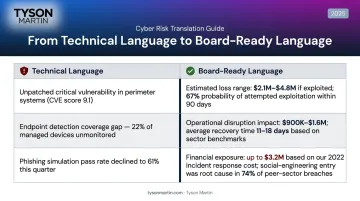
The second column gives a board something to act on. The first column gives them something to file.
Metrics That Actually Belong in Board Reports
Meaningful board-level risk metrics include:
- Average Annual Loss (AAL) — the expected annualized cost across all modeled risk scenarios
- Probable loss at a defined threshold — for example, what the organization could expect to lose in a 1-in-10-year event
- Return on Security Investment (ROSI) — comparing the cost of a proposed control to the loss exposure it reduces
- Loss range at confidence intervals — expressing exposure as "80% of modeled scenarios fall between $X and $Y"
NACD's 2026 guidance recommends directors ask for top cyber risks expressed in probable frequency and financial impact, and for financial cyber-risk appetite to be stated explicitly. These are baseline requests for any director doing their job.
Trend Over Point-in-Time
A single quarterly number tells a board very little. A four-quarter trend line tells them whether risk is increasing, stable, or declining — and gives them a basis for holding management accountable.
The dashboard I use with boards tracks 8–12 core indicators quarter-over-quarter, with defined thresholds that distinguish acceptable performance from escalation triggers. The emphasis is on movement, not snapshots.
Risk that connects to a real business decision gets acted on. A technology platform migration, an acquisition, a new market entry — quantified risk attached to those agenda items becomes part of the decision. That's where it drives action rather than sitting in an appendix.
What Board-Ready CRQ Reporting Looks Like in Practice
A board-level risk quantification report isn't a security operations summary dressed up in a different font. It has a distinct structure designed for governance decisions.
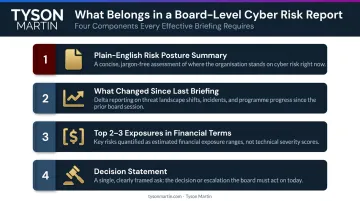
Core components of an effective board risk report:
- Plain-English risk posture summary — One paragraph a non-technical director can read in 90 seconds
- What changed since the last briefing — Whether risk increased, decreased, or held flat, and why
- Top 2–3 exposures in financial terms — Expressed as ranges with probability context, not severity labels
- Decision statement — What is being escalated to the board versus retained by management, with clear rationale
Stability Is a Feature
Board reporting fails when the metrics rotate. If the CISO presents a different set of indicators each quarter, trending becomes impossible and directors lose their frame of reference. Effective reporting uses a stable dashboard — the same indicators, the same format, quarter after quarter — so that changes in the numbers mean something.
Tyson Martin's board briefings follow a consistent 45-minute structure that keeps the conversation at the governance level:
- 15 min — Top risks and board questions
- 10 min — Dashboard review and trends
- 10 min — Posture and what changed
- 10 min — Decisions and decision rights
Frequency and Format
- Full board: Quarterly, with a one-page summary or 2–4 slides; escalation protocols for material changes between meetings
- Audit and risk committee: Quarterly deep review plus a monthly one-page "risk pulse" covering what changed, what needs a decision, and what's off track
- Incident escalation: Pre-defined triggers that fire automatically when thresholds are crossed — no judgment calls required in the moment
How CRQ Sharpens Decision Rights and Escalation Thresholds
Quantification is a governance tool, not just a reporting tool. When a board has defined risk appetite in financial terms, management has clear authority to act below that threshold and a clear obligation to escalate above it.
The Tiered Decision Structure
A practical framework uses three tiers:
- Low risk (limited local impact, low data sensitivity) → Management accepts within policy, no escalation required
- Medium risk (impacts a critical process, creates meaningful customer friction) → Executive approval required, time-limited
- High risk (material outage potential, regulated data exposure, brand damage) → CEO and board committee chair notified quickly; full board notification when thresholds are crossed
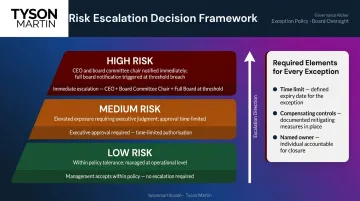
Every exception at any tier requires three elements: a time limit, compensating controls, and a named owner. An exception without an expiration date isn't an exception — it's the actual operating model.
Why Pre-Established Thresholds Matter During Incidents
Boards that have defined financial escalation thresholds before an incident respond faster and more consistently. When the decision criteria exist in writing — specific dollar amounts, specific downtime thresholds, specific data exposure triggers — teams spend the first hours of an incident solving the problem rather than negotiating authority.
The SEC's four-business-day disclosure clock starts when materiality is determined "without unreasonable delay." Organizations without pre-established financial thresholds have no consistent basis for that determination — which means the clock starts running before anyone agrees on whether it should. Documented, quantification-based thresholds remove that ambiguity before it becomes a liability.
Director Liability
Documented, quantification-based decision-making demonstrates informed oversight. The NACD notes that the business judgment rule may protect directors in private litigation when boards have performed and documented reasonable oversight. That protection depends on having a record — and the record depends on having a process grounded in something more defensible than a color-coded slide.
Common Mistakes That Undermine CRQ at the Governance Level
Treating CRQ as a Security Team Deliverable
The most common failure is building risk quantification for internal CISO use and then collapsing it into a briefing slide for the board. When that happens, directors lose the ability to interrogate assumptions, ask about trade-offs, or connect the numbers to their fiduciary responsibilities.
Board-level CRQ needs to be built for the governance audience — starting with the questions directors are accountable for answering, not starting with the metrics the security team already tracks.
Waiting for a Perfect Methodology
Organizations that defer quantification until they've fully implemented FAIR or another rigorous framework often go years without giving their boards any financially grounded risk picture. Starting with a rough, defensible estimate and improving it over time is consistently more valuable than waiting for precision.
If your top five exposures are expressed as financial ranges based on reasonable assumptions — even imperfect ones — that's a better governance foundation than any color-coded heat map.
Frequently Asked Questions
What is cyber risk quantification, and why does it matter to board members?
CRQ is the practice of expressing cyber risk in financial and probabilistic terms — likely loss ranges, probable frequency, and expected annualized exposure. Boards need this framing because governance decisions (investment approvals, risk acceptance, escalation thresholds) require a financial basis. A technical status report alone cannot support a funding decision or a risk acceptance vote.
How is quantified risk reporting different from a traditional red/yellow/green risk dashboard?
Qualitative ratings show status — they don't show consequence or cost. A quantified report gives directors a basis for comparing risk against appetite, approving security investments with a return-on-risk rationale, and assigning clear accountability. The numbers support a decision, not just a conversation.
What financial metrics should boards expect to see in a risk quantification report?
The core metrics are Average Annual Loss (expected annualized exposure), probable loss at a defined confidence interval (for example, the 90th-percentile loss scenario), and Return on Security Investment for major proposed controls. These connect security decisions to financial outcomes boards already understand.
How often should boards receive quantified cyber risk updates?
Most full boards engage quarterly with financial risk framing; audit and risk committees may review a monthly one-page pulse between those sessions. Escalation protocols should be defined in writing for material changes between scheduled meetings, so both the cadence and the exceptions are explicit.
What is a realistic starting point for an organization new to risk quantification?
Start with the risk data you already have. Assign rough financial ranges to your top five exposures using available incident data, insurance benchmarks, and recovery cost estimates. Document your assumptions. A directionally correct range with stated assumptions is a better governance tool than a color code with no supporting rationale.
How does risk quantification support regulatory compliance and cyber disclosure decisions?
Quantified thresholds give boards a consistent basis for materiality determinations under the SEC's cybersecurity disclosure rules — including the four-business-day incident reporting requirement. Documented, financially grounded oversight also aligns with NACD guidance and provides evidence of informed governance that regulators and courts increasingly recognize as the standard boards are expected to meet.