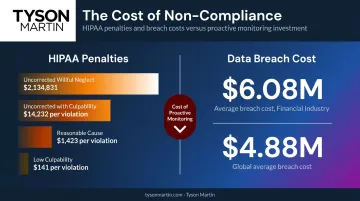
The financial stakes are real. IBM's 2024 breach research put the average financial-industry breach cost at $6.08M — 22% above the global average. A compliance gap caught by a monitoring tool costs a fraction of one discovered during a regulator's audit.
Compliance monitoring tools have matured well beyond basic audit logs. The best platforms now give boards and risk committees real-time visibility into control health across multiple frameworks simultaneously. The wrong one, however, creates a false sense of readiness — compliance theater dressed up with dashboards.
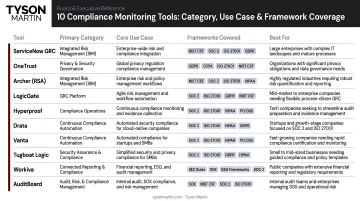
This guide covers 10 tools across automation-first platforms, enterprise GRC suites, and industry-specific solutions, with enough context to match each to your governance posture.
Key Takeaways
- Compliance monitoring tools continuously track controls, surface gaps, and generate audit-ready evidence across regulatory frameworks
- The 10 tools covered range from automation-first startups and enterprise GRC platforms to a financial-crime specialist
- Framework fit, integration depth, and board-reporting quality matter more than feature lists
- Four capabilities no tool should lack: real-time alerting, automated evidence collection, tamper-evident audit trails, and multi-framework support
- Define your governance framework before evaluating any tool
What Are Compliance Monitoring Tools and Why They Matter
Compliance monitoring tools are software platforms that continuously oversee an organization's controls, policies, and procedures to ensure adherence to applicable regulations and internal standards. Unlike annual audits, they track risk exposure in real time — catching drift between control state and compliance requirement before it becomes a finding.
The cost of getting this wrong is concrete. HIPAA civil monetary penalties in 2024 range from $141 per violation to $2,134,831 for uncorrected willful neglect depending on culpability tier. In financial services, the average breach now costs $6.08M — and neither figure includes reputational damage, customer churn, or regulatory remediation costs.
Proactive monitoring reduces that exposure by surfacing gaps before regulators do. The 10 platforms below were evaluated on their ability to reduce risk at the control level while producing defensible, auditable reporting for boards and executive teams — two requirements that rarely come from the same tool.
10 Best Compliance Monitoring Tools for Regulatory Readiness
Tools were selected based on regulatory framework coverage, scalability, integration depth, audit evidence quality, and suitability for regulated industries including financial services, healthcare, and retail.
1. Vanta
Vanta is an automation-first compliance platform widely adopted by technology companies. It covers SOC 2, ISO 27001, HIPAA, GDPR, PCI-DSS, CMMC (Levels 1, 2, and 3), NIST CSF, and US Data Privacy frameworks — with over 300 cloud integrations and a continuous compliance dashboard serving 16,000+ customers.
Speed-to-certification is the core value here. Automated evidence collection and real-time security checks cut manual audit prep time significantly — one customer cites 2,000 hours saved annually and a 50% reduction in audit completion time. For organizations without a large internal compliance team, that's a measurable operational gain.
| Category | Details |
|---|---|
| Best For | SaaS companies and tech-forward organizations pursuing SOC 2 or ISO 27001 |
| Key Features | Continuous control monitoring, automated evidence collection, 300+ integrations |
| Pricing | Custom (Essentials, Plus, Professional, Enterprise tiers — personalized quote required) |
2. Drata
Drata is an automation-driven platform built for startups and SaaS companies, covering 30+ frameworks including SOC 2, ISO 27001, ISO 42001, HIPAA, PCI-DSS, DORA, FedRAMP, and GDPR. Its compliance scorecards give lean teams a real-time view of their compliance posture without requiring dedicated GRC staff.
The results are concrete. A Drata case study with Metadata showed audit prep time reduced from roughly six weeks to two — a 60% reduction — with another customer citing $70,000+ in efficiency gains. Rapid implementation is the core value proposition.
| Category | Details |
|---|---|
| Best For | Lean engineering and compliance teams in high-growth startups |
| Key Features | Automated evidence collection, compliance scorecards, continuous control monitoring |
| Pricing | Starter, Growth, and Enterprise tiers — no public dollar price; demo required |
3. OneTrust
OneTrust is a comprehensive enterprise platform covering privacy, ESG, ethics, and GRC — used by 14,000+ organizations globally, including half of the Fortune Global 500. It handles GDPR, CCPA, ISO 27001, ISO 27701, SOC 2, and other multi-jurisdictional obligations through a modular architecture.
OneTrust's data mapping and consent management depth is what distinguishes it from narrower compliance tools. For organizations managing privacy obligations across multiple geographies, that modular architecture means adding jurisdictions without rebuilding the program from scratch. A Forrester Consulting study cited 227% ROI with a seven-month payback period.
| Category | Details |
|---|---|
| Best For | Global enterprises with multi-jurisdictional privacy and compliance obligations |
| Key Features | Data mapping, consent management, modular privacy and ESG compliance modules |
| Pricing | Scalable packages — enterprise custom pricing; no public dollar rate |
4. MetricStream
MetricStream is a full-scope enterprise GRC solution for large, multinational organizations managing complex regulatory environments across audit, risk, policy, and compliance domains. Its customer base — concentrated in financial services, energy, and other regulated industries — reflects how the platform is positioned.
Automated regulatory updates feed directly into the platform — changes in applicable rules surface without manual tracking. Integrated internal audit capabilities and risk heatmaps give compliance teams and audit committees a single view across frameworks. Forrester TEI analysis cited $8.4M in benefits, 133% ROI, and a six-month payback.
| Category | Details |
|---|---|
| Best For | Large enterprises and regulated financial institutions managing multiple frameworks simultaneously |
| Key Features | Regulatory intelligence feeds, integrated internal audit, risk heatmaps and analytics |
| Pricing | High total cost of ownership; custom enterprise pricing — contact required |
5. Hyperproof
Hyperproof is a compliance operations platform built for teams managing multiple frameworks at once. It supports 140+ frameworks — including SOC 2, HIPAA, CMMC, NIST SP 800-53, DORA, NIS2, FedRAMP, and GDPR — and connects directly into Jira, Slack, and Microsoft Teams so compliance tasks surface where engineers already work.
Its cross-framework control mapping prevents redundant effort. One customer case study showed a 70% reduction in workload; another reported managing 28 frameworks through a single platform with a 66% reduction in duplicative controls. For organizations subject to three or more overlapping regulations, that efficiency compounds quickly.
| Category | Details |
|---|---|
| Best For | Mid-market organizations managing overlapping regulatory frameworks simultaneously |
| Key Features | Multi-framework control mapping (140+ frameworks), automated evidence tasks, 200+ integrations |
| Pricing | No public price — demo and ROI calculator available |
6. LogicGate
LogicGate's Risk Cloud is a no-code GRC platform with a drag-and-drop workflow builder, 30+ pre-built compliance applications, and framework coverage for ISO 27001, PCI-DSS, SOC 2, NIST CSF, GDPR, HIPAA, CCPA, and others. It has automated 20,000+ workflows and claims a 25% task-efficiency gain and $250,000+ in annual savings for customers.
The platform's configurable architecture makes it the right choice for organizations with non-standard processes that rigid, out-of-the-box GRC tools can't accommodate. Its AI and risk quantification capabilities tie control gaps directly to business impact — useful for translating compliance posture into board-level language.
| Category | Details |
|---|---|
| Best For | Organizations with complex or non-standard GRC workflows requiring high configurability |
| Key Features | No-code workflow builder, 30+ pre-built compliance apps, risk-to-business-impact quantification |
| Pricing | Application-based licensing with Power User tiers — no public dollar price |
7. NAVEX Global
NAVEX One is an enterprise compliance suite trusted by 13,000+ organizations, including 75% of Fortune 100 and 500 companies. Its scope covers whistleblowing and incident management (EthicsPoint), policy management (PolicyTech), third-party risk screening (RiskRate), conflicts of interest management, and online ethics and compliance training.
NAVEX combines whistleblower management, policy enforcement, and vendor risk assessment in a single suite — a combination that most organizations otherwise cover with three separate tools. For regulated sectors with large distributed workforces, where culture and conduct risk carry as much regulatory weight as technical controls, that consolidation has real operational value.
| Category | Details |
|---|---|
| Best For | Large enterprises prioritizing ethics, policy, and third-party compliance alongside technical controls |
| Key Features | Whistleblower hotline (EthicsPoint), centralized policy and training, vendor risk screening |
| Pricing | Request-pricing model; bundled packages with potential 30% savings |
8. Secureframe
Secureframe is a guided compliance platform that simplifies audit readiness for SOC 2, ISO 27001, HIPAA, PCI-DSS, GDPR, NIST, and CMMC through pre-written policies, compliance checklists, and embedded employee security training. Its Comply AI feature and audit collaboration tools make it accessible for teams without dedicated compliance staff.
For organizations building their first formal compliance program, Secureframe's onboarding structure reduces the barrier to entry. The pricing and interface are calibrated for SMBs, with enough depth to support teams up to several hundred employees.
| Category | Details |
|---|---|
| Best For | SMBs and organizations building a compliance program for the first time |
| Key Features | Guided compliance checklists, prewritten policies, embedded security training, audit collaboration |
| Pricing | Fundamentals, Complete, and Defense packages — no public dollar price; quote required |
9. ServiceNow GRC
ServiceNow's Integrated Risk Management module covers Policy and Compliance Management, Risk Management, Audit Management, Operational Risk Management, Regulatory Change Management, and Operational Resilience Management — all within the ServiceNow ecosystem.
For enterprises already running ServiceNow for ITSM, this is the natural GRC choice. Compliance data flows alongside IT change management, incident response, and asset management without integration overhead. The result is a unified operational view that eliminates the friction of bridging separate platforms — and makes risk data available to the same teams who execute remediation.
| Category | Details |
|---|---|
| Best For | Large enterprises already on ServiceNow seeking unified GRC and ITSM |
| Key Features | Integrated ITSM and GRC workflows, continuous control monitoring, policy and audit management |
| Pricing | Enterprise licensing — bundled with or added to existing ServiceNow contracts |
10. ComplyAdvantage
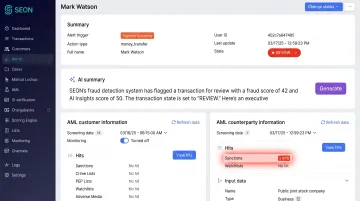
ComplyAdvantage is an AI-powered financial crime compliance platform built specifically for financial institutions, fintechs, and payment processors. Its Mesh platform covers AML, KYC, sanctions screening, adverse media monitoring, and real-time transaction monitoring — backed by a proprietary knowledge graph connecting 24M+ entities.
The platform claims up to an 82% reduction in false positives, with AI agents auto-remediating 65–85% of false positive alerts. For AML teams spending hours on manual queue review, moving from batch screening to continuous real-time monitoring frees up meaningful analyst capacity. Starter plans begin at $99/month for up to 2,000 entities.
| Category | Details |
|---|---|
| Best For | Financial institutions, fintechs, and payment processors managing AML/KYC and sanctions obligations |
| Key Features | AI-powered transaction monitoring, real-time sanctions and watchlist updates, customizable risk workflows |
| Pricing | Starter from $99/month; Enterprise requires sales contact |
Key Features to Look for in a Compliance Monitoring Tool
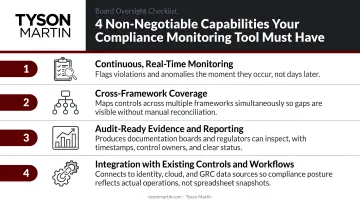
A tool's feature list is less important than whether it produces compliance outputs that hold up under scrutiny. Four capabilities are non-negotiable:
- Continuous control monitoring with real-time alerts — point-in-time checks miss the drift that happens between audits
- Automated, tamper-evident audit trails — evidence that can be altered or recreated isn't defensible under regulatory scrutiny
- Multi-framework support — separate tools for each regulation create redundant work and version control problems
- Role-based reporting — boards need trend data and decision triggers; IT operations need control-level detail; the same dashboard can't serve both
Beyond those four requirements, integration depth is the factor most commonly underestimated during procurement. A compliance platform that requires manual data entry at scale becomes a liability rather than an asset. Legacy system integration is the most frequent implementation failure point, and discovering that gap after go-live is expensive.
Scalability deserves its own evaluation question before purchase. As regulatory scope expands through new geographies, additional frameworks, or M&A activity, the platform must accommodate that growth without requiring a full re-implementation. Organizations often select a startup-tier tool that fits their current state and outgrow it before the second renewal cycle — stress-test this scenario explicitly during vendor evaluation.
How to Choose: Governance Framework First, Tool Second
These 10 tools were evaluated across five dimensions: regulatory framework breadth, continuous monitoring capability, audit evidence quality, integration ecosystem, and suitability for board-level trend reporting.
But the most important evaluation criterion isn't on any vendor's feature sheet.
The best compliance monitoring tool is one that produces stable, inspectable metrics that give a board's audit committee genuine confidence that risk is under control — not just evidence that boxes are being checked. A dashboard that floods the board with activity counts without showing trend, ownership, or business impact isn't governance. It's paperwork.
Tyson Martin is direct about this in his board advisory work: governance framework and decision rights must precede tool selection. When organizations buy tools to compensate for missing decision rights, the tools generate noise rather than confidence. The governance structure — who decides, how evidence is validated, how remediation is tracked — has to be in place first.
Organizations in transition are particularly exposed. Three scenarios repeat most often:
- New leadership defaults to tool acquisition as a visible signal of action
- Post-M&A integration triggers platform consolidation before ownership is clarified
- Post-incident environments rush to add monitoring layers without fixing the underlying accountability gaps
Without a framework defining risk ownership and escalation thresholds, even the most capable GRC platform produces activity counts rather than risk reduction.
The right question is: which tool produces evidence and trend reporting that supports defensible decisions by the board and auditors — not just documentation that something was measured?
Conclusion
No compliance monitoring tool replaces a sound governance framework. The right platform amplifies a well-designed compliance program; the wrong one adds cost and complexity without reducing actual risk exposure.
Before selecting a platform, assess your specific regulatory obligations, team size, integration requirements, and what your board and auditors actually need to see. Match the tool to those requirements — not to brand recognition or a sales demonstration that prioritizes features over fit.
For organizations that want an outside perspective on which tools align with their governance posture and risk profile, Tyson Martin provides fractional CISO and board advisory services — without the overhead of a full-time hire — that help leadership teams make defensible, inspectable technology decisions.
Frequently Asked Questions
Frequently Asked Questions
What is compliance readiness?
Compliance readiness is an organization's sustained, demonstrable ability to prove that its controls meet applicable regulatory standards and operate effectively — not just at audit time, but continuously. It requires both functional controls and the evidence infrastructure to prove it.
What are the main pillars of compliance readiness?
The six core pillars are:
- Governance framework and accountability
- Documented policies and controls
- Risk assessment and continuous monitoring
- Audit evidence management
- Employee training
All six must be operational, not aspirational. Documentation alone doesn't satisfy an auditor or a regulator.
What is the difference between compliance monitoring and compliance management?
Compliance monitoring is the continuous, real-time tracking of control performance and policy adherence. Compliance management is the broader program encompassing strategy, policy development, training, and remediation. Monitoring is one critical component within the larger management framework — necessary but not sufficient on its own.
How do I choose the right compliance monitoring tool for my industry?
Framework alignment beats feature count every time. Start with your primary regulatory framework — HIPAA for healthcare, AML/KYC for financial services, SOC 2 for SaaS — then evaluate on integration fit, scalability, and whether reporting satisfies board and auditor expectations, not just internal IT needs.
Do small and mid-size organizations need compliance monitoring tools?
Yes. Regulated SMBs face the same exposure as large enterprises, often with fewer resources to manage it manually. Platforms like Vanta, Drata, and Secureframe are built for smaller teams and provide a cost-effective path to audit readiness without a dedicated compliance department.
What is the biggest mistake organizations make when selecting a compliance tool?
Treating tool acquisition as a substitute for governance. Without defined decision rights, risk ownership, and escalation thresholds already in place, even capable platforms generate activity reports rather than risk intelligence. Governance structure must precede tool selection — not the other way around.