Introduction
Boards and executive teams face a harder governance reality heading into 2026. Regulatory obligations keep multiplying, cyber incidents are escalating in both frequency and consequence, and the SEC's cybersecurity disclosure rules now require public companies to report material incidents within four business days — putting board-level oversight under direct regulatory scrutiny. AI governance software alone is projected to grow at a 30% CAGR through 2030, a signal of how fast the compliance technology market is moving in response.
Choosing the wrong GRC platform creates its own category of risk. A poorly fit tool produces compliance theater:
- Dashboards full of green boxes while actual exposures go unmanaged
- Metrics that describe activity rather than risk
- Reporting that generates volume instead of decisions
This guide offers an independent, governance-first evaluation of the five platforms most worth considering in 2026 — what each does well, where each falls short, and which fits your organization's actual oversight needs.
Key Takeaways
- GRC platforms centralize risk, compliance, audit, and policy management into one inspectable view — replacing fragmented tools with a clear picture of exposure and controls.
- Top five GRC solutions for 2026: MetricStream, Diligent One Platform, ServiceNow GRC, AuditBoard, and IBM OpenPages.
- Right fit depends on organizational size, regulatory footprint, primary use case, and GRC maturity — analyst rankings are a starting point, not a decision.
- Boards should evaluate platforms on whether they produce board-ready reporting without manual assembly, not on feature count.
- No GRC tool replaces governance judgment. It amplifies it when deployed with clear decision rights and ownership.
What Is GRC and Why It Matters for Boards in 2026
GRC — Governance, Risk, and Compliance — is a structured approach to aligning leadership oversight, risk management, and regulatory adherence so that executives and boards have a single, inspectable view of what could go wrong and what controls exist to prevent it.
The software enables that view. It cannot substitute for the governance decisions that define who owns each risk, who can accept it, and who must act when thresholds are breached.
The most common GRC failure pattern is a governance problem, not a tool problem. When decision rights are unclear, risk acceptance is informal, and board reporting describes activity rather than exposure, a GRC platform automates the theater rather than replaces it.
How GRC Platforms Have Evolved
Early GRC tools were single-regulation, single-team solutions — structured checklists. Today's platforms are fundamentally more capable:
- Continuous control monitoring replaces periodic point-in-time assessments
- AI-driven regulatory change alerts flag relevant rule changes before they become gaps
- Risk quantification in monetary terms translates technical findings into board-level business impact
- Unified data model connects IT operations, audit, compliance, and third-party risk in one inspectable view
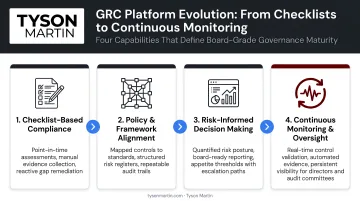
For boards and audit committees, this evolution makes oversight more executable. The condition is straightforward: the platform has to match the organization's actual regulatory footprint and maturity level, not the other way around.
The 5 Best GRC Solutions for 2026
These five platforms were selected based on depth of capability, AI and automation maturity, recognition by analysts including Gartner, IDC MarketScape, and Forrester, and their practical fit for organizations where boards require credible, auditable risk reporting.
MetricStream
MetricStream is a purpose-built, AI-first enterprise GRC platform that unifies risk, compliance, audit, cyber GRC, and third-party risk management in a single connected architecture. It is widely adopted by large global enterprises across financial services, healthcare, and technology sectors.
Its AiSPIRE capability is the defining differentiator: continuous control sensing and AI-driven regulatory change management that flags relevant regulatory updates before they create gaps. Low-code/no-code configuration allows compliance and risk teams to tailor workflows without heavy IT dependency, which matters operationally when regulatory requirements shift mid-cycle.
MetricStream holds consistent Leader recognition across Gartner, IDC MarketScape, and the Forrester Wave for GRC Platforms, which matters for organizations making long-term infrastructure commitments where platform stability and roadmap continuity are non-negotiable.
| Category | Details |
|---|---|
| Key Features | Unified enterprise risk, compliance, audit, cyber GRC, TPRM, ESG; AI-powered regulatory change alerts; continuous control monitoring; monetary risk quantification |
| Best For | Large and global enterprises seeking a single platform across all GRC domains with deep regulatory framework coverage |
| Ideal Org Size | Large to global enterprise (500+ employees, multi-jurisdiction regulatory obligations) |
Diligent One Platform
Diligent One Platform occupies a unique position in the market: it is the only solution that combines board governance tools with full GRC capabilities on a single platform. For organizations where the board is an active participant in risk oversight, not just a quarterly report recipient, that integration is a genuine structural advantage.
The platform combines board meeting management and secure director communications with enterprise risk, internal audit, compliance, and ESG modules. Over 100 third-party system integrations and AI-powered risk benchmarking against a proprietary database of real-world risks give audit committees context that isolated GRC data cannot provide.
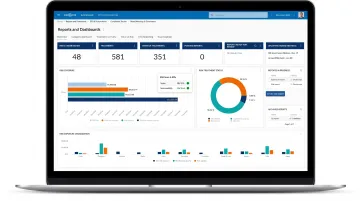
Diligent was named a Leader in the 2025 Gartner Magic Quadrant for GRC Tools and holds FedRAMP and DoD IL5 authorization, making it one of the few platforms suited for public sector and defense-adjacent organizations with stringent security requirements.
| Category | Details |
|---|---|
| Key Features | Board management + GRC on one platform; AI risk benchmarking; automated compliance tracking; FedRAMP/DoD IL5 authorization; ESG and third-party risk modules |
| Best For | Organizations where board-level oversight and GRC reporting must be seamlessly connected; public companies, nonprofits, and regulated entities with active audit committees |
| Ideal Org Size | Mid-market to large enterprise; particularly strong for public companies and organizations with formal board governance structures |
ServiceNow GRC
ServiceNow GRC is the leading choice for organizations already running ServiceNow infrastructure. For organizations that aren't, the integration advantage that defines this platform simply doesn't apply.
The platform's key differentiator is eliminating the data gap between IT operations and risk reporting. Incidents, vulnerabilities, and control failures surfaced in ITSM automatically flow into GRC workflows, reducing manual handoffs, accelerating escalation, and giving risk teams visibility into control failures in near real time rather than at the next quarterly review.
For organizations where IT and cyber risk represent a significant share of overall enterprise risk, that connectivity is material. ServiceNow GRC has received recognition from Forrester as a GRC leader and is a consistent performer in Gartner evaluations for integrated risk management.
| Category | Details |
|---|---|
| Key Features | Native integration with ITSM and SecOps; no-code workflow playbooks; policy and compliance management; continuous monitoring; intelligent chatbot for workflow initiation |
| Best For | IT-centric organizations seeking to unify IT service management and risk/compliance oversight on a single platform |
| Ideal Org Size | Mid-market to large enterprise; strongest for organizations already running ServiceNow infrastructure |
AuditBoard
AuditBoard (now rebranding as Optro) is the audit-first platform built for internal audit teams, SOX compliance programs, and risk functions that need intuitive collaboration and rapid user adoption. Over 50% of Fortune 500 companies now use AuditBoard's connected risk platform, an adoption rate that reflects both the platform's usability and its fit for audit-driven compliance programs.
Where heavier enterprise platforms require months of change management before teams are fully operational, AuditBoard's intuitive workflow design gets teams productive faster. Audit lifecycle management, collaborative evidence sharing, and automated reporting are built for teams that need to operate efficiently without a dedicated GRC administrator.
AuditBoard was named a Leader in the 2025 IDC MarketScape for Worldwide GRC Software and in the 2025 Gartner Magic Quadrant, confirming its maturity beyond audit-only use cases and its credibility as a full enterprise GRC platform.
| Category | Details |
|---|---|
| Key Features | Intuitive audit lifecycle management; SOX compliance workflows; collaborative task management and evidence sharing; automated audit reporting; risk assessment modules |
| Best For | Internal audit teams, SOX-regulated companies, and compliance-led organizations that prioritize audit quality and cross-functional collaboration |
| Ideal Org Size | Mid-market to large enterprise; particularly strong for publicly traded companies with active SOX compliance requirements |
IBM OpenPages
IBM OpenPages is an AI-powered, highly scalable GRC platform built for complex enterprise environments where risk taxonomy depth, regulatory framework coverage, and integration with existing enterprise infrastructure are baseline expectations. Banking, insurance, and energy sectors, where multi-entity structures and layered regulatory obligations are the norm, represent its strongest use cases.
Watson AI delivers predictive risk insights and regulatory intelligence, while deep integration with IBM's broader ecosystem (data governance, security, cloud) makes OpenPages a natural fit for large organizations already invested in IBM infrastructure. Its financial controls management and operational risk modules are particularly mature, reflecting decades of enterprise deployment experience.
IBM OpenPages was named a Leader in the 2025 Gartner Magic Quadrant for GRC Tools and in the IDC MarketScape. For large organizations evaluating long-term GRC infrastructure, that dual recognition across Gartner and IDC carries meaningful signal.
| Category | Details |
|---|---|
| Key Features | AI-powered (Watson) risk quantification and regulatory intelligence; enterprise risk, IT governance, financial controls, and operational risk modules; strong regulatory framework library |
| Best For | Heavily regulated industries (banking, insurance, energy) requiring deep risk taxonomy, complex multi-entity structures, and AI-driven compliance intelligence |
| Ideal Org Size | Large enterprise and global organizations with mature GRC programs and existing IBM infrastructure investment |
How to Choose the Right GRC Platform
Selecting a GRC platform through a feature-comparison lens is the most common — and most costly — mistake executives make. The organization that buys the most comprehensive platform available, rather than the one that fits its current maturity and regulatory footprint, ends up with expensive shelfware and shallow adoption.
The Governance-First Evaluation Lens
The evaluation criteria that actually matter for boards and executive leadership center on a single question: will this platform produce inspectable, auditable risk reporting that supports defensible decisions? From that foundation, four criteria follow:
- Does the platform connect risk, audit, compliance, and policy in one data model — or does it require manual reconciliation across modules?
- Is monitoring continuous, or does it still rely on periodic point-in-time assessments that miss what changes between reviews?
- Does Gartner, IDC, or Forrester recognize the vendor? Analyst coverage signals platform stability and roadmap investment — both matter for long-term infrastructure decisions.
- Does the platform match your current maturity level? A tool built for a mature, multi-jurisdiction enterprise creates friction and overhead for an organization still formalizing its risk taxonomy.
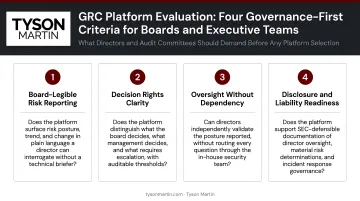
Those four criteria narrow the field. The following three questions stress-test what remains.
Three Pressure-Test Questions
Before finalizing any GRC platform shortlist, run each option through these operational questions:
| Question | What "good" looks like |
|---|---|
| Does it produce board-ready reporting without manual assembly? | Reports fit in one to two pages and stay consistent quarter to quarter — no hours of reformatting before each board meeting. |
| Does it support clear decision rights and escalation thresholds? | Risk escalation paths are built into the workflow, not assumed. Surfacing risk without triggering defined escalation produces dashboards, not governance. |
| Does it scale without requiring a full IT program to maintain? | Low-code configuration and native integrations let teams adapt to regulatory changes without dedicated engineering resources. |
Conclusion
The best GRC solution for your organization is not the one with the longest feature list — it's the one your team can operationalize to produce stable, meaningful risk visibility for leadership and the board. GRC software is a tool, not a governance program. Without clear decision rights, defined escalation thresholds, and ownership assigned to named individuals, any platform will generate noise instead of insight.
If your organization is evaluating GRC platforms and needs an independent perspective to align tool selection with board oversight requirements, Tyson Martin works with boards and executive teams as a fractional CISO and board advisor. He helps organizations across financial services, healthcare, and retail reach defensible technology and governance decisions — with clear escalation paths and reporting leadership can actually act on.
Frequently Asked Questions
What are governance, risk, and compliance services?
GRC services are the integrated processes, frameworks, and tools organizations use to align operations with strategic goals, manage financial and cyber risks, and maintain adherence to applicable laws and internal policies. Core components include risk assessments, compliance monitoring, audit management, and board-level reporting.
What is a governance, risk, and compliance framework?
A GRC framework — such as COSO, NIST, ISO 31000, or COBIT — gives organizations a repeatable, documented approach to identifying risks, assigning controls, monitoring compliance, and reporting to leadership. Frameworks replace ad-hoc processes with consistent governance that holds up under audit.
What are examples of GRC tools?
Examples span several categories: enterprise platforms (MetricStream, IBM OpenPages, ServiceNow GRC), audit-focused tools (AuditBoard), board-integrated platforms (Diligent One Platform), and compliance automation tools (Vanta, ZenGRC). The right fit depends on whether the primary driver is enterprise risk, audit quality, board oversight, or IT compliance.
What is the best GRC software?
There is no universal answer — fit to organizational context matters more than analyst rankings. MetricStream and IBM OpenPages suit large enterprises with broad regulatory obligations; Diligent One Platform leads where board governance and GRC must be unified; ServiceNow GRC fits IT-centric organizations; and AuditBoard leads for audit-driven compliance programs.
What are the five key areas of compliance?
The five commonly recognized areas are: regulatory compliance (laws and government requirements), corporate compliance (internal policies and codes of conduct), data privacy compliance (GDPR, HIPAA, CCPA), financial compliance (SOX and reporting standards), and IT/cybersecurity compliance (NIST, ISO 27001, PCI DSS).
Is compliance a governance risk?
Yes. When an organization cannot demonstrate adherence to regulatory requirements, the board faces legal, financial, and reputational exposure. Effective governance requires that compliance obligations are identified, monitored, and reported to leadership in a way that enables proactive intervention before regulators or auditors find the gaps.