Introduction
Investment advisors share sensitive client data with a surprisingly wide range of third parties — custodians, portfolio management platforms, CRM tools, trading systems, outsourced IT, and cloud storage providers. Each relationship is a potential compliance gap or breach vector. And regulators have noticed.
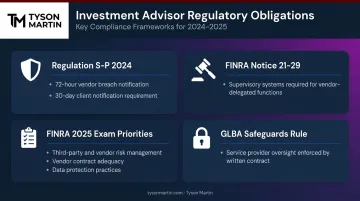
The SEC's amended Regulation S-P, adopted May 16, 2024, now requires registered investment advisers to notify customers within 30 days of a data breach — and to contractually require service providers to report incidents within 72 hours. FINRA's guidance makes equally clear that outsourcing to vendors doesn't transfer compliance responsibility. Advisors own the outcome.
Those requirements land hardest on small firms. With 92.7% of SEC-registered advisory firms employing 100 or fewer people, most teams are still tracking vendor obligations through spreadsheets, annual questionnaires, and email chains — processes that break down fast as vendor ecosystems grow.
Purpose-built VRM platforms are built for exactly this problem. This article covers the top platforms suited for investment advisors, the features that matter most, and how to avoid the selection mistakes that leave firms with expensive shelf-ware.
Key Takeaways
- Regulation S-P (effective August 2024) requires registered investment advisers to maintain a documented vendor oversight program
- 99% of RIAs use CRM systems, 97% use portfolio management platforms — the third-party exposure is significant and growing
- Top VRM platforms combine continuous monitoring, regulatory alignment, and board-ready reporting
- Top platforms to evaluate: OneTrust, Venminder, ProcessUnity, UpGuard, and Prevalent by Mitratech
- Platform selection should be driven by regulatory fit and team size — not brand recognition
Why Investment Advisors Face Unique Vendor Risk Challenges
A Complex Third-Party Ecosystem
According to Schwab's 2024 RIA Benchmarking Study, 99% of RIAs use CRM systems, 97% use portfolio management platforms, and 93% use financial planning tools. Add custodians, trading systems, cloud storage, and outsourced compliance services, and most advisory firms are running on a dense web of third-party dependencies — each one a potential entry point for a breach or a regulatory deficiency.
That dependency web creates a direct liability problem. When a custodian's security posture deteriorates or a portfolio platform exposes client records, the advisory firm is accountable — the vendor relationship doesn't transfer that liability.
The Regulatory Stakes
Investment advisors face layered obligations that make vendor oversight non-negotiable:
- Regulation S-P (amended 2024): Requires written policies requiring service providers to notify advisors within 72 hours of a breach; advisors must notify affected clients within 30 days
- FINRA Regulatory Notice 21-29: Member firms must maintain supervisory systems and written supervisory procedures for vendor-performed activities — outsourcing does not relieve compliance responsibility
- FINRA 2025 oversight priorities: Explicitly identify third-party risk, vendor data protection controls, and vendor contracts as examination focus areas
- GLBA Safeguards Rule: Requires financial institutions to oversee service providers by contract and verify their safeguards
The cost of getting this wrong is steep. IBM's 2024 Cost of a Data Breach report puts the average financial services breach cost at $6.08 million, with breaches taking an average of 168 days to identify and 51 days to contain.
Why Lean Teams Can't Manual Their Way Through This
The Investment Adviser Association reports 15,870 SEC-registered advisers in 2024. The vast majority are small — 68.5% manage less than $1B in AUM. One or two compliance professionals managing vendor oversight alongside client reporting, exam prep, and policy maintenance cannot sustain a spreadsheet-based program at that volume. At that scale, the question isn't whether to automate vendor oversight — it's which platform fits a lean team's workflow without adding another administrative burden.
Best Vendor Risk Management Platforms for Investment Advisors
The platforms below were evaluated on financial services regulatory alignment, compliance mapping depth, continuous monitoring capability, ease of use for lean teams, and scalability for advisory firm sizes.
Investment advisors face a specific compliance challenge: vendor oversight programs must satisfy SEC Regulation S-P, FINRA guidance, and GLBA simultaneously. Note: SEC Regulation S-P framework coverage varies by platform and is actively evolving — confirm current template availability directly with each vendor before procurement.
OneTrust
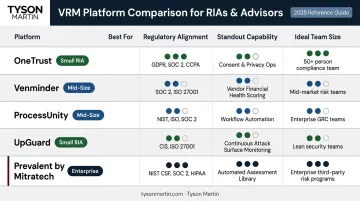
OneTrust's Third-Party Management module is built around privacy, data protection, and regulatory lifecycle management — a strong fit for advisory firms managing client data across multiple vendors. It was named a Leader in the 2026 Gartner Magic Quadrant for Third-Party Risk Management Tools for Assurance Leaders.
| Category | Details |
|---|---|
| Key Features | Lifecycle automation (onboarding to offboarding), dynamic compliance frameworks, continuous monitoring, vendor inventory dashboards |
| Regulatory Alignment | Maps to GDPR, SOC 2, HIPAA, and financial services privacy frameworks |
| Best For | Mid-to-large advisory firms with significant data privacy and governance obligations needing a unified GRC-linked platform |
Standout capability: Rule-based reassessment triggers automate re-reviews when vendor posture changes — reducing the manual follow-up burden on compliance teams.
Venminder (by Ncontracts)
Venminder is purpose-built for regulated financial institutions, including registered investment advisors (RIAs) — a distinction that matters when selecting a platform for a compliance-first environment. Its regulations library explicitly covers FINRA Regulatory Notices 11-14 and 21-29, GLBA, NIST CSF 2.0, and ISO 27001. It was recognized as a 2023 Gartner Peer Insights Customers' Choice for IT Vendor Risk Management in North America.
| Category | Details |
|---|---|
| Key Features | Continuous vendor screening, lifecycle management, contract and document oversight, centralized risk intelligence dashboard |
| Regulatory Alignment | Explicitly covers FINRA regulatory notices and GLBA |
| Best For | Investment advisors, RIAs, and wealth management firms needing a platform designed from the ground up for financial services regulatory environments |
Key differentiator: Continuous screening across cyber, financial, and business risk domains keeps compliance teams informed between formal review cycles — not just at annual assessment time.
ProcessUnity
ProcessUnity is a purpose-built TPRM platform recognized as a Leader in the 2026 Forrester Wave for Third-Party Risk Management Platforms. Its Global Risk Exchange contains 18,000+ pre-validated vendor assessments, which cuts the repetitive assessment work that strains lean advisory firm teams.
| Category | Details |
|---|---|
| Key Features | Full vendor lifecycle (onboarding, assessment, monitoring, offboarding), Global Risk Exchange, AI-assisted evidence review, configurable risk frameworks |
| Regulatory Alignment | Supports DORA compliance and configurable frameworks; confirm SOC 2, FINRA-relevant, and SEC cybersecurity template availability directly |
| Best For | Advisory firms with growing TPRM programs that want automation depth without building everything from scratch |
Standout capability: Dynamic scoping adjusts assessment depth based on vendor criticality — so a custodian gets a deeper review than a marketing email tool, automatically.
UpGuard
UpGuard is a cloud-based VRM platform known for fast deployment and accessible dashboards designed for non-technical compliance staff. G2 ranked it #1 for Third-Party and Supplier Risk Management and a Top 100 Software Company in 2026.
| Category | Details |
|---|---|
| Key Features | Continuous external monitoring, AI-assisted questionnaire automation, remediation workflows, security ratings, board-ready reporting |
| Regulatory Alignment | ISO 27001 risk-mapped questionnaire verified; GLBA content available |
| Best For | Smaller to mid-sized RIA and advisory firms that need a fast-to-deploy platform with strong external monitoring and clear compliance reporting |
Standout capability: Continuous external monitoring flags real-time vendor cyber risks — expired certificates, DNS misconfigurations, data leaks — without waiting for an annual questionnaire cycle.
Prevalent (by Mitratech)
Prevalent is an enterprise-grade TPRM platform combining assessments, continuous monitoring, and AI-assisted due diligence via Prevalent Alfred™, which Mitratech positions as an AI-powered virtual risk advisor for third-party due diligence.
| Category | Details |
|---|---|
| Key Features | End-to-end lifecycle management, AI-assisted due diligence, dark web monitoring, financial and operational risk domains, SLA/performance tracking |
| Regulatory Alignment | Multi-domain monitoring across cyber, business, and financial risk |
| Best For | Mid-to-large advisory firms or enterprise wealth management organizations needing multi-domain vendor risk coverage with mature workflow automation |
Worth knowing: Multi-domain coverage — cyber, financial stability, and business continuity — in a single platform is valuable for advisors assessing custodian resilience alongside cybersecurity posture.
Key Features Investment Advisors Should Prioritize in a VRM Platform
Financial Services Regulatory Compliance Mapping
The platform needs to support frameworks directly applicable to your firm's obligations: Regulation S-P, GLBA Safeguards Rule, and FINRA vendor oversight requirements. Generic ISO 27001 or SOC 2 templates don't automatically map to these.
Ask vendors directly whether their templates address:
- S-P's service provider notification requirements
- FINRA's supervisory procedure documentation expectations
Manual cross-referencing doesn't scale — especially for firms managing 20+ vendor relationships with a single compliance officer. Gaps show up in audits.
Continuous Monitoring Over Periodic Questionnaires
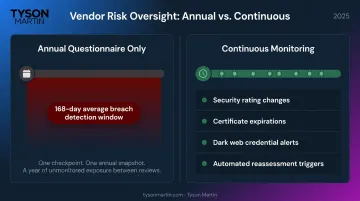
Regulatory frameworks set the floor for what you assess — but they don't protect you between assessments. Vendor risk doesn't stay static between annual reviews. IBM's data shows financial services breaches take 168 days on average to identify. A vendor compromise two weeks after your annual assessment may go undetected for most of the year.
What to look for in continuous monitoring:
- Real-time alerts on security rating changes, certificate expirations, or DNS issues
- Dark web monitoring for compromised vendor credentials
- Automated reassessment triggers when material changes occur
- Threshold-based escalation so compliance teams don't drown in alerts
Board-Ready and Exam-Ready Reporting
SEC examiners expect documented, defensible oversight — not raw data exports. The right platform generates executive-level dashboards showing:
- Complete vendor inventory with risk tiers
- Assessment status and overdue findings
- Remediation progress with owners and deadlines
- Concentration risk (over-reliance on single vendors)
When an examiner walks in, this dashboard is what they pull first. If you can't produce it on demand, the absence itself becomes a finding.
Vendor Tiering and Criticality Scoring
Not all vendors deserve the same scrutiny. Custodians and trading platforms with access to client assets and personal data belong in a different tier than a conference registration tool.
Tier your vendors by asking four questions:
- Does this vendor have production access or admin rights?
- Does it store or process sensitive client data?
- Would a disruption stop operations or trigger a regulatory obligation?
- Is it subject to sub-processor or fourth-party relationships?
Tiering lets lean teams concentrate enhanced due diligence where exposure is highest.
Scalability and Ease of Use for Lean Teams
Most firms underestimate implementation complexity until it stalls rollout. Consider:
- Can compliance staff (not IT) configure questionnaire templates?
- How intuitive is the vendor-facing portal?
- Does the platform automate follow-up reminders and overdue escalations?
- What does onboarding realistically take — days or months?
A platform that requires dedicated IT to configure and maintain will stall quickly at a two-person compliance team.
How We Chose the Best Platforms for Investment Advisors
Evaluation Criteria
These platforms were assessed specifically for:
- Financial services regulatory alignment — explicit coverage of Regulation S-P, FINRA requirements, and GLBA Safeguards Rule
- Compliance mapping depth — questionnaire templates built for regulatory frameworks, not just generic security standards
- Ease of deployment for teams without dedicated IT support
- Continuous monitoring capability — real-time alerts, not just periodic assessments
- Quality of board-level and exam-ready reporting — outputs that hold up under regulatory scrutiny
Common Selection Mistakes Advisory Firms Make
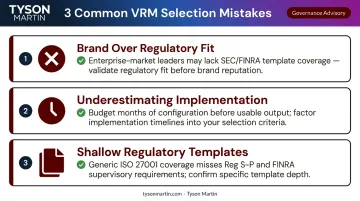
Three patterns consistently lead to poor platform choices:
- Choosing on brand recognition rather than financial services-specific regulatory fit — a platform dominant in general enterprise markets may have weak SEC/FINRA template coverage
- Underestimating implementation complexity — many platforms require months of configuration before they produce usable output
- Overlooking regulatory template depth — generic ISO 27001 or NIST CSF questionnaires don't address Reg S-P's service provider notification requirements or FINRA's written supervisory procedure expectations
The Governance Layer That Software Can't Replace
VRM software provides data infrastructure. It tracks questionnaire responses, security ratings, and contract documents. It cannot define decision rights, assign executive accountability, translate vendor exposure into business impact, or design the governance cadence that makes the program defensible under examination.
That governance layer has to be built before — or alongside — platform selection. Many advisory firms engage a board-level cybersecurity advisor to define selection criteria, establish decision rights, and build oversight structure that the software can then support.
Tyson Martin's vendor risk governance work addresses exactly this gap: the goal is a defensible, inspectable program — not just a software subscription.
Conclusion
Vendor risk management is now a regulatory accountability question for registered investment advisers, not just an operational checkbox. Regulation S-P's service-provider notification requirements, FINRA's supervisory procedure mandates, and the SEC's 2025 exam priorities around outsourcing and cybersecurity make clear that advisors are accountable for what their vendors do with client data.
The right platform matters. Regulatory alignment, scalability for your team size, and the quality of reporting you can produce during an SEC exam or board review should drive that decision — not feature count or sales demos.
Investment advisors who need help defining their vendor risk governance framework, selecting the right platform, or building board-level reporting that holds up under regulatory scrutiny can connect with Tyson Martin. He is a CISSP-certified board advisor with experience across financial services and enterprise risk governance. Reach out on LinkedIn or at tyson.martin@gmail.com.
Frequently Asked Questions
What's the leading vendor risk management tool in compliance software?
There's no single universal leader — the best platform depends on organizational size, regulatory environment, and program maturity. For financial services and compliance-heavy environments, OneTrust, ProcessUnity, and Venminder are frequently cited for their regulatory alignment and workflow depth.
What regulations require investment advisors to manage vendor risk?
The primary obligations come from amended Regulation S-P (service provider notification and written policies), the GLBA Safeguards Rule (service provider oversight by contract), and FINRA Regulatory Notice 21-29 (supervisory systems for vendor-performed functions). Regulators hold advisors accountable for third-party failures affecting client data.
How is vendor risk management (VRM) different from third-party risk management (TPRM)?
VRM typically refers to a narrower focus on supplier cybersecurity and compliance risk, while TPRM covers the broader external ecosystem — including operational, financial, and concentration risk across all third parties. The strongest platforms handle both within a single workflow.
How should investment advisors tier their vendors by risk level?
Tier vendors based on the sensitivity of client data they access, their operational criticality, and their regulatory obligations. Custodians, trading platforms, and data processors typically require the highest scrutiny and ongoing monitoring; lower-risk vendors like marketing tools require less frequent review.
Can smaller RIA firms use VRM platforms without a dedicated IT team?
Yes — platforms including UpGuard and Venminder are designed for lean compliance teams without dedicated IT support, offering pre-built templates, vendor portals, and automated workflows. Initial setup typically requires some configuration, even on the simplest platforms.
How often should investment advisors reassess vendor risk?
High-criticality vendors (custodians, portfolio systems, data processors) should have continuous monitoring with formal reassessments annually or after material changes. Lower-risk vendors may need less frequent reviews. Regulators expect evidence of an ongoing, risk-based program — periodic reviews alone won't satisfy that standard.