Introduction
Most organizations have a vendor risk management program. Far fewer have VRM reporting that actually drives decisions.
The problem isn't a shortage of data. Security teams generate assessments, monitoring alerts, and compliance findings constantly. The problem is that almost none of it gets translated into something leadership can act on. Reports land in inboxes, get skimmed, and generate no response — until something breaks.
The stakes for getting this right have never been higher. According to Verizon's 2025 Data Breach Investigations Report, third-party involvement now accounts for 30% of analyzed breaches — double the rate from the prior year. Meanwhile, regulatory pressure is tightening on multiple fronts, and boards are being held directly accountable for oversight gaps.
This guide covers:
- What VRM reporting actually is and why most programs fall short
- How the 2026 regulatory landscape has reshaped expectations
- The five report types every program needs
- How to tailor reports for each audience
- The metrics worth tracking
- The most common mistakes that undermine otherwise solid programs
Key Takeaways
- VRM reporting converts vendor risk data into decision-ready communication — it's not the same as a vendor assessment
- Third parties now appear in 30% of breaches, and DORA plus SEC rules make board-level VRM reporting a governance requirement
- Good reports show trend over time, not point-in-time snapshots, with every finding tied to an owner, deadline, and outcome
- Tailor reports by audience: operational detail for security teams, business impact framing for executives, trend plus decisions for the board
- The three most common failures: severity inflation, missing ownership, and static snapshots with no directional context
What VRM Reporting Actually Is (and Why It Fails at Most Organizations)
Vendor risk management reporting is the structured process of converting vendor risk data — assessments, monitoring findings, compliance status, remediation progress — into clear, decision-ready communication tailored for specific stakeholders. It is not the vendor assessment itself. The assessment gathers data. The report determines what that data means and who needs to act on it.
The Operational vs. Governance Split
Most organizations produce one type of VRM report: operational. These go to security, compliance, and procurement teams and contain the technical detail those teams need to do their jobs.
What's missing is the governance layer — reports designed for executives and the board that answer a different question: Are we managing vendor risk well enough, and what decisions do we need to make?
Without governance-level reporting, leadership can't exercise meaningful oversight. They see nothing until there's an incident. At that point, "we had a VRM program" is not a defensible position.
Why Most VRM Reports Fail
The core problem is that most reports read like raw data exports. Four patterns show up repeatedly in programs that aren't working:
- No prioritization — findings are listed, not ranked, so everything looks equally urgent
- No business context — technical findings aren't tied to revenue exposure, regulatory risk, or operational impact
- No named owners — accountability is diffuse, so nothing moves
- No change visibility — each report is a static snapshot with no comparison to last period
When 47 findings are all labeled "critical," none get treated as urgent. Risk teams tune out. Executives forward the email without reading it. The problem surfaces as a headline instead of a managed decision.
Good VRM reporting fixes this by connecting vendor risk to business outcomes — not just security metrics — and giving leadership something they can actually act on.
What "Good" Looks Like at a Structural Level
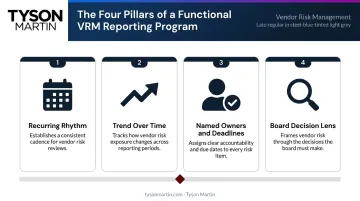
A functional VRM reporting program has a stable, recurring rhythm — not one-off snapshots triggered by audits or incidents. Each report shows trend over time, ties findings to named owners and deadlines, and defines what verified remediation actually looks like. The board view is not an evidence repository. It's a decision lens.
What's Changed in 2026: New Pressures Reshaping VRM Reporting
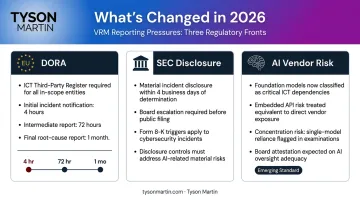
Three regulatory and risk developments have fundamentally changed what VRM reporting must do in 2026.
DORA and Financial Services ICT Reporting
The EU Digital Operational Resilience Act has applied since January 17, 2025, and its third-party risk requirements are detailed. DORA Article 28 requires financial entities to maintain a register of all ICT third-party contractual arrangements, distinguish services supporting critical functions, and report annually to competent authorities on the number and categories of those arrangements.
The incident reporting timelines are strict:
- Initial notification within 4 hours after classification and 24 hours after detection
- Intermediate report within 72 hours
- Final report within one month
US-headquartered firms aren't automatically exempt. If an organization operates an EU-regulated entity — a payment institution, investment firm, or insurance undertaking — that entity falls within DORA's scope regardless of where the parent is headquartered.
SEC Disclosure Rules and the Board Escalation Imperative
Under SEC Form 8-K Item 1.05, public companies must disclose a material cybersecurity incident within four business days after determining it is material. That clock applies to third-party-originated incidents just as much as internal ones.
The enforcement precedent is real. In October 2024, the SEC charged four companies — Unisys, Avaya, Check Point, and Mimecast — with misleading disclosures related to the SolarWinds supply chain compromise, with penalties totaling roughly $7M across the four firms.
The practical implication for VRM reporting: boards must be informed and briefed before a vendor incident becomes a public disclosure. That requires real escalation procedures, not just documentation.
AI Vendor Risk as a New Reporting Category
Traditional VRM questionnaires weren't designed for AI vendors. When a vendor embeds a third-party foundation model into its service delivery, or uses AI tools to process your customers' data, the risk profile changes in ways traditional questionnaires weren't designed to catch.
The evidence reinforces the gap. A Bank of England/FCA survey — reflecting dynamics that parallel US financial services — found that 46% of firms had only a partial understanding of the AI technologies they implemented, and third-party AI implementations account for 33% of AI use cases surveyed. NIST AI 600-1 goes further, explicitly identifying third-party AI components as requiring their own risk mapping:
- Procured datasets and training data
- Pre-trained foundation models
- Embedded software libraries and APIs
VRM reporting programs in 2026 need a dedicated category for AI vendor risk: what models are being used, who owns accountability, and where concentration exists.
The Core VRM Report Types Your Program Needs
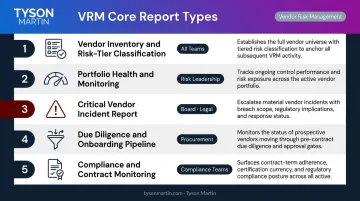
A complete VRM reporting program includes five distinct report types, each serving a different purpose and audience.
1. Vendor Inventory and Risk-Tier Classification Report
This is the foundation: a regularly updated map of all third-party relationships categorized by criticality (high, medium, low) based on data sensitivity, system access, business impact, and regulatory scope.
If this report isn't accurate and current, nothing else in your program is reliable. Refresh it at least quarterly. DORA requires financial entities to maintain and update exactly this kind of register for all ICT third-party contractual arrangements.
2. Portfolio Health and Continuous Monitoring Report
An aggregated view of the current security posture across the vendor portfolio — new vulnerabilities, changes in risk ratings, breach exposure, or policy shifts since the last cycle.
The key word is changed. A report that just shows current state without comparison to the prior period tells leadership nothing about whether the program is working.
3. Critical Vendor Incident and Performance Report
Focused on security events, service disruptions, or compliance failures involving high-risk or business-critical vendors. Includes incident timelines, vendor response quality, and any operational impact.
This report feeds the escalation procedures that DORA and SEC rules require. It should exist before an incident happens, not be created during one.
4. Due Diligence and Onboarding Pipeline Report
Tracks vendor assessments in progress: how many are pending, which have outstanding documentation requests, and what approvals are still needed before onboarding can complete. Risk and procurement leadership use it to manage the intake queue and spot bottlenecks before they delay a business-critical relationship.
5. Compliance and Contract Monitoring Report
Covers upcoming contract renewals, expiring certifications (SOC 2, ISO 27001), and contractual obligations vendors are at risk of missing. PCI DSS v4.0 Requirement 12.8.4 requires monitoring third-party service provider compliance status at least once every 12 months for payment card environments, which sets a reasonable floor for any regulated vendor relationship.
Tailoring VRM Reports to Your Audience
The same finding lands completely differently depending on who reads it. Audience-specific framing determines whether a finding generates action — or gets filed and forgotten.
Technical and Security Teams
This audience needs operational detail: specific control gaps, scan outputs, exploitation paths, and remediation steps with acceptance criteria. Reports for security teams should define what "done" looks like in concrete, verifiable terms — not "remediate the gap" but "implement MFA on all admin accounts and provide a screenshot of the configuration change within 14 days."
Risk and Compliance Teams
Map findings to specific regulatory frameworks. A missing access review isn't just a security gap — it's a specific control requirement under HIPAA, PCI DSS, or DORA depending on the vendor relationship. Translating technical gaps into compliance exposure language turns a security checklist into a compliance narrative that the risk and legal teams can actually use.
Executive Leadership (CEO, COO, General Counsel)
Executives need business impact framing, not security jargon. A cloud provider issue isn't "vendor risk" — it's a threat to uptime, customer experience, and revenue recognition. A marketing SaaS breach is "brand damage plus disclosure risk."
Each material finding gets framed around three factors:
- Likelihood — how plausible is a negative event in the next 12 months
- Impact — what happens to revenue, operations, trust, or legal exposure
- Confidence — how solid is the evidence behind the assessment
When data is thin or self-reported, the report says so. That honesty builds credibility. Each finding should close with a "so what" and a recommended decision — not an open-ended list of problems.
Boards and Audit Committees
Board-level VRM reporting fits in 1 to 2 pages or 2 to 4 slides. The format stays consistent quarter to quarter so directors can spot drift rather than spend meeting time reorienting to a new layout.
The structure Tyson Martin uses follows three layers:
- Coverage and exposure — total critical vendors in scope, how many are out of tolerance vs. last quarter, and concentration risk (top vendors by business impact)
- Change — new critical vendors added, vendors that improved or degraded with the driver, major open actions with owners and due dates
- Decisions requested — one to three items maximum, each with options, a recommended path, and clear ownership
Escalation thresholds should be pre-defined so boards move faster when an incident arrives. Amber triggers cover worsening trends over two consecutive cycles or rising exception counts. Red triggers cover threshold breaches, repeat incidents, or exceptions that expire without closure. When these thresholds are agreed upon in advance, escalation stops being a judgment call made under pressure.
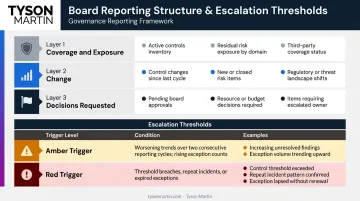
Pre-defined thresholds also shift the board's role from reactive to supervisory — directors can hold management accountable to agreed standards rather than negotiate severity under pressure every time a vendor incident surfaces.
The Metrics That Should Drive Every VRM Report
Coverage and Assessment Metrics
- Percentage of vendors assessed by risk tier
- Percentage with assessments that are current (not expired)
- Number of vendors pending initial assessment
These metrics reveal whether the program has adequate reach. DORA requires a maintained register of all ICT third-party arrangements. PCI DSS requires a documented list of service providers with access to cardholder data. Both set a minimum bar. Programs that wait for an audit to discover gaps are already behind.
Remediation and Accountability Metrics
- Average time to remediation by severity level
- Percentage of findings with an assigned owner
- Number of overdue items by owner or business unit
A finding that appears in the same status across two consecutive reporting cycles is an ownership failure, not a vendor failure. When previously remediated issues resurface, that warrants escalation — the underlying control or process never actually closed the gap.
Portfolio Health Indicators (Board-Relevant)
- Number of critical vendors with findings open beyond a defined threshold (90 days is a reasonable starting point)
- Number of vendors with no recent monitoring activity
- Vendors flagged for concentration risk — where one provider's failure could stop business operations
The board doesn't need visibility into all 200 vendors. The critical tier is typically 10 to 30 vendors by business impact, and concentration risk matters most at that level. A single cloud provider, payment processor, or logistics platform going dark should already have a named owner and a documented response path.
The Most Common VRM Reporting Mistakes (and How to Fix Them)
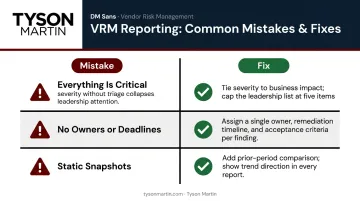
Everything Is "Critical"
When every finding carries the same severity label, nothing gets treated as urgent. Risk teams tune out, executives stop reading, and the program loses credibility before a single finding gets remediated.
Tie severity ratings to business impact — revenue exposure, regulatory obligation, or operational disruption. Present a maximum of five prioritized items to leadership per reporting cycle. If the "critical" vendor list contains 120 names, it's not a tier, it's a catalog.
Findings Without Owners, Deadlines, or Defined Success Criteria
A report that documents a risk without assigning accountability for resolving it is compliance theater. Risks get noted, not mitigated. Exceptions accumulate because no one owns the decision to close them.
Every reported finding needs three things:
- A single accountable owner responsible for resolution
- A remediation timeline tied to severity
- Acceptance criteria defining what verified remediation looks like
"Risk noted" is not an action.
Static Snapshots With No Trend Context
A point-in-time report can look fine while risk quietly grows. Without comparison to the prior period, leadership can't tell whether the program is improving, stalling, or heading in the wrong direction.
Build comparison into the standard reporting template. What is the current finding count vs. last period? What remediation actions closed since the last cycle? Is the overall vendor risk posture trending better or worse? Trend data is what makes reports useful for governance — and it's what boards need to exercise meaningful oversight.
Frequently Asked Questions
What are the steps in vendor risk management?
The core lifecycle follows five stages:
- Identify and categorize vendors by risk tier
- Conduct assessments and score responses
- Verify evidence and close documentation gaps
- Remediate findings with accountable owners
- Monitor continuously, with frequency matched to vendor criticality
High-risk vendors warrant more frequent touchpoints than low-risk ones.
How often should VRM reports be presented to the board?
Quarterly board or audit committee reporting covers portfolio health, top findings, and escalations. Monthly operational reporting goes to risk or compliance leadership. Real-time escalation procedures handle material vendor incidents that can't wait for the scheduled cycle.
What should a VRM report include for an executive audience?
Business impact framing in plain English, a prioritized list of the top five findings, trend comparison to the prior period, a recommended decision or action for each material item, and named accountability for every open finding.
What is the difference between a vendor risk assessment report and a VRM dashboard?
A vendor risk assessment report is a point-in-time document evaluating a specific vendor's controls and gaps. A VRM dashboard provides ongoing, aggregated visibility across the entire vendor portfolio. Both serve different audiences: the assessment is tactical; the dashboard is governance.
How should organizations handle new regulatory reporting requirements in 2026?
Map your current VRM reporting outputs against the specific requirements of applicable frameworks — DORA, SEC disclosure rules, HIPAA, GDPR. Identify gaps in report structure and escalation procedures, then update both to ensure material vendor incidents reach the board within required timeframes before they require public disclosure.
Who owns vendor risk reporting within an organization?
Ownership spans multiple functions: the CISO owns technical findings, risk and compliance leaders own the regulatory narrative, and the CFO or COO may co-own business impact framing. One person — often the CISO or a designated risk officer — must own the consolidated report that reaches leadership. If ownership sits in a shared inbox, it won't close.