Introduction
You have 20 minutes. The room includes a former CFO, two audit committee chairs, a general counsel, and a retired COO. None of them know what a CVE is — and they shouldn't need to.
This is the tension every CISO faces walking into a board meeting: explaining a year's worth of risk decisions to people whose primary concerns are business continuity, legal defensibility, and shareholder value. Most security leaders walk in with slides full of vulnerability counts and acronyms. They walk out having missed the moment entirely.
The problem isn't a knowledge gap on the board's side. A 2025 Gartner survey of 330 non-executive directors found that 90% lacked a measure of confidence in cybersecurity value — not because boards don't care, but because CISOs aren't giving them the right information to act on.
This guide covers:
- What boards actually want from a security briefing
- How to structure your slides for a non-technical room
- Which metrics land — and which ones kill credibility fast
- How to turn a quarterly presentation into a real governance relationship
Key Takeaways
- Boards need three things: where risk stands, how it's being managed, and what decisions they need to make.
- Frame every risk in financial terms — revenue impact, regulatory exposure, operational downtime — not technical severity ratings.
- Five stable board-level metrics beat a deck full of vulnerability counts and alert volumes.
- Always close with a specific ask: budget, risk acceptance, or policy direction.
- Governance is not a single presentation — it requires consistent reporting, escalation thresholds, and pre-meeting alignment.
What Boards Actually Want from a CISO Presentation
It's a Fiduciary Obligation, Not a Status Update
Boards aren't attending a security briefing out of curiosity. They're fulfilling a legal obligation. Directors need to demonstrate they were adequately informed about material risks and that those risks were being managed in a reasonable way — especially in the event of a post-incident regulatory investigation or shareholder litigation.
The SEC's cybersecurity risk management and disclosure rules, effective September 2023, formalized this responsibility. Under Regulation S-K Item 106, public companies must now disclose annually how the board oversees cybersecurity risk and management's role in assessing it. Material incidents must be disclosed within four business days of a materiality determination under Form 8-K Item 1.05.
The enforcement stakes are real. In 2024, the SEC settled charges related to the SolarWinds breach against:
- Unisys — $4M penalty for misleading cyber disclosures
- Avaya — $1M penalty
- Check Point — $995,000 penalty
- Mimecast — $990,000 penalty
- R.R. Donnelley — $2.125M for disclosure and internal-control failures
Boards understand this exposure. Every presentation is part of the record.
The Three Questions Every Board Is Implicitly Asking
Every director in that room wants answers to three questions — even if they never say them out loud:
- Where are we on risk? Has our exposure improved, worsened, or held steady?
- How effectively are we managing it? Is management in control, or are we reacting?
- What do you need from us? Budget, risk acceptance, policy direction?
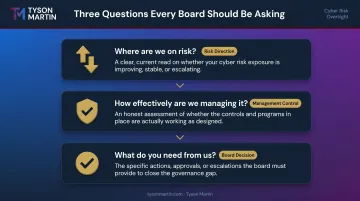
A CISO's job is to answer these questions clearly and drive the board toward a decision. Not to provide a status update. Not to educate the room on threat actors. A decision.
Board Oversight vs. CISO Execution
The boundary between oversight and execution is where most board presentations break down. Boards set risk appetite, fund priorities, and hold leaders accountable. The CISO runs the program, delivers controls, and reports back.
Confusing these roles produces presentations that are either too operational (the board doesn't need patch cycle data) or too vague (a single "we're in good shape" slide doesn't fulfill oversight). Getting the boundary right determines whether the meeting feels like governance or theater.
What to Include in a CISO Board Presentation: Slide-by-Slide
Keep this to 5 slides that remain consistent quarter over quarter. Directors should be able to spot drift and track progress without reorienting to a new format each meeting.
Slide 1 — Risk Posture Summary
Open with a plain-English statement of your current security posture and what changed since the last briefing. The goal: every director understands within 60 seconds whether risk went up, down, or held steady — and why.
A useful structure:
- What changed (directional movement, not a list of activities)
- What it means for the business
- What management is doing about it
- What support is needed from leadership
- What happens if action slips
Avoid vanity metrics here. The posture summary should show movement on things that matter — unresolved gaps around crown-jewel systems, identity coverage on privileged access, third-party concentration risk — not total patch count.
Slide 2 — Priority Risks with Business Impact
Present 3–5 active risks, each tied to a specific business consequence. The translation matters: boards understand revenue disruption, regulatory penalty, operational downtime, and reputational harm. They don't understand "critical vulnerability count."
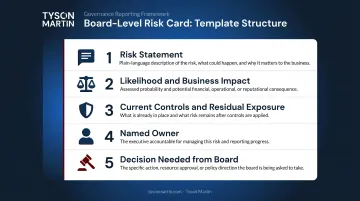
Each risk card should include:
- Risk statement in plain language
- Likelihood and potential business impact
- Current controls and residual exposure
- Named owner (one person, not a committee)
- Decision needed from the board
Slide 3 — Security Posture Trend
Risk cards tell the board where things stand today. This slide tells them whether the program is moving in the right direction.
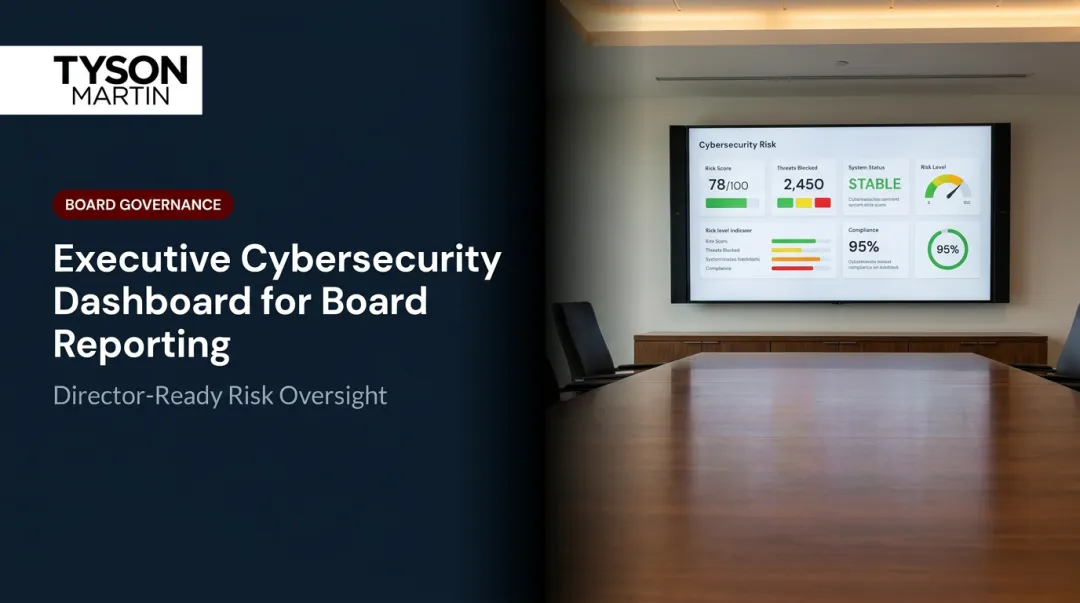
Show consistent metrics quarter over quarter so directors can see whether the program is improving, plateauing, or degrading. A single data point can mislead — a three-quarter trend tells the board whether their investment is working. Use the same dashboard format every meeting; consistency is itself a governance signal.
Slide 4 — Incidents, Near Misses, and Peer Events
Trend data shows direction. This slide grounds it in reality.
Cover significant incidents internally and at comparable organizations — and explain how the company would have fared. Near misses belong here too. Surfacing them proactively builds credibility; hiding them until something worse happens destroys it.
NACD's 2026 cyber guidance notes that boards cannot oversee cyber risk effectively when they only hear about incidents after the fact or during a crisis.
Slide 5 — Decisions Required and 90-Day Forward Plan
This slide separates a passive briefing from a governance conversation. Explicitly surface the decisions that belong to the board:
- Budget approvals
- Risk acceptance with time limits
- Policy direction
- Tradeoffs when resources are constrained
Follow with a 90-day forward plan: named owners, milestone dates, measurable outcomes. Accountability must be visible and specific.
How to Translate Cyber Risk into Business Language
The Core Reframe
Cybersecurity is not a technology problem. It's a business risk with technology dimensions. Every security concept must map to one of the currencies boards already track: money, uptime, legal exposure, and brand trust.
Instead of: "Identity controls are weak in the cloud admin layer." Say: "A compromised admin account could disrupt core systems, delay customer orders, and increase legal exposure if sensitive data is accessed."
The formula is: "Because we improved X, we reduced the chance of Y, which protects Z."
Quantifying Risk in Financial Terms
IBM's 2024 Cost of a Data Breach report gives CISOs a starting framework — not slide-ready numbers, but anchors for building your own estimate:
- Global average breach cost: $4.88M
- Financial-sector average: $6.08M (22% above the global mean)
- Industrial unplanned downtime: up to $125,000 per hour
Present impact in directional ranges — likely low, likely high — tied to your specific environment. False precision creates false comfort; ranges that acknowledge uncertainty are both more defensible and more credible in the boardroom.
NACD's board-level metrics guidance calls on boards to ask for the financial impact of top risks — productivity loss, incident-response costs, regulatory exposure — and to evaluate whether spend aligns with probable risk-scenario frequency.
First-, Second-, and Third-Order Harms
A ransomware attack isn't just downtime. The damage compounds in layers:
- First-order: Operational disruption, recovery costs (MGM disclosed approximately $100M in negative EBITDAR impact from its 2023 incident)
- Second-order: Customer trust erosion, regulatory scrutiny, contract penalties
- Third-order: Reshaped culture, leadership changes, lasting competitive disadvantage (Equifax's FTC settlement reached at least $575M)
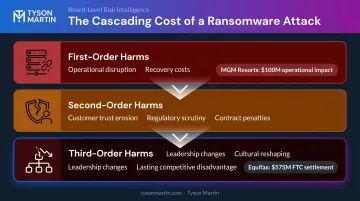
Even an incident that never makes headlines can trigger second- and third-order consequences that outlast the technical recovery by years. That's the case for proactive investment, not reactive spending.
Handling Sensitive Topics
Near misses, internal failures, and budget shortfalls all belong in the board briefing — but framed against one standard: share what the board needs to make a defensible decision, not everything the security team knows.
Every risk disclosed should come with a proposed mitigation, a cost estimate, and a clear recommendation. Directors who receive problems without options disengage. Directors asked to choose between defined paths stay invested — and accountable.
The Right Metrics for Board-Level Reporting
Governance Metrics vs. Operational Metrics
The distinction is simple: operational metrics tell the security team how to work; governance metrics tell the board whether the organization is safer.
| Operational (stays with the team) | Governance (goes to the board) |
|---|---|
| Number of alerts fired | Time to detect and contain a material incident |
| Patch count | Critical vulnerability remediation time on crown jewels |
| Phishing emails blocked | Detection coverage on key attack paths |
| Audit findings closed | Residual risk movement on top risks |
| Policy completion rates | Control coverage on highest-value systems |
The Five Board-Level Metrics That Matter
- Material risk reduction — Top 5 risks ranked, with movement over time and next decision needed
- Time to detect and contain — Express this as "how long you're exposed," not a raw MTTD/MTTR figure directors won't recognize
- Critical control coverage — MFA for privileged access, EDR on key servers, backup integrity on critical data
- Security debt burn-down — Track size, age, and closure pace on known prioritized gaps
- Third-party exposure — Percent of critical vendors with current reviews and tested incident paths
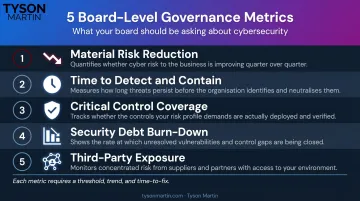
Every metric needs three elements: a threshold (what's acceptable), a trend (improving or degrading), and a time-to-fix (how long risk stays open). Without a defined threshold, directors have no basis to challenge the number or approve a response.
Consistency Is the Point
Once you've established these five metrics, keep the format stable. Using the same dashboard definitions quarter over quarter lets directors compare trends rather than re-orient to a new layout. NACD reports that 71% of respondents had cybersecurity on the audit committee agenda every quarter, with cybersecurity ranking as the primary audit committee priority for 50%. That cadence only produces value if the reporting format stays stable enough to reveal drift.
CISO Board Presentation Mistakes to Avoid
Mistake 1: Leading with Technical Detail
Vulnerability counts, patch rates, and tool configurations don't belong on the opening slide. They can live in an appendix — available if a director asks — but the main briefing must connect every data point to a business outcome.
The fastest way to lose a board's attention is to force them to decode technical language before they understand why it matters. Technical fluency is a CISO credential, not a presentation format.
Mistake 2: Reporting Activity Instead of Outcomes
Showing how many phishing emails were blocked or accounts provisioned tells the board what the team did. That doesn't answer whether the organization is actually safer.
The right question is whether risk went up or down — and by how much. Every metric on the slide should answer that directly. Anything that can't is activity data dressed up as governance reporting.
Mistake 3: Presenting Without a Clear Ask
Boards expect to be asked for decisions. A CISO who presents without a specific request leaves the board with no role to play — and no reason to fund or champion the program.
Every briefing should close with explicit asks:
- Approve this budget line before the next quarter
- Accept this residual risk for 90 days while remediation completes
- Assign accountability for this governance gap to a named owner
Without a specific request, the board has nothing to act on — and a presentation without action is just a status update.
Turning a One-Time Presentation into Continuous Board Governance
Presentation vs. Governance
A quarterly presentation is an event. Governance is an ongoing relationship built on clear decision rights, consistent reporting, and escalation thresholds that hold when a real incident hits.
The mechanics of sustainable governance:
- Hold pre-meeting one-on-ones with committee members to surface concerns before the formal session — no surprises in the room
- Maintain a consistent reporting format so directors track trends rather than relearn the structure each quarter
- Define escalation thresholds that specify exactly when the board gets notified and what decision they'll be asked to make
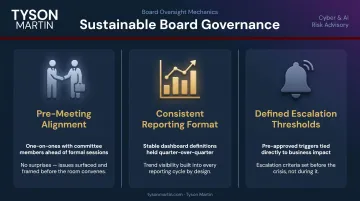
Escalation triggers should be pre-approved, measurable, and tied to business impact: incidents affecting crown-jewel systems, downtime exceeding agreed tolerance, confirmed exposure of regulated data, or any situation requiring risk acceptance beyond management authority.
Organizations in Transition
New leadership, M&A activity, post-incident recovery, and regulatory scrutiny all share one thing: the board reporting framework is either absent or broken precisely when it matters most.
Each scenario breaks governance in a different way — M&A creates ownership gaps, post-incident recovery shifts reporting to containment status, and CISO transitions leave boards without continuity in the metrics they've been tracking. In every case, the infrastructure needs to be rebuilt quickly and built right.
An advisor who knows what board-ready governance looks like can establish it in 30–60 days rather than 6–12 months. Tyson Martin works with organizations as a board advisor or interim CISO to build the reporting infrastructure, decision rights, and escalation frameworks that make presentations credible and defensible — including coaching CISOs on board delivery, aligning language with the CFO and general counsel, and running Q&A prep before high-stakes meetings.
The Real Goal
No CISO should be walking out of a board meeting hoping for applause. The measure of a successful board relationship is cleaner audit trails, faster escalation when an incident hits, and a board that is genuinely equipped to fulfill its oversight responsibility — not one that's been reassured and sent home.
Build that infrastructure now, and the next high-stakes meeting becomes a decision — not a performance.
Frequently Asked Questions
What is the CIO presentation to the board of directors?
A CIO board presentation covers technology strategy, infrastructure investment, and digital transformation priorities. It overlaps with the CISO's briefing around infrastructure risk and vendor exposure, but differs in that the CIO typically owns IT delivery and cost, while the CISO owns risk posture and security outcomes.
Should a CISO report to the CIO or CEO?
Both structures are common. ISC2 data from 2024 shows roughly one-third of US CISOs report to the CIO, with only 3% reporting directly to the CEO. The regulatory trend favors more independent reporting — when the CISO reports through the CIO, pressure to prioritize technology delivery over security can compromise the objectivity of board communications.
What should a CISO board presentation include?
Five core elements — everything else belongs in the appendix:
- Plain-English risk posture update
- Priority risks tied to specific business consequences
- Trend metrics on a consistent dashboard
- Incidents and near-misses, including peer events
- Explicit decisions required from the board
How often should a CISO present to the board?
Most CISOs present to the full board once annually and to the audit or risk committee quarterly. The committee updates are the substantive governance touchpoints — where real decisions get made. Annual full-board presentations tend to be higher-level and shorter.
How long should a CISO board presentation be?
15–20 minutes of presentation, with time reserved for discussion. Use a brief executive summary up front and a detailed appendix for follow-up questions — directors should be able to read the summary in under two minutes and leave knowing the three things they need to act on.
What metrics should a CISO present to the board?
Governance-level metrics only: security maturity trend, time to detect and contain incidents, critical control coverage on highest-value systems, security debt burn-down rate, and third-party exposure on critical vendors. Alert volumes, patch counts, and phishing click rates belong with the security team — not on the board slide.