
Introduction
Most cybersecurity briefings fail in one of two ways. The first: security leaders walk into the boardroom and lead with vulnerability counts, acronyms, and technical jargon — CVE identifiers, SIEM coverage rates, EDR telemetry — leaving directors to do the translation themselves. They won't, and they shouldn't have to.
The second failure is the opposite: vague reassurances. "We passed the audit, so we're good." "We've got it handled." These statements sound confident but carry no evidence, no trend, and no decision.
Both patterns share the same result: boards cannot govern what they cannot understand. Directors leave the room without the information needed to make decisions, accept tradeoffs, or hold management accountable.
This guide is for boards, audit and risk committees, and CISOs who want something better. It covers how to structure briefings that produce real decisions, what metrics actually support governance, and how to frame risk so the board can act on it — not just file the deck and move on.
Key Takeaways
- Translate cyber risk into financial and operational impact — not vulnerability counts or patch rates
- Every briefing needs three anchors: what changed, what it means for the business, and what decision the board must make
- Cadence is a governance signal: quarterly comprehensive briefings at minimum, with ad hoc updates for material incidents
- Governance structure — decision rights, escalation thresholds, and roles — must be documented before an incident, not improvised during one
Why Board-Level Cybersecurity Briefings Matter More Than Ever
The stakes for board cybersecurity oversight have shifted from best practice to legal requirement.
Since 2023, SEC rules require public companies to disclose their board-level cybersecurity oversight practices annually via Form 10-K (Regulation S-K Item 106). Boards must describe who oversees cybersecurity risk and how. Separately, Form 8-K Item 1.05 requires disclosure of material cybersecurity incidents within four business days of a materiality determination. These are enforceable requirements; compliance dates began December 2023 for most registrants.
Three pressures now converge on every board:
- Regulatory exposure: SEC disclosure rules are in effect, with annual Form 10-K oversight descriptions and four-day incident reporting windows that regulators can examine
- Financial exposure: IBM's 2024 Cost of a Data Breach Report puts the global average breach cost at $4.88 million — a 10% increase year over year
- Investor exposure: ISS incorporates cybersecurity governance factors — briefing frequency, director security expertise, supply chain risk practices — into its Governance QualityScore assessment, directly affecting investor perception and shareholder value
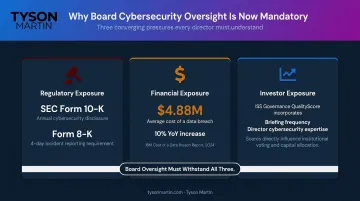
Taken together, these pressures mean board cybersecurity oversight must be substantive enough to withstand regulatory review, investor scrutiny, and post-incident examination — not just a standing agenda item that produces no decisions.
What to Cover in Every Board Cybersecurity Briefing
Current Risk Posture — What Changed Since Last Briefing
The highest-value framing is delta-focused. Boards govern direction and magnitude, not operational specifics. A static data dump — here's our current vulnerability count, here are our active threats — gives directors no basis for judgment.
The right question isn't "where do we stand?" It's "what changed, and is the trend moving in the right direction?"
Core elements of risk posture coverage:
- Controls strengthened, risks reduced, and initiatives completed since the last briefing
- New exposures, missed milestones, or rising threat activity that degraded posture
- Threats that increased in relevance since the prior session
- Top threats facing the organization and its sector
- Current exposure relative to defined risk appetite — inside or outside agreed thresholds?
Structuring the update this way lets boards track trends across quarters. It creates a governance conversation rather than a briefing they have to decode.
Business Impact Translation
Boards speak the language of revenue, regulation, reputation, and fiduciary responsibility. Every risk concept must be translated into those terms before it enters the boardroom.
The translation exercise in practice:
Instead of: "We have 47 unpatched critical vulnerabilities."
Say: "Our top unresolved exposure could allow an attacker to access our customer payment systems. The estimated financial impact of that scenario ranges from $X to $Y, including downtime, regulatory penalties, and notification costs."
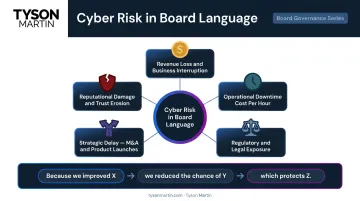
The five business impact lenses boards readily act on:
- Revenue loss and business interruption
- Operational downtime and its cost per hour
- Regulatory and legal exposure
- Strategic delay (product launches, M&A timelines)
- Reputational damage and trust erosion
Tyson Martin's translation framework follows a clear pattern: "Because we improved X, we reduced the chance of Y, which protects Z." This structure connects technical controls to outcomes boards already track.
Third-Party and Supply Chain Risk
Third-party risk cannot be treated as a secondary topic. Verizon's 2025 Data Breach Investigations Report found third-party involvement in 30% of breaches — up from roughly 15% the prior year, across more than 22,000 incidents analyzed.
What the board needs to see:
- Which critical vendors are being actively monitored
- Current posture of high-risk dependencies (not a full vendor list — a focused critical-vendor tier of 10–30 vendors)
- Any vendors requiring board-level attention or contractual action
- Open exceptions with owners and expiration dates
Every top vendor risk should be paired with a decision path: accept, reduce, transfer, or replace — with a named owner. A critical vendor is any third party whose failure could materially disrupt a core business service, expose sensitive data, or create significant compliance or financial impact.
Program Health and Resource Adequacy
Boards approve budgets when they understand what risk they are buying down — not what technology they are acquiring.
Program health elements to cover:
- Budget adequacy relative to the current risk profile
- Staffing levels and gaps in critical expertise
- Framework alignment — NIST CSF 2.0 is well-suited for board communication, with clear current-state/target-state gap analysis
- Cybersecurity insurance coverage, limits, and any exclusions relevant to top exposures
Frame every investment request in risk-reduction terms: "This investment reduces our exposure in X scenario by an estimated $Y" lands differently than a line-item technology budget.
Decisions Required of the Board
Every briefing should end with named decisions. A summary of what was covered is not a close.
Common board-level cybersecurity decisions:
- Approving updates to the risk appetite statement
- Authorizing a significant security investment (framed in risk-reduction terms)
- Ratifying a revised incident response or disclosure policy
- Formally delegating a decision category to management with defined thresholds
- Approving vendor risk exceptions that exceed management authority
This discipline prevents briefings from functioning as information sessions only. Named decisions create traceable governance accountability — and satisfy the SEC's requirement that oversight be substantive, not performative.
How to Communicate Cyber Risk in Board Language
The foundational principle: boards govern revenue, regulation, reputation, and fiduciary responsibility. CVEs, kill chains, and MITRE ATT&CK belong in operational security discussions, not the boardroom. Every risk concept needs translation before it gets to directors.
Use Stable Visual Dashboards, Not Raw Metrics
A well-designed dashboard showing directional movement — improving, stable, or degrading across a small set of key risk categories — gives boards what they need to govern. The goal is 8–12 metrics maximum, with five core outcome metrics that stay stable across quarters.
Recommended dashboard categories:
- Resilience — backup restore test results, actual restore times in drills
- Identity — privileged account MFA coverage, stale admin accounts removed
- Detection and response — time to detect, time to contain, repeat incident causes
- Third-party — percent of critical vendors with current assurance, open high-risk gaps
- Vulnerability — time to patch critical issues on priority systems (not enterprise averages)
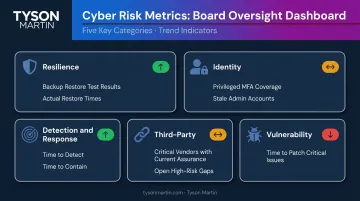
Each metric should include a trend arrow (improving / stable / worsening) and a threshold that triggers escalation. A single month can be misleading — a three-month trend tells the board whether risk is actually moving in the right direction.
Cyber Risk Quantification
Expressing cyber risk in financial terms gives boards the information they need to make resource decisions confidently. The FAIR model — Factor Analysis of Information Risk — provides a recognized quantitative framework for translating security exposures into dollar-range estimates.
Ranges that support decisions ("this scenario carries a potential financial impact of $500K–$2M") are more actionable than a single-point estimate that implies false precision. The goal is directional clarity, not actuarial accuracy.
The Plain-Language Test
Quantification prepares the numbers. Plain language prepares the room. If the presenter cannot describe the organization's top cyber risk in two sentences without using a technical term, the briefing is not board-ready.
That's a preparation discipline — it doesn't mean simplifying the underlying analysis. It means doing the translation work before you walk in the room.
The board's job is to make decisions. The presenter's job is to walk in with a clear analysis and a recommendation — not to present data and wait for directors to draw their own conclusions.
Governance Structure: Who, How Often, and What Decisions
Assigning Oversight Responsibility
Best practice is designating a specific committee — audit, risk, or a dedicated cybersecurity subcommittee — as the primary cybersecurity oversight body. The SEC requires companies to identify any board committee responsible for cybersecurity oversight in their Form 10-K disclosures.
Structure matters less than clarity on three points:
- Clear ownership: one committee holds formal responsibility, with no ambiguity about who that is
- Cybersecurity-literate director: at least one member who can provide informed challenge, not just receive updates
- Charter language with teeth: documented scope and cadence, not a vague mandate
Neither the full board model nor the committee model is inherently superior. What breaks governance is ambiguity about who owns it.
Establishing the Right Cadence
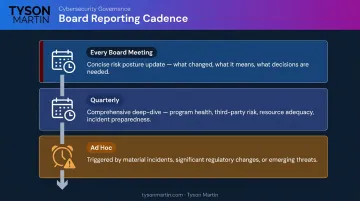
NACD's 2026 Director's Handbook identifies a Cyber-Risk Brief as a standing agenda item for every board meeting, with quarterly deep-dive sessions as a separate governance touchpoint.
At minimum:
- Every board meeting — a concise risk posture update (what changed, what it means, what decisions are needed)
- Quarterly — a comprehensive deep-dive covering program health, third-party risk, resource adequacy, and incident preparedness
- Ad hoc — triggered by material incidents, significant regulatory changes, or emerging threats that materially affect the organization's risk posture
Annual board tabletop exercises build firsthand understanding of how the organization responds under incident pressure — that's not a luxury, it's a governance requirement.
Defining Decision Rights and Escalation Thresholds
The most common governance failure is ambiguity about which decisions the board makes versus which it delegates to management. Under incident pressure, that ambiguity doesn't just slow things down — it produces the wrong decisions by the wrong people.
Decision categories that must be pre-defined in policy:
- Who can accept risk, and at what threshold does it require board visibility?
- Who approves security exceptions, for how long, and with what evidence?
- Who declares incident severity, and who can authorize shutting down systems?
- Who speaks externally during an incident — and who approves that communication?
- What budget reallocations require board authorization versus management discretion?
Building this governance layer is structural work — defining escalation thresholds, assigning explicit decision ownership, and creating a framework the board can actually inspect. A board advisor or interim CISO engagement can close these gaps quickly, because the blind spots are typically invisible to both the board and the internal security team when each is operating within its own scope.
Building Productive Board-CISO Dialogue
Private sessions between the board or committee and the CISO — without management in the room — build the trust necessary for candid conversations about risk and resource gaps. Directors need a channel where the CISO can be direct about what's working, what isn't, and where the organization is genuinely exposed.
What makes these sessions productive is specificity: not status theater, but direct conversation about resource gaps, unresolved risk decisions, and the difference between what the board has been told and what is actually true. That kind of dialogue changes what gets escalated — and how fast.
Incident Escalation and Disclosure Protocols
The governance principle: escalation thresholds and board notification protocols must be documented before an incident occurs. Boards that first learn about a material incident from media coverage have a governance failure — not just a security failure.
What must be pre-defined:
- Who can approve containment actions that may disrupt systems
- When to engage outside counsel and cyber insurance carriers
- Who speaks externally and who owns customer communications
- What the board chair needs in the first update (summary, current impact, actions underway, next update time)
- What constitutes a material incident requiring board notification
The SEC's four-business-day window under Form 8-K Item 1.05 runs from the point a materiality determination is made, with that determination required "without unreasonable delay" after discovery. Boards need to know in advance: how will they be informed, by whom, and what role do they play in the materiality determination itself?
Post-incident review closes the loop. Require formal reviews that assess what was learned, what changed, and what improved. That record — documented and acted on — is what demonstrates to regulators and investors that board oversight didn't stop when the incident did.
Frequently Asked Questions
Frequently Asked Questions
How often should the board receive cybersecurity briefings?
Best practice is a risk posture update at every board meeting, with quarterly deep-dive sessions covering program health, third-party risk, and investment adequacy. Ad hoc sessions should be triggered by material incidents, significant regulatory changes, or emerging threats that affect the organization's exposure.
What is the difference between a cybersecurity briefing and a cybersecurity report?
A report is a document summarizing program status. A briefing is an interactive governance conversation designed to surface decisions and provide directional oversight. The best briefings use a written report as a reference document, but focus the live session on dialogue and decisions.
What metrics should be included in a board-level cybersecurity briefing?
Boards are best served by trend-based metrics showing direction: risk posture movement over time, incident counts and severity trends, third-party risk status, and program investment versus measurable risk reduction. Granular operational metrics — patch percentages, alert volumes, tool coverage rates — belong in security team reviews, not board briefings.
Who should present the cybersecurity briefing to the board?
The CISO is typically the primary presenter. Where internal expertise is limited, or where an independent perspective strengthens credibility, a board advisor or external cybersecurity expert supports the process — either by coaching the CISO on board-ready communication or presenting directly to the committee.
What is the 80/20 rule in cybersecurity?
The 80/20 principle holds that a focused set of high-impact controls addresses the majority of meaningful risk. For boards, this means concentrating oversight on the highest-consequence risks — those that could materially disrupt the business — rather than governing every technical detail equally.
What are the 5 P's of cybersecurity?
The 5 P's framework — People, Processes, Policies, Platforms, and Perimeter — gives boards a quick lens for assessing whether a security program covers the human, procedural, and technical dimensions of risk. It's a useful practitioner heuristic, though NIST CSF 2.0's six functions (Govern, Identify, Protect, Detect, Respond, Recover) provide the more authoritative governance structure.