
Introduction
Cybersecurity has earned a permanent place on the board agenda. The problem is that most briefings still don't produce what boards actually need: clear oversight, defensible decisions, and genuine confidence in the organization's risk posture.
Research from MIT and Harvard Business Review found that nearly half of directors feel unprepared for a targeted cyberattack — despite most boards having at least one cyber expert. The briefings are happening. The outcomes aren't.
This guide covers what actually changes that dynamic:
- The five content areas every effective briefing needs
- How to translate cyber risk into plain business language
- How to build a dashboard that shows trajectory, not noise
- How to structure decision rights so the board can govern, not just listen
Effective board cyber briefings are not about impressing directors with technical depth. They are about producing three outcomes: clear oversight, credible reporting, and defensible decisions. Everything else is theater.
Key Takeaways
- Most board cybersecurity briefings fail because they report security activity rather than business risk
- Every briefing should cover five topics: threat landscape, program posture, regulatory exposure, third-party risk, and incident readiness — each framed as a board-level concern
- Translate every cyber risk into financial exposure, operational disruption, or regulatory liability — not technical metrics
- Board dashboards should show trend over time, not point-in-time snapshots
- Decision rights and escalation thresholds must be defined before an incident occurs
Why Most Board Cybersecurity Briefings Fall Flat
The pattern shows up consistently: a CISO walks into a board meeting with 40-plus slides covering vulnerability counts, threat actor profiles, CVSS scores, and heat maps. Directors leave informed about security activity but unable to make a single meaningful governance decision.
This is sometimes called the "47-slide problem," and it's a recognized failure mode among practitioners .
Two Different Languages in the Same Room
The core issue is structural. Security leaders are trained to present posture metrics. Boards are trained to govern risk through the lens of financial exposure, regulatory liability, competitive standing, and fiduciary duty. Neither group is wrong — but the briefing format rarely bridges the two frames of reference.
A 2023 NACD/WSJ Pro study found that only three in ten directors rated their board's ability to oversee a cyber crisis as high — even though more than three-quarters of those boards had at least one cyber expert. Having the expertise in the room doesn't guarantee governance quality.
What Underperforming Briefings Actually Look Like
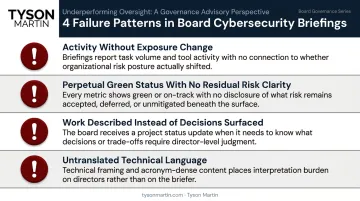
Based on common patterns across board engagements, a typical underperforming briefing has several recognizable features:
- Reports activity completed — tools deployed, patches applied, training finished — without showing how exposure changed for critical systems
- Stays green for months while the actual risk picture remains unclear; no one can explain what residual risk exists after controls
- Describes work done rather than surfacing risk choices that require board approval
- Uses technical language without translation, leaving directors to interpret security concepts they weren't trained to evaluate
The downstream consequences are concrete: boards without clear briefings struggle to ask productive questions, justify budgets, or document meaningful oversight in annual reports and regulatory filings. When a breach occurs or regulators ask for evidence of governance, those gaps surface fast.
Five Topics That Belong in Every Board Briefing
A structured briefing isn't about covering everything — it's about covering the right things consistently. These five areas form a stable framework that gives directors what they need to govern.
1. Threat Landscape and Risk Profile
This section should answer one question above all others: what changed since the last briefing?
Abstract threat descriptions don't produce decisions. Connecting the current threat environment to specific potential impacts does — revenue disruption, operational downtime, regulatory exposure, reputational harm.
Sector-specific context matters here. The threat facing a regional bank looks different from the threat facing a healthcare system or a retail chain, and the briefing should reflect that distinction.
2. Current Program Posture and Resource Adequacy
Boards need enough context to judge whether resources are proportionate to risk. That means covering:
- Governance structure and who owns accountability at each level
- Budget and headcount adequacy relative to the organization's risk profile
- Alignment to recognized frameworks (NIST CSF 2.0 is the current standard)
- Status of external providers and any priority initiatives
The framing that works best at the board level: who decides, how do you know (with evidence), and how do you improve. Framework alignment should be presented as a roadmap — where the organization is, where it's going, and what the gaps cost in risk terms.
3. Regulatory and Legal Exposure
For public companies, this topic carries direct fiduciary weight. The SEC's 2023 cybersecurity disclosure rules created two concrete obligations:
- Form 8-K Item 1.05: Material cybersecurity incidents must be disclosed generally within four business days of the materiality determination
- Annual 10-K Item 106: Companies must describe board oversight of cybersecurity risks and management's role in assessing and managing cyber threats
SEC enforcement in 2024 made clear this isn't theoretical — Unisys, Avaya, Check Point, and Mimecast were each charged with misleading disclosures related to a single cyber incident, with penalties ranging from $990,000 to $4 million. R.R. Donnelley faced a separate $2.125 million civil penalty after the SEC found its disclosure controls weren't designed to escalate incident information to decision-makers in time.
ISS Governance QualityScore also specifically asks how often senior leadership briefs the board on information security — making briefing frequency a visible governance signal to institutional investors.
4. Third-Party and Supply Chain Risk
This topic has moved from optional to essential. The 2024 Verizon Data Breach Investigations Report found that 15% of breaches involved a third party — a 68% increase from the prior year.
At the board level, third-party risk reporting should stay focused:
- Which vendors, if they failed, could materially disrupt a core business service or create significant regulatory exposure?
- What does the oversight approach look like, and what's the trend?
- Where are contractual protections, insurance coverage, or active remediation in place?
The board doesn't need a full vendor catalog. It needs a short critical-vendor tier — typically 10 to 30 vendors — with clear exposure, trend direction, and decision options for the highest-risk relationships.
5. Incident Readiness and Response Preparedness
Three questions cut through to whether resilience is real:
- Which operations can we tolerate going down, and for how long?
- Who makes decisions during an active incident, and how fast?
- What evidence shows resilience is actually improving — not just that activity is occurring?
Tabletop exercises answer these questions directly — but only when designed as decision drills, not technical demonstrations.
A 60-minute board-level tabletop should force real calls under limited information, test escalation authority, and surface role gaps before an actual incident does it under pressure.
How to Speak the Board's Language: From Technical to Business Risk
The CISO's job in a board briefing is not to educate directors on cybersecurity. It's to connect every cyber risk to the business consequences the board already governs. Terms like CVSS scores, dwell time, and EDR versus XDR have no place in a board briefing slide.
A Practical Four-Part Framing Model
For each material risk, structure the communication this way:
- What is the risk? One plain sentence, no jargon.
- What does the business impact look like if it materializes? Revenue, downtime, legal exposure, customer harm.
- What is currently being done about it? Specific actions, not general assurances.
- What is the board being asked to do? A decision, ratification, risk acceptance, or directive.
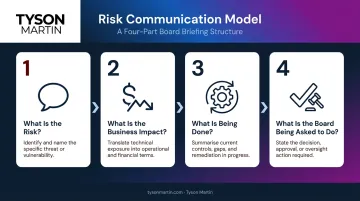
This structure turns reporting into governance. Without a clear ask at the end, directors have no way to distinguish a briefing from a status update.
Reporting Risk vs. Reporting Activity
The distinction matters more than most briefings acknowledge:
- Dashboards land when boards need directional orientation — not granular operations data
- Heat maps work when a decision is on the table
- Alert volumes only belong in the room when operational risk context is the explicit topic
The question a board briefing should answer is "are we going to lose revenue if a critical supplier goes down?" — not "did we patch 94% of vulnerabilities this quarter?"
AI as a Specific Communication Challenge
Translating that question-first discipline gets harder with AI threats — because the technology moves faster than most board vocabularies. AI-driven threats require plain-language treatment in every briefing. The UK's National Cyber Security Centre assessed in 2024 that AI will "almost certainly" increase the volume and impact of cyberattacks, with threat actors already using it for reconnaissance, phishing, and faster vulnerability exploitation.
Boards need to understand two dimensions:
- On the threat side: phishing is more convincing, exploitation is faster, and attackers who previously lacked sophistication now have fewer barriers to entry
- On the defense side: AI improves detection, accelerates triage, and identifies malicious content at a scale no human analyst team can match
The IBM 2024 Cost of a Data Breach Report found that organizations extensively using security AI and automation saved an average of $2.2 million compared to those that didn't. That's a financial framing boards can evaluate.
Tone and Structure
Lead with the risk posture summary and what changed — not with a program overview. End with a clear ask. If a director walks out unsure whether they just heard a status update or a governance decision, the briefing failed — regardless of how thorough the content was.
Building a Board Cybersecurity Dashboard That Shows Trend, Not Trivia
A board-level dashboard serves one purpose: giving directors a consistent view that lets them ask "are we better protected than six months ago?" — not "what does this number mean?"
What Goes on a Board Dashboard
Keep it to five to eight metrics, stable across every briefing. Appropriate categories include:
| Category | What It Shows |
|---|---|
| Risk posture trend | Direction of overall exposure over rolling periods |
| Critical asset exposure | Coverage and gaps on the organization's highest-value systems |
| Incident response readiness | Tested recovery times, escalation speed, tabletop completion |
| Compliance status | Material gaps and remediation trajectory |
| Third-party risk | Trend on critical vendor exposure |
| Security investment alignment | Whether spend matches the risk profile |
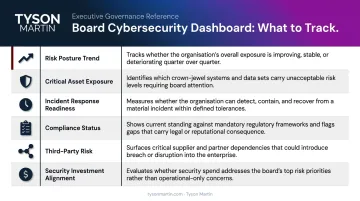
Each metric needs three elements to be board-ready: a threshold (what's acceptable), a trend line (direction over time), and a time-to-fix indicator (how long risk stays open).
Board Dashboard vs. CISO Dashboard
The distinction is straightforward:
- Board dashboard: Outcome metrics, trend lines over rolling periods, clear escalation thresholds, "what changed and why" narrative for any metric that shifted significantly
- CISO dashboard: Activity metrics, operational counts, tool-level data, patching percentages, alert volumes
If a metric doesn't change a decision, allocate resources, or trigger action, it belongs at the management level — not on the board's page.
Building This Framework Quickly
Organizations that struggle to build or maintain a consistent board reporting cadence benefit from an outside perspective. Tyson Martin's board advisory work produces a stable, decision-ready reporting baseline within the first 30 days of an engagement, with a full operating rhythm established by day 90.
Clarifying Decision Rights: What the Board Owns vs. What It Delegates
Without defined decision rights and escalation thresholds, cyber oversight becomes performative. Boards review reports with no clear framework for when to intervene, what they must approve, and what belongs to management. That ambiguity is most dangerous during an active incident, when the cost of negotiating authority is measured in hours.
The Board's Decisions vs. Management's Decisions
| Board Owns | Management Owns |
|---|---|
| Approving the organization's cyber risk appetite | Day-to-day security operations |
| Setting materiality thresholds for incident disclosure | Tactical risk prioritization |
| Approving major security investment above defined levels | Vendor selection and program execution |
| Ratifying the incident response framework | Exception management and remediation |
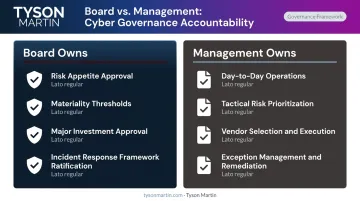
The most common gaps in practice:
- Unclear risk acceptance authority — lets material risks accumulate without board visibility
- Undefined escalation triggers — costs critical time when an incident is already in motion
- Informal policy exceptions with no expiry — create silent liability the board never sees
Escalation Thresholds as a Governance Tool
The board should have pre-agreed criteria defining what triggers a board-level notification or emergency session — not improvised calls made mid-crisis. A practical tiered model:
- Management resolves: Limited local impact, within policy parameters
- Executive approval required: Impact on critical processes, time-limited exposure
- Board escalation triggered: Risk of material outage, regulated data exposure, or potential SEC disclosure obligation
These thresholds should be tested through tabletop exercises. Boards that have never rehearsed the escalation path will negotiate authority in real time — during the hours that matter most.
Getting the Format, Frequency, and Presenter Right
Briefing Frequency
Quarterly updates work for most organizations, with ad hoc sessions triggered by:
- Material incidents or near-misses
- Significant changes in the threat environment
- New regulatory requirements or enforcement activity
- Major organizational changes (M&A, leadership transitions, system changes)
ISS Governance QualityScore specifically asks how often senior leadership briefs the board on information security matters — making frequency itself a visible signal to institutional investors, not just an internal governance choice.
Who Should Present and How
The CISO should lead the briefing . The presentation format, though, should be built for a non-technical audience — which often means the CISO needs coaching on how to brief plainly without retreating to technical jargon.
A 45-minute briefing structure that works:
- 15 minutes: Top risks and board questions
- 10 minutes: Dashboard and trend review
- 10 minutes: Posture and what changed
- 10 minutes: Decisions and decision rights
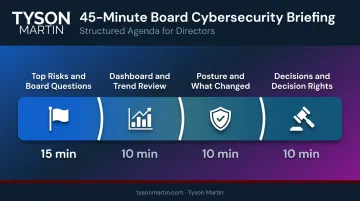
Private sessions between the board (or audit/risk committee) and the CISO — without other management present — build trust and create space for candid conversation about material risks that rarely surface in larger settings.
External advisors can also contribute to select briefings, offering the board an independent perspective without displacing the CISO.
Frequently Asked Questions
How often should a board receive a cybersecurity briefing?
Quarterly is the standard baseline, with ad hoc sessions triggered by material incidents, significant threat changes, or new regulatory requirements. ISS Governance QualityScore treats briefing frequency as a governance quality signal — so cadence carries visibility with institutional investors, not just inside the boardroom.
Who should present the cybersecurity briefing to the board?
The CISO should lead with meaningful involvement, supported by relevant executives as needed. Private CISO-only sessions with the board or audit committee — separate from management — allow candid discussion of material risks that may not surface in full leadership settings.
What metrics belong in a board-level cybersecurity dashboard?
Focus on trend-based outcome metrics: risk posture trajectory, incident response readiness, compliance status, critical asset coverage, and third-party risk. Operational counts like patching percentages or vulnerability totals belong at the management level, not on the board's dashboard.
How should cyber risk be translated into language the board understands?
Frame every risk in terms of financial exposure, operational disruption, regulatory liability, or reputational harm — and attach a plain-language ask to each one. Avoid technical terminology that requires security expertise to interpret. A useful test: can a director read the briefing, identify the decision required, and act — without follow-up questions?
What is the board's role versus management's role in cybersecurity oversight?
The board owns risk appetite, materiality thresholds, investment approval, and incident response framework ratification. Management owns operations, vendor selection, and execution. Where the line blurs most dangerously is when decision rights aren't defined before an incident forces the question.
What should a board do when a material cyber incident occurs?
Activate pre-agreed escalation thresholds — the incident response framework ratified by the board should drive decisions, not real-time negotiations about authority. For public companies, SEC Form 8-K disclosure is generally due within four business days of a materiality determination.