Boards think like risk owners and business stewards. CISOs are trained to think like security operators. That gap — not a knowledge deficit — is what causes most board presentations to fall flat.
This article walks through how to prepare step-by-step, what boards actually want to hear, the variables that determine whether a presentation lands or loses the room, and the mistakes worth avoiding.
Key Takeaways
- Board presentations are won before you enter the room — pre-briefs with committee chairs matter as much as the deck.
- Replace technical metrics with business-impact framing: vulnerability counts become revenue exposure and regulatory liability.
- Boards want one answer: Are we better protected than last quarter, and where are the gaps?
- A stable reporting format lets directors track trends over time rather than decode a new structure every quarter.
- Always close with a clear ask or a clear status — never end without a defined decision point.
How to Prepare for a CISO Board Presentation: A Step-by-Step Approach
Step 1: Research the Board Before You Build the Deck
Most CISOs open a blank slide deck and start with what they know. That's backwards.
Start with the audience. Board composition varies significantly : only 26% of S&P 500 directors and 16% of Russell 3000 directors had cybersecurity expertise as of 2024. That means the majority of the directors in your room will need business-level context, not technical shorthand.
Before building anything, answer these questions:
- Which directors sit on the audit, risk, or technology committee?
- Who has a finance, legal, or operational background?
- What risk language is already circulating from the CFO, CRO, or General Counsel?
- What has the board heard at recent meetings that your presentation should connect to?
Then do the pre-meeting work. Schedule informal conversations with key committee chairs — particularly the audit and risk committee leads — at least three days before the formal meeting. Cover the top two scenarios and any sensitive items.
This isn't relationship-building for its own sake. It prevents "gotcha" moments in the room, surfaces objections early, and ensures no director hears material news for the first time at the table.
NACD's 2026 Cyber Risk Oversight guidance is direct on this point: boards cannot oversee cyber risk effectively if they only interact with the CISO during annual presentations or after a crisis.
Step 2: Build Your Narrative Around Business Risk, Not Security Operations
The single most common failure in CISO board presentations is starting from tool data. Patch counts, alert volumes, and CVE lists mean something to a security team. Board members won't translate that data themselves.
Start from the business. Before touching slides, identify:
- The organization's top strategic objectives this year
- Active regulatory exposures or pending compliance deadlines
- Any M&A activity, major product launches, or operational changes
Then map where your security posture intersects each one. A ransomware exposure lands harder when it's framed as "five days of billing disruption, delayed shipments, and missed quarterly targets" rather than a malware risk category.
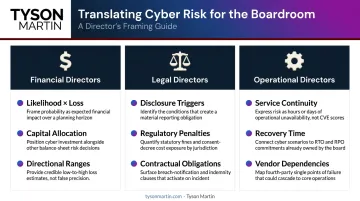
Effective translation formulas across director backgrounds:
- Financial directors: Frame risks as likelihood × potential loss, with directional ranges that support capital allocation decisions
- Legal directors: Map cyber events to disclosure triggers, regulatory penalties, and contractual obligations
- Operational directors: Focus on service continuity, recovery time, and dependency on critical vendors — particularly for time-sensitive operations
Be explicit about what belongs at the board level versus what's a management execution item. If a risk requires a board decision or investment approval, name it clearly. If it's being handled operationally, say so and move on. That distinction alone sharpens the ask.
Step 3: Select a Consistent Reporting Structure
A format that changes every quarter forces directors to decode structure before they can absorb content. Find a format and commit to it.
The recommended structure is a one-page dashboard plus short narrative with these stable components:
- Executive summary — what changed, what matters, what you need
- 3–5 metrics with trend direction — not just current state, but movement over time
- Top risks with heat level — short scenario, current controls, residual risk
- Incident readiness snapshot — last exercise date, top gaps, next test
- 90-day plan — owners, timelines, measurable outcomes
- Decisions requested — one to three items with options, cost ranges, and a recommended path
Limit the core presentation to three to five points. Everything else belongs in an appendix that directors can reference if questions arise. At least one visual should show change over time: mean time to detect and respond, risk posture trajectory, or maturity progress against a defined target state.
The NACD's 2026 Director's Handbook specifically supports this approach, noting that board-level metrics should evaluate performance, benchmark against industry practices, and support fiduciary oversight, not mirror operational reporting.
Step 4: Prepare for the Conversation, Not Just the Slides
The prepared content is the floor, not the ceiling. Directors will ask questions, and visible uncertainty during follow-up erodes everything that came before it.
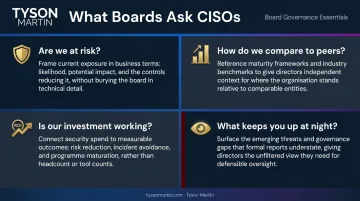
Prepare specific, direct answers to the four questions boards consistently ask:
- Are we at risk? Have a clear, honest answer. Don't hedge it.
- How do we compare to peers? Research industry benchmarks on security spend ratios and maturity
- Is our investment working? Tie spending to specific risk reduction outcomes
- What keeps you up at night? Answer this with precision, not theater
Brief the CEO, CFO, and relevant committee chairs on your prepared content before the meeting. Internal alignment should be visible to the full board, not just to you.
If there's bad news: a near-miss, a material vulnerability, a contained incident, plan the delivery in advance. Pair it with a remediation plan and timeline. The framing should demonstrate incident response capability, not confess a failure. Boards extend more trust to CISOs who surface problems early than to those who deliver clean reports until something breaks.
What Boards Actually Want to Hear from Their CISO
Boards aren't assessing your security program in technical terms. They're asking three things: Is the organization in a defensible position? Is risk being actively managed? Can leadership be trusted to escalate the right things at the right time?
The most useful thing a CISO can communicate is a clear, honest answer to: "Are we better protected than we were last quarter, and where are the remaining gaps?" That single question is worth more to directors than any volume of operational data.
Financial anchors that resonate at the board level:
- The global average cost of a data breach was $4.44 million in 2025, according to IBM's Cost of a Data Breach Report — down 9% from $4.88M the prior year, but still a concrete financial anchor for risk conversations
- 63% of organizations lack AI governance policies, and shadow AI can add $670K to the average breach cost — a governance and financial-risk topic that boards need to own
- Total GDPR fines since 2018 reached €5.88 billion as of January 2025, per DLA Piper — useful context for organizations with European data exposure
Peer benchmarking consistently ranks among the top requests from directors. Security budget as a percentage of IT spend rose from 8.6% in 2020 to 13.2% in 2024. Present how your organization's spend ratio, incident response readiness, or security maturity compares to peers in your sector — and be specific about where you sit relative to that range, not just what your internal numbers say.
Key Variables That Make or Break a Board Presentation
The same security posture can generate confidence or concern depending on how well these variables are managed.
Board Composition and Security Literacy
With only 26% of large-company directors having cybersecurity expertise, calibration matters. A board with a dedicated technology committee and a director with security experience needs different depth than a board encountering cyber risk primarily through audit discussions.
Over-explaining to a sophisticated board signals poor situational awareness. Under-explaining to a non-technical board creates confusion that erodes trust. The right calibration reads the room — and the pre-meeting conversations (Step 1) are where you gather that signal.
Strong indicators that a board is more sophisticated:
- Ask about tradeoffs rather than requesting tool lists
- Reference incident drills with defined decision roles
- Connect regulatory requirements to customer trust rather than treating them as separate concerns
Consistency and Format Familiarity
A stable reporting format is a governance asset, not just a scheduling convenience. When directors see the same structure each quarter, they can track trend and assess trajectory without re-learning your format. That cognitive surplus goes toward better questions and more productive discussion.
Gartner research found that 90% of non-executive directors lack a measure of confidence in cybersecurity value. A consistent dashboard that shows movement over time directly addresses this gap.
Regulatory and Contextual Timing
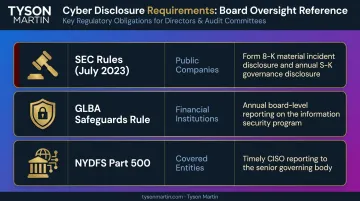
The regulatory environment shapes what boards need to hear and what oversight they're legally expected to exercise. Key obligations to know:
- SEC rules (adopted July 2023) require public companies to disclose material cyber incidents on Form 8-K and provide annual governance disclosure under Regulation S-K
- GLBA Safeguards Rule requires financial institutions to report to the board or equivalent governing body at least annually
- NYDFS Part 500 requires the CISO to report timely to senior governing body on material cybersecurity issues
If a high-profile incident has occurred at a peer organization since your last meeting, reference it directly and explain how your organization would respond to a similar event. That's situational awareness directors value — and notice when it's absent.
Common Mistakes CISOs Make When Presenting to the Board
These patterns erode director trust — often before the CISO realizes it's happening:
- Defaulting to technical language — Metrics and terms that require translation signal poor audience awareness and trigger disengagement fast. If directors are doing the translation themselves, you've already lost the room.
- Reporting activity instead of outcomes — Patch counts, training completion rates, and alert volumes tell directors nothing about whether business risk is shrinking. Boards evaluate cyber the same way they evaluate every other enterprise risk: through financial loss, operational disruption, and strategic impact.
- Softening bad news — Diluting or delaying disclosure of material risks violates fiduciary duty and, when discovered, destroys trust far faster than the original incident would have.
- Oversharing without prioritization — An exhaustive catalog of threats overwhelms without informing. Present your top two or three risks with precision; the appendix holds the rest.
- Treating the formal meeting as the primary channel — The boardroom presentation is one moment in an ongoing governance relationship, not the whole relationship. CISOs who skip the pre-meeting groundwork operate at a permanent credibility disadvantage.
Building Board Relationships Beyond the Presentation Room
The relationships built outside formal meetings determine how much credibility your words carry inside them. Directors who trust you personally give you the benefit of the doubt. Directors who only see you in formal settings scrutinize you more skeptically — and that skepticism shows up at exactly the wrong moments.
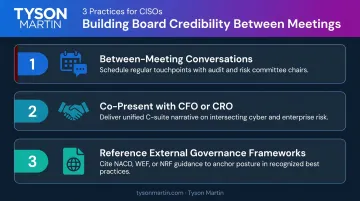
Three practices that build sustained credibility:
Schedule between-meeting conversations with audit and risk committee chairs — surface concerns early, test messaging before the room, and treat governance as an ongoing engagement rather than a quarterly event.
Co-present with the CFO or Chief Risk Officer when cyber and enterprise risk intersect. Presenting a unified story signals C-suite alignment and avoids the perception that security is competing for airtime rather than integrating with enterprise strategy.
Reference external governance frameworks to contextualize your posture — contributions from the NACD, the World Economic Forum's Centre for Cybersecurity, or the NRF CISO Executive Committee demonstrate that your approach reflects current best practices, not just internal judgment.
For organizations where the communication gap between CISO and board is significant, working with a board advisor or fractional CISO who operates on both sides of the table can accelerate trust-building. A structured engagement typically delivers:
- A one-page risk narrative in plain language
- A stable board metrics dictionary with consistent definitions
- A 90-day plan with named owners and measurable outcomes
- A two-week board-prep cadence that makes oversight routine, not reactive
Frequently Asked Questions
What is the biggest challenge CISOs face in their roles today?
The core challenge is translating technical security operations into business risk language that boards and executives can act on. Regulatory pressure, talent constraints, and the expectation to demonstrate ROI on security investment all compound this — but the translation gap remains the most consistent barrier to CISO credibility at the executive level.
Which is usually the best argument for a CISO not reporting to a CIO?
When security reports through the CIO, risk concerns can be subordinated to delivery timelines — the CIO is rewarded for speed, while the CISO must sometimes slow things down. Direct reporting to the CEO or board creates clearer accountability, surfaces material risks without political filtering, and keeps security oversight independent.
How often should a CISO present to the board of directors?
Quarterly is the standard baseline, with monthly reviews at the committee level. Additional briefings are warranted after material incidents, significant regulatory changes, or major business transitions like M&A — and between-meeting communication matters as much as the formal cadence.
What metrics should a CISO include in a board presentation?
Focus on outcome-oriented, trend-based metrics: mean time to detect and respond, risk posture trajectory, critical control coverage on high-value systems, security debt burn-down rate, and third-party exposure on critical vendors. Operational metrics (raw vulnerability counts, patch volumes, alert totals) belong in team-level reporting, not the boardroom.
How should a CISO handle a security incident before or during a board meeting?
Brief key board members before the formal meeting when possible. Pair any incident disclosure with current containment status, impact scope, and a remediation timeline. Frame it as a demonstration of the incident response capability the organization has built, not as a failure to be managed. Proactive disclosure consistently builds more trust than carefully timed silence.
How can a CISO make the case for a larger security budget to the board?
Frame the ask in cost-of-breach versus cost-of-control terms, anchored to peer benchmarking data: security budget averaged 13.2% of IT spend in 2024. Tie the specific request to a defined risk reduction outcome or strategic business objective, not a list of tools.