Introduction
Most cybersecurity executive summaries fail their audience — not because the security program is weak, but because the communication is. Boards are making investment and governance decisions based on these documents. When the summary is unclear, overly technical, or buried in jargon, leadership either ignores it or acts on an incomplete picture of risk.
A cybersecurity executive summary is not a technical document. It is a business communication tool. A CISO reads a security report looking for control gaps and remediation paths. A board member reads the same topic looking for three things: how exposed are we, what are we doing about it, and what do you need from us?
Getting that wrong has real consequences. The SEC's 2023 cybersecurity disclosure rule now requires public companies to report on board oversight of cyber risk, and regulators have already imposed financial penalties when disclosure controls failed.
This article covers exactly what an effective cybersecurity executive summary looks like:
- A clear definition of what it is (and what it isn't)
- The five core sections every summary needs
- A step-by-step writing process
- An annotated example
- The most common mistakes that undermine even well-run security programs
Key Takeaways
- A cybersecurity executive summary presents the organization's risk posture, key incidents, and remediation priorities in plain language for board and C-suite decision-makers.
- Strong summaries cover five sections: key findings, monitoring summary, incident summary, threat summary, and remediation recommendations.
- Every sentence must answer one question: what does this mean for the business?
- Tone and audience shape the document: an audit committee briefing reads differently than a CEO summary.
- The most common failures are excessive technical detail, missing business context, and no prioritization.
What Is a Cybersecurity Executive Summary (and Why It Matters to the Board)
A cybersecurity executive summary is the opening section of a security report that distills the organization's current risk posture, most significant threats, recent incidents, and recommended actions — written for decision-makers without deep technical backgrounds. It serves as a governance document, not a condensed version of the technical report.
Why Boards Are Now Accountable for Cyber Risk
Board accountability for cyber risk is now a legal and regulatory requirement, not just a communication preference.
Three regulatory shifts define the current landscape. The SEC's 2023 cybersecurity disclosure rule, effective September 5, 2023, requires public companies to disclose board oversight processes for cybersecurity risk and to report material cyber incidents within four business days of determining materiality. NIST CSF 2.0, published in February 2024, added the Govern function — establishing accountability, oversight, and risk appetite as core cybersecurity competencies.
In regulated industries, the stakes are higher still:
- Financial services: FTC Safeguards Rule (16 CFR 314.4(i)) requires written reports to the board at least annually
- EU financial entities: DORA, effective January 2025, makes the management body ultimately responsible for ICT (information and communications technology) risk
- Payments/retail: PCI DSS v4.0.1 establishes executive accountability for cardholder data environments
The consequence of getting this wrong isn't abstract. The SEC imposed a $2.125M penalty on R.R. Donnelley in 2024 for disclosure-control failures tied to a cyber incident. Four other companies faced charges in the same year for misleading disclosures related to the SolarWinds compromise.
Three Contexts Where Executive Summaries Appear
The structure shifts depending on the use case:
| Context | Primary Emphasis |
|---|---|
| Periodic board/committee reporting | Trend, posture, decisions needed |
| Post-incident briefing | Timeline, containment status, what's still uncertain |
| Strategic program assessment | Maturity gaps, roadmap, investment priorities |
The core principles — plain language, business framing, decision focus — apply across all three, though the weighting shifts with the context.
The 5 Core Sections of a Cybersecurity Executive Summary
These five sections aren't a rigid formula. Each serves a distinct purpose. Together, they give leadership a complete picture without requiring them to read the underlying technical report.
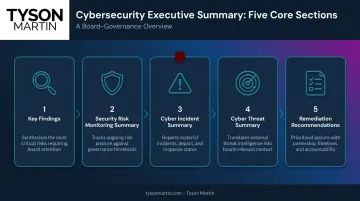
Key Findings
This section surfaces the two to four most consequential developments from the reporting period. Not the most technically interesting — the most consequential for the business.
Each finding should describe business impact, not technical mechanics. The question to answer: what could go wrong for the organization if this is left unresolved?
- Phishing exposure → risk of credential theft affecting customer account security
- Access control gap → unauthorized access to financial or regulated data
- Third-party misconfiguration → potential disruption to a revenue-critical service
Findings without consequence framing leave boards anxious with no clear path forward. The NACD's 2023 Director's Handbook on Cyber-Risk Oversight found that only 52% of boards discuss the material financial implications of a cyber breach — which means nearly half are making decisions without understanding the dollar exposure.
Security Risk Monitoring Summary
This section answers: what were we watching, and what weren't we watching?
Cover which systems, endpoints, vendors, and environments were actively monitored — and which areas fall outside current visibility. Acknowledging gaps builds credibility and surfaces resourcing decisions: if leadership doesn't know a gap exists, they can't fund coverage for it.
Boards need to separate risk level from confidence level. When data is thin or stale, say so plainly.
Cyber Incident Summary
This section covers significant security events from the reporting period. Keep the language causal and outcome-focused:
- What happened — in one sentence, plain language
- How it was detected — monitoring, user report, or third party notification
- Containment actions — immediate steps taken
- How long it took — time to identify and contain
For context: IBM's 2024 Cost of a Data Breach report puts the global average at 194 days to identify a breach and 64 days to contain it. Financial sector averages were 168 days and 51 days respectively. These benchmarks give boards a frame for evaluating whether your response times are within acceptable range.
If no significant incidents occurred, state that directly — and note what monitoring confirmed it.
Cyber Threat Summary
This section looks forward. It covers threat conditions that haven't yet produced incidents but carry real consequences for the business:
- Third-party and supply chain: Verizon's 2025 DBIR reports that breaches involving a third party doubled from 15% to 30% in a single year
- Ransomware: Present in 44% of reviewed breaches, with no organization too small to be targeted
- Vulnerability exploitation: Used as an initial access vector in 20% of breaches — a 34% increase year-over-year
- Cloud and identity: CrowdStrike's 2025 Global Threat Report shows new cloud intrusions increased 26% year-over-year
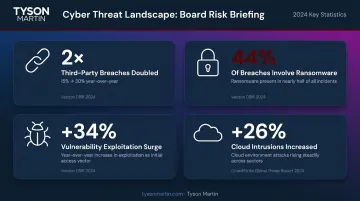
Frame these as business exposure, not tool telemetry. The board doesn't need to know which threat actor group is responsible. They need to know what services are at risk and how.
Remediation Recommendations
This is the section boards use to make budget and governance decisions. Vague or uncosted recommendations undermine the entire document.
Each recommendation should:
- Tie directly to a specific finding or threat
- Be prioritized by impact and urgency
- Include an estimated cost or resource requirement
- Include the risk consequence of delay or inaction
"Improve endpoint protection" is not a board-level recommendation. "Approve $180K to extend endpoint detection coverage to manufacturing floor systems, which currently have no visibility — leaving our largest operational site unmonitored" gives the board something actionable to decide on.
How to Write a Cybersecurity Executive Summary: Step-by-Step
The writing process matters as much as the final structure. Most poor executive summaries result from writing for the wrong audience or starting from technical output rather than business questions.
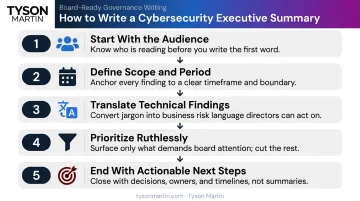
Step 1: Start With the Audience, Not the Data
Before drafting anything, answer: who reads this, and what decisions do they need to make?
- An audit committee determines whether risk is within tolerance and whether investment is adequate
- A CEO needs to know if operations or revenue are at risk
- A risk committee evaluates whether current exposures align with the organization's stated risk appetite
If you can't complete the sentence "After reading this, the board will decide..." — stop. You don't have a summary yet. You have documentation.
Step 2: Define Scope and Period
State clearly what was covered, over what time period, and what was excluded. This prevents misinterpretation and establishes accountability for coverage gaps.
Include a brief methodology note if relevant — continuous monitoring, third-party risk assessments, penetration testing results, or manual review.
Step 3: Translate Technical Findings Into Business Language
For every finding, ask: what could go wrong for the business if this is exploited or left unresolved?
Replace technical descriptors with consequence language:
| Technical Description | Business Language |
|---|---|
| SQL injection in payments API | A flaw in our payment system that could expose customer financial records |
| Weak IAM controls in cloud admin layer | A compromised admin account could disrupt core systems and delay customer orders |
| Unpatched third-party library in vendor software | A known weakness in a vendor we rely on for order fulfillment, with no patch applied |
The FAIR risk methodology supports this approach — defining risk in terms of probable frequency and probable magnitude of future loss, which maps naturally to the financial and operational language boards already use.
Step 4: Prioritize Ruthlessly
An executive summary that lists 20 findings isn't a summary — it's an index. Board-level readers cannot prioritize without context, and asking them to will produce poor decisions.
Surface only the highest-impact items. Group lower-severity findings thematically. Prioritize by:
- Likelihood of exploitation
- Regulatory or legal consequence
- Financial exposure
- Time sensitivity (is there an active exploitation window?)
Everything else gets grouped or deferred to the full technical report.
Step 5: End With Clear, Actionable Next Steps
The last thing leadership reads should answer: what do you need from us, and by when?
Write recommendations as decisions or approvals required — not as tasks assigned to the security team. Pair each with the consequence of delay:
- Approve budget for MFA deployment across all privileged accounts
- Set risk tolerance for third-party vendors with access to regulated data
- Require a third-party security audit of the payroll platform before contract renewal
If the board delays action, name what stays exposed. Leadership can then choose to act — or consciously accept the risk, with a clear record of what that decision cost them.
Cybersecurity Executive Summary Example
What follows is an annotated, illustrative example for a mid-sized enterprise in a regulated industry. It is not tied to a specific incident — it represents the structure and tone that works at the board level. Adapt it to your organizational context.
Example: Opening Context and Posture Statement
"This summary covers the period January 1 – March 31. The organization's security posture is moderate. No active compromise was identified during this period. Three high-priority vulnerabilities require board attention and remediation approval before the next reporting cycle."
Why this works: It leads with the bottom line, not methodology. Boards know immediately whether to be in crisis mode or planning mode. The posture statement is plain, not hedged, and directly sets up the sections that follow.
Example: Key Findings Block
Finding 1 — Phishing Exposure Our email security controls blocked 94% of phishing attempts last quarter. The remaining 6% reached employee inboxes. Two employees clicked links, though no credential theft was confirmed. Business consequence: until additional controls are in place, a successful phish could expose customer account data or allow unauthorized system access.
Finding 2 — Third-Party Vendor Misconfiguration A logistics vendor with access to our order management system had incorrectly configured its access permissions, allowing broader data visibility than contracted. The issue was identified and corrected. Business consequence: while no data was confirmed to have been exported, the exposure window lasted 47 days and included customer order history.
Finding 3 — Access Control Gap Fourteen former employees retain active credentials in two internal systems. Business consequence: unauthorized access to financial reporting data remains possible until these accounts are deactivated.
Note on format: Each finding is stated in terms of what was exposed, what it could mean, and what happened — not technical scan data or CVSS scores.
Example: Prioritized Recommendations Block
| Priority | Action | Resource Estimate | Risk if Delayed |
|---|---|---|---|
| Immediate | Deactivate 14 former employee accounts | 4 hours, IT | Active unauthorized access risk to financial data |
| 30-60 days | Deploy advanced email filtering and phishing simulation | ~$40K | Continued credential exposure risk |
| Strategic | Implement vendor access governance program | ~$120K over 6 months | Recurring third-party exposure similar to Q1 event |
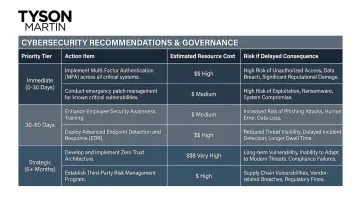
Note on tiering: These tiers separate emergency decisions from planning decisions. The board can act on the Immediate item today, approve the 30-60 day item this quarter, and allocate the strategic item to the planning cycle — without mixing them together.
Producing this kind of board-ready reporting on a recurring basis requires a specific skill set that most security teams aren't built for. Tyson Martin works directly with boards and audit committees to structure this reporting — either through fractional CISO support or a recurring board reporting retainer — so directors get consistent, decision-ready summaries without building that capacity in-house.
Common Mistakes That Undermine Cybersecurity Executive Summaries
Writing for the Security Team, Not the Board
The most common failure: a summary that reads like a technical brief. Security teams default to vocabulary and structure they use internally — CVSS scores, tool names, protocol references — because that's how they think about risk.
The fix is simple. Have a non-technical reader review the draft. Flag every sentence they can't act on or don't understand. If that person can't tell whether the company is safe or what the board is being asked to decide, the summary needs a rewrite.
No Prioritization or Hierarchy
Presenting all findings with equal weight forces the board to prioritize for themselves — which they'll do poorly without context. A board that sees 15 items of equal importance will either freeze or focus on the wrong ones.
Make the prioritization call and justify it in the document. If you present three findings instead of twelve, note that the remaining nine are tracked in the full report and don't require board decisions this cycle.
Missing the "So What"
Findings without consequence framing create anxiety without direction. Every key finding needs two things after the technical description: what it means for the business, and what happens if it isn't addressed.
The NACD's guidance is direct on this point: cyber risk metrics should present exposure in financial and operational terms, not purely technical metrics. Directors need to see the business consequence to make governance decisions — not just know that a vulnerability was found.
Length and Density
A board executive summary longer than one to two pages has typically failed its audience. Density signals poor editing, not thoroughness.
When editing for length, apply one test: does this drive a board decision, or does it document work? Content that falls into the second category belongs in the appendix or the full report — not on the two pages a director will actually read before the meeting.
When reviewing a draft, flag and remove:
- Technical metrics with no financial or operational translation
- Status updates on resolved items requiring no board action
- Tool names, vendor references, or methodology explanations
- Findings the security team tracks but the board cannot influence
Frequently Asked Questions
What is an executive summary for cybersecurity?
A cybersecurity executive summary is the opening section of a security report that presents the organization's risk posture, key findings, and recommended actions in non-technical language. It is written specifically for boards, C-suite executives, and other decision-makers who need business clarity, not technical detail.
What are the 5 parts of an executive summary?
The five standard sections are: key findings, security risk monitoring summary, cyber incident summary, cyber threat summary, and remediation recommendations. Each addresses a distinct decision-making need, covering everything from what happened to what the board should approve or fund.
How long should a cybersecurity executive summary be?
Effective executive summaries are typically one to two pages in written form, or three to five slides in a board presentation format. Either format should give decision-makers the full risk picture without requiring more than a few minutes to read.
How is a cybersecurity executive summary different from a full security report?
The executive summary contains only the business-relevant conclusions and decisions leadership needs. The full report is where security and engineering teams find technical evidence, detailed findings, reproduction steps, and remediation instructions.
How should a CISO present cyber risk to the board without using technical jargon?
Frame every finding in terms of business consequence — financial exposure, operational disruption, regulatory risk, or reputational harm — using plain-language equivalents for any technical terms. Anchor each recommendation to a decision the board can actually make, such as approving a budget, setting a risk threshold, or requiring an audit.
How often should a cybersecurity executive summary be updated?
Most organizations produce executive summaries quarterly, aligned to board meeting schedules. Interim briefings are triggered by significant incidents, material regulatory changes, or major shifts in the threat environment — such as a breach at a key vendor or a new ransomware campaign targeting your industry.