That gap is expensive. According to IBM's 2024 Cost of a Data Breach Report, the average breach now costs $4.88 million, a 10% increase from the prior year, with roughly 70% of breached organizations experiencing significant operational disruption. The financial exposure is real. The governance accountability is also real — and growing.
This guide is for CEOs, board members, and audit committee chairs who need to read a risk assessment report, ask the right questions, and make defensible decisions from it — without a technical background.
Key Takeaways
- A risk assessment report is only useful if it drives decisions, not just creates documentation.
- Board-ready reports translate risk into financial exposure, regulatory implications, and operational impact — CVSS scores don't belong in the boardroom.
- The most dangerous governance gap is not a lack of assessments. It's reports that nobody acts on.
- After every review, leaders need four answers: what changed, what it means financially, who owns the response, and what success looks like in 90 days.
Why Cybersecurity Risk Assessment Reports Belong in the Boardroom
Cybersecurity oversight is no longer something boards can safely delegate to IT and forget about.
The SEC's cybersecurity disclosure rules, adopted in July 2023, require public companies to disclose material cyber incidents within four business days of determining materiality. Boards must also annually disclose how they oversee cyber risk and what expertise management brings to it.
NAIC Model Law 668 and NYDFS Part 500 impose parallel requirements on financial services and insurance companies — including documented risk assessments, board-level reporting, annual compliance certifications, and five-year record retention.
The message from regulators is consistent: boards must demonstrate informed oversight, not passive receipt.
Two dynamics make that standard harder to ignore than it once was.
Personal liability now turns on process, not just outcomes. In 2024, the SEC charged R.R. Donnelley & Sons with cybersecurity control failures following a ransomware incident, resulting in a $2.125 million civil penalty. Separately, Delaware courts dismissed Caremark claims against SolarWinds directors — specifically because reporting systems existed. Evidence of structured oversight matters as much as the incident result.
The confidence gap is also measurable. Gartner reported in 2025 that 90% of non-executive directors lack a measure of confidence in cybersecurity value, with only 10% strongly believing their organization has the right cost-to-protection balance. That's not a technology problem — it's a reporting problem.
The Difference Between an Audit and a Risk Assessment
Directors need to understand this distinction clearly:
- A security audit answers: Do controls exist? Are they functioning as designed?
- A risk assessment answers: What exposure remains after those controls? What does it mean for the business, and what decisions need to be made?
Board oversight requires the second document — not the first.
What a Board-Ready Cybersecurity Risk Assessment Report Must Include
A board-ready report is not a technical summary. It's a decision tool. Here's what it needs to contain.
A Plain-English Risk Posture Summary
The report should open with where the organization stands right now — current exposure level, how it changed since the last review, and what's driving that change. Not a list of open vulnerabilities. Not a count of patched systems.
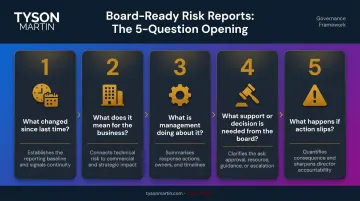
The five-question opening structure that works:
- What changed since last time?
- What does it mean for the business?
- What is management doing about it?
- What support or decision is needed from the board?
- What happens if action slips?
Business Impact Translation for Every Risk
Each identified risk must be expressed in business terms — not technical severity ratings. Technical findings like "vendor lacks MFA for admin access" become "a compromised admin account could expose customer data and disrupt operations."
The impact lenses that work for board audiences:
- Financial loss (ranges, not false precision)
- Operational disruption (days offline, revenue impact)
- Legal and regulatory exposure (penalty ranges, disclosure triggers)
- Strategic delay (M&A, product launch, market entry)
- Reputational harm (customer trust, investor confidence)
A ransomware event should appear in a board report as "five days of billing disruption, delayed shipments, contract penalties, and missed quarterly targets" — not as a malware classification.
A Prioritized Risk Register With Owners
The register is the governance spine of the report. It should cover the top 10 to 15 enterprise risks and remain stable enough to track meeting over meeting.
Each item should include:
| Element | What It Shows |
|---|---|
| Risk statement | Plain-English description |
| Likelihood and impact | Business terms, not CVSS |
| Key controls in place | What's already reducing it |
| Key gap | What's still exposed |
| Accountable executive | A named person, not a committee |
| Target date | When closure is expected |
| Trend direction | Improving, stable, or deteriorating |
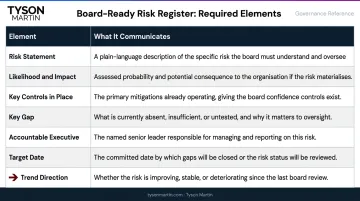
A risk register that has no owner and no deadline is a scan report. That's not governance.
Escalation Thresholds and Decision Rights
The report must make explicit which risks require board-level decisions versus management-level execution. A practical escalation ladder defines:
- Amber triggers: Worsening trends over two cycles, near misses, rising exception counts
- Red triggers: Threshold breaches, repeated incidents, expired exceptions without closure
Each threshold defines who gets notified, how fast, and what information must accompany the first update. When thresholds are pre-agreed, boards move faster, because the decision rules exist before the crisis requires them.
A 90-Day Action Plan With Measurable Outcomes
The report should end with a concrete roadmap, not observations. Each item needs:
- Named owner (role, not "the security team")
- Due date with milestone definition for "done"
- Cost range and key dependencies
- Evidence of closure (test results, access review, logs)
Accountability requires a weekly working session to unblock delivery and a monthly executive review to make decisions and explicitly accept risk. If a fix slips, that should be visible within two weeks — not two quarters.
Organizations preparing for a first board-level cyber review, or those inheriting ad hoc reporting practices, can work with Tyson Martin to establish a structured, inspectable reporting format — typically operational within 30 days of engagement.
How Business Leaders Can Read a Risk Assessment Without Technical Expertise
You don't need to understand the technology. You need to understand the business consequences.
Start With What Changed
A well-structured report makes trend visible immediately. The opening should answer "what changed since last time" — without requiring the reader to compare raw data across two documents. If you need to flip between reports to figure out whether things got better or worse, the report failed before you opened it.
Interpret Risk Ratings in Business Context
When a risk is rated "critical" or "high," the right question is not "what does that score mean?" It's: "If this materializes, what is the business impact?"
CVSS scores measure technical severity. They do not measure what a breach would cost your organization, how long operations would be disrupted, or which customers would leave. Boards need the business translation — and should push back if they're not getting it.
Know Where Each Risk Sits in Your Treatment Framework
Business leaders should be able to identify, for each top risk, which of four postures applies:
- Accepted: The board formally approved living with this risk
- Mitigated: Controls reduce it to tolerable levels
- Transferred: Insurance or contract shifts financial exposure
- Avoided: The activity creating the risk has been stopped
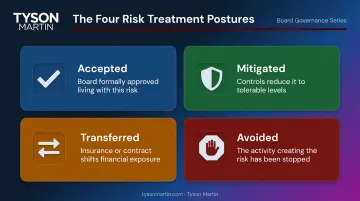
If you can't identify where your top five risks fall — or if nobody can show you a documented approval for the ones that are "accepted" — that's a governance gap. The right response to that gap is questions.
Three Questions Every Board Member Should Ask
After reviewing any risk assessment report, ask the CISO or security team:
- Which of these risks would stop us from operating?
- Which risks require a decision from this board today?
- What would a breach in our highest-risk area cost us?
If the answers are vague or require follow-up research, the report needs to be restructured — not the questions. Those answers should also inform how often the board needs to be briefed.
Build Pattern Recognition With a Stable Dashboard
WEF research shows that 62% of high-resilience organizations provide regular board updates on cyber trends and vulnerabilities, compared to just 29% of low-resilience organizations — and 60% of CISOs brief boards three to four times per year. Frequency matters, but only if the format supports pattern recognition.
The format that supports pattern recognition tracks 8 to 12 core metrics consistently across quarters — with targets, trend arrows, and plain-English commentary explaining what movement means. A single month can mislead. A three-month trend tells you whether risk is improving, flat, or deteriorating.
Common Reporting Failures That Leave Business Leaders in the Dark
Most boards aren't getting poor oversight because their organizations don't do assessments. They're getting poor oversight because the reports don't produce decisions.
The Data Dump
Reports that list hundreds of vulnerabilities with no business context, no prioritization, and no clear ask. The board walks out overwhelmed — without understanding what, if anything, requires their attention. Tyson Martin describes this as buying "paper" instead of clarity: policies look complete, controls look mapped, exceptions get politely documented — while real paths to material loss stay open.
The Vanity Metric Problem
Activity metrics masquerading as risk reduction:
- "98% patch compliance" — but crown-jewel systems are 30 days behind
- "All employees completed training" — but phishing reporting rates are low and privileged access is loose
- "Blocked 50,000 attacks this month" — which says nothing about what got through
Completion is not effectiveness. Boards should ask what changed about the organization's exposure — not how busy the security team was.
The Inconsistent Framework Problem
When the methodology shifts between cycles, trend analysis becomes impossible. Directors can't benchmark progress, identify drift, or hold anyone accountable because there's no stable baseline to compare against.
Structure matters as much as content. Trust in reporting builds when definitions stay consistent, the impact model doesn't shift, and the format is recognizable quarter over quarter.
All three failure patterns share the same root problem: reports designed to demonstrate activity rather than inform decisions. The next section covers what a board-ready report actually looks like.
From Assessment to Action: The Business Leader's Next Steps
Receiving a risk assessment report is the beginning of the governance cycle, not the end.
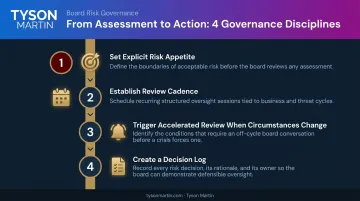
Four disciplines translate the report into defensible governance:
Set explicit risk appetite. Formally document which risks the board accepts, which it directs management to mitigate, which transfer to insurance, and which require escalation. That record is precisely what SEC Item 106, NYDFS, and NAIC compliance certifications require.
Establish review cadence. A monthly dashboard review at the committee level and a quarterly full-board update creates the oversight rhythm regulators expect. Annual-only reporting creates blind spots that accumulate between cycles.
Trigger accelerated review when circumstances change. Post-incident, M&A transactions, and leadership transitions all warrant immediate cadence resets. NACD notes that M&A transactions are targeted by ransomware actors; cyber remediation costs should be built into the transaction structure before close, not surfaced after.
Create a decision log. Every risk acceptance, mitigation approval, and escalation decision should be documented with dates and owners. Without that record, governance is a conversation rather than an inspectable process — a distinction that matters when a regulator, auditor, or plaintiff's attorney asks what the board knew and when.
For organizations navigating leadership transitions, M&A events, or post-incident recovery, Tyson Martin provides interim CISO leadership and board advisory support to build this infrastructure fast: assessment cadence, reporting standards, and decision frameworks — typically delivering a ranked risk view and board-ready baseline within 30 days.
Frequently Asked Questions
What should be included in a cybersecurity risk assessment report for the board?
A board-ready report should include a plain-language risk posture summary showing what changed, a business impact translation for top risks, a prioritized risk register with named owners and trend direction, clear escalation thresholds defining board versus management decisions, and a 90-day action plan with measurable outcomes and closure criteria.
How often should a cybersecurity risk assessment be conducted?
Most organizations run formal assessments annually, with monthly dashboard reviews and quarterly board-level risk register updates. Regulated industries, M&A activity, or a recent incident typically require a faster cadence — and a full reset immediately after any material event.
What is the difference between a cybersecurity risk assessment and a security audit?
A security audit evaluates whether controls exist and are functioning correctly. A risk assessment determines what residual risk remains after those controls, what that risk means for the business, and what decisions need to be made. Board oversight requires the risk assessment — the audit alone doesn't answer the governance questions directors are responsible for.
What questions should a board ask when reviewing a cybersecurity risk assessment report?
Every board review should start with five questions:
- What changed since our last review?
- Which risks require a board decision today?
- Which risks could halt operations?
- What would a breach in our highest-risk area cost?
- Who owns each top risk by name?
If the report can't answer all five, it needs to be redesigned.
How do business leaders use a risk assessment to make defensible decisions?
Documenting each risk decision — accepted, mitigated, transferred, or escalated — with named owners, timelines, and approval dates creates an inspectable record of informed governance. That record is what satisfies SEC disclosure requirements, NYDFS and NAIC certifications, and Caremark-standard oversight scrutiny when a breach is litigated.