Introduction
Most ERM teams know how to identify and assess risk. Fewer know how to report it in a way that boards can actually use.
Board-ready risk reporting is the structured, repeatable method by which ERM teams transform raw risk data into curated, decision-enabling packages that boards can act on with confidence. For ERM professionals, CISOs, risk committee leads, and board advisors, getting this right is not optional — boards make fiduciary decisions based on these reports, and inconsistency erodes trust, delays escalation, and leaves material risks invisible.
The core problem is that many ERM programs produce technically sound risk work but fail at the final step. Reports arrive as dense register extracts, change format quarter to quarter, and bury what directors actually need:
- Confirmation the risk profile is within appetite
- Visibility into what changed since the last report
- Clarity on decisions requiring board attention
According to NC State's 2025 State of Risk Oversight report, only 32% of executives rate their organization's risk oversight as mature or robust, and just 11% believe ERM provides strategic advantage. The reporting stage is where most of that gap lives.
This article covers what boards actually need from a risk report, how to structure one, how to build a repeatable production cadence, and the mistakes that cause solid ERM programs to fail at delivery.
Key Takeaways
- Board-ready risk reports are curated, narrative-led summaries, not register extracts dropped into a slide deck
- Boards need three things: confirmation the risk profile is within appetite, what changed since last period, and what decisions require their attention
- Consistent format across quarters matters as much as content — a shifting structure makes trajectory invisible
- Translating technical risk into business-impact language is the hardest step and the most commonly skipped
- The most damaging failure modes: stale ratings, format drift, missing risk movement narrative, and activity-based reporting that buries the real signal
What Boards Actually Want From a Risk Report
The board's job with risk information is not to manage individual risks. It is to confirm the aggregate exposure is within appetite, verify that management owns the risks, and make strategic or resource decisions when escalation is warranted.
That distinction matters more than most ERM teams acknowledge in practice.
Oversight vs. Operation
Boards need a one-level-up view: business framing, not operational granularity. When this distinction is ignored, directors receive thick register extracts full of control language and technical detail they cannot evaluate.
The consequences follow a familiar pattern: directors disengage from risk discussions, the ERM function loses its seat at the strategy table, and material risks go unaddressed because no one framed them as board decisions.
NACD's 2023 Risk Committee Blueprint puts it plainly: boards must understand risk aggregation, risk concentration, and complex interconnections — not individual control status updates. The board's frame of reference is strategy, financial performance, and organizational reputation. Every element of a board risk report should connect back to one of those three.
What Directors Consistently Cannot Find
In practice, board directors most frequently struggle to identify:
- Clear decision points — what specifically requires board action versus management discretion
- What actually changed — not just updated ratings, but why they moved and what it means
- Named ownership — who owns the risk, not just which department it sits in
- Business impact translation — exposure framed in revenue, downtime, legal cost, or customer trust, not technical severity
Most format problems in board risk reports are actually content problems. When those four questions go unanswered, no redesign fixes the room.
The Structure of an Effective Board Risk Report
High-performing ERM teams use a consistent five-section structure so directors can orient quickly, track changes across cycles, and find what they need without working through the entire pack. Consistency in structure is not a cosmetic preference — it is what allows boards to build pattern recognition over time.
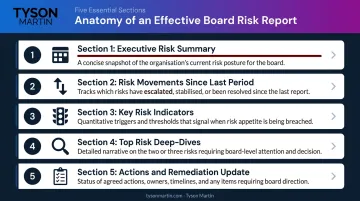
Executive Risk Summary
A one-page or one-slide overview of the organization's current risk profile: aggregate position relative to appetite, a heat map or top risk list, and a brief narrative on internal and external factors shaping the risk landscape this period.
NC State's research shows effective board reports cover cover 10 to 15 key risks, with tiered reporting pushing lower-tier risks to the audit or risk committee rather than the full board.
Risk Movements Since Last Period
This section — what increased, decreased, newly emerged, or closed — is what separates a live program from a static document. Every movement must carry a brief rationale, not just a color change. A risk that moved from amber to red without explanation tells the board nothing useful and signals that ratings may not be trustworthy.
Key Risk Indicators
KRIs function as the board's early-warning system. Traffic-light status summaries (green, amber, red) work well here, with a brief explanation for any indicator that crossed a threshold since the last report. The goal is to demonstrate that monitoring is continuous rather than episodic.
A quick diagnostic: KRIs that look identical quarter after quarter — even as the external threat environment shifts — are being compiled for meetings, not tracked between them.
Top Risk Deep-Dives
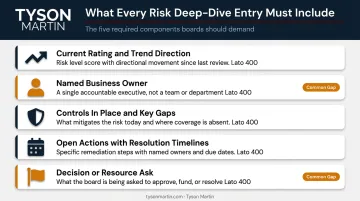
This section covers the top three to five risks in detail. Each entry should include:
- Current rating and trend direction
- Named business owner (not just the CISO or IT department)
- Controls in place and key gaps
- Open actions with expected resolution timelines
- Decision or resource ask, if any
An entry without a named business owner and a specific timeline is superficial. Boards need to see active ownership, not just listed risks.
Actions and Remediation Update
This is the accountability section. It covers status on previously agreed actions, progress since the last board meeting, and any slippage explained with cause and revised timeline. Boards track whether commitments are followed through — and this section does more to establish or erode ERM credibility than any other.
How ERM Teams Build a Repeatable Reporting Cadence
The difference between producing a strong report once and producing one consistently every quarter is process architecture. Mature ERM functions treat the board pack as the output of a fixed-stage cycle, not a project that restarts from scratch each time. That structural shift is what ends the perpetual scramble.
NC State's 2023 State of Risk Oversight found only 40% of organizations describe their risk process as systematic and repeatable, while 25% describe it as mostly informal and unstructured. The reporting stage is where that informality shows up most visibly.
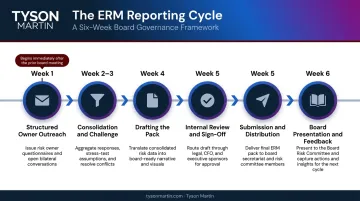
A practical six-week cycle:
Week One: Structured Owner Outreach
Distribute templated update requests to all risk owners immediately after the last board meeting — not a blank email. Effective prompts force concrete answers:
- What is the top risk you want us to accept this quarter, and why is it acceptable now?
- What changed in your exposure since last period?
- What decision do you need from leadership?
- What proof would you show if someone were skeptical of this update?
Starting outreach the week after the last board meeting — rather than two weeks before the next one — is the single most impactful scheduling change most ERM teams can make.
Weeks Two and Three: Consolidation and Challenge
The ERM team's role during this window is analytical, not administrative. Chase responses, review updates for consistency, and actively challenge ratings that appear stale or misaligned with current KRI signals. A risk that has sat at "medium" for three consecutive cycles with no narrative update is a flag worth pushing on.
Week Four: Drafting the Pack
Write the executive narrative, compile risk movements, check KRI status, and prepare the top risk section from data that has already been validated. Drafts built from validated inputs rather than last-minute extracts require fewer revision cycles and carry fewer factual inconsistencies into the boardroom.
Week Five: Internal Review and Sign-Off
The CRO, CFO, or senior risk sponsor reviews the draft, challenges inconsistencies, and approves the narrative framing.
This is also where a board advisor or independent reviewer adds genuine value: stress-testing whether the report answers the questions directors will actually ask, or whether it is still written for an internal risk audience.
Week Six: Submission and Distribution
Submit to the board pack with enough lead time for directors to read and prepare questions. A board that receives risk information 48 hours before a meeting consistently produces weaker governance conversations than one that has had the pack for a week.
Translating Risk Into Board Language: Clarity Over Volume
The hardest part of board risk reporting is not gathering the data. It is reframing technical, operational, and cyber risks in terms that resonate with directors whose primary reference points are strategy, financial performance, and organizational reputation.
The Business Impact Anchor
Every material risk needs to be anchored to a business impact metric. Not "critical vulnerability in authentication layer" — but "a gap that could expose customer transaction data and disrupt payment processing, with potential revenue disruption and regulatory notification obligations."
A practical formula that works across risk types:
Because we addressed X, we reduced the chance of Y, which protects Z.
That structure — action, risk reduced, business outcome protected — forces the translation to happen at the source rather than asking directors to do it themselves.
Risk Trending vs. Risk Trivia
Boards need to see whether a risk is improving, deteriorating, or stable over time, and why. A long list of controls that were tested last quarter is not trending — it is trivia. The question the board cares about is: is the organization more or less exposed than it was three months ago, and what drove the change?
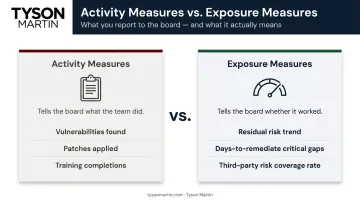
Metrics should show direction. The distinction matters:
- Activity measures: vulnerabilities found, patches applied, training completions
- Exposure measures: residual risk trend, days-to-remediate critical gaps, third-party risk coverage rate
Boards need exposure measures. Activity counts tell them what the team did. Exposure trends tell them whether it worked.
The Role of a Senior Risk Translator
NACD's 2026 Cyber-Risk Oversight guidance reports that 86% of Fortune 100 companies now disclose cybersecurity as a board expertise area in at least one director biography — a recognition that technical risk without business translation is ungovernable.
Organizations without a senior risk translator — a CISO, CRO, or board-level advisor who bridges technical teams and directors — produce accurate reports no one acts on. Translation is a governance function, not a presentation skill.
The clearest sign translation is missing: the board's only decision is whether to ask a follow-up question. A board-ready report puts real choices on the table — accept this risk for six months while the revenue program completes, or fund the remediation now and adjust the project timeline.
Common Mistakes That Undermine Board Risk Reports
Three mistakes account for most board risk reports that fail to drive useful oversight. Each is correctable — and each signals something about the discipline of the ERM function producing them.
Conflating the Risk Register with the Board Report
The risk register is management's working inventory. The board report is a curated summary of what matters and what requires director attention. Sending a register extract to the board — even a well-organized one — overwhelms directors with operational detail and buries the decisions that need their judgment.
A useful board report fits on one to two pages or two to four slides. If it runs longer, it is probably still written for a risk management audience.
Format Inconsistency Quarter to Quarter
Reports that change structure, scoring methodology, or risk categories from period to period make it impossible for boards to track trajectory or develop the pattern recognition that makes oversight meaningful. They also signal operational discipline problems in the ERM function itself.
Consistency in format is not rigidity — it is the mechanism by which boards build useful institutional memory about the organization's risk profile over time.
Stale Data and Episodic Monitoring
Experienced directors quickly notice stale data. Common signals include:
- Risks unchanged across two or more cycles
- KRIs reflecting conditions from months ago
- Action items carrying no progress notes
ISO 31000:2018 is clear that monitoring and review should be ongoing — not triggered by the approach of a board meeting.
Treat a quarterly deep-dive with monthly risk pulse updates as the floor, not the ceiling. When major events occur — an acquisition, a significant incident, a regulatory change — the register should update before the standard cycle.
Frequently Asked Questions
What are the key components and steps of enterprise risk management?
ERM covers four core activities: identifying risks, assessing their likelihood and impact, responding with controls or acceptance decisions, and monitoring for changes over time. Board-ready reporting is how that work becomes visible to governance — the mechanism through which director oversight actually happens.
How often should ERM teams produce board-ready risk reports?
Quarterly full board risk packs are the standard cadence, with interim updates to the risk or audit committee for material changes. The SEC's four-day cyber incident disclosure rule has raised the bar on incident-triggered reporting readiness — escalation paths and materiality thresholds need to be pre-built and tested, not improvised mid-incident.
What is the difference between a risk register and a board risk report?
The risk register is the working inventory used by management to track risks, owners, controls, and action status. The board report is a curated, narrative-led summary of the most significant risks and movements, designed for directors who are overseeing rather than managing.
What should a board-ready risk report always include?
Five non-negotiable elements: an executive risk summary, risk movements since last period with rationale, KRI traffic-light status, top risk deep-dives with named owners and open actions, and a remediation update on previously agreed commitments.
How do ERM teams keep risk data current between reporting cycles?
The foundation is structured owner update cadences, continuous KRI monitoring, and dashboards that reflect register changes in real time. The key is embedding the update process into normal operating rhythm so reporting cycles don't require a scramble to pull current data.
What role should a board advisor or fractional CISO play in producing risk reports?
A board-level risk advisor translates technical language into business framing and stress-tests whether the pack is decision-ready before it reaches directors. The primary value is challenging the narrative and framing early — when it can still be fixed.