The test is simple: can your board answer what risks they've accepted, who owns them by name, and what changed since the last meeting? When that answer is "not really," the program exists on paper but not in practice.
This guide covers what ERM governance actually requires — not framework theory, but what separates programs that hold under pressure from those that collapse at the moment they're needed most.
TL;DR: Key Takeaways
- ERM governance is the accountability and decision-rights structure that determines who identifies, owns, escalates, and acts on risk — not just documents it
- Boards own oversight, not operations — that means defined risk thresholds, reporting that shows trends, and escalation paths tested before a crisis hits
- COSO, ISO 31000, and NIST provide useful structure — what makes any of them work is named ownership and executive accountability at every tier
- The biggest ERM governance gap isn't risk identification — it's the disconnect between what management tracks and what the board can actually act on
- Organizations in transition (M&A, leadership change, post-incident) are most exposed when governance structures are unclear
What Is ERM Governance (and Why Most ERM Programs Fall Short)
ERM and ERM governance are not the same thing. ERM is the discipline of identifying and managing risk enterprise-wide. ERM governance is the accountability structure that determines:
- Who has authority over which risks
- At what threshold decisions escalate
- How the board receives visibility into the organization's risk posture
Without governance, ERM becomes a reporting exercise rather than a management system.
The Silo Problem
Traditional risk management keeps risk in functional lanes: legal tracks litigation, IT tracks vulnerabilities, finance tracks exposure. Each function manages its own slice, and no one owns the intersections. ERM is supposed to fix that — but it only does so when governance design forces cross-functional ownership, a unified risk register, and a clear reporting chain to leadership.
Without that structure, risk owners remain siloed even after an enterprise framework has been adopted. The framework sits on top of unchanged accountability patterns.
Why ERM Programs Lose Traction
PwC notes that some ERM programs "aren't getting the desired traction, either losing momentum or lacking adequate investment." The root cause is rarely the wrong framework. It's the absence of governance clarity.
When nobody can say who decides, the program becomes a debate club. Decisions drift, findings sit in backlogs with no clear owner, and risk registers get updated before board meetings and ignored the rest of the year.
Tyson Martin's board advisory work identifies this pattern : organizations can point to documentation but can't answer "who is accountable for our top three risks by name and role?" When the answer is "the CISO handles it" or "we all share it," accountability has been diffused rather than assigned. That's documentation, not governance.
The Cyber Governance Gap
Technology and cybersecurity risks are among the fastest-growing categories of enterprise risk — yet board oversight structures frequently haven't kept pace. According to NACD research, only 3 in 10 directors rate their board's ability to oversee a cyber crisis highly. That's a governance gap, not a knowledge gap.
Boards generally take cyber seriously. The gap is structural: oversight mechanisms haven't been designed to give directors the visibility and decision authority they need when it matters.
The Core Components of an ERM Governance Structure
Governance and Accountability Layer
Effective ERM governance starts with defining who is accountable for what. That means:
- Distinguishing the board's oversight role from management's execution role
- Establishing whether the organization has a CRO, CISO, or equivalent with authority (not just a title)
- Documenting decision rights so risk owners know when to manage autonomously versus when to escalate
Every decision-rights map should answer these questions without debate:
- Who accepts risk at what threshold?
- Who approves exceptions and for how long?
- Who breaks ties when security competes with delivery?
- Who declares incident severity?
- Who owns critical vendor go/no-go decisions?
Risk Appetite and Tolerance Framework
RIMS defines risk appetite as "the amount and type of risk an organization is willing to pursue or retain," and risk tolerance as "the acceptable variation around risk appetite." Both require written, board-approved statements to be useful.
What makes an appetite statement defensible:
- Translates crown jewels into measurable thresholds (hours of downtime, dollars of fraud loss, coverage percentages)
- Ties each threshold to a business promise — uptime for revenue, integrity for reporting, privacy for trust
- Specifies who can accept low, medium, and high risk, and what requires board approval
- Uses specific numbers, not vague words like "low" or "moderate"
Without this, "acceptable risk" is whatever management says it is at the moment — a position that won't hold under regulatory scrutiny or post-incident review.
Escalation Design and Decision Thresholds
Few ERM programs get this right. Escalation thresholds define the conditions under which a risk moves from management's plate to the board's attention.
Without pre-agreed thresholds, escalation becomes reactive, inconsistent, or politically driven. Proper escalation design includes:
- Measurable triggers tied to business impact (dollars, downtime, data sensitivity, legal exposure) — not subjective assessments
- Clear notification lists for each trigger level with expected response times
- Pre-approved rules so teams spend incidents solving problems rather than negotiating authority
- Defined first-30-minute protocols covering who can approve containment and when to engage outside counsel
Monitoring, Metrics, and Board-Ready Reporting
Activity metrics and risk posture metrics are not the same thing. Activity metrics show what the team did — training completion rates, patches deployed, policies updated. Risk posture metrics show whether exposure is actually shrinking.
A stable board-ready dashboard:
- Contains 8–12 consistent metrics tracked over time (not a new slide deck each quarter)
- Shows trend direction: improving, stable, or worsening
- Maps each metric to an "in appetite" or "out of appetite" threshold
- Surfaces material changes since the last briefing — not a recitation of every risk the organization faces
The Board's Role in Overseeing Enterprise Risk
Oversight vs. Management
The board's responsibility is not to run the ERM program. Its job is to ask hard questions, validate that management has adequate processes, and define what information the board actually needs to govern. A board that passively receives a risk report is not the same as a board that oversees risk through structured dialogue, documented follow-through, and clear accountability.
What the Board Should Actually Be Asking
These questions move boards from passive recipients to active overseers:
- What are our top five risks, and have they changed since last quarter?
- Who owns each one by name, and what are they doing about it?
- At what threshold would management escalate to us — and when did we last test that?
- What risk did we accept in the last quarter, and who approved it?
- What would we show a regulator or cyber insurer as evidence of oversight?
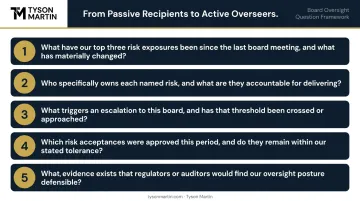
When management can't answer question 4 specifically, the risk acceptance process exists on paper only.
The Reporting Failure
Most ERM reports fail at the board level for the same reason: they're too long, too operational, and optimized for comprehensiveness rather than materiality. Boards end up with a recitation of every identified risk rather than clear signal on what changed and what requires a decision.
Effective board-level risk reporting looks like:
- Plain-English risk posture (not technical jargon)
- What changed since the last briefing and why it matters
- Clear indication of whether the organization is within its stated risk appetite
- Decisions needed from the board — funding, tradeoffs, policy, risk acceptance
Tyson Martin's board advisory work focuses on this gap — replacing noise-heavy reporting with structured oversight that supports defensible decisions. The practical result: boards stop being surprised, and management stops rebuilding the narrative from scratch before every meeting.
Cyber and Technology Risk as a Governance Priority
Two regulatory frameworks now make cyber governance a board-level accountability, not an IT footnote:
- SEC (2023 cybersecurity disclosure rules): Public companies must disclose material incidents and describe cybersecurity risk management annually in Form 10-K. Item 106 specifically requires identifying responsible committees and explaining how the board is kept informed.
- NYDFS Part 500: Financial services firms must ensure the senior governing body exercises oversight of cybersecurity risk management and regularly reviews management reports.
Boards that treat cyber as an agenda afterthought now face direct disclosure and liability consequences. The question isn't whether to govern it — it's whether your current process would hold up to regulatory scrutiny.
ERM Governance Frameworks: A Practical Comparison
No framework substitutes for governance design. But frameworks provide structure once ownership and accountability are clear.
| Framework | Best For | Key Characteristic |
|---|---|---|
| COSO ERM (2017) | Publicly traded companies | Connects risk management to strategy and performance; five components span Governance & Culture through Information & Reporting |
| ISO 31000:2018 | Any organization seeking flexibility | Principles-based, internationally applicable, embeds risk thinking in decision-making; not certifiable |
| NIST RMF | Technology-heavy and government-adjacent organizations | Structured 7-step process (Prepare → Categorize → Select → Implement → Assess → Authorize → Monitor); NIST IR 8286 bridges cybersecurity risk into broader ERM |
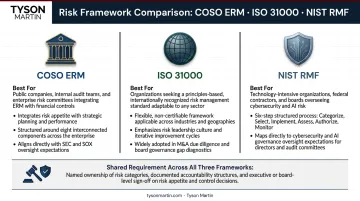
COSO is the dominant choice for public companies because it explicitly integrates risk management with strategy-setting and performance objectives, making it well-aligned to board oversight requirements. COSO's 2017 framework positions risk management as a strategic function, not just a compliance exercise.
ISO 31000 provides principles and a framework without prescribing a rigid structure. It works for organizations that want internationally recognized rigor without the compliance overhead of a certifiable standard — no certification process, no mandatory controls list.
NIST was built for information systems but has become the natural bridge between technical security governance and broader ERM. In retail, healthcare, and financial services, where cyber risk sits at the top of the enterprise risk register, NIST IR 8286 specifically helps organizations roll cybersecurity risk into enterprise risk registers.
Building an ERM Governance Program That Works Under Pressure
Start with Governance Design, Not Framework Selection
The most common mistake: choosing a framework before clarifying who owns risk, who reports to whom, and what the board expects. Framework selection before governance design produces a program that looks organized on paper and functions poorly under stress.
Governance design — decision rights, escalation thresholds, ownership assignments — should precede or run parallel to framework selection. The framework gives you structure; governance gives you accountability. Without both, you have a compliance artifact that won't hold up when a real event tests it.
Build for Inspectability
An inspectable ERM program means that at any point, leadership, auditors, or regulators can trace a risk from identification to ownership to response to board reporting. That traceability matters most precisely when the governance structure gets stress-tested — during M&A, leadership transitions, or post-incident reviews.
EY notes that robust board oversight across the full transaction lifecycle is vital to support agility and realize intended value during transactions. Organizations navigating these transitions often benefit from bringing in an experienced outside perspective — a board advisor or interim CISO — to stabilize governance quickly, before a real event tests its limits.
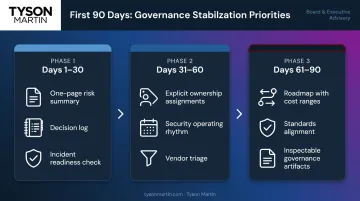
That stabilization follows a concrete sequence. When Tyson Martin steps into an interim CISO role during a transition, the first 90-day governance priorities are:
- Days 1–30: One-page top risks summary with named owners and deadlines; decision log documenting accepted and deferred risks; incident readiness check with defined roles
- Days 31–60: Explicit ownership for control gaps; security operating rhythm with weekly check-ins and monthly risk reviews; triage of critical third-party vendors
- Days 61–90: Longer-term roadmap with sequencing and cost ranges; standards alignment kept practical, not a paperwork project; governance artifacts designed to be inspectable by the next leadership team
Measure Maturity and Set a Target
The RIMS Risk Maturity Model assesses ERM competency across seven attributes — including ERM Process Management, Risk Appetite Management, and Business Resiliency — using 68 key readiness indicators. The maturity ladder runs from ad hoc to leadership.
The goal isn't a perfect score. It's closing the most critical governance gaps in a defined timeframe with measurable outcomes. Organizations that try to jump from ad hoc to optimized in one initiative end up with a bigger documentation problem than they started with. Pick the two or three governance gaps that create the most exposure and close those first.
Frequently Asked Questions
What is the role of governance in enterprise risk management?
Governance is the accountability and decision-rights structure that determines who identifies, owns, escalates, and reports on risk. Without it, even well-designed ERM frameworks fail to produce consistent outcomes — risk management becomes periodic documentation rather than ongoing operational discipline.
What is the difference between ERM and traditional risk management?
Traditional risk management operates within individual functions — legal, IT, finance — each managing its own slice. ERM creates enterprise-wide visibility, unified ownership, and board-level oversight across all risk categories — including the interdependencies no single function can see on its own.
Who is responsible for ERM governance in an organization?
Management designs, operates, and owns the program; the board oversees, challenges, and sets expectations. A CRO, CISO, or equivalent executive typically leads the day-to-day function — but named ownership of individual risks must extend to business leaders, not just the risk team.
How does a board oversee enterprise risk management effectively?
Effective board oversight requires:
- A defined risk appetite that sets clear boundaries
- Structured reporting showing material changes and trend over time
- Pre-agreed escalation thresholds
- Regular dialogue with management, not just passive receipt of updates
Receiving a risk register without engaging on it is acknowledgment, not oversight.
What are the most common ERM governance frameworks?
Three frameworks dominate the field:
- COSO ERM — strategy and performance-integrated; widely used by public companies
- ISO 31000 — principles-based and internationally applicable; flexible by design
- NIST RMF — structured and cybersecurity-focused, with an explicit ERM bridge via NIST IR 8286
What makes an ERM governance program fail?
The most common failure causes:
- No defined decision rights or escalation thresholds
- A gap between what management tracks and what the board actually sees
- Treating ERM as a compliance exercise rather than an operational governance system
When risk ownership is left undefined, the program produces activity, not accountability.