Introduction
Most organizations have some form of risk management in place. What most lack is a clear, pre-agreed answer to one simpler question: when a risk outgrows its current owner, what happens next?
That gap — between identifying a risk and getting it to the right decision-maker — is where manageable problems become crises. Boards receive sanitized summaries. Middle managers assume someone else escalated. A vulnerability that was low-severity on Monday becomes a material incident by Friday.
The SEC now requires material cybersecurity incidents to be disclosed within four business days of a materiality determination. For boards, audit committees, CISOs, and executive teams in financial services, healthcare, and retail, that deadline makes informal escalation habits a governance liability — not just an operational inconvenience.
This article covers the definition, end-to-end process, key components, and the failure modes that determine whether your escalation structure holds under pressure.
Key Takeaways
- A risk escalation framework is a pre-defined governance structure that determines when a risk must be transferred to a higher authority, who receives it, and what decision is required
- Escalation is triggered by threshold breaches — severity, velocity, or organizational impact that exceeds the current owner's authority — not ad hoc judgment calls
- The process runs from identification → threshold assessment → escalation routing → authority decision → feedback loop
- Functioning frameworks need clear decision rights, defined thresholds, standardized communication formats, and named ownership at each tier
- Without a formal framework, organizations escalate too late, route to the wrong level, or skip escalation entirely
What Is a Risk Escalation Framework?
A risk escalation framework is the structured set of rules, roles, thresholds, and communication protocols that govern when and how a risk is transferred from one level of ownership to a higher authority within the organization. Two related concepts are frequently conflated with it — and the distinctions matter for governance design:
- General risk management identifies, assesses, and monitors risks — but stops short of defining what happens when a risk exceeds its owner's capacity to act
- Incident response activates after harm has occurred; escalation is the mechanism that should prevent reaching that point
The framework's purpose is specific: ensuring that risks with material impact on the organization's objectives, compliance posture, or reputation reach the right decision-makers at the right time.
The NIST Definition as a Starting Point
NIST defines risk escalation as occurring "when a particular threshold is reached, either based on a time frame or some other risk condition, thus requiring a higher level of attention." A practical example from NIST IR 8286B: a risk that remains unaddressed for more than two fiscal periods without adequate treatment may be flagged for additional scrutiny.
That framing yields two practical trigger types:
- Time-based triggers — a risk unresolved beyond a defined window
- Condition-based triggers — monitoring indicates that a risk's exposure rating will significantly exceed initial estimates
Both apply in enterprise cyber risk governance, though not equally. Cyber threats routinely hit condition-based triggers — a threat actor's dwell time, a vendor's breach, a control failure detected in monitoring — long before any time-based threshold would fire. A framework that only watches the calendar will always be late.
Why Board Governance Requires a Formal Risk Escalation Framework
The Core Governance Gap
In most organizations, risk is managed at the operational level until something goes wrong. Without a formal framework, there is no consistent signal for when a risk outgrows its current owner. Boards and C-suite executives remain unaware of exposure until it is material or publicly visible.
The problem is predictable. When no one has documented who can accept risk, at what threshold, and with what authority, ownership blurs. IT assumes security is handling it; security assumes legal has it covered. The risk sits in an email thread with no record of who made the call.
The Regulatory Dimension
Regulated industries face explicit expectations. The SEC's cybersecurity disclosure rules, adopted July 26, 2023, require domestic registrants to disclose material cybersecurity incidents within four business days of determining materiality — and to disclose board oversight processes and management's role in assessing and managing material cyber risks annually.
The SEC doesn't use the word "escalation" in its rules. But the operational implication is clear: organizations need documented processes that move material risk information to decision-makers without unreasonable delay.
Enforcement cases make this concrete:
| Company | Year | Failure | Penalty |
|---|---|---|---|
| First American Financial | 2021 | Senior executives not informed of vulnerability scope | $487,616 |
| Blackbaud | 2023 | Employees didn't communicate breach details to disclosure managers | $3M |
| R.R. Donnelley | 2024 | Deficient controls for escalating cyber info to disclosure decision-makers | $2.125M |
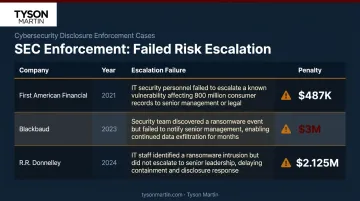
In each case, the technical exposure existed. What failed was the process for getting that information to the people with authority to act on it.
The Velocity Problem
Cyber risk moves faster than traditional risk cycles. A threat that registers as low-severity at the start of the week can become a material incident before the next scheduled risk review. Pre-defined thresholds and routing paths have to exist before an event occurs. There is no time to build them once one is underway.
How the Risk Escalation Process Works
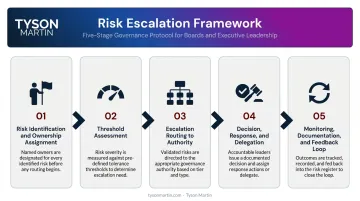
The end-to-end flow follows five steps. Each step has a defined owner, a clear handoff, and a documented output.
Step 1: Risk Identification and Initial Ownership Assignment
Every identified risk gets an initial owner assigned at the appropriate level — operational, functional, or enterprise — based on where the risk originates and its preliminary severity. That owner monitors the risk and initiates escalation when thresholds are met. No owner means no accountability, and no accountability means escalation won't happen on time.
Step 2: Threshold Assessment
Escalation is triggered by defined thresholds, not subjective judgment. Common threshold criteria include:
- Severity or impact rating exceeding a pre-set level
- Risk remaining unresolved beyond a defined time window (NIST cites two fiscal periods as an example)
- Likelihood or exposure estimate increasing significantly above initial assessment
- Risk affecting multiple business units or strategic objectives
- Control failures or repeat breaches of the same risk category
Threshold definitions must reference the organization's documented risk appetite. Without that anchor, escalation decisions become inconsistent — and inconsistent escalation is what audit committees and regulators scrutinize first.
Step 3: Escalation Routing to the Appropriate Authority
Not all risks go to the board. Escalation should be tiered:
Operational team → Functional leader → C-suite → Board or Audit Committee
NIST SP 800-39 describes this as three levels of risk management: organization, mission/business process, and information system. The routing decision depends on scope and materiality. A risk that affects one system routes differently than one triggering regulatory disclosure obligations or strategic-level exposure.
Routing errors in both directions are costly. Escalating low-severity risks to the board desensitizes directors and wastes decision-making time. Failing to escalate a material risk above the functional manager leaves it unaddressed at the wrong tier — with no one accountable at the level that can act.
Step 4: Decision, Response, and Delegation
The receiving authority does four things:
- Reviews the escalation with provided context
- Decides on a response: accept, mitigate, transfer, or escalate further
- Names a specific owner for the response action
- Sets a specific timeline and follow-up checkpoint
This is where decision rights matter most. The framework must pre-define what authority each tier holds — who can accept risk, at what threshold, and for how long. When those rights are documented in advance, decision time during a live event compresses significantly — the path forward is already established before the incident begins.
Step 5: Monitoring, Documentation, and Feedback Loop
Escalation isn't a one-way handoff. The framework must include:
- Tracking escalated risks in the risk register
- Communicating resolution back to the originating owner
- Confirming when a risk returns to routine monitoring or is formally closed
- Capturing trend data for board and audit committee reporting
The ownership assigned in Step 1 doesn't end at handoff — it extends through resolution. A risk that gets escalated but never followed up on is worse than no escalation at all. It creates the appearance of governance without the accountability that makes governance real.
Key Components of an Effective Risk Escalation Framework
Risk Appetite and Tolerance Thresholds
The framework must be anchored to the organization's documented risk appetite. NIST CSF 2.0 (GV.RM-02) requires risk appetite and tolerance statements to be established, communicated, and maintained. Without documented thresholds for severity, velocity, and residual risk, escalation decisions become subjective and inconsistent.
Every incident feels like a surprise when no one agreed in advance what "too much" looks like. Thresholds should be defined in business terms: hours of downtime, financial loss, customer harm, legal exposure. Abstract severity ratings don't create decision clarity.
Decision Rights Matrix
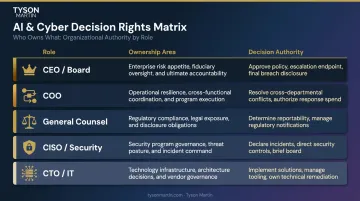
This is the component that most frameworks skip or under-specify. A decision rights matrix defines who has authority to accept, mitigate, transfer, or escalate each risk category at each organizational tier.
A functional structure typically maps across:
- CEO / Board: sets risk appetite, breaks ties on escalated decisions
- COO: owns operational continuity and cross-team execution
- General Counsel: owns legal exposure and notification strategy
- CISO / Security: owns risk clarity and independent challenge
- CTO / IT: owns engineering priorities and technical debt tradeoffs
Ambiguous decision rights are the single most common reason escalation frameworks fail during real incidents. Establishing this matrix before an incident occurs, with explicit thresholds tied to business impact, is what separates frameworks that hold under pressure from ones that collapse into committee confusion.
Escalation Communication Format
Every escalation package should answer four questions: what happened, what's impacted, what's being done, and what decision is needed. At minimum, an escalation communication should include:
- Description of the risk and what changed since last assessment
- Current severity and velocity assessment
- Actions already taken and their status
- Proposed response options
- The specific decision required from the receiving authority
The NC State ERM Initiative's one-page rapid risk assessment template structures this in a format that works under pressure without overloading senior leaders. A red/amber/green status indicator helps — but only if it doesn't hide uncertainty. If something is unknown, the escalation should state that plainly, along with when clarity will be available.
Escalation Ownership and Accountability
Every escalated risk must have a named owner at the escalated level. Not a team. Not a committee. A person who is accountable for the decision and its outcome.
Escalation without ownership transfer is one of the most common failure modes: the risk moves up the chain, the senior leader assumes someone below is managing it, and it stalls with no one accountable.
Integration with the Risk Register
Escalated risks must be formally documented in the organization's risk register — not just tracked in email threads or meeting notes. This enables boards and audit committees to see trend data rather than point-in-time snapshots, supports defensible reporting, and creates the audit trail that regulators and insurers expect.
NIST IR 8286C describes the artifact chain: cybersecurity risk registers, risk detail records, and enterprise risk profiles that aggregate across the organization. The escalation framework should specify exactly how and when escalated risks get logged and updated.
Best Practices for Risk Escalation in Enterprise and Cyber Governance
Build the framework before you need it. Organizations that attempt to define escalation paths during an active incident lose critical time and frequently route to the wrong level. The framework must be built, agreed upon, and tested in calm conditions. Tabletop exercises — structured as 60-minute decision drills with cross-functional participants — are the most effective way to pressure-test routing, thresholds, and communication formats before a real event forces the question.
Separate escalation from blame. The most persistent cultural barrier to timely escalation is the perception that raising a risk reflects poor performance. When escalation is treated as informal or stigmatized, risks accumulate below the threshold of visibility until they breach it at scale.
Leaders should establish clearly that delayed escalation — not the risk itself — is the governance failure. Near-miss disclosures should be treated as learning opportunities, not indicators of fault.
The IIA's guidance on auditing culture specifically asks whether issues are escalated under an established protocol and whether employees feel safe speaking up. Treat that as a governance control, not a cultural afterthought.
Translate risk into business language at each tier. Operational risk owners describe problems in technical terms. Board members need business impact, strategic relevance, and clear decision options. The communication standards within the framework should define how risk severity gets translated at each escalation level.
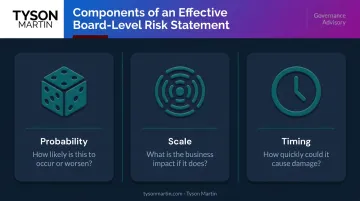
A reliable three-part risk statement covers:
- Probability — how likely is this to occur or worsen
- Scale — what is the business impact if it does
- Timing — how quickly could it cause damage
If a director can't restate the risk in plain English after a briefing, the escalation communication hasn't done its job.
Common Pitfalls and Misconceptions About Risk Escalation Frameworks
Most escalation failures aren't random. They follow predictable patterns — framework gaps that look like human errors until you examine how the governance structure was designed in the first place.
Treating Escalation as a Last Resort
When escalation is informal or culturally stigmatized, risks accumulate quietly beneath the threshold of visibility. Teams hold onto problems, waiting until they're undeniable before surfacing them — by which point options are limited.
Organizations that manage risk well treat escalation as a pre-designed governance function, not an admission that something went wrong.
Conflating Escalation With Risk Reporting
These are not the same thing. Reporting communicates status on a scheduled basis. Escalation transfers authority and demands a decision — it's event-driven, not calendar-driven.
Organizations that rely on periodic risk reports as their escalation mechanism will consistently lag behind fast-moving threats. By the time the next quarterly report is due, the risk has already moved.
Over-Escalating or Under-Escalating Based on Faulty Thresholds
Both directions are framework design failures, not individual judgment errors:
- Over-escalation desensitizes boards and consumes decision-making capacity on low-stakes issues
- Under-escalation leaves material risks managed at the wrong organizational level, often until they become crises
Well-calibrated thresholds and a tiered routing structure resolve both, provided they're designed with enough specificity to hold under pressure.
Frequently Asked Questions
What is the risk escalation model?
The risk escalation model is a tiered, threshold-based governance structure that defines when a risk exceeds the current owner's authority and must be transferred to a higher decision-making level. It specifies who receives the escalated risk, what context must accompany it, and what decision or action is expected in response.
What are the 5 components of the risk framework?
A risk escalation framework has five core components:
- Risk appetite and tolerance thresholds
- A decision rights matrix
- A standardized escalation communication format
- Named ownership and accountability at each tier
- Integration with the risk register for documentation and trend tracking
What triggers a risk escalation?
Escalation is triggered by defined threshold breaches — including severity ratings exceeding agreed limits, risks unresolved beyond a set time window, significant increases in likelihood or potential impact, control failures, or risks affecting strategic objectives beyond the current owner's authority to address.
What is the difference between risk escalation and risk reporting?
Risk reporting communicates status to stakeholders on a scheduled basis. Risk escalation is an active, event-driven transfer of authority and decision-making responsibility triggered by a specific threshold breach. Reporting tells people what's happening; escalation requires someone to decide what to do about it.
Who is responsible for escalating risks in an organization?
The risk owner at each tier is responsible. The person or team monitoring a risk is accountable for recognizing when a threshold has been met and initiating escalation. Pre-assigning these responsibilities in the framework eliminates ambiguity before a live risk event forces the question.
How do you document a risk escalation?
Each escalation should be logged in the risk register with the trigger, receiving authority, decision made, assigned response owner, and resolution timeline. This creates the traceability needed for board reporting and post-incident review.