Introduction
Most organizations can produce an IT risk policy document. Far fewer can answer a board's pointed question — "What's our current risk posture, and what changed since last quarter?" — without a scramble.
That gap is where IT risk governance breaks down. The documentation exists. What's missing are the decision rights, escalation thresholds, and operating rhythm required to answer hard questions under pressure — before the board asks them.
Research from ISACA found that only 40% of boards were confident they understood the specific cyber risks facing their organization — and fewer than one-third were confident in the amount of time spent discussing those risks.
What follows is a practical breakdown of IT risk governance — the domains that matter, where programs fail in the field, and what it takes to build a framework that holds when pressure hits.
Key Takeaways
- IT risk governance isn't a policy file: it's decision rights, escalation thresholds, and continuous oversight.
- The five ISACA governance domains give boards five questions they should always be able to answer.
- Most organizations combine NIST CSF with COBIT or ISO 38500 — no single framework covers everything on its own.
- Most programs stall at documentation and never build the operational habits that make governance real.
- Board reporting should answer three questions: current posture, what changed, and what decision is needed.
What Is an IT Risk & Governance Framework?
An IT risk governance framework is the combination of structures, policies, decision rights, and oversight mechanisms that ensure technology-related risks are identified, assessed, and managed in alignment with business strategy. The emphasis belongs on that last part.
A governance framework defines who decides, at what threshold, and how those decisions are documented and reviewed. It is not a policy file, and it is not a GRC platform — it is the mechanism that makes technology risk decisions consistent and accountable.
Governance vs. Management vs. GRC
These three terms get conflated constantly in boardrooms — and the confusion drives real governance failures:
- IT governance defines who decides, at what threshold, and how decisions are documented and reviewed.
- IT management is the day-to-day execution — operating systems, deploying software, managing infrastructure. Management executes under governance.
- GRC (Governance, Risk & Compliance) is an enterprise-wide discipline spanning legal, financial, compliance, and technology risk across all business functions. IT governance is one component of it.
When boards conflate these, they tend to either over-delegate (assuming the CISO has it covered) or over-involve (diving into technical details that belong in management, not oversight). The board's role is to set direction, approve risk appetite, and hold management accountable. That role needs to be explicit, not implied.
Why This Matters Beyond Compliance
Getting those distinctions wrong has a cost that shows up fast — usually during an incident or a regulatory exam. Without clear decision rights and escalation thresholds, every incident becomes improvised crisis response. With them, the organization can show regulators, auditors, and directors that risk decisions are defensible.
In regulated industries, the stakes are concrete:
- Financial services: The OCC's Cybersecurity Supervision Work Program is structured around NIST CSF functions and expects evidence of ongoing oversight — not point-in-time documentation.
- Healthcare: HHS/OCR states that HIPAA risk analysis must be ongoing and continuous, not a periodic event.
- Retail/payments: PCI DSS v4.0.1 requires executive management to review assessment results annually and approve remediation plans — a governance obligation, not an IT task.
- Public companies: SEC rules adopted in 2023 require registrants to describe the board's role in overseeing cybersecurity risk — a disclosure that demands actual governance, not a paragraph of aspiration.
The 5 Core Domains of IT Governance Every Board Should Understand
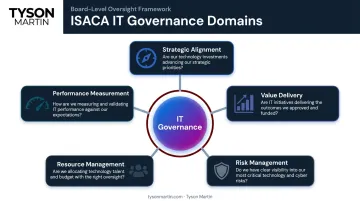
ISACA's IT Governance Institute identifies five foundational domains for IT governance: Strategic Alignment, Value Delivery, Risk Management, Resource Management, and Performance Measurement. Think of these as five questions a board should be able to answer about its technology program at any given time.
Strategic Alignment
Can IT leadership explain how each major initiative connects to a specific business goal?
Strategic alignment means IT investment priorities directly advance the organization's competitive strategy — not just enabling operations. The signal at the board level is whether IT leaders can map each major initiative to a measurable business outcome: reduced onboarding time, improved uptime for revenue-critical systems, faster regulatory compliance.
When everything is approved and nothing is stopped or delayed, that's a red flag. Strategic organizations maintain a "stop list" alongside their roadmap — explicit tradeoffs between speed and control, growth features and reliability work.
Value Delivery
Is there evidence of benefits realization, or just project completion reports?
Poor value delivery looks like activity-based reporting: policies updated, employees trained, tickets closed. Boards should look for outcome language — did the initiative reduce customer onboarding time? Improve uptime to a specific threshold? Cut time-to-remediate vulnerabilities?
Value delivery means IT investments produce measurable outcomes. If a metric can't trigger a decision, it's reporting, not oversight.
Risk Management
Is cybersecurity risk connected to the enterprise risk appetite statement, or does it live only in the IT department?
This domain is most directly relevant to board oversight. Cybersecurity threats, operational disruptions, and compliance exposures must connect to the enterprise risk appetite — the thresholds that define what the organization will and won't tolerate.
Without that connection, the CISO speaks one language, the CFO another, and the board receives competing frameworks with no common denominator. The result is escalation without resolution.
The board-level signal: risk discussions reference specific appetite thresholds, not just severity ratings.
Resource Management
Are vendor relationships governed with the same rigor as internal controls?
Resource management covers people, infrastructure, vendors, and budgets. Third-party risk is where boards most frequently underinvest. Most organizations rely on questionnaires, SOC reports, and sprawling spreadsheets — tools that generate volume but rarely surface the decisions that matter.
Effective board-level vendor oversight requires:
- A short "critical vendor" tier (10–30 vendors) for board visibility
- Each top vendor risk paired with a decision path: accept, reduce, transfer, or replace
- Exceptions visible until closed, with dates and named owners
Performance Measurement
Is the board receiving signal or noise?
Effective performance measurement produces a stable dashboard — 8 to 12 metrics, with roughly five board-level outcome indicators held constant over time. The goal is trend visibility: what improved, what deteriorated, what requires a decision.
A dashboard that's always green, with no exceptions and no tradeoffs, offers no basis for a decision. Boards need directional trend data — not a one-time snapshot that expires before the next meeting.
Common IT Risk Governance Frameworks: A Plain-English Overview
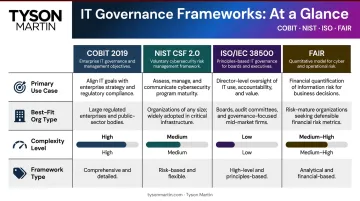
No single framework covers everything. Organizations typically select one as a primary structure and add others for specific needs. The right choice depends on your regulatory proof requirements, your risk profile, and what your team can realistically sustain.
| Framework | Best For | Complexity |
|---|---|---|
| COBIT 2019 (ISACA) | Large enterprises needing structured oversight across the full IT function; strong SOX and GDPR alignment | High |
| NIST CSF 2.0 | Cybersecurity risk; flexible, widely recognized; aligns with financial services regulatory expectations | Low–Medium |
| ISO/IEC 38500:2024 | Board-level governance structure; the Evaluate-Direct-Monitor cycle for senior executives | Low–Medium |
| FAIR | Quantifying cyber risk in financial terms; translating exposure into expected loss for board reporting | High (data-intensive) |
A few practical notes:
- NIST CSF 2.0 now includes six core functions — Govern, Identify, Protect, Detect, Respond, and Recover. The new "Govern" function specifically establishes cybersecurity risk management strategy at the organizational level.
- ISO/IEC 38500 was updated in 2024 and is designed for governing bodies of all sizes — it's the most accessible entry point for boards that need governance structure without COBIT's implementation complexity.
- FAIR is the only major quantitative framework. It translates risk into financial exposure rather than severity ratings, giving boards dollar-range estimates they can tie to decisions — but it requires strong data inputs to produce reliable loss estimates.
Selection guide:
- Mid-market organizations in regulated industries often start with NIST CSF paired with ISO 38500 — low lift, credible baseline
- Large enterprises with complex IT environments tend to use COBIT as the primary structure, with other frameworks layered in
- Organizations preparing for board reporting should consider adding FAIR specifically where quantifying financial exposure matters most
Where Most IT Risk Governance Programs Break Down in Practice
Framework selection is the starting point, not the outcome. Most programs stall at documentation and never achieve operational maturity. Four failure patterns account for the majority of governance breakdowns.
The Static Assessment Problem
Annual risk reviews and point-in-time questionnaires produce snapshots that are outdated before the report is filed. Risk positions change with every new vendor, system change, or threat actor development.
HHS/OCR states this directly in HIPAA guidance: risk analysis must be ongoing and continuous to identify when security measures need updating. Regulators don't accept annual snapshots as evidence of continuous oversight — and neither should boards.
The Silo Problem
When cybersecurity risk is managed separately from enterprise risk, the result is disconnected reporting. The CISO speaks one language, the CFO another. The board receives competing frameworks with no common denominator and no clear risk appetite to anchor decisions.
The WEF Global Cybersecurity Outlook 2026 found that only 45% of boards in high-resilience organizations had a clearly defined and documented role in overseeing cybersecurity. In low-resilience organizations, board involvement was nearly absent.
The Decision Rights Failure
The most common structural gap: teams don't know what requires management approval versus board notification. Without clear thresholds, every incident becomes improvised response, and every board briefing becomes a judgment call about how much to share and in what format.
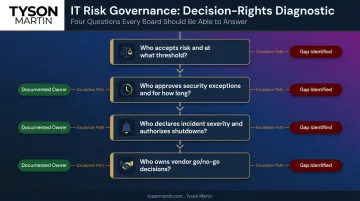
Specific questions that should have documented answers:
- Who accepts risk, and at what threshold?
- Who approves security exceptions, and for how long?
- Who declares incident severity and can authorize system shutdowns?
- Who owns vendor go/no-go decisions for critical suppliers?
Without documented answers, decisions get deferred — and when they do happen, no one can defend how or why.
The Reporting Problem
Board-level IT risk reporting that lists every metric and every incident trains boards to disengage. Reports that read like an information security audit file: too long, too technical, never stating what decision is needed. The result is compliance storytelling rather than actionable oversight.
The fix is a three-question structure that every board report should answer:
- What changed since last time?
- What does it mean for the business?
- What does management need from the board?
Reports built around those questions drive accountability and cut noise.
IT Risk Governance Best Practices for Boards and Executive Teams
Establish Decision Rights Before Selecting a Framework
Define who owns each risk domain, what thresholds trigger escalation to management versus the board, and how those decisions get documented. A practical decision-rights map should answer — without debate — who accepts low risk, who accepts medium risk, and what must escalate to the board.
Escalation rules should be threshold-based: dollars, downtime, data sensitivity, or legal exposure. Exceptions require expiry dates; "temporary" controls without an end date quietly become permanent policy.
Build for Continuous Monitoring, Not Compliance Events
Governance programs that only activate during audits create false assurance. The triggers for reassessment should be event-driven, not calendar-driven:
- New vendor relationships added to the critical tier
- System architecture changes affecting crown-jewel assets
- Security incidents above defined severity thresholds
- M&A activity, leadership transitions, or material regulatory changes
The calendar review has its place — annually at minimum. But treating it as the only trigger leaves material risk gaps between cycles.
Design Board Reporting Around Three Questions
Every board report should answer:
- What is the current risk posture?
- What changed since the last briefing?
- What decision or action does the board need to take?
The WEF Global Cybersecurity Outlook 2025 found that 62% of high-resilience organizations provide board members regular updates on recent cyber incidents and risk predictions, versus 29% of low-resilience organizations. That gap doesn't close on its own — it reflects a deliberate choice about how seriously the board treats risk as an ongoing oversight responsibility.
Treat the Framework as a Living System
Schedule formal framework reviews at least annually and after significant organizational changes. Each review should produce three outputs:
- A documented record of what was reviewed and what changed
- Findings with owners — not observations left floating without accountability
- Decisions made — the documented trail that makes governance defensible to regulators, auditors, and outside counsel
When to Bring In External Expertise
Some governance gaps are structural — they require external perspective to close, not more internal effort. The signals are recognizable:
- The board receives inconsistent answers to the same risk questions across different briefings
- Post-incident response reveals no clear escalation path — roles blur under pressure
- Regulatory examiners raise concerns about oversight quality, not just technical controls
- A leadership transition leaves a governance gap with no internal owner
- M&A integration requires rapid assessment of inherited IT risk
In these situations, an interim or fractional CISO — someone who has led governance programs at enterprise scale — can establish decision rights, tighten reporting, and build inspectable execution faster than internal hiring alone.
Deloitte Canada research found that 53% of organizations encountered a critical cybersecurity issue after announcing a merger or acquisition. And with 49% of cyber leaders reporting they don't see a future in their current roles (ISC2, 2025), leadership transitions are increasingly a governance risk in their own right.
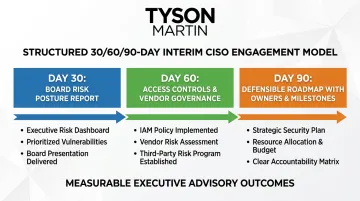
That's the context driving demand for structured external advisory support. Tyson Martin works with boards and executive teams in these scenarios, providing the oversight structure, governance diagnostics, and board-ready reporting organizations need without the delay of a full executive search. His interim CISO engagements follow a structured 30/60/90-day delivery model with measurable outcomes at each interval:
- Day 30 — Plain-English risk posture delivered to the board
- Day 60 — Tightened access controls and vendor governance in place
- Day 90 — Defensible roadmap with named owners and measurable milestones
Frequently Asked Questions
What is the IT risk governance framework?
An IT risk governance framework combines structures, policies, decision rights, and oversight processes to identify, assess, and manage technology-related risks in alignment with business strategy and regulatory obligations. Unlike a policy document, it defines who decides, how decisions are made, and how oversight is maintained continuously.
What are the 5 areas of IT governance?
ISACA identifies five domains: Strategic Alignment, Value Delivery, Risk Management, Resource Management, and Performance Measurement. Together, they cover whether IT investments support business strategy, deliver value, manage risk, use resources well, and produce the right outcomes.
What are the common IT governance frameworks?
The most widely used frameworks are COBIT 2019, NIST Cybersecurity Framework (CSF) 2.0, ISO/IEC 38500, and FAIR. Most organizations combine frameworks — one as the primary governance structure, others for specific needs like cybersecurity risk or quantitative exposure analysis.
What is the difference between IT governance and IT risk management?
IT governance is the broader structure — covering strategic alignment, decision rights, and board oversight across the full technology function. IT risk management is a domain within governance focused specifically on identifying, assessing, and mitigating technology-related threats. Effective IT risk management depends on governance to define ownership and the thresholds at which decisions escalate.
Who is responsible for IT governance in an organization?
IT governance is shared: the board sets risk appetite, executive leadership (CEO, CIO, CISO) owns strategy and execution, and governance committees define accountability across IT and business units. The failure mode is assuming the CISO owns it entirely — that conflates management with governance.
How often should an IT risk governance framework be reviewed?
Formally, at least annually. But the more important triggers are event-driven: leadership transitions, mergers and acquisitions, major incidents, and material changes in regulatory requirements. Document each review, the findings, and the decisions made — that record is what makes governance defensible.