Introduction
Most organizations have selected an IT risk framework. Many have documented controls, assigned a CISO, and produced quarterly security reports. And yet boards still get surprised by incidents, still struggle to answer basic questions about risk posture, and still receive briefings full of technical detail that don't point to any clear decision.
That gap — between framework selection and governance execution — is the real problem.
The 2025 IBM Cost of a Data Breach Report puts the global average breach cost at $4.4M, down slightly from 2024 due to faster containment. Speed of response, it turns out, matters as much as framework choice. Meanwhile, 72% of cyber leaders report that organizational cyber risks are rising, according to the 2025 WEF Global Cybersecurity Outlook.
This article covers what enterprise technology governance actually means, the five components that make a framework operational, and how leading frameworks compare at the board level. It also examines why most frameworks fail in practice — and the answer is rarely the methodology itself.
Key Takeaways
- Framework selection is not governance execution — most organizations have one without the other
- Effective governance defines who decides, not just what controls exist
- Decision rights and escalation structures are the most commonly missing component
- Board reporting should answer three questions: current posture vs. appetite, what changed since last time, and what decisions are needed now
- In regulated industries, a single methodology rarely holds — layered frameworks are the standard
What Enterprise Technology Governance Actually Means
Enterprise technology governance is the system that determines who decides on technology risk, how those decisions are made, and how the board maintains meaningful oversight. It is not IT operations, and it is not compliance management — both of those focus on execution, not oversight structure.
The distinction matters practically. Governance answers strategic questions:
- What risk appetite has the organization set?
- How does technology investment align to business objectives?
- What thresholds trigger escalation to the board versus management?
Many boards confuse activity with governance. When security briefings consist of patch counts, tool deployments, and training completion rates, that's reporting on execution — not governance. Real governance shows explicit decisions, named owners, and measurable evidence that risk exposure is narrowing over time.
Framework vs. Governance Structure
This is where most organizations fall short. An IT risk management framework is a methodology — NIST CSF, ISO 27001, COBIT. A governance structure is the people, decision rights, and accountability that make the framework real.
Organizations routinely have the former without the latter:
| Framework | Governance Structure |
|---|---|
| Methodology (NIST CSF, ISO 27001, COBIT) | People, decision rights, and accountability |
| Documents what to do | Determines who decides and who is answerable |
| Can exist without owners | Requires assigned authority and tested escalation paths |
| Sits on a shelf | Operates through a stable reporting cadence |
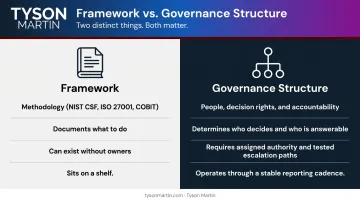
A documented framework with no assigned decision authority, no tested escalation path, and no stable reporting cadence is just a binder on a shelf.
The NACD's 2024 public-company survey found that director confidence in technology oversight is significantly higher when technology appears on the agenda at every board meeting (34% very or extremely confident) versus once a year or less (10%). Cadence alone doesn't create governance. Its absence, though, is a consistent indicator that governance has never moved off the page.
The Five Core Components of an Effective Framework
Risk Identification
Risk identification must go beyond cataloging threats. The practical starting point is mapping which systems, vendors, and processes are most critical to business continuity — what Tyson Martin calls "crown-jewel identification." Questions like which business process cannot fail during an incident? and what's the maximum acceptable downtime? ground risk identification in operational reality rather than theoretical severity ratings.
Without that business context, risk registers fill up with technical vulnerabilities that no executive can prioritize.
Assessment and Prioritization
Effective assessment combines likelihood and impact with business context : financial exposure, regulatory consequence, and operational disruption. Generic high/medium/low labels lose meaning in board reporting because they don't connect to what the organization is actually trying to protect.
Risk ratings should reflect:
- Revenue at risk
- Regulatory notification requirements
- Customer trust exposure
- Recovery timeline
That translation from technical to business terms is what makes assessment useful above the CISO level.
Control Design and Mitigation
Controls need two things to be real: specific risk linkage and named ownership. Technical controls (encryption, endpoint detection, MFA) and administrative controls (policies, access governance) both require someone who can be held accountable.
Weak control design shows up in predictable ways:
- Risk exceptions approved by email with no expiry date
- Policies that exist on paper but can't be demonstrated in practice
- Ownership that defaults to "IT" rather than a named individual with authority to commit resources
Continuous Monitoring and Reporting
Monitoring is not an annual exercise. Per NIST SP 800-137, continuous monitoring is the mechanism for maintaining ongoing visibility into assets and awareness of threats, replacing point-in-time snapshots with persistent evidence of control effectiveness.
For board reporting, this means dashboards that show trend over time rather than a status at a single moment. A single quarter can mislead. Three quarters of trend data reveal whether risk is actually improving — or the numbers just look better on paper.
Governance and Decision Rights
This is the component most commonly missing in practice. Clear governance requires:
- Which risk decisions belong to the board (risk appetite, major exceptions, escalation thresholds)
- Which belong to the CISO or CIO (program execution, control design, vendor selection)
- Which belong to management (day-to-day operations, incident response)
- Escalation triggers that are pre-defined and tested, not invented under pressure
As Tyson Martin puts it: "If you can't name who decides, you can't move fast safely. Clear decision rights are a control."
The Leading IT Risk Management Frameworks: A Board-Level View
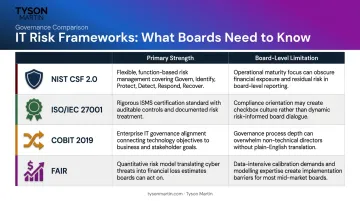
Framework selection matters less than whether the chosen framework is operationalized. Many organizations select a sound methodology and fail to connect it to board oversight or business decision-making. With that caveat, here's how the five most-referenced frameworks compare at the board level.
| Framework | Primary Strength | Board-Level Limitation |
|---|---|---|
| NIST CSF 2.0 | Common language for risk posture reporting; Govern function addresses strategy, policy, and oversight | Requires additional processes for third-party risk and reporting cadence |
| ISO/IEC 27001:2022 | Certification documents control ownership and continuous improvement; strong for regulatory assurance | Internally focused; doesn't inherently address vendor risk or board reporting cadence |
| COBIT 2019 | Connects IT strategy to business objectives; 40 governance and management objectives | Implementation complexity requires significant organizational commitment |
| FAIR | Quantifies cyber risk in financial terms (loss exposure, probable frequency) | Not a full control/governance model; requires data discipline and experienced practitioners |
Framework Layering for Regulated Industries
Most regulated enterprises don't pick one framework. They layer them by governance purpose:
- NIST CSF for cybersecurity structure and executive reporting
- ISO 27001 for certification and ISMS evidence
- COBIT for governance alignment and IT-strategy linkage
- FAIR for financial quantification in board and audit committee discussions
Financial services organizations also navigate FFIEC guidance; healthcare entities must satisfy HIPAA risk analysis requirements; retail and payment environments layer in PCI DSS. Framework selection in regulated industries is a board-level strategic decision, not a technical one.
That decision got clearer when NIST CSF 2.0, published in February 2024, added Govern as its sixth function: organizational context, cybersecurity strategy, supply-chain risk management, and oversight. The addition formalized what boards now need to ask directly — not just whether a framework exists, but whether governance accountability is built into it.
The Governance Gap: Why Frameworks Fail in Practice
The core failure mode is treating framework adoption as the goal rather than the starting point.
The result looks like this:
- Documented controls that are never tested
- Risk ratings that don't change between reporting cycles
- Board reports full of technical detail but no clear decisions
- Escalation paths that exist on paper but collapse under pressure
Symptoms of the Governance Gap
In board advisory and diagnostic engagements, Tyson Martin consistently identifies the same failure patterns:
- Risk exceptions approved by email with no expiry date
- Projects going live without a documented security sign-off path
- Third-party risk with no single accountable owner
- Incident severity levels defined but no pre-determined authority to declare them
- Metrics that change every quarter, preventing any trend from forming
- Policies that exist but teams can't produce evidence they follow them
The SEC enforcement action against First American Financial in 2021 illustrates what happens when escalation fails. The company's information-security personnel identified a critical vulnerability — one that exposed over 800 million document images — but senior executives were never informed. First American had its own 45-day remediation policy; it failed to follow it due to a risk-level tracking error. The SEC settlement included a $487,616 penalty. The governance failure wasn't technical — it was the absence of a functioning escalation path.
What Operational Maturity Looks Like
Mature governance is distinguishable from documented governance by several characteristics:
- Risk oversight is continuous, not annual
- Control evidence is inspectable — logs, test results, access reviews — not self-reported
- Escalation thresholds are tested through tabletop exercises before an incident
- The board receives a stable dashboard showing trend, not a different set of metrics each quarter
- Bad news reaches the board early, not after impact
Organizations in transition — new leadership, M&A activity, regulatory scrutiny, or post-incident recovery — typically need an experienced external perspective to close this gap. Tyson Martin works with boards and executive teams at exactly these inflection points, building 90-day execution plans with named owners and measurable outcomes.
The deliverables are concrete: reduced privileged accounts, tested disaster recovery, tighter escalation structures, and board reporting formats that surface trend and decision points clearly.
What Board-Level Technology Oversight Should Actually Look Like
The board does not manage technology risk. It oversees it. Those are different jobs — and conflating them is how boards end up evaluating firewall configs instead of asking whether the organization can absorb the risk it's carrying.
The board's actual role:
- Set risk appetite (what the organization will tolerate and what it won't)
- Approve escalation thresholds
- Receive credible and consistent risk reporting
- Ensure accountability for technology risk is clearly assigned at the executive level
- Ask the right questions — not evaluate technical controls directly
What Effective Board Reporting Requires
Effective reporting answers three questions after every briefing:
- What is our current risk posture relative to appetite?
- What changed since the last briefing, and why does it matter?
- What decisions do we need to make today?
If the reporting structure doesn't enable those three answers, the board has no real oversight — only the appearance of it.
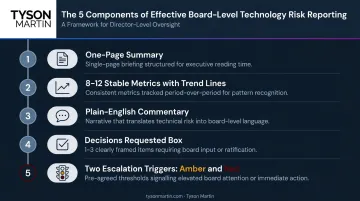
In practice, board-ready technology risk reporting includes:
- A one-page summary showing posture, changes, and decisions requested
- 8–12 stable metrics with approved thresholds and trend lines (not rotating scorecards)
- Plain-English commentary explaining what drove changes
- A "Decisions requested" box with one to three items, each with options, cost ranges, and a recommended path
- Two escalation triggers: amber (worsening trends, near misses) and red (threshold breaches, repeat violations)
NACD guidance on cyber-risk reporting recommends that boards receive technology risk updates at least quarterly, with between-cycle notifications triggered by material incidents or significant changes in risk exposure.
The SEC's 2023 cybersecurity disclosure rules require public companies to disclose material cyber incidents within four business days of a materiality determination and to describe board oversight of cybersecurity risks in annual filings. That means the governance structure has to hold up in a proxy statement — not just in a board presentation. Boards without documented oversight processes are exposed on both fronts: operationally and in their disclosures.
Frequently Asked Questions
What are the key components of an enterprise technology governance and risk management framework?
The five core components are risk identification, assessment and prioritization, control design and mitigation, continuous monitoring and reporting, and governance/decision rights. Of these, governance and decision rights — defining who decides what, and what triggers escalation — is the component most frequently missing or underdeveloped in practice.
What does enterprise governance mean?
Enterprise governance defines who holds decision-making authority, how those decisions are held accountable, and how oversight bodies like boards get the information needed to fulfill their fiduciary responsibilities. Unlike day-to-day management or IT operations — which focus on execution — governance establishes the oversight structure above it.
How is an enterprise technology governance framework different from a compliance framework?
Compliance frameworks establish the controls required to meet regulatory standards. A governance framework determines who owns those controls, how decisions escalate, and how the board maintains ongoing oversight. Governance is the operating structure. Regulatory compliance is one of its outputs.
How often should boards review technology risk posture?
Boards should receive technology risk updates at least quarterly, with between-cycle notifications triggered by material incidents, significant vendor changes, or regulatory developments. The cadence matters less than the consistency and comparability of what is reported each cycle — rotating metrics prevent trend analysis.
How do you choose the right IT risk management framework for your organization?
Selection depends on your regulatory environment, organizational size, and governance priorities:
- NIST CSF — cybersecurity structure and executive reporting
- ISO 27001 — certification and ISMS evidence
- COBIT — governance alignment
- FAIR — financial risk quantification
Most regulated enterprises use complementary frameworks rather than a single one.
What is the board's role in technology governance?
The board's role is oversight, not management: setting risk appetite, approving escalation thresholds, receiving credible and consistent risk reporting, and ensuring accountability for technology risk is clearly assigned at the executive level. Boards should govern at that altitude — not evaluate technical controls directly.