
Introduction
Most organizations have invested in cybersecurity tools. Firewalls, endpoint detection, SIEM platforms — the stack grows every year. But when the board asks "how exposed are we right now?" or "who decides when to take a system offline?", the room goes quiet.
That's a governance problem, not a technology problem.
Cybersecurity governance is the operating system behind every security investment: the structure that determines who decides, what thresholds trigger action, and how leadership stays accountable. Without it, even well-funded security programs produce uncertainty rather than oversight.
A 2025 Gartner survey found that 90% of non-executive directors lack a meaningful measure of confidence in cybersecurity value — not because boards don't care, but because most reporting doesn't give them what they need to act.
This guide covers what cybersecurity governance actually is, what a framework must include, how to choose the right model for your organization, and how to build something a board can inspect, question, and act on — without needing a security background to do it.
Key Takeaways
- Cybersecurity governance sets who decides, who's accountable, and what thresholds require board action — management executes within that structure
- Boards are now directly accountable under SEC disclosure rules, NIS2, and DORA — delegation to IT is no longer adequate
- Every governance framework needs five components: risk appetite, decision rights, policies, board reporting, and monitoring
- NIST CSF 2.0, ISO 27001, COBIT 2019, and CIS Controls each serve different organizational needs — choose based on your structure and regulatory exposure
- Governance theater — frameworks on paper with no accountability structure — is the most common failure mode
What Is Cybersecurity Governance — And Why the Board Must Own It
Governance vs. Management: A Clear Distinction
Cybersecurity governance is the strategy, structure, and accountability mechanisms that guide how an organization makes decisions about cyber risk. It is not the same as cybersecurity management.
Governance sets the rules of the road; management drives the car.
Boards and executives own governance: what risks to accept, what thresholds trigger escalation, how resources get allocated. The CISO and security team own management — how controls are implemented, monitored, and improved. Conflating the two is where most organizations go wrong.
As Tyson Martin puts it when working with boards: "The board should challenge, approve, and guide. It should not run your response plan or manage your backlog." That clarity of role is itself a governance deliverable.
Governance has four observable qualities when it's working:
- Explicit decisions with clear owners
- A steady reporting cadence
- Documented escalation thresholds
- Evidence that actions actually reduced risk
Without all four, you have activity. Boards that can't point to each element have a governance gap — whether they know it or not.
Why Boards Cannot Delegate This to IT
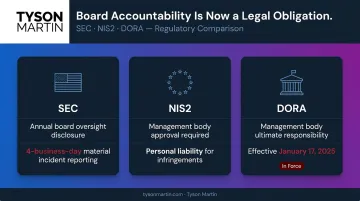
That distinction between governing and managing matters most when regulators come looking. Board oversight of cybersecurity is no longer a best practice — it's a legal obligation in several jurisdictions.
- SEC (US): Rules adopted July 26, 2023 require annual disclosure of board oversight of cybersecurity risks (Form 10-K, Item 106) and material incident disclosure within 4 business days of materiality determination
- NIS2 (EU): Article 20 requires management bodies of essential and important entities to approve and oversee cybersecurity risk-management measures — and allows personal liability for infringements
- DORA (EU financial sector): The management body bears ultimate responsibility for ICT risk and must approve the digital operational resilience strategy, effective January 17, 2025
The SEC has already enforced this. Blackbaud paid a $3M penalty in 2023 for misleading disclosures after a ransomware attack. In 2024, Unisys, Avaya, Check Point, and Mimecast faced penalties ranging from $990,000 to $4M for materially misleading cyber disclosures. These aren't technical failures — they're governance failures.
Core Components of a Cybersecurity Governance Framework
Risk Appetite
Every governance framework starts with one foundational question: how much cyber risk is the organization willing to accept in pursuit of its business objectives?
NIST defines risk appetite as "the types and amount of risk, on a broad level, an organization is willing to accept in its pursuit of value." NIST CSF 2.0 goes further, requiring that risk appetite and tolerance statements be established, communicated, and maintained — not just documented once and shelved.
This is a board-level decision. It connects directly to business strategy: how much operational disruption is acceptable? What data exposure would trigger regulatory action? What third-party risk concentration is tolerable? Management cannot answer those questions on behalf of the board.
Decision Rights and Escalation Thresholds
This is the component most organizations skip — and the one that breaks first in a real incident.
Decision rights define who has authority to make which security decisions, at what cost or risk level, without requiring escalation. Without them, three predictable failures occur:
- Risk gets accepted informally, with no record and no expiry
- Vendors get onboarded with security gaps that nobody had authority to formally approve
- Incidents arrive, and the team spends the first hour negotiating authority instead of containing damage
A practical escalation model uses tiers matched to impact:
| Impact Level | Decision Owner | Example Trigger |
|---|---|---|
| Low (local, limited) | Management within policy | Routine access request |
| Medium (critical process affected) | Executive with time limit | Vendor with significant risk gap |
| High (material outage, regulated data) | CEO + Board committee chair | Active breach, ransomware |
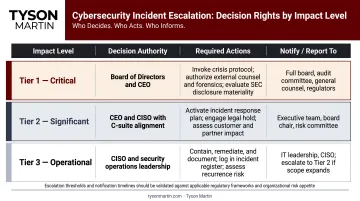
Organizations that establish these thresholds before an incident hits spend that time on containment — not on figuring out who has authority to act.
Policies and Procedures
Governance policies set direction and are board-approved. Standards operationalize them at the CISO level. Procedures implement them at the team level.
That hierarchy matters. Policies without accountability structures are decoration. For any policy to function as governance, four questions need documented answers:
- Who approved it?
- Who is accountable for compliance?
- When was it last reviewed?
- What happens when it's violated?
If those answers aren't on record, the policy isn't governance — it's paperwork.
Board Reporting and Communication
Effective governance reporting answers three questions every quarter:
- What is our current risk posture?
- What changed since last quarter?
- What decisions does the board need to make?
A well-designed board dashboard fits on one to two pages. It shows trend data, not tactical trivia. It uses plain language. It includes a "decisions requested" section with options, cost ranges, and a recommended path — so directors can govern rather than just observe.
What it excludes: long vendor narratives, raw technical metrics, green dashboards with no exceptions or uncertainty, and activity counts that obscure actual risk posture.
Continuous Monitoring and Improvement
Governance is not an annual exercise. NIST CSF 2.0's Govern function, NIS2 Article 20, and DORA all treat continuous oversight as a baseline expectation.
Translating that expectation into practice means matching review depth to the right frequency:
- Weekly: Execution check-ins to maintain momentum
- Monthly: Management review of what changed, what's stuck, what needs a decision
- Quarterly: Board-level trend reporting on top risks, posture movement, and decisions needed
Metrics that belong in board reporting: time to detect and contain high-impact incidents, critical open findings with owners and due dates, MFA coverage on key systems, backup restore test results, and third-party concentration risk.
Major Cybersecurity Governance Frameworks Compared
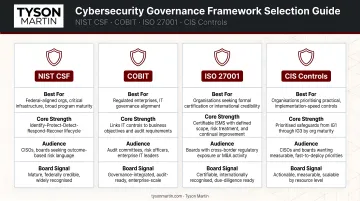
Organizations use established frameworks rather than building from scratch for good reason — they provide regulatory credibility, auditor recognition, and a shared vocabulary across boards, legal teams, and regulators. Framework choice should match the organization's regulatory environment, risk profile, and maturity.
NIST Cybersecurity Framework 2.0
Released February 26, 2024, NIST CSF 2.0 introduced six core functions: Govern, Identify, Protect, Detect, Respond, Recover.
The addition of Govern is the significant change. It explicitly addresses how organizations establish risk management strategy, define roles and responsibilities, set risk appetite, and maintain oversight. Governance becomes a named, first-class component rather than an implied one.
CSF 2.0 is voluntary but widely adopted. According to NACD's 2025 survey, 58% of public company boards use NIST CSF to manage and oversee cyber risk. It serves as the baseline for many US regulatory frameworks and works well as a risk-based foundation for organizations at any maturity level.
Best suited for: Organizations wanting US regulatory alignment and a flexible, outcomes-based framework.
ISO/IEC 27001 and 27014
, particularly useful where IT risk and business risk are deeply intertwined, as in financial services and healthcare.
CIS Controls v8.1 takes a different approach: a prioritized, actionable list of safeguards focused on implementation rather than governance philosophy. It's most valuable for organizations that need prescriptive guidance and quick wins over a broad framework.
Quick selection guide:
| Situation | Recommended Framework |
|---|---|
| Regulated industry with complex IT governance | COBIT 2019 |
| US regulatory alignment, flexible foundation | NIST CSF 2.0 |
| International certification, enterprise contracts | ISO 27001 |
| Prescriptive implementation, resource-constrained | CIS Controls v8.1 |
How to Build a Cybersecurity Governance Framework: A Step-by-Step Roadmap
Step 1 — Assess Your Current State
Before choosing a framework or drafting a policy, understand where you actually stand. A governance gap assessment examines:
- What security decisions are currently being made, by whom, and whether they're documented
- Whether risk exceptions have owners, expiry dates, and compensating controls — or get approved by email and forgotten
- Whether incident response roles are clear, tested, and practiced — or blur under pressure
Common findings from initial assessments fall into a familiar pattern:
- Metrics change every month, so trends never form
- Policies exist but teams can't show evidence they follow them
- Audit findings repeat because nobody owns the fix
These aren't technical problems. They're governance problems.
A focused gap assessment against your chosen framework can be completed in 10 to 15 business days and produces a decision-rights map, control maturity snapshot, evidence gaps list, and a 90-day plan.
Step 2 — Define Decision Rights and Governance Structure
Establish who owns what before pressure forces the question.
This means:
- Board level: Risk appetite, policy approval, material escalations
- Executive level (CEO, COO, GC): Breaking ties, operational continuity, legal notifications
- CISO level: Risk clarity, control design, board reporting
- Management level: Execution within approved policy and thresholds
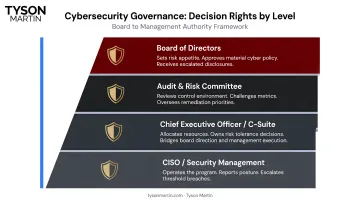
Document escalation thresholds explicitly — the specific risk or cost levels that require board notification or decision. Pre-decide who can authorize containment actions that may disrupt systems, when to engage outside counsel, who speaks externally during an incident, and who owns customer communications.
This is the governance infrastructure most organizations lack. Without it, incidents become authority negotiations.
Step 3 — Develop and Approve Policies
Draft board-level governance policies covering:
- Risk appetite and tolerance
- Acceptable use and access standards
- Incident notification obligations (internal and regulatory)
- Third-party risk requirements
These must be approved at the board or executive level — not authored by the security team and shelved. Policies should be concise, auditable, and reviewed annually or when material business conditions change. If a policy hasn't been reviewed in over a year, it isn't functioning governance.
Step 4 — Establish Board-Ready Reporting
Build a reporting cadence that gives the board what it needs to govern, not what's easiest to produce.
A board-ready governance report includes:
- Current risk posture in plain language
- What changed since last quarter — and why it matters
- Top risks with named owners and target states
- Key risk indicators that show direction, not activity counts
- Decisions requested, with options and a recommended path
The format matters as much as the content. A report that changes structure every quarter forces directors to reorient rather than govern — consistency is what makes trend visible.
For organizations that need to build this capability quickly, working with a board advisor or fractional CISO can compress the timeline from months to weeks, with decision rights, a reporting baseline, and a 90-day plan with named owners in place from the start.
Step 5 — Monitor, Audit, and Iterate
Establish a continuous monitoring cadence and track a small, stable set of metrics. Metrics that shift every quarter prevent the board from seeing trend — and trend is what governance oversight requires.
Schedule formal governance reviews at minimum annually, and after any significant incident or material change in the business. Each review should answer a direct question: does our governance still reflect how the business actually operates? If decision rights have drifted, thresholds feel outdated, or reporting has grown stale, that's the signal to recalibrate — before the next incident forces the issue.
Common Governance Failures That Leave Boards Exposed
Governance Theater
Governance theater is having a framework on paper with no accountability structure to enforce it. The symptoms are specific:
- Policies that haven't been reviewed in years
- No documented escalation thresholds
- Risk exceptions approved by email with no expiry date
- Security teams reporting into IT rather than directly to executive leadership
- Boards that receive activity dashboards and still can't answer "what are our top three risks and who owns them?"
When an incident hits, organizations running governance theater find that documentation is not the same as governance. Regulators, insurers, and auditors ask for evidence — board minutes, tested plans, measurable controls — not policy binders.
Conflating Compliance with Security
Passing an audit or holding a certification confirms that an organization met a standard at a point in time. It does not confirm ongoing security posture.
The SEC's enforcement record makes the distinction concrete. First American, Blackbaud, and the four companies charged in 2024 all had disclosure processes and security programs. The governance failure was in accountability — what leadership knew, when they knew it, and whether they communicated it accurately. Compliance with a reporting standard is not the same as functioning governance over actual risk.
No Clear Escalation Path During Incidents
When an incident hits and escalation paths aren't pre-defined, the first hour becomes an authority negotiation. Who can authorize taking systems offline? Who notifies regulators — and within what timeframe? Who speaks to the board?
Regulatory timelines don't wait for organizations to figure this out:
- SEC: Material incident disclosure within 4 business days of materiality determination
- NIS2: Early warning within 24 hours, full notification within 72 hours
- DORA: Initial notification within 4 hours of classification as major, no later than 24 hours from awareness
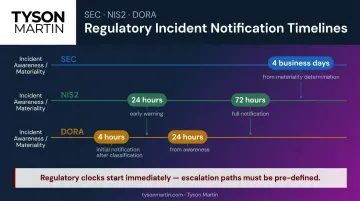
Without pre-defined decision rights and escalation thresholds, organizations improvise. That improvisation — with regulatory clocks already running — produces missed deadlines, inconsistent disclosures, and the kind of enforcement exposure that a documented escalation path would have prevented.
Frequently Asked Questions
What is cybersecurity governance?
Cybersecurity governance is the overarching strategy, policies, and accountability structures that guide how an organization makes and oversees decisions about cyber risk. It is distinct from cybersecurity management, which handles day-to-day execution of controls and response.
What should a cybersecurity governance framework include?
A complete framework includes five components: a defined risk appetite, documented decision rights and escalation thresholds, board-approved policies, a structured reporting cadence for leadership, and a continuous monitoring and review process.
What is the cybersecurity governance structure?
A governance structure defines who is accountable for cybersecurity decisions at each level : the board sets risk appetite and approves policy, the CISO leads strategy and reporting, and management executes controls. Clear escalation paths connect each level.
What is an example of a governance framework?
NIST CSF 2.0 is a widely adopted example. Its six functions — Govern, Identify, Protect, Detect, Respond, Recover — provide a comprehensive structure, with the Govern function specifically addressing how organizations embed cybersecurity into enterprise risk management.
What is the NIST cybersecurity governance framework?
NIST CSF 2.0, released February 26, 2024, added Govern as a core function. This made governance — covering risk strategy, roles, and oversight — an explicit part of the framework rather than an implied element of the other five functions.
What are the three pillars of GRC?
GRC stands for Governance, Risk, and Compliance. Governance sets strategic direction and accountability structures; risk management identifies and prioritizes threats against business objectives; compliance ensures adherence to applicable laws, regulations, and standards. Effective governance is what makes risk and compliance programs functional rather than ceremonial.