Introduction
Picture the scene: a risk report lands on the boardroom table. Dozens of metrics, heat maps, color-coded dashboards. A director leans back and says, "That's a lot of data. But so what?"
It happens every quarter. Not because directors are disengaged — but because of a structural failure in how organizations translate risk data into board-level decisions.
The cost is real. When boards cannot extract a clear decision from a risk report, three things happen:
- Directors rubber-stamp management's position without genuine scrutiny
- They disengage entirely and wait for something to break
- They ask for more data, which produces a larger version of the same problem
According to PwC's 2025 Annual Corporate Directors Survey, 48% of directors say their board's oversight of cyber risk needs improvement. That figure reflects a broader dysfunction: reports that generate discussion but not decisions, and oversight that looks active but operates on autopilot.
What follows is a diagnosis of why most risk reports fail the "So What?" test, what boards are actually asking for beneath the data, and a practical structure for reports that produce decisions rather than deferred conversations.
Key Takeaways
- Most board risk reports dump data instead of answering the only question that matters: what this means for strategy, and what action the board must take.
- Boards want calibration — has risk improved, deteriorated, or held steady since the last meeting, and why?
- The fix: link risk to business objectives, show trend over time, and separate board decisions from management ownership.
- Good reporting defines escalation thresholds, assigns named owners, and uses plain language anyone at the table can act on.
- Risk reports are a strategic dialogue tool. Not a compliance artifact.
Why Board Risk Reports Fail the 'So What?' Test
Most risk reports are built from the inside out. They start with what the security or risk team tracks operationally — vulnerabilities, incidents, control percentages — and work outward toward the board. The result is a compliance artifact, not a governance tool.
The Data Dump Trap
Organizations confuse comprehensiveness with credibility. When a report covers 40 risks across 12 categories with color-coded heat maps, it signals volume, not insight. Boards receive the report without knowing which three things they should be losing sleep over.
When a board packet reads like a vendor audit file, directors end up interpreting SOC 2 language, debating questionnaire scores, or sifting through raw risk assessments. That is the wrong job for a director.
The Technical Language Failure
Reports written for risk professionals use terminology that does not translate to business consequence:
- CVSSv3 severity scores
- Residual risk ratings
- Control effectiveness percentages
- Compliance maturity levels
A director cannot make a resource allocation or strategic decision based on a severity score. The metric has to connect to a business outcome — revenue impact, regulatory exposure, operational disruption — before it is board-usable.
The Missing Ask
The most consequential structural gap: most risk reports do not specify whether the board is being asked to approve, decide, escalate, or simply note the information.
When there is no explicit ask, directors default to nodding along. Accountability evaporates. Votes feel automatic, with little real challenge — which is precisely the pattern that precedes governance failures.
The NC State/AICPA 2025 State of Risk Oversight found that only 23% of organizations formally discussed risk management information when the board discussed the strategic plan. When risk and strategy never share the same conversation, the report has no decision to support — and the board has no reason to engage.
What Boards Are Really Asking When They Say 'So What?'
"So what?" is not a complaint about presentation quality. It is a request for four specific things that most reports fail to provide:
- What changed? Not a status snapshot — what is different from last quarter?
- What does it mean for our strategy? How does this connect to the objectives we approved?
- What is management doing about it? Is the response credible and sufficient?
- What do you need from us? Is there a decision, a resource, an escalation?
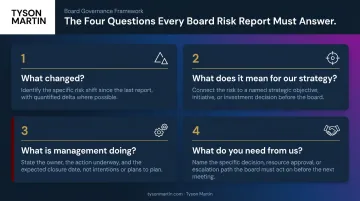
A report that answers these four questions proactively eliminates the "So What?" before a director can ask it.
Calibration, Not Reassurance
Boards are not looking for reassurance. They need calibration. Directors must understand whether the organization's risk posture has improved, deteriorated, or held steady since the last briefing — and why.
A static snapshot of current risk levels provides no calibration. Only trend data does. Showing that open critical vulnerabilities dropped from 140 to 87 over three reporting periods tells a story. Showing that 87 vulnerabilities exist tells the board nothing about whether management is in control.
The Strategic Context Question
A cyber risk that threatens a digital transformation initiative is board-level. A phishing rate statistic is not — unless click rates are climbing fast enough to compromise the organization's ability to execute on a strategy the board already approved.
Risk reporting must be anchored to the strategic plan the board owns, not to the operational metrics the security team tracks. When those two things are disconnected, the report reads as if it belongs to a different organization.
Decision Rights
Embedded in every board risk report is an implicit question directors rarely articulate: what decisions belong to us, and what is management handling?
When reporting fails to draw that line, boards either over-reach into operational detail or under-perform on the oversight responsibilities they are legally accountable for. Both failures are common — and both are avoidable when reporting explicitly assigns decision authority rather than leaving it to interpretation.
The Elements of a Board Risk Report That Drives Decisions
The Opening Risk Posture Statement
Every board report should open with a plain-English risk posture statement — two to three sentences that tell directors where the organization stands today and what changed since the last briefing.
This replaces the executive summary dashboard that directors skim without absorbing. In practice, it sounds less like "control effectiveness is at 87%" and more like:
"A ransomware event could cause multi-day downtime in revenue systems if recovery steps fail under pressure. This risk has increased since last quarter due to three unresolved exceptions in critical system patching. Management is addressing this; we need the board to approve an exception closure deadline."
That opening frame orients the room before a single metric is discussed — the difference between a report that gets read and one that gets filed.
The Decision Register
Every board-facing risk update should identify three categories of decisions explicitly:
- Decisions the board is being asked to make — with a clear recommendation and stated tradeoffs
- Decisions management has already made — with a brief rationale
- Decisions that are delegated and being tracked — with owners and review dates
Without this register, risk reports produce conversation without accountability. The governance record should show what was decided, who owns the execution, and when progress will be reviewed. Boards that revisit the same unresolved items meeting after meeting — with no named owner and no deadline — have stopped governing and started going through the motions.
Trend Over Trivia
Instead of reporting the current count of open vulnerabilities or incidents, show the direction of travel across the past two to three reporting periods:
| Metric | Q2 | Q3 | Q4 | Status |
|---|---|---|---|---|
| Critical vulns unpatched | 140 | 112 | 87 | Improving |
| Time to detect (days) | 9 | 8 | 11 | Deteriorating |
| Privileged account MFA coverage | 71% | 84% | 91% | Improving |
| Failed change rate (critical systems) | 6% | 5% | 5% | Stable |
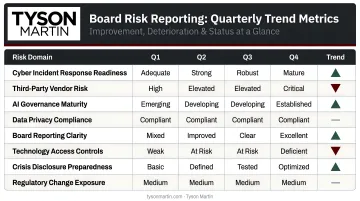
A single month can mislead. A three-month trend tells the board whether risk is getting worse, holding steady, or improving — and whether management is actually in control.
The 'Top Risks' Structure
Direct board attention to no more than three to five enterprise-level risks per session, using a consistent format for each:
- What it is — in plain language, tied to a business outcome
- Why it matters — financial, operational, regulatory, or reputational consequence
- What management is doing — with a named owner and a milestone date
- What the board should know or decide — explicitly stated
Consistency across meetings lets directors track progress rather than relearning context each cycle. When the format changes every quarter, directors spend their attention orienting themselves instead of exercising judgment.
Common Mistakes That Invite the 'So What?' Response
The Green Dashboard Problem
When everything reads green or within tolerance, boards have no basis for exercising judgment. Risk reports that define thresholds so broadly that almost nothing triggers a conversation eliminate the governance value of the report entirely.
The Silicon Valley Bank case illustrates the cost. The Federal Reserve OIG's 2023 material loss review found that unreliable interest-rate-risk modeling outputs gave SVB's board a false sense of safety in a rising-rate environment, and that board committees did not sufficiently challenge the design and content of risk information presented to them. The dashboards stayed green. The bank failed.
Optimistic reporting is often not dishonest — it is a system that rewards the wrong behavior. Teams learn what generates praise and what triggers panic. Reporting shifts toward what feels safe to share. Exposure compounds in the background while the board sees nothing worth discussing.
The Copy-Paste from Last Quarter
Risk reports that carry forward the same language, the same top risks, and the same mitigation status without meaningful update signal one thing clearly: the reporting process is rote, not reflective.
Directors notice when nothing ever changes. It erodes confidence faster than a bad risk outcome would. The fix is requiring every report to explicitly address what changed, what management did, what still needs work, and where delay would increase exposure. If those answers are the same as last quarter, that itself is newsworthy — and should be stated plainly.
Too Much, Too Fast
Overwhelming directors with slides, statistics, or technical detail in the first five minutes guarantees disengagement. The right sequencing is:
- Lead with the "so what" — what changed, what it means, what you need
- Support it with evidence — trend data, KRI status, mitigation progress
- Close with the ask — explicit decisions, owners, and dates
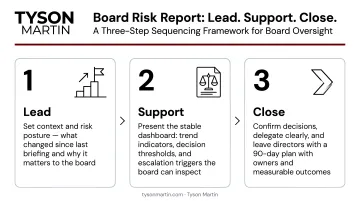
Inverting this order (opening with 20 slides of data before arriving at the point) is the single most common cause of the "So What?" response.
Who Owns Risk Reporting — and What Good Escalation Looks Like
Ownership vs. Coordination
Risk reporting ownership is not the same as risk ownership. The CISO or CRO typically coordinates the board report — but risk owners, the executives actually accountable for the activities that generate risk, should speak to the board about risks within their domain.
This model increases credibility. It eliminates the "one person translates everything" bottleneck that turns board briefings into filtered summaries. When the CFO speaks to financial risk and the COO speaks to operational risk, directors get direct lines of accountability rather than a single intermediary's interpretation.
The NC State 2025 State of Risk Oversight found that formal risk oversight is assigned to the Audit Committee in 42% of organizations and a dedicated Risk Committee in 33% — but regardless of structure, the accountability for reporting quality rests with the board itself.
What Functional Escalation Thresholds Look Like
Vague "material risk" definitions collapse under pressure during real incidents. Functional escalation thresholds are pre-agreed, measurable, and specific:
- Level 1 (Informational): Minor issues with no business impact — management handles, no board notification
- Level 2 (Management Response): Non-critical system impact or limited user effect — executive notification within 24 hours
- Level 3 (Executive Escalation): Critical system impact, potential data exposure, or regulatory concern — CEO and board committee chair within 4 hours
- Level 4 (Board Escalation): Confirmed data breach, extended revenue system outage, ransom demand, or regulatory investigation — immediate board notification
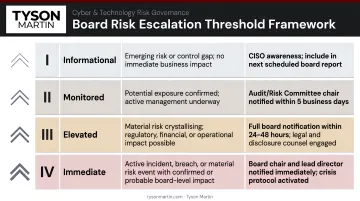
In a real incident, the first decision is rarely technical — it's about who has authority to act. When escalation thresholds are pre-approved and tested through tabletop exercises, that question is already answered before the call starts.
Closing the Feedback Loop
Getting escalation right is half the job. The other half is confirming the reporting itself is working. After each briefing, directors should indicate whether the report gave them what they needed to perform their oversight function — and reporting teams should ask rather than assume.
Boards that never give feedback and teams that never request it will perpetuate the "So What?" problem indefinitely. A steady reporting cadence lowers drama over time. Directors stop feeling surprised. Management stops rebuilding the narrative every meeting. The conversation becomes more disciplined when everyone can see progress, slippage, and unresolved decisions in the same frame.
Frequently Asked Questions
What should a risk report include?
An effective board risk report includes a plain-language risk posture summary, the top two to three enterprise risks tied to strategic objectives, mitigation status with named owners, decisions required of the board, and any escalation thresholds triggered since the last briefing — everything else belongs in operational reporting.
How to present risk management to the board?
Lead with the "so what" — what changed, what it means for strategy, and what the board is being asked to decide — before presenting supporting data. Use a consistent format across meetings so directors track progress rather than relearn context. Close every presentation with a clear ask, a named owner, and a date.
Who is responsible for risk reporting?
The CISO or CRO typically coordinates board risk reporting, but risk owners — the executives accountable for specific business activities — should present the risks within their domain. The board ultimately holds management accountable for the quality and accuracy of the reporting it receives.
What makes a key risk indicator effective?
Effective KRIs are metrics tied to strategic objectives, show trend over time, and trigger pre-agreed escalation thresholds — not generic industry benchmarks. Only 26% of organizations had robust KRI reporting to senior executives as of the NC State 2024 survey.
How do you report a risk?
Describe the risk in plain language tied to business impact. State the likelihood and potential consequence. Indicate what is being done to manage it and whether the current response is sufficient. Identify who owns it, what the escalation path looks like, and whether a board decision is required — or whether it is within management's authority to resolve.