Introduction
Board packs stuffed with printed reports, color-coded tabs, and courier-delivered materials still circulate in boardrooms across regulated industries. For many boards, this is simply how it has always been done. But familiarity is not the same as fitness for purpose.
The problem isn't inconvenience. It's governance liability. Boards are being asked to provide rigorous oversight of cyber risk, financial exposure, and strategic decisions. The medium delivering that information actively works against the quality and security of those deliberations.
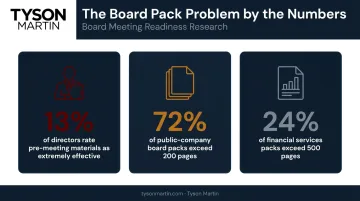
According to NACD's board-pack research, only 13% of directors rate their pre-meeting materials as "extremely effective," and 72% of public-company board packs exceed 200 pages. In financial services, that number jumps to 24% exceeding 500 pages. Directors are drowning in volume while starving for clarity.
What follows covers the specific risks paper-based reporting creates — confidentiality exposure, version failures, regulatory gaps, and structural decision-quality failures — along with concrete best practices for boards ready to modernize. The goal isn't paperless for its own sake. It's governance that holds up under scrutiny.
Key Takeaways
- Paper board packs create confidentiality breaches, version control failures, and audit trails that can't be verified
- Physical documents freeze data at print time — boards make decisions on snapshots while the risk environment keeps moving
- SEC cybersecurity disclosure rules (effective 2023) require auditable board oversight that paper cannot support
- Best practices include moving to a secure board portal, standardizing templates around trend data, and formalizing a retention and destruction policy
- The goal isn't paperless reporting — it's credible, inspectable, and defensible oversight
Why Boards Still Rely on Paper Board Reports
Paper persists for understandable reasons. It feels controllable. Handing a director a physical document carries an intuitive sense of containment — no servers, no logins, no IT dependency. For boards with directors who aren't digitally native, paper removes a potential friction point entirely.
That perceived simplicity masks a real problem. The moment a board pack leaves the printer, the organization loses visibility into where it goes, who reads it, how copies are made, and whether it ever gets properly destroyed. A document in a director's briefcase offers no chain of custody, no access log, and no retrieval mechanism.
The shift to hybrid and remote board meetings made this fragility harder to ignore. When directors are geographically dispersed, physical materials create compounding problems:
- Late amendments get emailed as attachments rather than official updates
- Some directors print; others don't — creating immediate version divergence
- By the time the meeting convenes, no one can confirm everyone has the same document
The result is an operational bottleneck with real governance consequences: decisions made on mismatched information, no audit trail, and no practical way to retrieve sensitive materials after the fact.
Key Risks of Paper-Based Board Reporting
Confidentiality Breaches and Insider Threat Exposure
Board packs routinely contain an organization's most sensitive information: cybersecurity posture, M&A targets, executive compensation, litigation status, and financial projections. Paper copies circulating among directors, couriers, executive assistants, and hotel business centers create an uncontrolled chain of custody with no visibility into who has accessed what.
Ponemon's 2023 Cost of Insider Risks report found that 55% of insider-risk incidents were caused by careless or negligent employees — not malicious actors. The Verizon DBIR also notes that misdelivery errors, including physical documents, remain a documented breach pathway.
The risk isn't hypothetical. It's the assistant who forgot to shred. The director who left materials in a hotel room. The courier whose bag was stolen. Each scenario represents a potential confidentiality breach with no detection mechanism and no recovery option.
Version Control Failures and Information Inconsistency
Consider this scenario: updated financials are prepared two days before a board meeting. The amendment reaches most directors by email. One director printed the original pack four days prior and never checked for revisions. The board deliberates — and votes — while working from different versions of the same material.
Paper has no native version tracking. There is no system-generated indicator that one copy is superseded. No notification goes out. The decision record reflects a vote taken on data that, for at least some directors, was already outdated.
That outcome isn't a fringe scenario. It's the predictable result of any distribution process that relies on physical copies and manual follow-up — and it recurs every time an amendment is issued close to a meeting date.
Lost or Incomplete Audit Trails
This is where paper-based reporting moves from operational inconvenience to legal exposure.
Three overlapping frameworks create audit trail obligations that paper cannot satisfy:
- SEC Release No. 33-11216 (effective September 5, 2023) requires registrants to describe board oversight of cybersecurity risks and how the board is kept informed
- SOX Section 404 requires management to maintain evidential matter supporting internal control assessments
- NACD guidance states that board minutes should document when cybersecurity appeared on the agenda, including risk updates and incident summaries
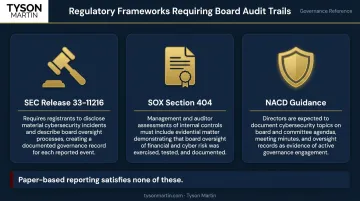
Paper cannot provide a system-generated log of who accessed which documents, when, and in what context. In a post-incident regulatory inquiry, that gap matters.
When regulators ask what the board knew and when, the inability to prove directors received and reviewed accurate, current information shifts liability onto individuals. Paper offers no traceable answer to that question.
Stale Data and the Snapshot Problem
Paper reports are outdated the moment they are printed. Mandiant's 2024 M-Trends report recorded a global median attacker dwell time (the window between initial breach and detection) of 10 days — down from 16 days the prior year. The threat environment moves faster than quarterly print cycles.
By the time a board meeting convenes, the cybersecurity posture, financial position, or incident status reported in the pack may have shifted materially. Paper has no mechanism to flag what changed after printing. Directors are navigating with a rear-view mirror while the organization moves forward.
The Decision-Quality Problem
Paper-based reporting doesn't just create security risks. It creates a structural governance failure.
Boards are responsible for oversight, not operations. That distinction matters because meaningful oversight requires pattern recognition: the ability to distinguish a temporary fluctuation from a developing risk trend. Paper cannot provide this. Every board pack is a snapshot — no longitudinal context, no comparison to prior periods, no mechanism to show whether the risk posture is improving or deteriorating.
NACD data frames this clearly:
- 59% of directors report three or more concerns with their board packs
- Among the most common complaints: materials are too backward-looking and too light on risk reporting
- 60% say board packs are too operational at the expense of strategy
This is the "trivia vs. trend" failure mode. A board receiving a single quarter's incident count has information. A board seeing that count tracked over six quarters — with context on what drove changes — has oversight.
Content quality is only part of the problem. The decision-quality gap compounds further when materials arrive late or inconsistently. NACD found that 15% of directors report materials are not distributed early enough for adequate review, with directors preferring packs 7 days before meetings. When directors arrive with varying levels of preparation — some having reviewed materials thoroughly, others catching up in the room — deliberation quality suffers and consensus becomes harder to reach.
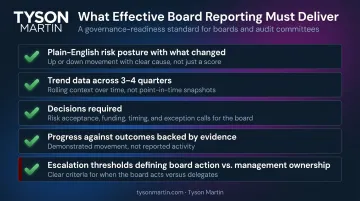
What effective board reporting should deliver instead:
- Plain-English risk posture with what changed since the last briefing (up or down, and why)
- Trend data across 3–4 quarters, not point-in-time scores
- Decisions required: risk acceptance, funding, timing, exceptions
- Progress against outcomes backed by evidence, not just status updates
- Escalation thresholds that define when the board acts versus when management owns it
Compliance and Regulatory Exposure
The regulatory environment has tightened considerably, and paper-based board reporting creates structural gaps across multiple frameworks.
| Framework | Core Requirement | Paper's Gap |
|---|---|---|
| SEC Release 33-11216 (effective Sept. 5, 2023) | Annual disclosure of board oversight of cyber risk; Form 8-K within 4 business days of material incident | No auditable record of what board reviewed or when |
| SOX Section 302/404 | CEO/CFO disclosure control certifications; evidential matter supporting ICFR assessments | Paper doesn't produce system-generated access or review logs |
| HIPAA (45 CFR 164.316) | Security Rule documentation retained 6 years from creation or last effective date | Physical records degrade, get lost, or are destroyed outside retention schedules |
| FTC Disposal Rule | Appropriate disposal of sensitive consumer information | Paper disposal requires certified shredding; ad hoc destruction creates liability |
Regulation S-K Item 106(c) warrants attention here. Under the SEC's cybersecurity disclosure framework, public companies must describe how their board oversees cybersecurity risks. "Oversight" in a regulatory context is not self-certifying — it requires documentable evidence of the process. Paper board packs cannot demonstrate this at scale.
The SEC's enforcement history shows what happens when documentation trails fail. In 2021, the SEC charged First American Financial for disclosure controls failures after a vulnerability exposing over 800 million document images went unescalated to senior decision-makers — a case built squarely on inadequate information governance.
Improper or inconsistent retention creates its own exposure. Records go missing during office moves, get discarded by staff unaware of a retention hold, or simply deteriorate over time. When regulators or plaintiffs ask what the board knew and when, "we can't locate those materials" is not a defensible answer.
Best Practices for Secure, Effective Board Reporting
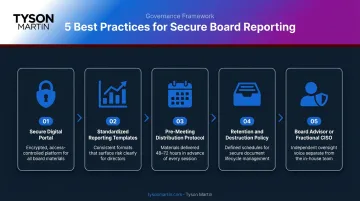
The transition away from paper-based reporting is, at its foundation, a governance decision. Here's what it looks like in practice:
1. Adopt a secure, access-controlled digital board portal. The portal should maintain full version history, track document access by director, enforce retention schedules, and generate audit logs automatically. This eliminates the core vulnerabilities of paper without adding meaningful complexity for directors — and ensures "who saw what, when" has a verifiable answer.
2. Standardize the reporting template around trend data. Every board pack should follow a consistent structure:
- Plain-English risk posture summary
- What changed since the last briefing (up, down, and why)
- Key metrics showing trend over 3–4 quarters, not point-in-time snapshots
- Decision items with defined escalation thresholds
- Short action list with owners, dates, and definitions of "done"
Consistency across quarters is what makes trend analysis possible. Rotating metrics hide drift; stable metrics reveal it.
3. Establish a formal pre-meeting distribution protocol. Define distribution deadlines, require confirmation of receipt, and build a process for issuing digital amendments before the meeting. This replaces the ad hoc paper shuffle with an auditable, time-stamped workflow. Late changes are no longer absorbed silently — they're tracked and confirmed.
4. Define and enforce a document retention and destruction policy. The policy should specify:
- How long meeting materials must be retained (minimum 6 years for HIPAA-covered entities; longer where SOX or state law applies)
- Who holds responsibility for retention management
- How destruction is certified for both digital and any remaining physical materials
Without a defined destruction schedule, over-retained materials create their own exposure — litigation holds, unnecessary discovery scope, and potential HIPAA violations from materials that should have been destroyed.
5. Consider a board advisor or interim CISO to build the framework from the governance layer down. Getting to credible, inspectable reporting requires more than a format change. It means rebuilding what reaches the board: the data sources, decision rights, escalation logic, and accountability structure. Organizations in regulated industries, or navigating leadership transitions, often benefit from an advisor who can design that infrastructure from the governance layer down.
Tyson Martin's advisory practice does exactly this — building board reporting frameworks in financial services, healthcare, and retail that are accurate, current, and audit-ready, with governance rigor and board usability built in from the start.
Frequently Asked Questions
Frequently Asked Questions
What are the biggest security risks of paper board packs?
Paper board packs carry an organization's most sensitive information — cyber posture, M&A targets, compensation, litigation status — with no chain-of-custody tracking. Once printed, there is no visibility into who reads, copies, or retains them, and no mechanism to detect or recover from a breach.
How does paper-based board reporting create regulatory liability?
The SEC's cybersecurity disclosure rules and SOX both require auditable evidence of board oversight: who reviewed materials, when, and what decisions followed. Paper produces none of that — no access logs, no version history, no confirmed receipt records — leaving boards exposed when regulators or plaintiffs demand proof.
What should a board report include to support effective cyber risk oversight?
Effective board reports should include a plain-English risk posture, what changed since the last briefing, trend-based metrics tracked over multiple periods (not point-in-time snapshots), and clearly defined decision items with escalation thresholds that specify when the board must act versus when management retains ownership.
How can boards transition away from paper reporting without disrupting operations?
A phased approach works best: start with a secure digital portal that mirrors the existing pack structure, then standardize templates around trend data, establish distribution and amendment protocols, and train directors. Success depends on governance fluency throughout the process, not just technical implementation.
Are there legal requirements for how long board meeting materials must be retained?
Retention requirements vary by framework and jurisdiction. Healthcare boards face a 6-year HIPAA minimum; SOX-covered entities must preserve documented evidence of control reviews; state-law obligations add further variation. Paper systems rarely satisfy these multi-year requirements with the audit-ready access regulators expect.
What is the role of a board advisor or fractional CISO in improving board reporting?
A board advisor or fractional CISO translates technical risk into board-ready language, structures the reporting framework around trend data and clear decision items, and ensures the governance infrastructure holds up under regulatory review. The result is reporting that supports defensible decisions rather than generating noise directors have to filter.