Introduction
When NIST released CSF 2.0 on February 26, 2024, the most consequential change wasn't a new control category or updated technical guidance. It was structural: a sixth core function called Govern, placed first in the framework's official order.
That placement is deliberate. The Govern function signals that cybersecurity risk management can no longer be delegated to the security team and reviewed once a quarter in a slide deck. It belongs in the boardroom, alongside financial and operational risk, with the same structured accountability.
The SEC's 2023 cybersecurity disclosure rules made that expectation legally enforceable. Boards that treat cyber as a technical matter — rather than an enterprise risk — now face direct regulatory exposure.
This article is written for boards, audit and risk committees, CEOs, General Counsel, and CISOs navigating what that accountability actually requires. It covers what the Govern function is, what its six categories demand in practice, and what the regulatory consequences of getting it wrong now look like.
Key Takeaways
- The Govern function is NIST CSF 2.0's new sixth core function, formally placing cybersecurity governance at the leadership level — not just IT.
- Six categories define it: Organizational Context, Risk Management Strategy, Roles and Responsibilities, Policy, Oversight, and Supply Chain Risk Management.
- NIST explicitly names boards of directors as part of the intended audience for the framework's governance guidance.
- Voluntary on paper — but the SEC and FTC increasingly cite it as a baseline for expected governance conduct.
- Treating Govern as a documentation exercise rather than an active discipline is where most implementations quietly fail.
What Is the Govern Function in NIST CSF 2.0?
The Govern function provides the strategic foundation that every other part of the framework operates within. In plain terms: it answers who is responsible for cybersecurity risk decisions, what authority they hold, and how those decisions connect to the organization's mission and risk tolerance.
That's a different question than "what controls do we run?" The other five functions (Identify, Protect, Detect, Respond, Recover) describe operational security activities. Govern sets the context, authority, and direction that those functions depend on.
NIST describes the Govern function's purpose as providing "outcomes to inform how an organization achieves and prioritizes the other five Functions in the context of mission and stakeholder expectations."
That definition matters because Govern is frequently misunderstood in practice.
What Govern is not:
- A compliance checklist that security teams complete, file, and forget
- A substitute for decision-making — writing policies isn't the same as enforcing them
- A periodic exercise, like an annual review or point-in-time assessment
It requires active, ongoing oversight with defined accountability at the senior leadership and board level. Real governance means decisions are being made, recorded, and revisited. The binder is evidence of that — not a replacement for it.
Why NIST Added Govern — and Why the Timing Matters
The Govern function didn't emerge from academic review alone. It arrived alongside a regulatory environment that had changed what leadership accountability for cybersecurity means.
The Regulatory Backdrop
The SEC adopted its Cybersecurity Risk Management, Strategy, Governance, and Incident Disclosure rules on July 26, 2023. The rules require public companies to disclose material incidents within four business days and to report annually on board oversight of cybersecurity risk and management's role in assessing it. Most registrants faced compliance for fiscal years ending on or after December 15, 2023.
The FTC has mapped its enforcement actions to NIST CSF functions and categories, explicitly describing the framework as a resource organizations can use to identify, implement, and improve cybersecurity practices. In 2022, the FTC took action against Drizly and its CEO James Cory Rellas personally for security failures that exposed data on 2.5 million consumers — a direct signal that executive accountability is real and individual.
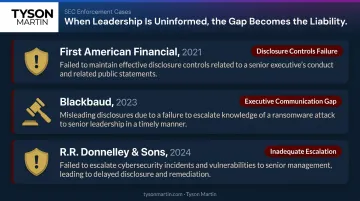
Each of three SEC enforcement actions tells the same story: leadership was uninformed, and that gap became the liability.
- First American Financial (2021) — security staff knew about the vulnerability; disclosure controls failed to surface it to management
- Blackbaud (2023) — misleading disclosures traced to breakdowns between technical teams and executives responsible for filing
- R.R. Donnelley & Sons (2024) — inadequate escalation left leadership without the information needed to make accurate disclosure decisions
The Accountability Shift
Prior to CSF 2.0, governance elements were scattered across the other five functions. Consolidating them into a standalone core function — placed first — signals that leadership accountability must be as structured and demonstrable as financial risk governance.
CSF 2.0 also expanded scope. Where the original framework was aimed primarily at critical infrastructure organizations, NIST now states that CSF 2.0 "can be used by any organization, regardless of size, sector, or maturity." That expansion means the Govern function applies to mid-market companies, nonprofits, and regulated industries that may not have previously considered NIST CSF relevant to them.
The Six Categories of the Govern Function
Each category has subcategories and implementation examples in the full framework. What follows focuses on what each one demands in practice — not just a restatement of NIST's language.
Organizational Context (GV.OC)
NIST defines this as: "The circumstances — mission, stakeholder expectations, dependencies, and legal, regulatory, and contractual requirements — surrounding the organization's cybersecurity risk management decisions are understood."
In practice, this means organizations must connect their cybersecurity program to actual business context. That means knowing which stakeholders depend on which systems, what regulatory obligations apply to which data, and where contractual commitments create security obligations.
The shift from CSF 1.x is meaningful: cataloging assets is not enough. Organizations must contextualize those assets against business purpose and actual risk — explaining why a system matters, not just that it exists.
Risk Management Strategy (GV.RM)
NIST defines this category as requiring organizations to establish and communicate "priorities, constraints, risk tolerance and appetite statements, and assumptions" to support operational risk decisions.
This is where cybersecurity leaves IT and enters the boardroom. NIST is explicit that cybersecurity risk management must integrate into enterprise risk management — not run alongside it as a parallel silo.
In advisory practice, effective risk appetite statements are written in business terms: maximum downtime for critical systems, data loss thresholds, fraud tolerance per period, regulatory exposure limits.
"We have a low risk appetite" is not a risk appetite statement — it's an intention without teeth. Specific thresholds give management something to design around and boards something to measure against.
Roles, Responsibilities, and Authorities (GV.RR)
NIST defines this as: "Cybersecurity roles, responsibilities, and authorities to foster accountability, performance assessment, and continuous improvement are established and communicated."
This is where decision rights must be formalized. The critical questions this category forces organizations to answer:
- Who accepts risk at what threshold, by name and role?
- Who approves security exceptions, and for how long?
- Who declares incident severity and can authorize taking systems offline?
- Who owns vendor go/no-go decisions for critical suppliers?
- When security conflicts with business delivery, who breaks the tie?
"The CISO handles it" or "we share responsibility" are red flag answers to these questions. Diffuse accountability is no accountability. If a governance structure can't survive a leadership change — because decisions were assumed rather than documented — it isn't governance.
Policy (GV.PO)
NIST's definition: "Organizational cybersecurity policy is established, communicated, and enforced."
The emphasis in practice is on "communicated" and "enforced" — not just "established." Policies are living instruments, not static documents written once and filed. They must reflect actual risk posture, evolve as threats and business objectives change, and serve as a measurable baseline.
A policy that exists in a SharePoint folder but isn't enforced, reviewed, or referenced in decisions provides no governance value and limited legal protection.
Oversight (GV.OV)
NIST defines this as: "Results of organization-wide cybersecurity risk management activities and performance are used to inform, improve, and adjust the risk management strategy."
Oversight is continuous, not periodic. It requires boards to monitor whether policies and strategies are working, surface gaps as they emerge, and course-correct — not simply receive an annual briefing and consider the obligation met.
In practice, effective board oversight operates on a defined cadence: monthly metrics reviews focused on trends and exceptions, quarterly reviews of top risks and major changes, and annual tabletop exercises that test decision-making under pressure.
The reporting that reaches boards must show trend, not point-in-time snapshots. Boards receiving inconsistent, jargon-heavy, or activity-focused updates cannot meet the GV.OV standard — and that gap creates real regulatory exposure.
Cybersecurity Supply Chain Risk Management (GV.SC)
NIST defines this as: "Cyber supply chain risk management processes are identified, established, managed, monitored, and improved by organizational stakeholders."
Supply chain attacks remain a primary attack vector. The Verizon 2024 DBIR reported a 180% year-over-year increase in exploitation of vulnerabilities as an initial access step, with third-party issues contributing to breach patterns.
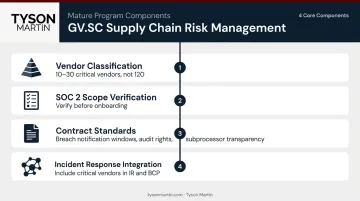
GV.SC requires more than maintaining a vendor list. A mature implementation includes:
- Classify vendors by business impact, not alphabetically. A useful critical tier contains 10-30 vendors, not 120.
- Verify SOC 2 scope alignment before onboarding — accepting certificates at face value without checking scope is a common gap.
- Set contract standards that specify breach notification windows in hours, audit rights, subprocessor transparency, and recovery objectives tied to business continuity tolerances.
- Include critical vendors in incident response and business continuity planning — not discovered to be absent during an actual event.
The SEC's 2024 action against R.R. Donnelley & Sons specifically noted that the company used a third-party provider for network security monitoring but failed to assess or respond to that provider's alerts appropriately — a GV.SC failure with direct legal consequences.
What the Govern Function Actually Requires from Boards and Leadership
The Govern function is not primarily an IT deliverable. Boards and executive teams must take ownership of cybersecurity risk in the same structured way they govern financial risk.
What Board-Level Accountability Looks Like
Boards don't need to understand technical controls in detail. They do need to:
- Evaluate whether management's cybersecurity risk posture aligns with the organization's approved risk appetite
- Assess whether reporting is credible, consistent, and shows trend rather than just activity
- Ensure escalation paths exist, are documented, and have been tested
- Approve risk appetite statements, not just receive them for information
Informed board engagement means asking specific questions:
- "Who is accountable for our top three cyber risks — by name and role?"
- "What risk did we accept in the last quarter, and who approved it?"
- "Which single vendor failure could stop revenue within 24 hours?"
- "How fast can we restore critical services, and when did we last prove it?"
Vague answers to any of these questions identify where governance has broken down — not where the CISO needs better slides.
Closing the Reporting Gap
Most organizations have a CISO and a security function. The reporting that reaches the board is often a different matter — filled with activity metrics (blocked attacks, patches applied, tickets closed) that describe motion without measuring protection.
GV.OV implicitly requires that board reporting enable trend analysis and informed decision-making. A useful board update should answer five questions:
- What changed since the last meeting
- What it means for the business
- What management is doing about it
- What support, if any, is needed from the board
- What happens if action slips
The shift from activity reporting to risk-posture reporting is one of the most persistent gaps in board advisory work — particularly in organizations where the CISO produces technically accurate reports that boards cannot translate into decisions.
Defensible Governance Documentation
Poor reporting isn't just an oversight problem — it becomes a legal one after a breach. Organizations that cannot demonstrate structured governance face materially greater regulatory and reputational exposure. The Govern function provides that defensible structure, but only if it reflects actual practice, not aspirational policy.
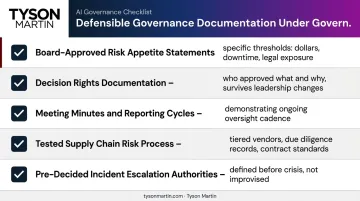
What defensible governance documentation looks like under Govern:
- Board-approved risk appetite statements with specific impact thresholds (dollars, downtime, data sensitivity, legal exposure)
- Decision rights documented to survive leadership changes — recording who approved what and why
- Meeting minutes and reporting cycles demonstrating ongoing oversight
- A tested supply chain risk management process with tiered vendors, due diligence records, and contract standards
- Incident escalation authorities pre-decided before a crisis, not improvised during one
For organizations in transition — post-incident, under regulatory scrutiny, or without mature security leadership — a fractional CISO or board-level cybersecurity advisor can translate these requirements into governance structures that are inspectable and defensible on an accelerated timeline.
Common Mistakes Organizations Make When Implementing Govern
Treating It as a Documentation Project
The most frequent misapplication: organizations produce policies, assign nominal roles, and consider the work complete — without ever operationalizing the oversight, escalation, or decision-rights structures the framework requires. Policies look complete. Controls look mapped. But exceptions get documented politely while real paths to material loss stay open.
Governance that exists only in documents provides compliance theater, not actual protection.
Delegating Govern Entirely Downward
In many organizations, governance documents are created by the security team and never meaningfully reviewed by leadership. The board is "informed" — usually with a slide deck reviewed once a year — rather than engaged.
When accountability for Govern sits entirely with the CISO, the framework is being misapplied. The Govern function explicitly requires executive and board engagement, not passive receipt of information.
Underestimating GV.SC
Vendor risk-ranking, due diligence, and recovery planning for critical suppliers are among the most under-implemented aspects of the Govern function — and among the most scrutinized by regulators following a supply chain incident.
Common gaps include:
- Vendor lists that catalog hundreds of suppliers without meaningful risk tiering
- Due diligence that ends as a report with no operational follow-through
- Critical vendors missing from incident response and business continuity plans
- No defined triggers for reassessment when vendor relationships materially change
Frequently Asked Questions
What is the Govern function in NIST Cybersecurity Framework 2.0?
The Govern function is the sixth core function added in NIST CSF 2.0. It establishes the governance foundation — defining risk management strategy, clarifying accountability, and providing leadership oversight across the other five functions.
What addition was made to NIST CSF 2.0 in 2024?
The primary addition was the Govern function — a new sixth core function that formalizes cybersecurity governance as a leadership-level responsibility. CSF 2.0 also expanded its scope from critical infrastructure organizations to all organizations regardless of size, sector, or maturity level.
Is NIST CSF 2.0 mandatory?
NIST CSF 2.0 is voluntary, but regulators including the SEC and FTC reference it when evaluating whether organizations have implemented adequate cybersecurity governance. For public companies and regulated industries, it effectively operates as a baseline expectation — even without a formal legal mandate.
What are the core functions of NIST Cybersecurity Framework 2.0?
The six core functions in official order are: Govern, Identify, Protect, Detect, Respond, and Recover. Govern is the new addition in the 2.0 update, providing the strategic and accountability layer that the other five functions operate within.
What does the NIST Cybersecurity Framework do?
NIST CSF gives organizations a common language for managing and communicating cybersecurity risk. It's adaptable across industries and organization sizes, and works equally well for internal risk decisions or external reporting to boards and regulators.
Is the NIST Cybersecurity Framework a U.S. government framework?
NIST CSF was created by a U.S. federal agency and originally focused on critical infrastructure protection. It's now widely adopted by private sector organizations globally — neither government-only nor government-mandated. Any organization can adopt it voluntarily.