A gap analysis gives you a structured, defensible answer to a simple question: where does your security program fall short against a recognized standard? Without that answer, security spending lacks rationale, regulators get vague responses, and boards make decisions without the information they need.
This article covers what a NIST CSF gap analysis actually involves — the five steps, what you need in place before you start, when to do one, what shapes the quality of results, and the mistakes that cause most efforts to stall.
Key Takeaways
- A NIST CSF gap analysis compares your current controls against the six functions of CSF 2.0 — Govern, Identify, Protect, Detect, Respond, and Recover — to reveal where your program falls short
- The output is a risk-prioritized remediation roadmap, not a compliance checklist — it informs board decisions and budget allocation
- Quality depends on scope clarity, data integrity, stakeholder participation, and whether findings get translated into owned, executable priorities
- Most valuable before audits, during M&A, after leadership transitions, or when regulators ask questions your team can't answer
- It succeeds with executive sponsorship, clear decision rights, and a direct path from findings to action
How to Perform a NIST CSF Gap Analysis
Step 1: Define Scope and Choose Your Framework Version
Start with the version question. NIST released CSF 2.0 on February 26, 2024. The key structural difference from CSF 1.1 is the addition of a sixth function — Govern — which covers organizational context, risk management strategy, roles and responsibilities, policy, and oversight. For boards and executive teams, the Govern function is the most significant change: it makes cybersecurity governance an explicit part of the framework rather than an implied one.
CSF 1.1 had 108 subcategories across five functions. CSF 2.0 has 106 subcategories across 22 categories and six functions. For most organizations starting fresh, CSF 2.0 is the right choice.
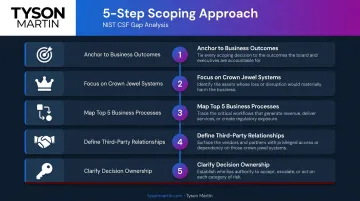
Scope definition is where most gap analyses go wrong before they begin. A useful scoping approach:
- Anchor the assessment to specific business outcomes — resilience, compliance stability, or customer assurance
- Focus on "crown jewel" systems, your identity stack, and your highest-impact vendors — not everything
- Map the top five business processes that depend on technology (order-to-cash, payroll, care delivery, billing)
- Define which third-party relationships carry enough access or business impact to be included
- Clarify decision ownership upfront: who can accept risk, approve exceptions, and own remediation when it crosses teams
Calibrate scope to your actual risk profile and available resources. Too broad and the analysis stalls; too narrow and you miss systemic risk.
Step 2: Gather Data and Establish a Current-State Baseline
Before interviews begin, collect what already exists:
- Current security policies and procedures
- Network architecture diagrams
- Previous audit findings and open items
- Incident response plans and post-incident reviews
- Vendor contracts with security obligations
- Any prior risk assessments
The most revealing data rarely comes from documents alone. Organizations routinely have controls that exist in practice but are undocumented — and others that are documented but not practiced. A paper review misses both.
Structured interviews surface what documentation hides. Interview sessions of 60–90 minutes with key roles — CEO or COO, CIO, security lead, legal, HR, product, and IT operations — reveal where decision-making breaks down and where controls fail in practice.
The interview posture matters: curiosity, not interrogation. Listen for where exceptions pile up, which controls exist only on paper, and where nobody can break ties when priorities conflict.
Bring existing evidence into every session — policies, audit notes, incident logs. It sharpens your questions and quickly surfaces answers that don't match documented reality.
Step 3: Map Existing Controls Against the Six NIST CSF Functions
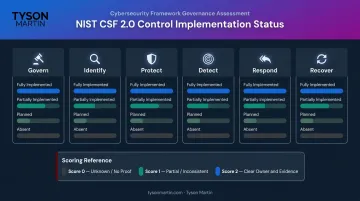
This is where data collection becomes structured assessment. For each of the six functions, evaluate which controls are:
- Fully implemented: consistent, evidenced, with a named owner
- Partially implemented: some evidence but not repeatable
- Planned but not in place: documented intent, no execution
- Absent: no policy, no practice, no owner
NIST SP 1301 defines this as comparing your Current Profile against a Target Profile — a side-by-side view that reveals gaps and informs the action plan. NIST's CSF 2.0 Reference Tool lets you explore all 106 subcategories and export findings directly.
Don't score every subcategory in isolation. The goal is identifying which categories represent the highest concentration of control gaps relative to your risk profile. A practical scoring approach uses a 0–2 scale:
- 0 = Unknown or no proof (mostly opinion)
- 1 = Partial or inconsistent (some evidence, not repeatable)
- 2 = Clear owner and evidence (can show who owns it, what "good" means, and proof it works)
The scale measures confidence and repeatability, not perfection.
Step 4: Identify and Document Gaps with Risk Context
A finding without business context is a list, not a risk assessment. For each identified gap, document:
- What is missing and why it matters to the business
- Which threat scenarios it enables (ransomware, compromised identity, vendor breach)
- Business impact — financial loss, operational disruption, regulatory exposure, reputational harm
- Risk rating — High, Medium, or Low, based on likelihood and impact
Agree on rating criteria before the analysis begins. Without a consistent methodology, findings can't be compared or sequenced — and the resulting roadmap becomes impossible to defend to leadership.
Translate technical findings before they reach any executive audience. "Subcategory PR.AC-1 is partially implemented" becomes: "Unauthorized users could access sensitive systems, creating liability exposure and potential operational disruption." That's decision-ready language.
Step 5: Build a Prioritized Remediation Roadmap and Assign Decision Rights
Organize findings into a Plan of Action and Milestones (POAM) structured around:
- Risk priority — highest-impact gaps addressed first
- Dependencies — sequencing based on which controls enable others
- Realistic timelines — 12–18 months with quarterly detail, not aspirational targets
- Measurable outcomes — "evidence received and validated" counts as done; "vendor committed to fix" does not
Each remediation item needs one accountable owner — not a committee — with a due date, cost range, and the specific proof that will confirm closure.
Decision rights must be defined explicitly:
| Level | Who Decides |
|---|---|
| Management | Operational issues with limited local impact, routine security fixes |
| CISO/CTO | Medium-impact risks, launch readiness, major third-party integrations |
| Board/Risk Committee | Material outages, regulated exposure, risks exceeding agreed thresholds |
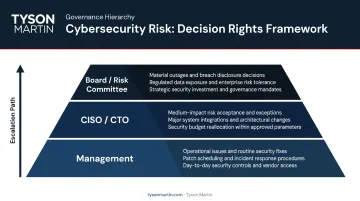
Without decision rights, POAMs stall the moment a resource conflict appears.
Before You Start: What Your Organization Needs in Place
The quality of a gap analysis is directly proportional to the preparation that precedes it.
Executive Sponsorship and Stakeholder Access
Executive sponsorship means naming a specific sponsor — typically the CEO, COO, or CIO — who clears blockers and owns risk decisions. Their role is to ensure the process has real authority, not just advisory status.
When sponsorship is absent, interviews deteriorate. Stakeholders give defensive answers, severity gets quietly downgraded, and findings avoid the uncomfortable conversations that leadership should be having. The bottleneck in most gap analyses isn't technical — it's access, decisions, and follow-through.
Secure a weekly executive checkpoint early. That cadence turns "availability" into real engagement.
Security Documentation and System Inventory
At minimum, have these ready before the assessment begins:
- An up-to-date asset inventory
- A list of third-party vendors with data access and their business impact
- Current security policies, even if incomplete
- Any open audit findings or prior assessment results
Incomplete documentation doesn't disqualify an assessment — but not having it available causes the process to stall during data collection.
Internal Expertise or External Support
Organizations without a dedicated CISO — or with a CISO who lacks bandwidth to lead the process — should consider engaging an independent advisor to structure and facilitate the analysis. This matters most when the organization needs findings translated into board-ready language and governance outputs, not just a technical report.
Tyson Martin structures gap analyses for boards and executive teams, producing outputs designed for governance use: risk registers, prioritized remediation plans, and board-ready reporting. Engagements draw on enterprise experience at AWS, Home Depot, and Best Buy, and active roles at the NACD, WEF Centre for Cybersecurity, and NRF CISO Executive Committee.
When Does Your Organization Need a NIST CSF Gap Analysis?
A gap analysis is not a one-time compliance exercise. It's most valuable at specific inflection points where the cost of not knowing your risk exposure is highest.
Conduct one when:
- A regulatory audit or cyber insurance renewal is approaching
- A leadership transition has occurred — new CISO, CIO, or CEO
- M&A activity is underway (pre- or post-close)
- A security incident or near-miss has occurred
- Regulators or investors are asking questions your team can't answer confidently
These aren't the only moments that matter. A gap analysis is equally warranted when no single trigger exists but the underlying conditions have quietly shifted:
The current program may also be insufficient when:
- The threat landscape has shifted (new markets, new products, remote workforce expansion)
- Security spending lacks a defensible rationale tied to actual risk
- The last formal assessment is more than two years old
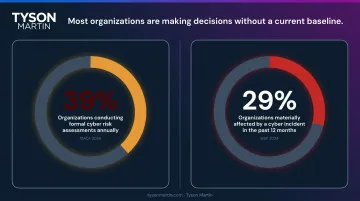
According to ISACA's 2024 data, only 39% of organizations perform a formal cyber risk assessment annually — meaning most organizations are making spending and governance decisions without a current baseline. The WEF's 2024 Global Cybersecurity Outlook found that 29% of organizations were materially affected by a cyber incident in the prior 12 months. Waiting for a triggering event, in other words, is itself a risk decision.
Key Factors That Shape the Quality of Your Results
Two organizations can follow the same steps and produce gap analysis outputs of very different quality. Four variables determine which outcome you get.
Scope Precision
Too broad and findings are too diffuse to prioritize. Too narrow and systemic risks go undetected. Revisit scope at the start of each assessment cycle : attackers follow change, not your audit calendar. If the business launched new products, adopted new SaaS platforms, or restructured operations since the last assessment, the scope needs to reflect that.
Stakeholder Participation Quality
The accuracy of the findings depends on whether interviewees understand the controls they own and give honest answers. Organizations with siloed security cultures or fear of accountability tend to underreport control deficiencies — creating false confidence at the board level. The right interview posture, grounded in existing evidence before questions are asked, reduces this risk.
Risk Rating Methodology
Agree on rating criteria — likelihood, impact, regulatory exposure, exploitability — before the analysis begins. Organizations that rate gaps without consistent methodology produce findings that can't be compared, sequenced, or defended to leadership. When the underlying ratings are inconsistent, the POAM becomes indefensible.
Translation to Board Language
Gartner reported in 2025 that 90% of non-executive directors lack a measure of confidence in cybersecurity value. The gap between what security teams produce and what boards can act on is real and persistent.
The board doesn't need to know that "subcategory PR.AC-1 is partially implemented." They need to know that unauthorized users could access sensitive systems, and what that means for liability, operations, and reputation.
That translation from subcategory language to business impact language isn't optional. It's what determines whether findings drive decisions or collect dust.
Common Mistakes That Undermine Gap Analysis Results
Treating scope as an afterthought. Organizations that begin interviews before defining scope waste time on low-risk areas while missing high-risk ones. Worse, scope decisions made midway through the process invalidate earlier findings and force rework.
Conducting the analysis without executive participation. When gap analysis is handled entirely by IT or security staff without leadership involvement, findings get consistently downgraded in severity. The resulting POAM fails to secure the budget or attention it needs — because nobody with authority has skin in the game.
Producing a report without a remediation owner. The most common reason gap analysis findings go unaddressed is that the final report identifies what is broken without specifying who is accountable for fixing it, by when, and with what resources. Without a named owner, deadline, and allocated resources, the finding will sit unaddressed.
Six months later, the same gaps appear again — usually right before an audit or an incident.
Frequently Asked Questions
How long does a NIST CSF gap analysis typically take?
For a mid-size enterprise with a defined scope, expect four to eight weeks from kickoff to final report. The most time-intensive phases are stakeholder interviews and data collection — not the mapping exercise itself — and poor documentation readiness or limited executive availability will push that timeline out.
What is the difference between a NIST CSF gap analysis and a full cybersecurity risk assessment?
A gap analysis compares current controls against a framework benchmark to identify deficiencies. A full risk assessment evaluates the likelihood and impact of specific threats against the organization. Both are complementary — many organizations benefit from conducting both, with the gap analysis informing the scope of the risk assessment.
Which version of the NIST CSF should we use — 1.1 or 2.0?
CSF 2.0, released in February 2024, is the recommended version for most organizations — it added the Govern function and expanded applicability beyond critical infrastructure. Organizations already using 1.1 should plan a structured transition using NIST's CSF 1.1-to-2.0 change analysis document rather than treating 2.0 as a parallel track.
Do we need to conduct a NIST CSF gap analysis every year?
Annual assessments are a best practice. A full gap analysis should also be triggered by material changes — leadership transitions, significant technology changes, M&A activity, or a security incident — regardless of when the last one occurred.
Who should lead a NIST CSF gap analysis — internal staff or an external advisor?
Internal teams bring organizational context but often lack objectivity or bandwidth. External advisors bring independence and framework expertise. Organizations without a dedicated CISO, or those preparing board-level outputs from the findings, typically benefit most from external leadership of the process.
What should the board-facing output of a NIST CSF gap analysis look like?
One to two pages or two to four slides. Summarize risk posture by CSF function, call out the highest-priority gaps in business impact terms, and present a prioritized remediation roadmap with owners, timelines, and resource requirements. The board needs decisions it can act on — not a catalog of technical control findings.