Introduction
Most organizations believe their security controls are working. They have policies, tools, and dashboards to prove it. Then an audit happens, a board member asks a pointed question, or worse — a breach occurs — and the gap between assumed security and actual security becomes painfully visible.
A security gap analysis exists to surface that gap before someone else does. According to IBM's 2024 Cost of a Data Breach report, the average global breach now costs $4.88 million — up from $4.45 million the prior year, with financial services averaging $6.08 million per incident. At those numbers, a structured analysis that takes weeks is one of the cheapest risk management decisions a board can authorize.
This guide explains what a security gap analysis is, why boards and executives need one, how to conduct it step by step, and what good outputs actually look like.
Key Takeaways
- A security gap analysis compares your current controls against a defined framework to identify where deficiencies exist
- Used as a governance tool, it gives leadership defensible, evidence-based risk decisions — not just a compliance checkbox result
- The process runs five stages: define scope, inventory controls, map to a framework, prioritize gaps, build a roadmap
- Common frameworks include NIST CSF, ISO 27001, CIS Controls, and PCI DSS
- Without regular gap analysis, organizations operate on assumptions and material risks stay invisible to leadership
What Is a Security Gap Analysis?
A security gap analysis is a structured evaluation that measures an organization's existing security controls, policies, and processes against a chosen industry standard or regulatory framework to identify where meaningful deficiencies exist.
The word "gap" covers more ground than the term implies. It's not just missing technology. A gap can be:
- A policy that exists on paper but is never enforced
- An incident response plan that's documented but never tested
- Former employees with active system credentials
- Unclear ownership over a critical control
- A third-party vendor connection that no one is monitoring
Consider a concrete example: a company has a written password policy requiring MFA on all administrative accounts. An audit reveals that MFA was rolled out for corporate email but never extended to the cloud infrastructure console. The policy exists. The control doesn't. That's a gap.
How It Differs from a Risk Assessment
These two tools are complementary but not interchangeable:
| Security Gap Analysis | Risk Assessment |
|---|---|
| Benchmarks current state vs. a standard | Evaluates likelihood and impact of threats |
| Answers: "What do we have vs. what's required?" | Answers: "What could happen and how bad?" |
| Output: control-by-control gap register | Output: risk-ranked threat scenarios |
| Drives remediation decisions | Drives risk acceptance decisions |
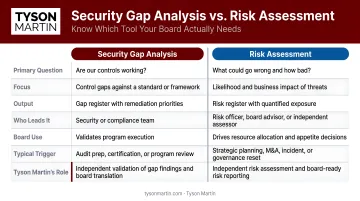
Running both gives leadership a complete picture. A gap analysis tells you what's missing. A risk assessment tells you what could go wrong. Without both, you can't answer the question that boards actually need answered: do your current controls hold under real conditions?
Why Security Gap Analysis Is Critical for Boards and Organizations
The Regulatory Reality
Boards can no longer treat cybersecurity as a purely technical matter delegated to the IT department. The regulatory environment has changed materially.
Three overlapping obligations now apply directly to board-level cybersecurity oversight:
- SEC (July 2023): Public companies must disclose material cybersecurity incidents on Form 8-K within four business days and provide annual disclosure of board oversight and management's role in assessing cyber risk.
- NYSE audit committee standards: Require documented discussion of risk management policies and steps taken to monitor and control major risk exposures.
- NACD's Director's Handbook on Cyber-Risk Oversight — developed with CISA and the FBI — provides principle-based guidance on exactly this kind of oversight.
A gap analysis produces the documented evidence base that makes that oversight defensible.
Converting Noise Into Decisions
Most boards receive security updates that read like activity reports: number of alerts, patches applied, incidents handled. None of that answers the question a director actually needs answered: Are our material risks under control, and are we getting better or worse?
A gap analysis replaces dashboard noise with prioritized findings. It separates material gaps — the ones that represent real exposure — from manageable ones. That distinction is what allows leadership to make resource allocation decisions with confidence rather than guessing.
The Business Continuity Argument
Undetected gaps in access controls, patch management, and vendor integrations are frequently the entry points exploited in ransomware and data breaches. The Verizon 2025 Data Breach Investigations Report found that exploitation of vulnerabilities reached 20% as an initial access vector — a 34% increase over the prior year. Median time to mass exploitation of a known vulnerability: five days. Median time to full remediation: 38 days.
A 33-day window between known exposure and containment is not a technical footnote — it's the operational window attackers rely on.
Resource Prioritization
That remediation gap also has a budget dimension. Security budgets are finite, and without a gap analysis, organizations over-invest in visible, low-risk controls and leave high-impact areas underfunded. A gap analysis gives leadership the data to direct spending where it produces the greatest reduction in material risk — not just where it's most comfortable.
How to Conduct a Security Gap Analysis: Step by Step
Many organizations rush into gap analysis without clear scope or framework alignment, producing findings too broad to act on. Each step below is designed to ensure findings are specific, risk-ranked, and tied to accountable owners.
Step 1 – Define Scope and Objectives
Before any assessment work begins, answer two questions precisely:
What is being assessed?
- A specific business unit or system
- A regulatory requirement (HIPAA, PCI DSS)
- A framework (NIST CSF, ISO 27001)
- The full enterprise security program
What is driving this analysis?
- Audit preparation
- M&A due diligence
- Post-incident review
- Board reporting
- Cyber insurance renewal
The business objective shapes what "good enough" looks like and how findings get prioritized. An analysis scoped for insurance renewal looks different from one scoped for a board-level governance review.
Step 2 – Inventory Assets and Current Controls
Document what the organization is protecting:
- Data classifications and where sensitive data lives
- Critical systems and applications
- Third-party integrations and vendor connections
- Access points (remote access, cloud consoles, admin accounts)
- Operational processes that depend on security controls
Assess existing controls for effectiveness, not just presence. A documented policy that is never enforced is a control gap just as much as a missing policy. Both technical controls (firewalls, MFA, encryption) and administrative controls (policies, training, vendor contracts) belong in the review.
Gaps in the asset inventory itself are a common and serious finding — you cannot protect what you cannot see.
Step 3 – Select a Framework and Map Gaps
Choose the appropriate benchmark based on regulatory exposure and industry context:
| Framework | Best Used When |
|---|---|
| NIST CSF | Broad enterprise program; executive risk communication |
| ISO 27001 | Certification required; customer trust or contract pressure |
| CIS Controls | Practical hygiene baseline; engineering-level execution |
| PCI DSS | Payment card data is in scope |
| NIST 800-53 | High-assurance environments; government or critical infrastructure |
Once the framework is selected, compare each control requirement against the documented and observed current state. This produces a control-by-control gap register recording the finding, its severity, and the evidence reviewed.
Organizations navigating multi-framework requirements — a retailer subject to both PCI DSS and state privacy laws, for example — often benefit from an experienced fractional CISO leading this mapping. A hybrid approach (NIST CSF for executive reporting, CIS Controls for engineering execution, ISO 27001 for the governance layer) lets organizations map once and report once rather than duplicating effort across frameworks.
Step 4 – Prioritize and Build a Remediation Roadmap
The gap register from Step 3 is raw material — prioritization is what makes it actionable. Score each gap across two dimensions:
- Likelihood the gap will be exploited
- Business impact if it is
This produces a risk-ranked list that separates material gaps from lower-priority findings. A 90-day remediation roadmap should include:
- Quick wins (0–30 days): Privileged access cleanup, MFA coverage gaps, backup integrity checks
- Risk reducers (31–60 days): Email security, internet-facing patch cadence, logging and alert triage
- Foundational capabilities (61–90 days): Asset inventory, vulnerability management process, third-party intake
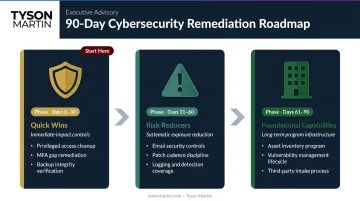
Each initiative needs a named owner (a role, not a committee), a due date, and a verification step. Without those three elements, the roadmap is a list of intentions — not a plan leadership can hold anyone accountable to.
Step 5 – Establish Continuous Review and Governance
A gap analysis is a point-in-time snapshot. Threat landscapes, regulatory requirements, and organizational infrastructure change continuously. Re-run the analysis:
- Annually
- After significant M&A activity
- Following new technology deployments (major cloud migrations, AI tools)
- After a security incident
Build a governance mechanism to track remediation progress, escalate stalled items, and report status to leadership in plain language. The gap analysis only produces value if findings get closed and leadership can see the trend line improving.
Security Gap Analysis: A Practical Example
Consider a mid-sized organization in a regulated industry preparing for a board audit review. They conduct a NIST CSF gap analysis using the Current Profile vs. Target Profile methodology — documenting what controls they have today against what the framework requires.
Three significant gaps surface:
- Incident response testing gap — An IR plan exists on paper, but it has never been exercised. No one has confirmed who actually has authority to take systems offline or approve external communications during an active incident.
- Access control gap — The access review reveals former employees with active credentials in cloud systems. The offboarding checklist exists; IT simply wasn't looped in when HR processed departures.
- Unmonitored vendor connection — A legacy integration with a third-party logistics vendor has no logging, no monitoring, and hasn't been reviewed in two years.
Each gap represents a distinct entry point. Together, they illustrate something common in regulated organizations: documented processes that exist in theory but haven't been stress-tested against operational reality.
The 90-day action plan:
- Days 1–30: IT pulls admin access lists, removes former employee credentials, and confirms MFA coverage. Owner: IT Director.
- Days 31–60: Security operations schedules and conducts a tabletop exercise with executives. Owner: CISO/security lead.
- Days 61–90: Vendor management initiates a formal review of the third-party connection, covering breach notification obligations and monitoring standards. Owner: Vendor Risk Manager.
The board receives a one-page status update showing three findings, three owners, and progress against milestones — the kind of reporting that shows a clear trajectory and builds confidence rather than simply cataloging problems.
How Tyson Martin Can Help
Security gap analyses produce real value only when their outputs are credible to boards and actionable for operations. That requires someone who understands both worlds.
Tyson Martin is a board advisor and fractional CISO with direct experience leading security and technology transformation at Home Depot, where he developed the company's first holistic cybersecurity and infrastructure strategy aligned to ISO 27001 and NIST CSF, and at Best Buy, where he directed the national cybersecurity roadmap across Geek Squad's operations including PCI DSS alignment for customer-facing environments.
He's an active contributor to the NACD, the NRF CISO Executive Committee, and the World Economic Forum's Centre for Cybersecurity — which means he frames findings in the governance language boards and executives actually use to make decisions.
The engagement model is structured for speed and accountability. Tyson steps in as an interim or fractional CISO to scope and lead the gap analysis, build the remediation roadmap, and establish the governance framework that makes progress visible and decisions defensible — without a full-time executive hire.
Engagements follow a 90-day arc with defined deliverables at each milestone:
- Day 30: Scoped gap assessment with prioritized findings
- Day 60: Remediation roadmap with owners and timelines assigned
- Day 90: Governance framework established with board-ready reporting in place
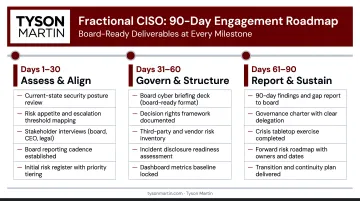
Engagements can extend into ongoing quarterly governance once the initial program is stabilized.
That structure is particularly valuable when an organization is navigating a moment of pressure or change. An independent gap analysis provides the objectivity internal teams rarely can provide to their own boards in situations such as:
- Post-incident recovery requiring a credible account of what failed
- M&A due diligence where cyber risk affects deal valuation or integration planning
- New leadership needing an honest baseline before committing to a program
- Regulatory scrutiny from the SEC, a board audit committee, or an external examiner
When the question is how material cyber risks are being identified and managed, the answer needs to be documented, evidence-based, and defensible.
Frequently Asked Questions
What is security gap analysis?
A security gap analysis is a structured process comparing an organization's current security controls and policies against a chosen framework or standard to identify where meaningful deficiencies exist. The output is a prioritized list of gaps — with evidence — that leadership can act on to reduce material risk.
What is a NIST gap analysis?
A NIST gap analysis measures an organization's security posture against the NIST Cybersecurity Framework's core functions — Identify, Protect, Detect, Respond, Recover, and Govern — to pinpoint control gaps. It's widely used because it's risk-based, federally recognized, and translates well into executive reporting.
What is a gap analysis example?
A common example: a NIST CSF gap analysis reveals that an organization's incident response plan is documented but never tested, its patch management cadence is inconsistent on internet-facing systems, and a legacy vendor connection lacks monitoring. Each finding is specific and actionable — with a clear owner and remediation path already attached.
What is the best tool for gap analysis?
There's no single best tool. The right approach depends on the framework, scope, and organizational maturity — options range from structured questionnaires and GRC platforms to practitioner-led advisory engagements. For findings that need to hold up at the board level, the quality of the assessor matters more than the tool.
What are the four types of gap analysis?
The four common types are: performance gap (current vs. target outcomes), compliance gap (controls vs. regulatory requirements), process gap (actual workflow vs. defined procedure), and capability gap (what security capabilities exist vs. what the environment requires). Cybersecurity gap analysis typically combines the compliance and capability gap types.