Introduction
Most boards have approved a security budget. Many have a CISO. Some have even passed a compliance audit. Yet when a breach happens—or a regulator asks pointed questions—leadership discovers the security program wasn't nearly as solid as the dashboards suggested.
A cybersecurity maturity assessment surfaces that gap directly. Rather than checking whether specific tools exist or rules are met, it asks a harder question: how capable, consistent, and improvable is the entire security operation?
According to PwC's 2026 Global Digital Trust Insights survey, only 6% of organizations feel confident across all surveyed cyber vulnerabilities—yet 77% of directors now discuss the financial implications of cyber incidents. The confidence gap is real. A maturity assessment is how organizations close it with evidence rather than assumption.
This article covers what a maturity assessment measures, how the five-level scoring scale works, which frameworks structure it, what domains it evaluates, and how to turn findings into decisions leadership can act on.
Key Takeaways
- A cybersecurity maturity assessment evaluates how capable, repeatable, and improvable your security program is, going beyond whether tools are in place to measure how well they actually hold up.
- Most frameworks score programs on a five-level scale, from ad hoc and reactive (Level 1) up to continuously optimized (Level 5).
- Leading frameworks include NIST CSF 2.0, CIS Controls, CMMC, and ISO 27001—each suited to different industries and regulatory environments.
- What matters most is what follows the score: a prioritized roadmap with named owners, timelines, and outcomes leadership can inspect.
What Is a Cybersecurity Maturity Assessment?
A cybersecurity maturity assessment is a structured, evidence-based evaluation of how well an organization's security program is built, managed, and improving over time. It examines policies, controls, people, and processes against a recognized benchmark—and produces a score that reflects consistency and capability, not just configuration.
What It Is Not
Three other assessment types are commonly confused with maturity assessments:
- Penetration testing — simulates a specific attack to find exploitable weaknesses in a system or environment
- Vulnerability scanning — identifies technical gaps in software, configurations, or network architecture
- Compliance audit — checks whether specific regulatory requirements have been met at a point in time
A maturity assessment asks a broader question: how capable and consistent is the entire security operation? Unlike a cyber risk assessment—which identifies and prioritizes specific threats—a maturity assessment evaluates whether the program managing those threats is actually functioning.
Why Boards Should Care About This Distinction
Compliance checkboxes can pass while core security capabilities remain fragile. An organization can have MFA listed as a policy requirement while administrators still use shared accounts. It can document a backup standard while nobody has tested a restore on the systems that run revenue.
Maturity assessments surface exactly that gap. When Tyson Martin works with boards post-incident, the most common discovery isn't that controls were missing from the policy—it's that controls on paper had never been confirmed in practice. That's what keeps a passing audit from translating into actual resilience.
The 5 Levels of Cybersecurity Maturity
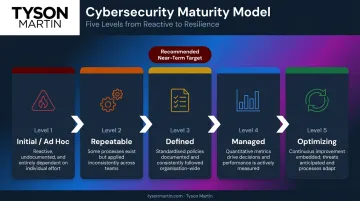
Most maturity assessments use a five-level scale derived from CMMI-style process maturity models. The levels describe how systematically and reliably security work gets done—not how sophisticated the technology stack is.
| Level | Label | What It Looks Like in Practice |
|---|---|---|
| 1 | Initial / Ad Hoc | Reactive and undocumented. Security depends on individual effort. No consistent processes exist. |
| 2 | Repeatable | Basic controls exist but are applied inconsistently across teams or locations. |
| 3 | Defined | Standardized, documented policies are followed organization-wide. |
| 4 | Managed | Security performance is measured with metrics. Decisions are data-driven. |
| 5 | Optimizing | Continuous improvement is built in. Proactive threat hunting and automation are integrated. |
How to Use These Levels
The scale is not a pass/fail grade. It is a tool for understanding trend and trajectory.
A realistic target for most organizations is Level 3 across core domains—security is documented, consistent, and organization-wide rather than dependent on which team or individual is handling it that day.
The move from Level 2 to Level 3 is often where security investment produces the clearest return. At Level 2, controls exist but execution varies. At Level 3, the same process runs in April and in October and produces comparable outcomes—without requiring heroics.
That consistency is what makes security inspectable. Boards can track progress against a defined baseline rather than relying on assurances that vary by quarter.
According to PwC's Global Digital Trust Insights survey, only 2% of surveyed businesses had implemented firm-wide cyber resilience—which gives some directional sense of how rare the upper levels truly are. For most organizations, Level 3 is the right near-term target: difficult enough to require real commitment, achievable enough to deliver measurable governance improvement within a defined program.
Frameworks Used in Cybersecurity Maturity Assessments
Frameworks are the measuring stick. They define what "good" looks like at each maturity level and structure the questions asked during the assessment. The right framework depends on the organization's industry, regulatory environment, and business objectives.
| Framework | Structure | Best Used When |
|---|---|---|
| NIST CSF 2.0 | Six functions: Govern, Identify, Protect, Detect, Respond, Recover | Board-level taxonomy; risk-based prioritization; executive communication |
| CIS Controls v8.1 | 18 controls across three Implementation Groups (IG1, IG2, IG3) | Practical baseline for lean teams; fast implementation with measurable weekly progress |
| CMMC | Three compliance tiers | Mandatory for DoD contractors; increasingly referenced as a best-practice model outside defense |
| ISO 27001:2022 | ISMS requirements and certification | Customer-driven certification requirements; global operations; repeatable governance |
Framework selection hinges on four factors:
- Regulatory drivers — which mandates or standards apply to the industry
- Customer requirements — whether clients or partners require specific certifications
- Threat profile — the realistic attack surface and adversary types the organization faces
- Organizational capacity — the team size and internal resources available to execute
For organizations managing multiple compliance obligations, the practical solution is to map once and report once: pick one primary framework as the assessment lens, then crosswalk to others. Running parallel assessments against separate frameworks drains resources without adding insight. In practice, NIST CSF often serves as the primary lens, with CIS Controls providing the implementation detail underneath it.
What a Maturity Assessment Evaluates: Core Domains
Governance and Risk Management
This domain asks whether security is led from the top and integrated into business decisions.
Assessors look for:
- A documented RACI showing who decides, who executes, and who is consulted
- Risk acceptance processes with named owners and expiry dates (not email threads)
- Security included in strategic conversations: M&A, product launches, partnerships
- A stable cadence of reviews—weekly execution check-ins, monthly risk reviews, quarterly board updates
A common red flag: when asked who owns the top three cyber risks by name and role, the answer is "the CISO handles it." Mature governance names business leaders as accountable owners, not just security staff.
Identity and Access Management
IBM's 2024 Cost of a Data Breach report identified stolen or compromised credentials as the most common initial attack vector at 16% of breaches. Verizon's 2025 DBIR found that 88% of web application breaches involved stolen credentials.
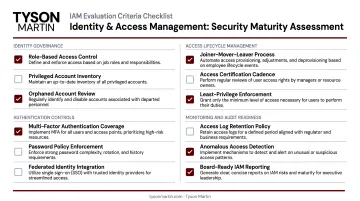
Assessors evaluate:
- MFA enforcement across email, admin accounts, and remote access
- Role-based access controls and least-privilege enforcement
- Onboarding and offboarding processes (joiner-mover-leaver hygiene)
- Monitoring and restriction of privileged accounts
Threat Detection and Vulnerability Management
This domain measures how proactively the organization finds and fixes weaknesses before attackers exploit them. The 2025 Verizon DBIR found exploitation of vulnerabilities as an initial access vector reached 20%—a 34% increase over the prior year.
Key assessment indicators:
- Whether vulnerability scanning is scheduled or ad hoc
- Patching speed on internet-facing systems
- Whether a SIEM or monitoring tool is in place and actively triaged
- IBM found the average breach lifecycle was 258 days in 2024—detection maturity directly shortens that window
Incident Response and Recovery
Strong detection only matters if the organization can act on what it finds. The most persistent maturity gap Tyson Martin encounters: incident response plans that exist on paper but have never been tested under real pressure.
Assessors look for specific evidence, not documentation alone:
- A plan that exists and has been exercised in the past 12 months
- Defined playbooks for ransomware, phishing, and business email compromise
- Clear decision rights: who can take systems offline, who approves emergency spending, who leads external communications
- Tested backups—actual restore results on crown-jewel systems, not backup policies
Documentation without a drill is scored as a gap, not a control.
Security Culture and Third-Party Risk
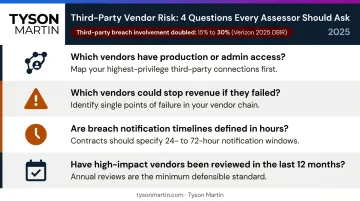
Verizon's 2025 DBIR reported that the human element was involved in 60% of breaches, and that third-party involvement in breaches doubled—from 15% to 30%—year over year.
For security culture, assessors examine whether training is continuous and behavior-tracked, or a once-a-year checkbox with no outcome measurement.
Vendor exposure gets the same scrutiny. For third-party risk, mature programs can answer:
- Which vendors have production or admin access?
- Which vendors, if they failed, would stop revenue or service delivery?
- Are breach notification timelines contractually defined in hours, not "reasonable time"?
- Have high-impact vendors been reviewed in the last 12 months?
How to Conduct a Cybersecurity Maturity Assessment
Step 1 — Define Scope and Choose a Framework
Decide what will be evaluated — the entire organization or a specific business unit — and which assets and data types are in scope. That boundary determines depth and resource requirements.
Choose a framework based on regulatory obligations and business context. Skipping this step produces assessments that are either too narrow to be meaningful or too broad to be actionable.
Step 2 — Collect Evidence from Multiple Sources
Self-reported questionnaires are a starting point, not a conclusion. Evidence must be corroborated through:
- Structured interviews with IT, security, and business stakeholders
- Review of existing policies, audit reports, and past findings
- Technical validation—patch levels, firewall configurations, access review logs
- Specific artifacts: restore logs, access review results, incident exercise after-action reports
"We have a process" is not evidence. Restore logs and access review exports are.
Step 3 — Score Maturity Across Domains
Gathered evidence is mapped to the chosen framework's controls, and each domain receives a maturity score (1–5). Scoring should be documented with rationale. An incident response plan that exists but has never been tested scores lower than one that is actively exercised, regardless of how thorough the document looks. Visual outputs like radar charts or heat maps make those scores legible to non-technical stakeholders.
Step 4 — Gap Analysis and Roadmap Development
The gap analysis is where assessment work becomes decision-driving. Each gap between current state and target state should translate into a prioritized, time-bound recommendation with a named owner.
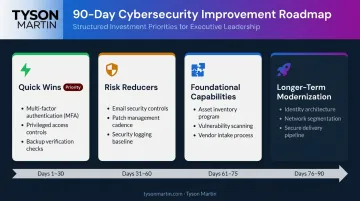
Tyson Martin's standard 90-day plan organizes initiatives into four funding buckets:
- Quick wins — MFA coverage, privileged access cleanup, backup integrity checks
- Risk reducers — Email security, patching on internet-facing systems, logging and alert triage
- Foundational capabilities — Asset inventory, vulnerability scanning, third-party intake process
- Longer-term modernization — Identity architecture, network segmentation, secure software delivery
Each initiative includes an owner, a target date, a risk outcome in plain business language, and the decision it drives.
Step 5 — Report to Leadership and Reassess Regularly
Findings must be communicated differently depending on the audience.
For boards and executives: A one-page dashboard with trend lines, thresholds, top risks, what changed since last time, and specific decisions needed. No technical jargon.
For technical teams: Detailed, actionable task lists with deadlines and escalation paths.
A maturity assessment is not a one-time event. Annual reassessments are standard practice, with additional reviews triggered by major incidents, leadership changes, mergers and acquisitions, or significant infrastructure shifts. Each cycle builds on the last — tightening the program and giving leadership a credible record of progress over time.
Best Practices for Turning Findings Into Board-Level Action
Secure executive sponsorship before the assessment begins
Assessments without board-level endorsement rarely translate into meaningful change. When leadership treats this as a strategic exercise rather than an IT task, it shapes resource decisions, encourages honest self-reporting, and accelerates remediation. The board doesn't need to run the assessment—but it does need to endorse it, receive the findings, and approve the roadmap.
Focus on trend, not a single score
A first maturity score without context is nearly meaningless. What matters is direction: is the program improving quarter over quarter? Are the domains carrying the highest regulatory or operational risk showing movement? Stable dashboards that show trend over time are far more useful than point-in-time reports.
Prioritize ruthlessly—highest-consequence gaps first
Most organizations discover more gaps than they can fix simultaneously. The prioritization question isn't "what's lowest-hanging fruit?" It's "which gap, if exploited, would cause the greatest business disruption or regulatory exposure?"
Trying to advance every domain at once disperses effort and usually produces marginal improvement everywhere rather than meaningful improvement where it matters.
Assign named owners with clear escalation thresholds
Roadmap recommendations stall when no one owns implementation. Every initiative needs a named owner, a defined timeline, and an escalation path if it falls behind. The board's role is to inspect progress, not manage execution—but that inspection must be built into the board's agenda with a consistent cadence.
Consider bringing in an experienced external perspective
Organizations undergoing leadership transitions, preparing for regulatory scrutiny, or running their first formal maturity assessment benefit from engaging a fractional or interim CISO who has structured assessments across diverse environments.
An external advisor provides what internal teams typically cannot:
- Independent benchmarking that shows how the organization compares to actual peers
- Credibility with auditors and insurers who treat internal assessments skeptically
- Translation of findings into defensible board decisions, free from the organizational politics that can skew internal reporting
This is the kind of engagement Tyson Martin provides to boards and executive teams. His background running security at AWS, Home Depot, and Best Buy—combined with his active involvement with the NACD, World Economic Forum's Centre for Cybersecurity, and the NRF CISO Executive Committee—means findings arrive with the context of what peer organizations at comparable scale have actually built, not just what a framework checklist prescribes.
Frequently Asked Questions
What is a cybersecurity maturity assessment?
It is a structured evaluation of how well an organization's security program—its people, processes, and technologies—is built and consistently executed. Results are measured against a recognized scale to identify gaps and guide prioritized improvement rather than checking specific boxes.
What is a cybersecurity maturity assessment model?
A maturity model, such as NIST CSF 2.0, CIS Controls, or CMMC, is the framework used to define what good security practice looks like at each level. It gives the assessment a structured measuring stick rather than relying on subjective judgment.
What are the 5 levels of cybersecurity maturity?
Level 1 (Ad Hoc/reactive), Level 2 (Repeatable but inconsistent), Level 3 (Defined and standardized), Level 4 (Managed with metrics), and Level 5 (Optimized with continuous improvement). Most organizations sit somewhere between Levels 2 and 3 when they conduct their first formal assessment.
How do you conduct a cybersecurity maturity assessment?
Five steps drive the process:
- Define scope and select a framework
- Gather evidence through questionnaires, interviews, and technical review
- Score each domain against the framework's controls
- Identify gaps between current and target state
- Produce a prioritized roadmap with named owners and deadlines
What are the three main types of security assessments?
Risk assessments identify and prioritize specific threats and vulnerabilities. Compliance audits check whether an organization meets specific regulatory requirements. Maturity assessments evaluate the overall capability, consistency, and sophistication of the security program across all domains.
What is a cybersecurity maturity assessment questionnaire?
It is the structured set of questions used to collect evidence, organized by domain (governance, access management, incident response) and distributed to IT, security, and business stakeholders. Responses are a starting point—not a final answer—and must be corroborated with technical evidence and documentation.