Introduction
Most security budgets are finite. Threats are not.
Executives face a persistent tension: cyber threats are multiplying while boards demand cost discipline and operational momentum. The instinct is to protect everything equally — patch everything, audit everything, lock down everything regardless of exposure. That instinct is expensive and largely ineffective.
According to a 2025 Gartner survey, 85% of CEOs now say cybersecurity is critical for business growth — yet global security spending is forecast to hit $212 billion in 2025, up 15% year over year, with no corresponding guarantee of proportionally better outcomes.
The problem isn't investment. It's prioritization.
A risk-based approach to cybersecurity moves organizations from reactive, checkbox-driven security to deliberate, prioritized defense. This article covers:
- What a risk-based approach actually means in practice
- How it differs from compliance-driven security
- Its four operational pillars
- How to implement it across an enterprise
- How to make cyber risk legible to boards without turning directors into security experts
Key Takeaways
- A risk-based approach means identifying, scoring, and prioritizing threats by likelihood and business impact — not treating every risk the same.
- Compliance sets a floor; risk-based thinking defines strategy above that floor.
- The four pillars: risk identification, risk assessment and prioritization, risk treatment, and continuous monitoring.
- Effective implementation requires a defined risk appetite, clear ownership, and measurable indicators tied to governance.
- Boards need risk posture in business terms: financial exposure, operational impact, and trend direction — not raw vulnerability counts.
What Is a Risk-Based Approach to Cybersecurity?
A risk-based approach identifies an organization's specific threat landscape and evaluates the likelihood and business impact of each risk. Security resources concentrate where they produce the greatest reduction in harm — not spread uniformly across all systems regardless of exposure.
NIST SP 800-37 Rev. 2 describes this as a "disciplined, structured, and flexible process for managing security and privacy risk" that gives senior leaders the information needed to make efficient, cost-effective decisions.
That distinction matters because the two most common alternatives to risk-based thinking leave organizations exposed in ways that are easy to miss until something goes wrong.
How It Differs From Compliance and Maturity Models
Two common alternatives miss the mark in predictable ways:
- Compliance-driven security satisfies regulatory minimums (PCI DSS, HIPAA, SOX). It tells you whether you've met a standard — not whether you've addressed your actual exposure.
- Maturity-based security pursues a defined level of security capability. Progress is measured against a benchmark, not against the threats targeting your specific environment.
Both can create a false sense of security. An organization can pass every audit and still be exposed to risks that the framework simply doesn't address.
Why Context Changes Everything
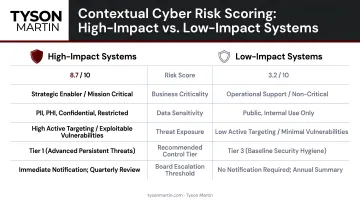
The same threat carries a very different risk score depending on what's at stake. A ransomware attack targeting a retail payment platform — one that processes thousands of transactions per hour — creates immediate revenue loss, customer harm, and regulatory exposure. The same attack hitting an internal logistics scheduling tool is disruptive but recoverable, with far lower downstream consequence.
That's why risk scoring is always contextual — shaped by your assets, your sector, and the specific consequences your organization can and cannot absorb. Two organizations can face identical threats and arrive at completely different priorities.
Why Compliance Alone Is No Longer Enough
Compliance frameworks are designed to establish minimum baselines. They're updated reactively — after major incidents reshape regulatory thinking — not in anticipation of emerging attack patterns. That timeline mismatch creates real exposure.
The Equifax Example
The Equifax breach illustrates this clearly. In 2017, attackers exploited CVE-2017-5638, a known Apache Struts vulnerability that had gone unpatched. They remained undetected for 76 days. According to the U.S. House Oversight Committee report, roughly 148 million people — nearly 56% of American adults — had their personal data exposed.
The FTC settlement reached at least $575 million, potentially $700 million. A known vulnerability. A failed patching process. A compliance posture that didn't prevent any of it.
MOVEit tells a similar story. In 2023, the Cl0p ransomware group exploited a zero-day SQL injection vulnerability in MOVEit Transfer software, affecting organizations across government, healthcare, and financial services. Unlike Equifax — where the failure was a missed patch — MOVEit exposed a different problem: compliance frameworks offer no coverage for threats that didn't exist when the controls were designed.
The Distinction That Matters
Compliance is the floor, not the ceiling.
Organizations that treat regulatory checkboxes as their security strategy are measuring effort instead of managing risk. The two are not the same — and that distinction carries real consequences:
- Strategic gap: Compliance tracks control existence, not control effectiveness against current threats
- Governance liability: Boards that accept audit results as evidence of security posture are exposed — regulators and courts don't accept "we passed the audit" as a defense when material harm occurs
The Four Pillars of a Risk-Based Cybersecurity Strategy
Pillar 1 — Risk Identification
Before any prioritization can happen, organizations need a complete picture of what they're protecting and what threatens it. That means:
- Asset inventory: data, systems, applications, and third-party dependencies — including vendors that support critical revenue, care delivery, or payments
- Threat mapping: the actors and attack vectors most relevant to your sector
- Regulatory scope: for healthcare, financial services, and retail, the inventory must account for regulatory perimeter as well as operational exposure
CIS Control 1 anchors this work: managing and tracking all enterprise assets connected to the infrastructure. Without this, risk scoring is guesswork.
In practice, the most commonly missed dependencies are:
- Identity and privileged access: stale accounts, shared credentials, over-permissioned cloud roles
- Critical vendor concentrations: single payment processor, single hosting platform
- Cloud misconfigurations: environments assumed "secure by default" that have never been validated
Pillar 2 — Risk Assessment and Prioritization
Once assets and threats are mapped, each identified risk gets scored by two variables: likelihood (how probable is this threat materializing?) and impact (what does it cost the business if it does?)
Established frameworks like NIST SP 800-30 and the FAIR model provide structured methods for this scoring. The output is a ranked risk register — from risks that can be accepted without material consequence, to risks demanding immediate treatment.
The ranking does the real work. It converts a list of threats into a prioritized investment thesis.
Pillar 3 — Risk Treatment
Four options exist for each identified risk:
| Treatment | Description |
|---|---|
| Mitigate | Implement controls to reduce likelihood or impact |
| Transfer | Shift exposure via cyber insurance or contractual requirements |
| Accept | Document the risk and monitor it within defined thresholds |
| Avoid | Exit the activity that creates the risk |
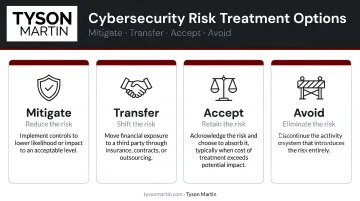
The right choice depends on the cost of a control versus the expected loss it prevents — a business calculation, not a technical one. A $500,000 control protecting a $200,000 risk exposure isn't a good investment, regardless of what the vulnerability scanner recommends.
Pillar 4 — Continuous Monitoring and Reassessment
Risk-based security isn't a point-in-time assessment. It requires:
- Ongoing threat monitoring: the environment changes faster than annual reviews can capture — the Verizon DBIR notes that 31% of breaches now originate with software vulnerabilities
- Reassessment triggers: M&A activity, new vendors, system changes, and regulatory shifts all require fresh review
- Control effectiveness validation: existing controls need regular confirmation they're still working
ISO 27001:2022 formalizes this: risk assessments must be performed at planned intervals or when significant changes occur. NIST SP 800-37 frames it as "near real-time risk management through continuous monitoring processes."
These four pillars operate as a continuous cycle. Risk treatment decisions create new dependencies that feed back into identification. Monitoring surfaces new risks that restart prioritization. Each pass through the cycle produces more precise scoring and better-calibrated controls.
How to Implement a Risk-Based Cybersecurity Approach
Step 1 — Define Risk Appetite Before Touching Controls
Risk appetite is the explicit, board-approved threshold of risk the organization is willing to carry. Without it, every security decision becomes a judgment call made by the security team instead of a governed business decision.
Risk appetite should be expressed in concrete, measurable terms — not vague descriptors like "low" or "moderate." A practical format includes:
- Downtime limits: "Our customer portal must be restored within 6 hours of a major outage"
- Data loss windows: "We accept losing up to 15 minutes of order data"
- Financial thresholds: "We accept up to $50,000 in confirmed fraud loss per quarter from digital channels"
This one-page statement comes from leadership, not the security team. Without it, risk treatment decisions have no anchor.
Step 2 — Conduct a Structured Risk Assessment
Walk through four activities in sequence:
- Asset discovery — identify critical systems, data, and vendor dependencies
- Threat modeling — map relevant actors and attack vectors to those assets
- Vulnerability identification — surface gaps in controls, configurations, and processes
- Likelihood and impact scoring — rank each risk against the appetite statement
No perfect inventory is required on day one. Start with the systems that support revenue, care delivery, or legal obligations — the crown jewels — and build outward from there.
Step 3 — Establish KRIs and KPIs
The World Economic Forum's cybersecurity guidance distinguishes two types of indicators clearly: KRIs provide a snapshot of current risk level, while KPIs show movement toward or away from the defined risk appetite.
Linking the two gives executives a navigable dashboard rather than a static report. Useful board-level metrics include:
- Top five material risk scenarios with movement over time
- Time to detect, contain, and restore critical services
- Critical control coverage on highest-value systems (MFA, EDR, patching SLAs)
- Security debt burn-down rate on prioritized gaps
- Third-party risk review coverage on critical vendors
Every metric should have a clear owner, a defined target, and a decision it can drive — fund, fix, accept, or stop.
Step 4 — Align Security Investment to Highest-Priority Risks
The Gordon-Loeb economic model, published in the ACM Transactions on Information and System Security, establishes that security investment should be proportional to expected loss reduction — not spread evenly across all assets.
McKinsey's research validates this in practice: one organization increased projected risk reduction 7.5 times at no additional cost by reordering its security initiative backlog — the same budget, resequenced by risk priority, produced a dramatically different outcome.
Step 5 — Build Governance and Review Cadence
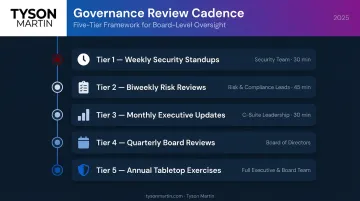
Implementation without governance reverts to one-time project thinking. A sustainable cadence looks like:
- Weekly security standups (30 minutes): blockers, critical risks, incident updates
- Biweekly risk reviews (45 minutes): update top risks, confirm owners, decide what to accept or fix
- Monthly executive updates (30 minutes): trends, unresolved exposures, decisions needed
- Quarterly board reviews: tied to business changes and top risk movement
- Annual tabletop exercises: test escalation decisions under pressure
Each risk in the treatment plan needs one named owner — committees distribute responsibility too broadly to hold anyone accountable when a decision actually needs to be made.
Translating Cyber Risk Into Board-Level Decisions
Why Technical Reporting Fails at the Board Level
Dashboards filled with vulnerability counts, patch rates, and CVSS scores don't answer what boards actually need to know: what is our exposure, what changed, and what do we need to decide?
When boards can't evaluate cyber risk in those terms, they can't exercise meaningful oversight. The SEC's 2023 cybersecurity disclosure rules made this a formal governance obligation — requiring disclosure of board oversight of cybersecurity risk and management's role in assessing material exposure. "We passed the audit" no longer satisfies the governance standard.
In most fractional CISO engagements, the gap is reporting that's either too technical or a comfort blanket of green charts — status updates that generate no decisions. Everything looks fine until it isn't.
Shifting to Business-Language Risk Reporting
The shift requires mapping cyber risk to business outcomes boards already track: financial loss, operational disruption, legal and regulatory exposure, strategic delay, and reputation harm.
The FAIR model provides a structured methodology for assigning financial ranges to cyber risk scenarios. Rather than reporting "identity controls are weak in the cloud admin layer," the board-ready version reads: "A compromised admin account could disrupt core systems, delay customer orders, and increase legal exposure if sensitive data is touched."
That framing is decision-ready. The technical version is not.
Directional ranges work better than precise dollar estimates — boards need decision-grade information, not false precision that creates comfort where none is warranted. That financial framing only works, though, if the governance structure is in place to act on it.
Decision Rights as the Governance Mechanism
Clear decision rights determine who decides which risks to accept versus treat, what triggers escalation from management to the board, and what authority the security team has to act without further approval.
A practical escalation ladder operates on two tiers:
- Amber triggers: worsening trends over two review cycles, near-misses, rising exception counts
- Red triggers: threshold breaches, repeat incidents, expiring exceptions without closure
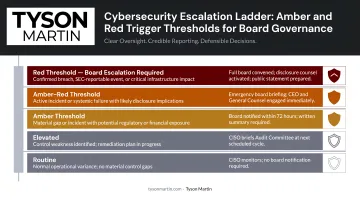
Without pre-decided escalation criteria, organizations either over-escalate (slowing operations) or under-escalate (leaving boards unaware of material exposure). Both create governance risk.
Tyson Martin works with boards and executive teams on precisely this problem: building the reporting structures, escalation thresholds, and governance clarity that let boards exercise credible cyber oversight without requiring technical expertise. That work — closing the gap between what security teams produce and what boards need — is where a fractional CISO or board advisor delivers the most tangible value.
Frequently Asked Questions
What is a risk-based approach to cybersecurity?
A risk-based approach identifies, scores, and prioritizes cyber threats based on their likelihood and potential business impact. Rather than applying uniform controls across all systems, it concentrates security resources on the risks that carry the greatest consequence, enabling better outcomes with the same or less spend.
What is an example of a risk-based approach?
A healthcare organization conducts a risk assessment and identifies unauthorized access to patient records as its highest-priority risk: high likelihood, high regulatory exposure, and significant reputational consequence. It concentrates investment in access controls and monitoring for that environment, then formally accepts lower-scoring risks elsewhere with documented rationale.
What are the four pillars of a risk-based approach?
There are four pillars:
- Risk identification — knowing what you're protecting and what threatens it
- Risk assessment and prioritization — scoring risks by likelihood and impact
- Risk treatment — deciding to mitigate, transfer, accept, or avoid
- Continuous monitoring — reassessing as the threat landscape and business evolve
Is ISO 27001 a risk-based approach?
Yes. ISO 27001:2022 explicitly requires organizations to conduct a risk assessment and design controls based on their specific risk profile. However, certification doesn't guarantee a mature risk-based posture. The quality of that assessment determines whether the program actually works.
How does a risk-based approach differ from a compliance-based approach?
Compliance-based security satisfies external regulatory requirements and sets a minimum baseline. A risk-based approach uses the organization's own threat environment and risk appetite to drive decisions, going above the compliance floor to address risks that regulations don't cover.
How do I communicate cyber risk to my board of directors?
Translate technical findings into business terms: financial exposure ranges, operational disruption scenarios, and trend direction rather than vulnerability counts. Board briefings should answer what changed since the last meeting, what decisions are required, and whether the organization remains within its defined risk appetite.