

Ransomware appeared in 44% of all breaches in 2025, up 37% from the prior year. Third-party involvement in breaches doubled from 15% to 30%. The global average data breach now costs $4.4 million. These aren't security statistics — they're business continuity numbers that belong in board conversations.
This article gives you a practical breakdown of what cyber risk appetite means, who sets it, how to define it step by step, and — critically — how to make it stick. The gap most organizations miss isn't a missing policy document. It's the absence of real escalation thresholds, clear decision rights, and genuine accountability.
A written appetite statement that lives in a policy repository is not governance. Let's talk about what actual governance looks like.
Key Takeaways
- Cyber risk appetite is a strategic board decision, not a CISO checklist item
- Risk appetite sets the boundary; risk tolerance defines when action is required
- Effective appetite statements are specific and measurable, not aspirational
- Every appetite statement needs a paired KRI and escalation trigger to be enforceable
- Appetite only holds in real incidents when decision rights are pre-assigned
What Cyber Risk Appetite Really Means — And Why Boards Can't Ignore It
Cyber risk appetite is the amount and type of cyber-related risk an organization is willing to accept in pursuit of its business objectives. NIST defines it as "the types and amount of risk, on a broad level, an organization is willing to accept in pursuit of value."
In board terms: how much could we lose before it threatens our ability to operate or grow?
This is not a security team preference. It's a strategic threshold — the same category as financial targets and capital allocation decisions. The board sets it. Management executes within it.
Why Undefined Appetite Costs More Than You Think
Without a defined appetite, organizations don't actually eliminate risk decisions — they just make them badly. Tyson Martin, who has observed this pattern across enterprise environments at AWS, Home Depot, and Best Buy, notes that organizations without defined appetite tend to "patch what's loud, not what's risky" and "fund what's urgent, not what matters."
The result is predictable:
- Over-investment in visible but low-impact controls
- Under-investment in identity hardening, logging coverage, and recovery testing
- Scattered decisions that contradict each other across business units
- Boards learning about material risk exposure only after an incident
As Tyson puts it: "If you don't define your technology risk appetite, you still have one. It just lives in scattered decisions, exceptions, and 'we'll fix it later' promises."
That pattern is fixable — but only once appetite is defined with two specific components.
Two Dimensions Boards Must Address
A well-defined appetite reflects both:
- Willingness — what risk the organization strategically chooses to accept or pursue
- Capacity — the financial and operational ability to absorb loss without threatening solvency
Both need grounding in business reality. When defined properly, risk appetite reframes cybersecurity as a resource allocation decision — one that lets leadership weigh cyber exposure directly against operational, regulatory, and reputational risk.
Risk Appetite vs. Risk Tolerance: A Critical Distinction
Conflating these two terms is one of the most common governance mistakes — and it produces policies that look complete but fall apart under pressure.
| Term | Definition | Operates At |
|---|---|---|
| Risk Appetite | The strategic boundary — how much risk the organization chooses to accept in pursuit of objectives | Board / executive level |
| Risk Tolerance | The operational limit — the maximum deviation from appetite before escalation is required | Management / operational level |
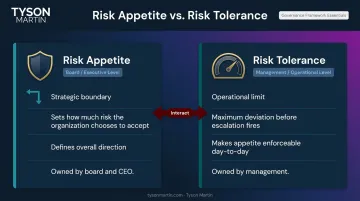
NIST CSF 2.0 GV.RM-02 requires both to be established, communicated, and maintained. The governance gap is that most organizations define neither with enough specificity to act on.
How They Work Together: A Concrete Example
Appetite statement: "We have low appetite for third-party vendor incidents that expose customer data."
Tolerance threshold: "Any vendor with unresolved critical security findings must remediate within 30 days, or access is revoked."
The appetite statement gives direction. The tolerance threshold makes it enforceable. Without both, you have a preference — not a policy.
When the two blur together, security teams end up setting operational thresholds that don't reflect business strategy — and boards approve vague language that nobody downstream can act on. Keeping them distinct assigns ownership: the board sets appetite, management owns tolerance, and both have something specific to answer for.
Who Owns Cyber Risk Appetite Inside Your Organization
The board of directors, CEO, and enterprise risk committee set cyber risk appetite. Not the CISO. Not IT. The SEC's 2023 disclosure rules make this ownership structure explicit — registrants must disclose both the board's oversight of cybersecurity risks and management's role in assessing and managing them.
The FFIEC puts it plainly: the board-approved cyber risk appetite statement is part of the enterprise-wide risk appetite statement.
The CISO's Actual Role
Tyson Martin frames this distinction clearly for boards he advises: "The board owns thresholds and risk acceptance for material issues. Management owns execution."
The CISO's job is to:
- Translate technical exposure into financial and operational impact terms
- Model potential loss scenarios with business-relevant numbers
- Present options with tradeoffs — not mandates disguised as recommendations
- Stay the expert witness, not the decision-maker in the room
When boards ask, "How much risk are we taking on this?" the CISO should be able to say: "This customer portal has a single point of failure. It could be down for 24 hours during peak season. Here are your options."
The board then responds with a real choice — fund the fix, delay a launch, require a control by a specific date, or accept the risk with eyes open.
Governance Structure Requirements
The risk appetite statement should be:
- Formally approved by the board or risk committee
- Reflected in enterprise risk policy
- Reviewed at least annually — or after any material event (M&A, major incident, regulatory change, leadership transition)
How to Define Your Cyber Risk Appetite: A Practical Step-by-Step Approach
Most organizations can produce a working draft appetite statement in a single session. Full refinement typically takes two to six weeks — if the right people are in the room and the process is structured from the start.
Step 1 — Start With What You're Protecting
Before writing anything, map your crown jewels: revenue systems, operational systems, trusted data, and regulated obligations. Then translate each into harm statements:
- "If our payment systems go down, we lose $X per hour"
- "If customer data is exposed, we face regulatory investigation and customer attrition"
- "If our supply chain portal is compromised, operations halt"
Harm statements force the conversation into business terms — which is exactly where appetite decisions belong.
Step 2 — Engage the Right Stakeholders
Effective appetite-setting requires input from operations, legal, finance, HR, and business line leaders — not just IT and security. Their perspectives ensure thresholds are realistic and earn organizational buy-in. Exclude them and you get a document nobody respects.
Step 3 — Define Your Core Risk Categories
Identify where cyber risk is most material to your specific business. Common starting points:
- Data security and privacy
- Identity and access management
- Third-party and supply chain risk
- Operational continuity
- Compliance and regulatory obligations
- Cloud security
- AI and emerging technology (37% of organizations have processes to assess AI tool security before deployment)
Tailor categories to your actual threat profile. A healthcare organization prioritizes differently than a retailer.
Step 4 — Establish Appetite Levels by Category
Use a clear scale: Zero Appetite, Low, Moderate, High. Apply different levels to different risk types within the same domain.
A statement like "we have zero appetite for unencrypted sensitive customer data in public cloud environments" gives teams something to act on. "We take security seriously" gives them nothing.
Step 5 — Pair Statements With Measurable Thresholds
Every appetite statement needs a corresponding metric. If your statement is "low appetite for customer-impacting downtime," define it:
- Maximum acceptable downtime: 4 hours per quarter
- Recovery time objective (RTO): 2 hours for Tier 1 systems
- Mean time to detect (MTTD): under 24 hours
Numbers like these give both the board and the operations floor a shared definition of "acceptable."
Step 6 — Define KRIs and Escalation Triggers
Establish what signals a breach of appetite, who is notified, and what decision authority activates. Two trigger levels work well in practice:
- Amber: Worsening trend over two reporting cycles, near miss, or rising exception count
- Red: Threshold breach, repeat breach, or exception that expires without closure
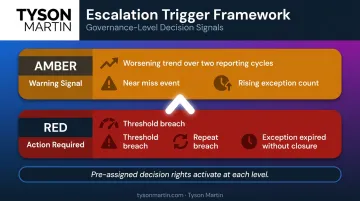
Pre-assigned decision rights are what separate a working escalation protocol from a decorative one. When pressure hits, there's no time to negotiate authority — those answers need to already exist on paper.
Examples of Cyber Risk Appetite Statements Across Key Domains
Good appetite statements are specific, tied to a measurable threshold, and reference a business outcome. Here are five examples across common domains:
| Domain | Appetite Statement | Threshold |
|--------|-------------------|-----------|
| Data Security | Zero appetite for unencrypted sensitive customer data in public cloud environments | Any unencrypted sensitive data in public cloud = immediate remediation required |
| Identity & Access | Low appetite for privilege escalation risk | MFA required for all admin access; any unprotected privileged account escalates within 48 hours |
| Third-Party Risk | No vendor access to sensitive systems without current SOC 2 or equivalent | Vendors failing assurance reviews lose access within 30 days of finding |
| Compliance | Zero appetite for intentional non-compliance with applicable regulations | Any known compliance violation escalates to legal and risk committee immediately |
| Operational Continuity | Low appetite for core service disruptions | Maximum 4-hour RTO for Tier 1 systems; MTTD under 24 hours for active threats |
Notice the threshold column: that's where vague policy language becomes an operational instruction someone can act on at 2 a.m. The domain framing also shifts by sector. A financial services firm anchors appetite around regulatory exposure and audit defensibility. A healthcare organization centers it on patient data integrity and HIPAA breach thresholds. The starting point is always the same — what the business cannot afford to lose — but the statements that follow should reflect the specific risks that keep your leadership team up at night.
Turning Your Appetite Statement Into Governance That Actually Works
The most common failure mode: organizations produce an appetite statement, file it in a policy repository, and never reference it again.
For appetite to shape decisions, it must be embedded in how the organization actually operates. According to the 2024 Audit Committee Practices Report, 73% of boards discuss cybersecurity at least quarterly — but only 24% believe their audit committee has sufficient cybersecurity expertise to act on what they hear. Frequency without substance isn't governance.
What Functional Governance Looks Like
Tyson delivers a lightweight operating rhythm that connects appetite to actual decisions:
- Weekly executive checkpoints (30 minutes): top risks, open incidents, blocked decisions
- Biweekly risk decision meetings (45-60 minutes): exceptions, funding asks, major change reviews
- Monthly board/committee summaries (one page): top risks, trend indicators, decisions needed
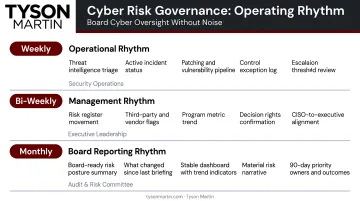
Board reporting maps every metric to an approved threshold — not activity counts. If a metric can't answer "in appetite or out of appetite," it belongs in management reporting, not board reporting.
The Decision Rights Piece
A risk appetite statement only holds in real incidents if decision rights are pre-assigned. When these answers are vague, risk gets expensive fast.
Tyson's RACI framework for incident decisions:
- Responsible: CISO — security execution, risk analysis, and options
- Accountable: CEO or named executive — final risk acceptance and business tradeoffs
- Consulted: Legal — on response, privacy, and contracts
- Informed: Key business owners — with clear action items and dates
Pre-decide your "first 30 minutes" rules before an incident happens. Who can approve containment actions that may disrupt systems? Who speaks to customers? Who contacts cyber insurance? These conversations held under pressure produce bad outcomes. Held in advance, they create speed without chaos.
Those pre-assigned rights are only as durable as the appetite statement behind them — which is why governance also requires a defined review cycle.
When to Reassess Appetite
Appetite requires scheduled review, not a one-time approval. Trigger a formal review after:
- Mergers, acquisitions, or divestitures
- Significant regulatory changes
- Material security incidents
- Leadership transitions
- Major shifts in the threat landscape or technology environment
The OCC requires boards to reevaluate and approve risk appetite at least annually. Treat it as a living document, not a policy artifact.
When appetite is embedded in real governance, executives gain the confidence to move fast on digital initiatives. The boundaries are known. The decision rights are clear. And when pressure hits, the governance structure holds because it was built before the incident — not improvised during one.
Frequently Asked Questions
Frequently Asked Questions
What is cyber risk appetite?
Cyber risk appetite is the amount and type of cyber-related risk an organization is willing to accept in pursuit of its business objectives. It is a strategic decision made at the board and executive level, not a technical one. The core question it answers: how much could we lose before it threatens our ability to operate?
What is the difference between risk appetite and risk tolerance?
Risk appetite is the strategic boundary: how much risk the organization chooses to accept in pursuit of its objectives. Risk tolerance is the operational limit, the measurable threshold that triggers escalation, a control, or corrective action when breached. Appetite shapes policy; tolerance makes it enforceable day to day.
How do you write a cyber risk appetite statement?
Four steps structure the process:
- Engage cross-functional stakeholders from legal, finance, operations, and business lines
- Define risk categories relevant to your business model
- Assign appetite levels using a clear scale (Zero, Low, Moderate, High)
- Pair each statement with a measurable threshold or KRI that signals when appetite has been breached
What are examples of cyber risk appetite statements?
"Zero appetite for unencrypted sensitive customer data in public cloud" and "Low appetite for undetected malicious activity; MTTD under 24 hours" are both effective examples. Good statements are specific, tied to measurable outcomes, and reference what the business actually cannot afford to lose.
What is risk tolerance in cybersecurity?
Risk tolerance is where appetite becomes actionable. It defines the maximum acceptable deviation before a control, alert, or escalation fires — the measurable answer to: how much deviation can we live with before we act? For more on how appetite and tolerance relate, see the question above.
What are the common types and levels of risk appetite?
A standard four-level scale covers: Zero Appetite, Low, Moderate, and High. Different levels apply to different risk categories — zero appetite for compliance violations alongside moderate appetite for controlled use of emerging technologies, for example. The categories and levels should reflect the organization's actual threat profile, not a generic template.