Introduction
Most organizations have conducted a security risk assessment. Far fewer are actually running a security risk assessment program — and that distinction is where real exposure lives.
The difference is not semantic. A one-time assessment produces a report. A program produces repeatable, governed risk reduction.
When Tyson Martin works with boards and audit committees, he consistently finds the same pattern: the report landed, everyone agreed the findings were important, and almost nothing changed. Findings parked in backlogs. Ownership diffused. The same gaps surfacing 12 months later.
This guide is written for boards, audit committees, CEOs, COOs, and risk leaders who need to understand how a security risk assessment program works operationally — not just what it is in theory. If you're evaluating whether your organization has a functioning program or just documentation that resembles one, this is for you.
Key Takeaways
- A security risk assessment program is a recurring, governed cycle — not a compliance exercise that resets annually
- Program outputs should drive board-level decisions on risk appetite, resource allocation, and residual risk acceptance
- Five core steps: scope and governance, asset identification, threat and vulnerability analysis, risk evaluation, remediation and monitoring
- Common failure modes: checkbox treatment, unclear ownership, and findings that never reach decision-makers
- Effectiveness requires executive sponsorship, defined risk tolerance, and a reporting cadence tied to real decisions
What Is a Security Risk Assessment Program?
A security risk assessment program is a structured, recurring process that identifies which assets an organization depends on, what threatens them, and what a successful attack would actually cost. The output is a prioritized risk register that informs investment decisions and board governance — not a binder on a shelf.
The distinction between a program and a point-in-time assessment matters enormously to boards evaluating their actual risk posture.
A point-in-time assessment is a snapshot — often compliance-driven, often valuable, but with no built-in follow-through. A program is continuous, governed, and owned. As Tyson Martin frames it: "An assessment gives you clarity once. Governance makes that clarity repeatable."
Without that governance layer, a predictable failure cycle emerges: the report arrives, leadership acknowledges it, and six months later the same vulnerabilities resurface — right before an audit, a deal, or an incident.
The Three Assessment Types Used Within a Program
Programs typically draw on three methodologies:
- Quantitative assessments assign dollar-value estimates to risk scenarios using models like FAIR (Factor Analysis of Information Risk), which has more than 18,000 members worldwide and growing adoption in regulated industries
- Qualitative assessments use descriptive ratings — high, medium, low — based on expert judgment; faster to produce, but harder to defend to regulators or investors
- Hybrid approaches combine both, using qualitative ratings to prioritize where quantification makes sense
Which methodology a program uses shapes what the board actually receives. Regulated industries are moving away from qualitative heat maps as the primary reporting artifact: the NACD's 2026 Cyber Risk Handbook recommends board reporting include top risk scenarios with quantified financial impacts, not color-coded grids. Directors can't make defensible investment decisions from a red-yellow-green chart alone.
Why Boards and Executive Teams Need a Formal Program
Regulatory Requirements Are Not Optional
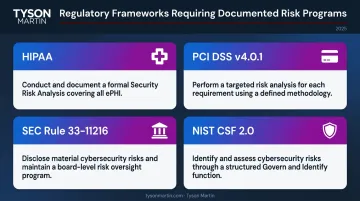
Multiple frameworks require documented, repeatable programs with evidence of follow-through — not just periodic assessments:
- HIPAA: 45 CFR 164.308(a)(1)(ii)(A) requires an accurate and thorough risk assessment of threats to electronic protected health information, paired with risk management measures sufficient to reduce identified risks
- PCI DSS v4.0.1: Requirement 12.3 mandates formal identification, evaluation, and management of risks to the cardholder data environment, reviewed at minimum annually
- SEC Rule 33-11216 (2023): Regulation S-K Item 106 requires registrants to describe their processes for assessing, identifying, and managing material cybersecurity risks in enough detail for a reasonable investor to understand — and disclose board oversight of those processes
- NIST CSF 2.0: The GOVERN function requires that cybersecurity risk management strategy and expectations are established, communicated, and monitored; GV.RM-06 specifically calls for a standardized method for calculating, documenting, and prioritizing cyber risks
In 2015, the SEC found that R.T. Jones Capital Equities Management failed to adopt written cybersecurity policies and imposed sanctions. The enforcement action was not triggered by a breach — it was triggered by the absence of a documented program.
The Business Case Beyond Compliance
Compliance creates the floor, not the ceiling. The operational case is just as compelling: IBM's 2025 Cost of a Data Breach Report puts the global average breach cost at USD $4.4 million. Organizations with mature programs contain incidents faster because risk owners and escalation paths are already defined — no one is improvising governance under pressure.
A functioning program also shortens the response window during M&A, investor due diligence, or enterprise sales cycles. When buyers ask for proof of security posture, organizations with governed programs can produce it. Those without one face delayed closes, valuation adjustments, or failed diligence — none of which are recoverable on a short timeline.
How a Security Risk Assessment Program Works
The program runs on a defined cadence: comprehensive assessments annually, supplemented by triggered reassessments when material changes occur. It produces a risk register reviewed regularly, informing a reporting cycle that connects findings to decisions at the management and board level.
Program inputs include:
- Asset inventories and system classifications
- Threat intelligence relevant to industry and geography
- Prior assessment findings and remediation status
- Current compliance obligations and regulatory changes
Program outputs should be:
- A prioritized risk register with owners and timelines
- A remediation plan with success criteria
- Executive and board reporting that shows trend over time, not just a current-state snapshot
Step 1: Define Scope, Risk Tolerance, and Governance
Before any technical work starts, the program needs documented answers to three governance questions:
- What is in scope — which systems, processes, and third parties
- What level of risk the organization will accept — the board's risk appetite expressed in practical, measurable terms
- Who owns the program and each risk category within it
Tyson Martin's approach to risk tolerance skips vague language entirely. Rather than "low," "moderate," or "acceptable," he helps boards define thresholds in plain business terms: "Our customer portal must be restored within 6 hours of a major outage," or "We accept up to $50,000 in confirmed fraud loss per quarter from digital channels." Those thresholds become the guardrails that make prioritization possible.
Without this governance foundation, assessments produce findings with no accountable follow-through. Risk exceptions get approved by email with no expiry date. Projects go live without documented security sign-off. Third-party risk has no single owner. These are governance failures, not security team failures.
Step 2: Identify and Value Assets
Asset identification catalogs digital and physical assets, classifies each by criticality to business operations and data sensitivity, and assigns value reflecting both tangible cost (replacement, revenue impact) and intangible cost (regulatory exposure, reputation).
The assets that matter most are what Tyson Martin calls "crown jewels": billing systems, production infrastructure, patient records, identity systems, and core applications. Each should have a named owner and a documented maximum acceptable downtime.
Untracked assets are the blind spots attackers are most likely to exploit. Organizations can't protect what they haven't confirmed they own.
Step 3: Analyze Threats and Vulnerabilities
This step assesses internal and external threat actors by capability and motivation, runs vulnerability identification activities, and applies threat intelligence relevant to the organization's industry.
The 2025 Verizon Data Breach Investigations Report analyzed 12,195 confirmed breaches and found:
- Ransomware present in 44% of breaches
- The human element involved in approximately 60% of breaches
- Third-party involvement doubled from 15% to 30% year over year
For regulated industries specifically: healthcare recorded 1,542 confirmed breaches with medical data as the most compromised data type; financial services saw 927 breaches, with social engineering among the dominant patterns; retail recorded 419 breaches. These aren't hypothetical threat categories — that's where organizations in those sectors should concentrate vulnerability identification effort.
A common gap Tyson Martin identifies in assessments: controls get checked, but attack paths don't get mapped. An assessment can confirm MFA is configured while missing the admin account that bypasses it. Real threat analysis traces how an attacker would actually reach business impact rather than stopping at which controls are documented.
Step 4: Evaluate, Score, and Prioritize Risk
Risk scoring combines likelihood (of a threat exploiting a vulnerability) with potential business impact. That scoring must connect to the organization's defined risk tolerance to produce prioritized, actionable output.
Common frameworks include NIST SP 800-30, ISO/IEC 27005, and FAIR. NIST defines risk explicitly as a function of adverse impact and likelihood. One critical distinction: CVSS scores measure vulnerability severity, not enterprise risk. Boards should not receive CVSS scores as primary risk reporting. A critical CVSS score on a system with no business-critical data is a different governance conversation than the same score on a payment processing system.
Board reporting should express priority in business terms: risks that threaten revenue, risks that threaten operations, and risks that trigger regulatory exposure. The translation from technical finding to business impact is where most security reporting fails. That gap is also where boards lose confidence in the program.
Step 5: Remediate, Monitor, and Report
The ongoing phase assigns remediation ownership with clear timelines and success criteria, tracks progress against the risk register, and reports on a cadence that supports governance.
Effective reporting structure for boards:
- What changed since the last cycle (risks increased, decreased, and why)
- Current top exposures in plain business language
- Progress against remediation commitments with evidence
- Specific decisions or approvals being requested
- What happens if action slips
Tyson Martin's board reporting follows a one-page format with trend indicators, not static snapshots. Trend matters: a board that sees the same five risks for three consecutive quarters, unchanged, should be asking different questions than a board watching a risk register that moves. The NACD reports that 43% of public company directors and 57% of private company directors consider improving management cyber-risk reporting quality "very" or "extremely important" — a clear signal that most current reporting is not meeting governance needs.

Key Factors That Determine Program Effectiveness
Governance and Ownership
The most common reason security risk assessment programs fail is diffuse or undefined ownership. The program needs an accountable executive owner, clear decision rights for each risk category, and escalation thresholds defined before pressure hits.
A practical governance model answers five questions without requiring debate:
- Who accepts risk and at what threshold?
- Who approves security exceptions and for how long?
- Who decides budget tradeoffs when security competes with delivery?
- Who can declare incident severity or shut systems down?
- Who owns vendor go/no-go decisions for critical suppliers?
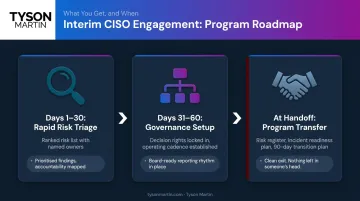
For organizations without a dedicated CISO or with a vacant security leadership role, an interim CISO can design, own, and run the program until a permanent structure is in place. Tyson Martin's interim CISO engagements follow a defined structure:
- Days 1–30: Rapid risk triage and a ranked risk list with named owners
- Days 31–60: Decision rights locked in, operating cadence established
- At handoff: A usable risk register, a practiced incident readiness plan, and a 90-day transition plan
Third-Party Risk Integration
Governance doesn't stop at your own systems. The 2025 DBIR documents third-party involvement doubling to 30% of confirmed breaches — and any third party with access to your systems or data is part of the attack surface.
A tiered assessment approach scales scrutiny to the criticality and access level of each relationship. Tier 1 vendors — those that could stop revenue within 24 hours if they failed — warrant hard evidence: SOC 2 Type II reports, penetration test summaries, and contractual breach notification windows measured in hours.
The critical board-level question Tyson Martin asks about every program: "Which single vendor failure could stop revenue within 24 hours, and what proof do we have they'd notify us fast?" Most organizations can't answer it confidently.
Common Misconceptions That Undermine Security Risk Assessment Programs
"We did our assessment last year." An annual assessment that isn't refreshed or monitored between cycles produces false confidence, not real risk reduction. NIST includes "maintain the assessment" as a core program step. HIPAA explicitly frames risk analysis as part of an ongoing security management process. Attackers follow business change — new vendors, infrastructure shifts, acquisitions — not audit calendars.
"Risk assessment is a security team function, not a board responsibility." The security team leads technical execution. But risk appetite setting, resource allocation, and acceptance of residual risk are governance decisions that cannot be delegated to the CISO alone.
Boards that treat assessment as purely operational create the conditions for a governance failure when an incident occurs. When regulators or investors ask who approved the risk posture, there needs to be a documented, defensible answer — and that answer has to come from the board.
"A detailed report means a working program." Extensive documentation without evidence that findings changed anything is program activity without program outcomes. Two regulatory requirements make this explicit:
- HIPAA pairs risk analysis with risk management under 45 CFR 164.308(a)(1)(ii)(B) — documentation alone satisfies neither
- HHS corrective action plans require implementation follow-through, not just a completed assessment on record
When regulators or incident investigators review your program, the question isn't how thorough the report was. It's whether anything changed because of it.
Frequently Asked Questions
What are the steps of a security risk assessment program?
Five core steps define the program: define scope, governance, and risk tolerance; identify and value assets; analyze threats and vulnerabilities; evaluate and prioritize risk against the organization's defined tolerance; and implement remediation with ongoing monitoring and board reporting. The program is cyclical — each step feeds the next, and "maintain the assessment" is not optional.
What are the types of risk assessment in a security risk assessment program?
Programs use three methodologies: quantitative assessments (dollar-value risk scenarios using models like FAIR), qualitative assessments (descriptive ratings based on expert judgment), and hybrid approaches combining both. Regulated industries increasingly expect quantified, financially grounded output rather than qualitative heat maps alone.
How often should a security risk assessment program be conducted?
Effective programs run two tracks: a comprehensive annual cycle and event-triggered reassessments following material changes — M&A activity, system deployments, significant incidents, leadership transitions, or major regulatory updates. Organizations running only the annual track often discover their risk register has drifted well out of sync with their actual operating environment.
Who should own and lead a security risk assessment program?
Program ownership sits with a designated security executive — typically the CISO — with board-level sponsorship setting risk appetite and approving resource allocation. Organizations without permanent security leadership can engage an interim CISO to build the program and establish governance structures that transfer cleanly to the permanent hire.
How do you communicate security risk assessment findings to a board of directors?
Board reporting should translate findings into business language: current risk posture, what changed since the last briefing, top exposures with their potential business impact, and the specific decisions or approvals being requested. Technical metrics the board cannot act on belong in the appendix, not the opening slides.
What is the difference between a security risk assessment and a vulnerability assessment?
A vulnerability assessment identifies technical weaknesses in specific systems. A security risk assessment is broader — it evaluates threats, vulnerabilities, and potential business impact against the organization's risk tolerance, producing a prioritized risk register that drives governance decisions. Vulnerability assessment outputs feed into the threat and vulnerability analysis step of that larger program.