Introduction
Boards are under more pressure than ever to demonstrate meaningful cybersecurity oversight — but many are still receiving risk reports that describe threats without helping anyone decide anything. A heat map showing three "high" risks in red tells a director exactly nothing about which one to fund first or how much exposure the company is actually carrying.
The methodology behind the assessment is where that problem starts. Qualitative and quantitative risk assessment produce fundamentally different outputs, and choosing the wrong one for the wrong audience creates reporting that looks thorough but can't support a real decision — and no amount of polish fixes that.
According to WEF research on board cyber governance, 70% of directors view cybersecurity as a strategic enterprise risk — yet only 17% report realizing any benefit from cyber risk quantification. That gap sits squarely in methodology.
Whether you're building a risk program from scratch, preparing for SEC disclosure requirements, or trying to give your board something they can actually act on, this guide breaks down how each methodology works, where each one falls short, and how to match the right approach to the right audience and decision.
Key Takeaways
- Qualitative assessment uses descriptive scales (high/medium/low) — quick to implement, accessible to non-technical stakeholders, and well-suited for triage
- Quantitative assessment translates risk into financial and probabilistic terms — making it objective, defensible, and built for board-level conversations
- Qualitative is faster to implement; quantitative requires more data but supports cost-benefit decisions
- Neither method wins outright — the right choice depends on your program's maturity, data availability, and audience
- Most mature programs use both: qualitative for breadth, quantitative where financial justification is required
Qualitative vs. Quantitative Risk Assessment: Quick Comparison
| Dimension | Qualitative | Quantitative |
|---|---|---|
| Risk expression | Descriptive: high/medium/low, red/yellow/green | Financial: dollar values, probabilities, frequency ranges |
| Speed | Fast — days to weeks | Slower — requires data collection and modeling |
| Data requirements | Low — expert judgment-based | Higher — needs historical incidents, asset values |
| Subjectivity | High — assessor-dependent | Lower — model-driven, repeatable |
| Output format | Heat maps, ordinal rankings | ALE figures, probability ranges, cost-benefit ratios |
| Best for | Triage, early programs, compliance mapping | Board reporting, investment decisions, M&A, regulatory filings |
The table above captures the trade-offs, but one distinction deserves more attention than a column header can convey: qualitative ratings like "3 out of 5" or "high" are ordinal — they indicate position or order, not measured quantities. NIST SP 800-30 draws this line clearly, noting that quantitative assessments use numbers whose meanings and proportionality are maintained, while qualitative assessments use nonnumerical categories or levels. A "high" ransomware risk and a "high" third-party risk may represent vastly different financial exposures — and ordinal labels won't tell you which one to address first.
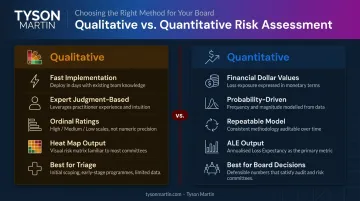
The two approaches work together, not against each other. Most mature programs use qualitative methods to triage and prioritize, then apply quantitative rigor where the financial stakes justify the modeling effort — typically for board reporting, capital allocation, and regulatory filings.
What Is Qualitative Cybersecurity Risk Assessment?
Qualitative risk assessment evaluates threats based on likelihood and impact using descriptive or ordinal ratings — typically red/yellow/green scales or high/medium/low labels. NIST defines it as a method based on descriptors rather than statistical values. Results depend on the judgment and experience of whoever is conducting it — which is both its strength and its constraint.
Core Benefits
- Completed in days without extensive data infrastructure or financial modeling expertise
- Adapts quickly to new threats, vendor onboarding, or post-incident triage
- Directly supports compliance work under NIST CSF, ISO 27001, and similar frameworks
- Gives organizations with no existing risk program a workable starting point
Key Limitations
The NCSC warns that qualitative approaches "can miss patterns and trends visible in measured data" and that qualitative evidence may be discounted as one person's subjective opinion. When multiple risks share the same "high" rating, prioritization becomes guesswork.
That's a real governance problem. Boards cannot set a tolerance threshold or approve a budget line against a color code.
The DREAD Model in Practice
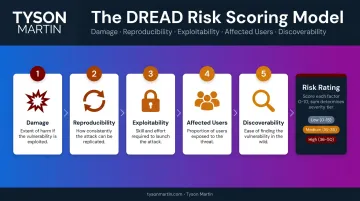
DREAD is a concrete example of qualitative risk scoring in action. Each threat is rated across five factors:
- Damage — severity of potential harm
- Reproducibility — ease of repeating the attack
- Exploitability — skill or effort required to execute
- Affected users — breadth of impact
- Discoverability — how readily an attacker can locate the vulnerability
Each factor gets a score, scores are averaged, and the result produces a ranked risk rating. The output is faster than financial modeling, but the ratings are relative — two threats with a score of 7 may have vastly different real-world cost implications.
Where Qualitative Assessment Fits
Qualitative methods are the right starting point for:
- Initial risk identification before financial data is available
- Vendor onboarding evaluations
- Organizations under new leadership (new CISO, post-incident, M&A transition) that need a quick baseline
- Compliance-driven assessments where the framework asks for risk categories, not dollar values
- Any scenario where speed matters more than precision
What Is Quantitative Cybersecurity Risk Assessment?
Quantitative risk assessment expresses cyber risk in measurable financial and probabilistic terms. As the NCSC describes it, quantification expresses risk in terms stakeholders care about — including monetary value, frequency, or hours of downtime. The word "quantitative" means actual measured quantities, not ordinal scales with numbers attached.
The ALE Formula
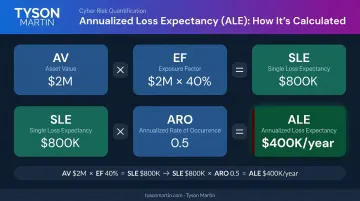
The most widely recognized quantitative formula is Annualized Loss Expectancy (ALE):
ALE = Single Loss Expectancy (SLE) × Annualized Rate of Occurrence (ARO)
Breaking that down:
- Asset Value (AV): What is this system or data set worth to the business?
- Exposure Factor (EF): What percentage of that asset value would be lost in a breach?
- SLE = AV × EF: The estimated financial loss from a single incident
- ARO: How many times per year is this incident likely to occur?
- ALE: The expected annual financial cost of this risk
Example: A customer database worth $2M with a 40% exposure factor gives an SLE of $800K. If a breach is estimated to occur once every two years (ARO = 0.5), the ALE is $400K per year. That's a number a CFO or board member can reason about.
Core Benefits
- Ranks competing risks by dollar exposure, not subjective "high/medium/low" labels
- Justifies security spend directly: a $200K control that reduces a $400K ALE risk is a straightforward business case
- Connects internal estimates to real-world stakes: IBM's 2025 Cost of a Data Breach Report puts the global average breach cost at $4.44M
- Supports SEC cybersecurity disclosure requirements (adopted July 26, 2023), which require public companies to describe material risks and their financial impact in exactly these terms
Limitations — and Why They're Manageable
Quantitative assessments require historical incident data, modeling expertise, and more effort to build. But the NCSC makes an important point: uncertainty ranges are acceptable. Imperfect data can still be used, because uncertainty can be captured explicitly — a range of $300K–$600K is more useful to a board than "high."
Organizations don't need to start over. The NCSC explicitly states that quantification can be introduced alongside existing approaches without replacing them.
The FAIR Framework
The most widely recognized quantitative framework is FAIR (Factor Analysis of Information Risk), maintained by the Open Group as an international standard. FAIR quantifies cyber risk in financial terms and is designed to complement — not replace — existing frameworks like NIST CSF, ISO 27005, and OCTAVE. According to the FAIR Institute's 2025 State of Cyber Risk Management report, nearly 45% of organizations currently use or plan to use FAIR, and among adopters, 90% report success in their risk management efforts.
Where Quantitative Assessment Delivers Most Value
- Board and executive risk reporting
- Cybersecurity investment prioritization (which control first, and why)
- Cyber insurance underwriting decisions
- SEC cybersecurity disclosure and materiality determination
- M&A due diligence, where financial valuation of technical findings gives acquirers defensible numbers at the negotiating table
Which Approach Should Your Organization Use?
The answer depends on four variables: risk maturity, data availability, decision audience, and what the output needs to support.
Choose Qualitative When:
- You're standing up a risk program for the first time
- You need to triage a large threat surface quickly
- Financial data on assets and incidents isn't yet available
- The primary output is a compliance mapping or a risk register for the security team
Choose Quantitative When:
- You need to justify a security investment to the CFO or board
- Two or more "high" risks need to be prioritized against each other
- You're preparing for SEC disclosure and need to assess materiality
- You're conducting M&A diligence or cyber insurance renewal
- Your board is asking "what could this actually cost us?"
The Case for a Hybrid Model
Most mature security programs use both. Qualitative assessment covers the breadth — fast triage across the full risk landscape. Quantitative methods then go deeper on the highest-priority risks where financial stakes justify the modeling effort.
In board advisory work, this hybrid view hinges on what Tyson Martin calls "decision-grade metrics" — metrics that change a decision, allocate money, or trigger action. Qualitative heat maps support initial triage, but they're not sufficient for governance. Boards need thresholds, trend data, and confidence levels paired with risk scores — not just colors.
The governance connection is direct: boards cannot fulfill oversight obligations from a heat map alone. A board that can't answer "what is our acceptable financial exposure for this risk category?" hasn't set a risk tolerance — it's just acknowledged that risk exists.
Quantitative framing, even with ranges rather than precise figures, gives risk committees the language to set tolerances, approve investments, and document defensible oversight for regulators and shareholders.
From Risk Assessment to the Boardroom
Having the right methodology is only half the problem. Many organizations conduct solid assessments and then present the findings in language that stops a board conversation cold. Technical outputs — control gaps, CVE scores, maturity ratings — don't tell directors what they need to know.
HBR/MIT CAMS research found that more than half of board-level participants wanted reports showing the financial dollar value associated with potential breaches — not operational metrics like phishing test pass rates. Directors want to understand exposure, not activity.
What Effective Board Risk Reporting Looks Like
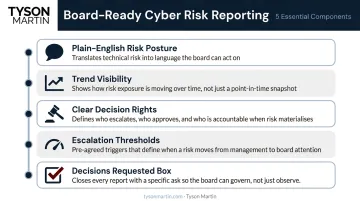
Translating risk assessment into board-ready outputs requires a specific structure:
- Plain-English risk posture: "A compromised admin account could expose customer data and disrupt operations" — not "Vendor lacks MFA for admin access"
- Trend visibility: Movement matters more than snapshots. Boards need to see whether exposure is rising or falling quarter over quarter
- Clear decision rights: What the board approves vs. what management owns — defined in advance, not debated during a crisis
- Escalation thresholds tied to quantified exposure: Pre-agreed triggers that tell the board when a risk has crossed from management's domain into theirs
- A "decisions requested" box: One to three items with options, cost ranges, and a recommended path
The NACD's 2026 cyber-risk oversight toolkit now specifically asks boards to request top cyber risks expressed in terms of probable frequency and financial impact — and to ask which quantification model is being used. That's a governance expectation, not a best practice suggestion.
Organizations in regulated industries, under new security leadership, or approaching SEC disclosure obligations typically need an independent board advisor to build the assessment framework, align it to governance requirements, and translate findings into reporting that drives decisions.
Tyson Martin works directly with boards and executive teams on exactly this: replacing noisy dashboards with clear oversight, establishing risk appetite statements and escalation thresholds that hold under real pressure. If your organization is ready to move from heat maps to board-ready oversight, connect with Tyson to explore what that engagement looks like.
Frequently Asked Questions
What is the main difference between qualitative and quantitative cybersecurity risk assessment?
Qualitative assessment ranks threats using descriptive labels like high, medium, or low, relying on expert judgment rather than financial data. Quantitative assessment assigns actual dollar values and probabilities to risks, enabling direct comparison and cost-benefit analysis. The core distinction is ordinal ranking vs. measured financial quantities.
Which risk assessment method is better for board-level reporting?
Quantitative reporting is generally more effective for boards because it frames risk in financial terms: exposure, likelihood, and cost — directly tied to investment and governance decisions. Qualitative assessments communicate the breadth of the threat landscape but cannot support threshold-setting or budget justification alone.
Can qualitative and quantitative risk assessments be used together?
Yes, and most mature programs do exactly this. Qualitative methods provide fast, broad triage across the full risk landscape. Quantitative analysis then goes deeper on the highest-priority risks where financial stakes justify the modeling effort. The NCSC explicitly supports introducing quantification alongside existing approaches without starting over.
What is the FAIR model and how does it relate to quantitative risk assessment?
FAIR (Factor Analysis of Information Risk) is an internationally recognized standard for quantifying cyber risk in financial terms, maintained by the Open Group. It provides the structure to calculate probable loss frequency and financial magnitude, and complements existing frameworks like NIST CSF and ISO 27001 rather than replacing them.
How do you calculate Annualized Loss Expectancy (ALE)?
ALE = Single Loss Expectancy (SLE) × Annualized Rate of Occurrence (ARO). SLE multiplies asset value by the exposure factor — the percentage of asset value likely lost in an incident. ARO is how often that incident is expected per year. Together, they produce an estimated annual financial cost for a given risk.
What maturity level does an organization need before adopting quantitative risk assessment?
Organizations don't need perfect data to start. The NCSC confirms that uncertainty ranges are acceptable and imperfect data can be used explicitly. Having a basic asset inventory, some incident history, and clear risk ownership is enough to begin. Starting with ranges rather than precise figures is valid — and far more useful to a board than another color-coded heat map.