
Introduction
Ask most organizations to show you their cyber risk limits, and they'll hand you a risk appetite statement. It will say something like "we have zero tolerance for data breaches" or "we maintain a low risk tolerance for operational disruption." Ask the follow-up question — what's the specific number, who owns it, and what happens when it's crossed — and you'll get silence.
That gap between policy language and governance mechanics is where boards lose oversight. According to PwC's pulse survey, only 44% of directors believe their board strongly understands the company's cybersecurity vulnerabilities. An appetite statement doesn't fix that. A risk limit does.
Risk limits are the governance mechanism that makes board-level cyber oversight possible without requiring directors to be technical experts. They translate ambiguous risk posture into specific, measurable bounds that drive real decisions.
What follows is a practical breakdown: what risk limits are, how they differ from thresholds, how to build them, and where ownership sits between the board and management.
Key Takeaways
- A risk limit is a pre-agreed, measurable bound that triggers a defined action when crossed — not a review.
- Thresholds are early warnings; limits are hard stops. Both are required for effective governance.
- Every limit needs a metric, a bound, a named owner, and a response protocol.
- The board approves top-tier limits tied to material business outcomes; management owns the operational layer beneath.
- Risk limits that lack funded remediation paths and formal exception tracking are governance theater.
What Is a Risk Limit in Cyber and Technology Governance?
A risk limit is a board-approved, measurable boundary placed on a specific risk metric. When that boundary is crossed, a defined action is required. Not a meeting. Not a review. An obligation to act.
Risk appetite statements work differently. They describe how much risk the organization is willing to accept in pursuit of business objectives — useful context, but no binding outcome when conditions shift.
The Three Components Every Limit Must Have
Every cyber or technology risk limit requires three structural elements:
- A risk metric — the thing being measured (e.g., critical vulnerability remediation rate)
- A risk measure — how it's quantified (e.g., percentage of critical vulnerabilities remediated within defined SLA)
- A bound — the value that must not be crossed (e.g., no more than 5% of critical vulnerabilities unpatched past the SLA window)
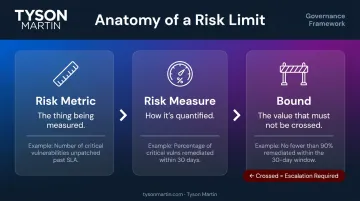
Without all three, you have a preference, not a limit.
The World Economic Forum's principles for board governance of cyber risk recommend that boards define cyber risk tolerance as a measurable threshold for losses from cyber events on an annualized basis — a framing that deliberately anchors limits to business impact, not security team activity.
Why Cyber Risk Has Been Slower to Adopt This Discipline
Financial risk management has used explicit limits for decades — position limits, concentration limits, loss limits. Cyber risk governance has lagged because the field developed from a technical discipline, not a financial one. The result: organizations measure patch counts and firewall events — but cannot tell a board whether they're inside or outside acceptable risk levels.
That's changing. NIST CSF 2.0 now explicitly requires practitioners to give managers and executives key performance indicators and key risk indicators that communicate cybersecurity posture — meaning boards should expect to receive measurable risk status, not just activity summaries.
Risk Limits vs. Risk Thresholds: Two Lines Every Board Needs
Thresholds and limits are distinct governance instruments — and most boards that struggle with escalation timing are missing one of them.
The Threshold: Yellow Light
A threshold is an early-warning line. When crossed, it triggers monitoring, escalation, or a management response — but not a halt.
Example: Critical vulnerability remediation falls below 90% on-time completion. The threshold triggers a management review and a documented response plan within the next reporting cycle.
The threshold gives time to act before a limit is breached.
The Limit: Hard Stop
A limit is a hard stop. When crossed, it requires a defined, often board-level, response.
Same example: On-time remediation falls below 70%. The limit triggers executive escalation, mandatory resource reallocation, and board notification before the next scheduled meeting.
Why You Need Both
The gap between threshold and limit is the response window. Organizations that skip thresholds and jump straight to limits find out about problems when they're already crises, leaving no room for the board to act before the damage is done.
A practical two-level trigger model:
- Amber triggers — a worsening trend over two consecutive cycles, a near miss, or a rising exception count
- Red triggers — a threshold breach, a repeat breach, or an exception that expires without closure
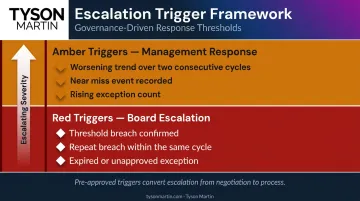
When these triggers are pre-approved by the board, escalation becomes a process rather than a negotiation during an active incident.
The Building Blocks of a Meaningful Cyber Risk Limit
Start With a Workable Risk Taxonomy
Before setting limits, the organization needs an agreed-upon list of the cyber and technology risks it cares about most. It doesn't need to be perfect — it needs to be useful, consistently applied, and complete enough to avoid major gaps.
A practical four-bucket taxonomy for mid-market and enterprise organizations:
- Technology risk — vulnerabilities, weak identity controls, legacy systems, risky configurations
- Third-party risk — vendors with data access, outsourced IT, SaaS tools, critical dependencies
- Compliance and legal risk — audit gaps, privacy obligations, contract commitments, reporting timelines
- Operational and trust risk — fragile processes, unclear incident roles, poor backups, customer promises
The trap is spending months perfecting the taxonomy before it's been stress-tested by real decisions. Start with this structure, assign owners to each bucket, and adjust it once you've run it through two or three reporting cycles.
Select the Right Metrics: The 80/20 Approach
Identify the roughly 20% of risk measures that represent 80% of material exposure. Aim for 8 to 12 total metrics, with five board-level outcome metrics kept stable across reporting cycles.
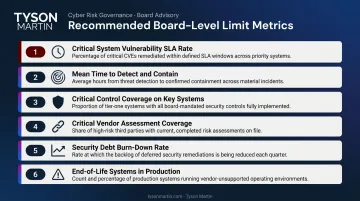
Strong candidates for formal limits:
- Percentage of critical systems past defined SLA for vulnerability remediation
- Mean time to detect and contain a security incident
- Critical control coverage on highest-value systems (MFA on privileged accounts, EDR on key servers)
- Percentage of critical vendors with current, reviewed security assessments
- Security debt burn-down rate — the size and age of known, prioritized gaps
- Percentage of end-of-life or unsupported systems in the production environment
Outcome Metrics vs. Control Proxies
Two types of metrics belong in any limit framework:
| Type | What It Measures | Example |
|---|---|---|
| Outcome metric | Direct risk exposure | Number of unauthorized access events |
| Control proxy | Adherence to a control as a stand-in for risk | MFA coverage across privileged accounts |
When direct risk measurement is immature, control proxies are a legitimate starting point. Label them as proxies — and build a concrete path toward outcome-based measurement over time.
Set Limits Against Reality, Not Benchmarks
A limit that the organization cannot meet — with no target date, no named owner, and no funded path — is a liability, not a governance tool. Every limit should be set with:
- A target date for compliance
- A named owner — a specific person, not a team or function
- A funded path that has cleared budget review
Copying industry benchmarks without this context produces limits that management either quietly fails against or formally overrides through an undocumented exception process. Either outcome is a governance failure: one is invisible, the other is documented but unresolved. The board should ask, for every limit: who owns it, when is it due, and what is funded to close the gap.
How to Set Risk Limits Step by Step
Step 1: Anchor Limits to Business Outcomes
Risk limits should be derived from business tolerance for disruption — not reverse-engineered from what the security team thinks is achievable. The board-level framing:
"How much degradation in [X] are we willing to accept before it affects our customers, our revenue, or our regulatory standing?"
Translate that into plain-language thresholds with attached numbers:
- "Our customer portal must be restored within 6 hours of a major outage"
- "We can accept losing up to 15 minutes of order data, not more"
- "We accept up to $50,000 in confirmed fraud loss per quarter from digital channels — anything above escalates"
These are business decisions, not security decisions. The CISO informs them; the board approves them.
Step 2: Set Both a Threshold and a Limit for Each Metric
For each selected metric:
| Layer | Definition | Who Acts |
|---|---|---|
| Threshold | Early warning requiring management response | Management |
| Limit | Hard stop requiring board escalation | Board/Executive |
The gap between threshold and limit must be realistic given the organization's detection and response capabilities. A narrow gap between the two leaves no room to act before the board is already in crisis mode.
Step 3: Assign Clear Ownership and Response Protocols
Every limit needs a named owner — one person accountable for monitoring utilization and triggering the defined response. A complete response protocol specifies:
- Notification routing by role: board for oversight, CEO for enterprise command, CISO for security response, General Counsel for legal strategy
- Response timing: immediate notification for material breaches, 15–30 minute updates during active incidents
- Required actions before the next reporting cycle: containment confirmed, remediation backlog with owners and dates, decision log capturing who approved what and why
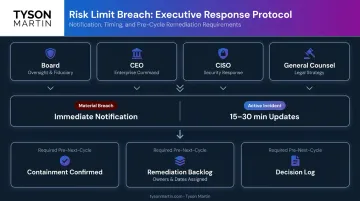
Without this protocol, limits become shelfware — documented but never acted on when it counts.
Step 4: Document Approvals and Deviations Formally
When the board or executives approve operating above a limit, that deviation must be documented as a time-bound exception with:
- A named owner
- An expiry date (required, not optional)
- A compensating control active during the exception period
- A confirmed monitoring mechanism
Organizations without a formal exception process find that limits get quietly ignored rather than formally overridden — and that's exactly what regulators and auditors look for.
For organizations without a standing CISO or formal risk function, an interim or fractional CISO can establish these processes quickly — creating a framework that's inspectable from day one rather than rebuilt after the fact.
Step 5: Build in a Review Cadence
Risk limits are not set-and-forget. Review at minimum annually, with the following off-cycle triggers built into the governance calendar:
- A breach or near-miss at a peer organization
- A major acquisition or leadership transition
- A regulatory change affecting disclosure or control requirements
- Persistent threshold breaches suggesting the limit is miscalibrated
- New AI use cases or major cloud migrations that expand the attack surface
Who Sets What: Board vs. Management Level Limits
The Governance Hierarchy
The board approves top-tier limits — those connected to the organization's most material risks, where a breach would require a board-level decision. These include maximum acceptable downtime for critical services, maximum data loss windows, material fraud thresholds, and concentration risk limits for critical vendors.
Management sets and owns the operational limits beneath these: patch timelines by system tier, vulnerability remediation schedules, access review frequencies, and routine exception approvals within policy.
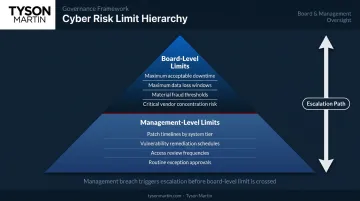
Each layer should be calibrated so a management-level limit breach triggers escalation well before a board-level limit is breached.
What the Board's Role Actually Is
NACD's 2026 cyber risk handbook reports that 57% of private company directors and 43% of public company directors rank improving the quality of cyber-risk reporting as very or extremely important. Yet 83% of public company boards already discuss cybersecurity at nearly every meeting. The gap isn't frequency — it's quality and actionability.
The board's role is not to approve every risk decision. It's to:
- Approve the framework within which management operates
- Be informed promptly when that framework is stressed
- Make decisions when a limit breach requires board-level action — resource allocation, risk acceptance, or public disclosure
How This Changes Board Reporting
When limits are properly constructed, board reporting shifts from presenting a stack of technical metrics to reporting on limit utilization — which measures are within bounds, which are approaching thresholds, and which require board action.
A one-page board dashboard format:
- Core metrics with trend arrows and threshold status
- Top risks with movement since last briefing
- Incidents and near-misses
- Decisions needed from the board (explicit, not implied)
The narrative follows a simple pattern: "Because we improved X, we reduced the chance of Y, which protects Z." Directors get a clear line of sight from security posture to business consequence — without needing to interpret technical data themselves.
Common Mistakes That Make Risk Limits Useless
Mistake 1: Abstract Appetite Statements Masquerading as Limits
Declaring "zero tolerance for data breaches" is not a limit. It's a wish. It produces no measurement, no threshold, no response protocol, and no accountability. These statements actively harm governance by creating a false sense of coverage while foreclosing honest conversation about actual exposure.
Mistake 2: Setting Limits Without Funding the Path to Compliance
A limit on end-of-life systems the organization cannot afford to remediate is a liability, not a control. Boards that approve limits without approving resources to meet them are setting up management to either fail visibly or misreport quietly.
The SEC has charged companies — including Blackbaud ($3 million settlement) and R.R. Donnelley ($2.125 million settlement) — for cybersecurity disclosure and controls failures that trace back to exactly this pattern.
Mistake 3: Treating Limit-Setting as a One-Time Exercise
Risk limits set during an audit cycle and left untouched become stale and misleading. The threat landscape, organizational risk profile, and business environment all change. Limits must keep pace.
Assign a governance owner explicitly accountable for the refresh cycle — otherwise the annual review becomes the calendar event that gets pushed every quarter.
Frequently Asked Questions
Frequently Asked Questions
What is a risk limit?
A risk limit is a pre-agreed, measurable bound placed on a specific risk metric. When the bound is crossed, a defined action is required — not a discussion. Unlike a risk appetite statement, which describes general posture, a risk limit produces a binding, documented outcome.
What is an example of a risk limit?
No more than 5% of critical systems may remain unpatched beyond the defined SLA window. A threshold set at 10% triggers a management review; crossing the 5% limit requires board escalation and mandatory resource reallocation.
What are the 5 levels of risk rating?
NIST SP 800-30 Rev. 1 defines a five-level scale for information security risk: Very Low, Low, Moderate, High, Very High. The specific scale matters less than applying it consistently across the risk taxonomy so comparisons are valid across time and domains.
What is the 3-5-7 rule in risk management?
The 3-5-7 rule originates in trading and investment risk — not enterprise cyber or technology governance. It has no standardized definition in board-level cyber risk frameworks from NIST, NACD, COSO, or ISACA. Applying a trading heuristic to cyber governance without defining it explicitly creates more confusion than clarity.
How often should risk limits be reviewed?
At minimum annually, with off-cycle reviews triggered by material incidents, major organizational changes such as M&A or leadership transitions, regulatory changes, or persistent threshold breaches that signal miscalibrated limits.
Who is responsible for setting cyber risk limits?
The board approves the top-tier limits and the overall framework. Management — typically the CISO, CIO, or Chief Risk Officer — proposes, monitors, and operates within those limits. Organizations in transition can engage an interim CISO to build the initial framework and hand off a documented, board-ready structure to permanent leadership.