Introduction
Most organizations have the documents. There's a risk charter somewhere, a committee structure on paper — and the last audit signed off on both. Then an incident hits — and nobody can answer who actually owns the decision.
That gap between documented governance and functional governance is where boards get exposed. According to NC State and AICPA's 2024 State of Risk Oversight survey of 377 U.S. executives, only 29% rated their risk oversight as mature or robust. The other 71% have governance that exists — they're not sure it holds.
This guide covers:
- What risk governance actually is — and how it differs from risk management
- How the Three Lines of Defense model assigns ownership across the organization
- What functional risk ownership looks like in practice
- The structural failures that consistently leave boards exposed
TLDR: Key Takeaways
- Risk governance defines who decides and who is accountable — separate from who executes
- The Three Lines of Defense model clarifies ownership at every organizational level: act, oversee, assure
- Decision rights and escalation thresholds separate functional governance from compliant-on-paper governance
- Risk ownership must be assigned to a named individual, documented with authority, and tested under pressure
- The most common governance failures are preventable when ownership is clear and structures are stress-tested before an incident
What Is Risk Governance?
Risk governance is the system that determines how risk decisions get made, who is accountable for them, and how risk information flows to leadership. NIST CSF 2.0 frames the Govern function as covering organizational context, risk management strategy, roles, responsibilities, policy, and oversight. ISO 31000:2018 is equally direct: managing risk is part of governance and leadership, and fundamental to how an organization is managed at all levels.
That framing matters. Governance is not the tactical controls themselves. It's the authority structure that gives those controls direction, ownership, and accountability.
How Governance Fits Within GRC
Within a broader GRC program, risk governance is the foundational layer. Without it:
- Risk management activities operate without strategic direction
- Controls exist but lack documented authority
- Reporting reaches the wrong people — or no one
- Boards can't distinguish between real oversight and activity updates
That's what makes the components below consequential — they're not documentation artifacts. They're what separates a functioning risk program from one that looks structured on paper and breaks under pressure.
Core Components of a Risk Governance Program
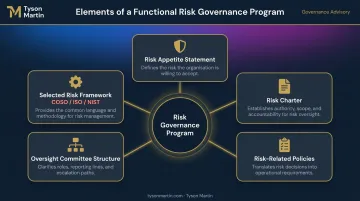
A functional risk governance program typically includes:
- Risk appetite statement — board-approved boundaries that define what risk the organization will and won't accept
- Risk charter — formalizes scope, authority, and how risk information flows to the board
- Risk-related policies — translate appetite into operational rules
- Oversight committee structure — defines who reviews, challenges, and approves risk decisions
- Selected risk framework — COSO ERM, ISO 31000, or NIST CSF provide the operating architecture
Each element reinforces the others. A risk appetite statement without a supporting committee structure is a policy document. A committee without a charter is a meeting. The components work together — or they don't work at all.
Risk Governance vs. Risk Management: Why the Distinction Matters
These two concepts get conflated constantly — and the confusion creates real governance gaps.
Risk governance sets the strategy, authority, and accountability structure. Risk management is the operational execution within that structure. Governance without management is strategy that never executes. Management without governance is execution without authority.
A concrete example: governance approves a cybersecurity policy targeting zero data breaches and defines who owns the decision if a breach occurs. Risk management implements the firewall, trains the staff, and monitors the detection controls. Each layer depends on the other — but they are not interchangeable.
Sequencing Is the Problem
Governance must come first. Organizations that skip ahead to risk management processes without governance in place end up with:
- Controls that lack documented authority
- Ownership gaps where no one is clearly accountable
- Risk reporting that doesn't reach the right level
- Boards asking questions that management can't answer
The SEC's enforcement action against First American Financial illustrates the cost. In 2021, the SEC charged First American with disclosure-controls failures after information security personnel identified a vulnerability but senior executives responsible for disclosures were never informed. The settlement was $487,616 — and the root problem wasn't technical. It was an escalation failure caused by unclear governance.
Why Boards Need to Care
When boards direct management to "implement GRC" without first establishing governance, the directive has no foundation to land on. The consequence isn't just inefficiency — it's liability exposure.
Three predictable failures follow:
- Undefined ownership: Risk decisions float without a named accountable party
- Missing escalation thresholds: No criteria exist for what reaches the board vs. stays with management
- Stuck information: Risk data accumulates at the operational level and never surfaces where decisions are made
The result is a board that is either drowning in operational noise or — more dangerously — operating blind on material risks. Neither position is defensible to shareholders, regulators, or insurers when something goes wrong.
The Three Lines of Defense: How Governance Structures Risk Ownership
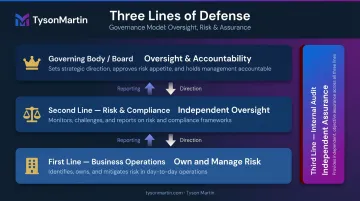
The Three Lines model — updated by the IIA in 2020 — is the practical framework for assigning risk ownership at different organizational levels. The 2020 update made an important shift: it renamed the model from "Three Lines of Defense" to the "Three Lines Model" and explicitly placed the governing body at the apex. Boards cannot delegate governance away, even when management runs risk processes.
First Line — Business Operations
The first line consists of frontline business units and operational managers. They own risk in their processes. That ownership means identifying, assessing, and controlling risk day-to-day — not handing it off to the risk team and moving on.
First-line ownership is only meaningful when responsibilities are documented, not assumed. Staff need to know what they own, what they're expected to report, and when to escalate.
What the first line should report upward:
- Risk heat map status for owned domains
- Key risk indicators in red or amber with trend data
- Incident and near-miss data
- Status of open mitigation actions
- Overdue audit findings
Second Line — Risk and Compliance Oversight
The second line — risk management, compliance, legal — provides independent oversight of the first line. It sets policies, monitors adherence, and defines escalation thresholds — without absorbing ownership from the first line. That boundary matters.
The second line's core functions include:
- Setting the risk framework, policies, and escalation thresholds
- Monitoring first-line adherence and flagging gaps
- Aggregating risk reporting for management and the board
- Maintaining the risk appetite statement and tolerance limits
A management risk committee with a documented charter often serves as the governance backbone here. Without a charter that defines mandate, authority, and decision rights, the committee is a discussion group — useful, but not a governance body. That's where the third line comes in — to verify the whole structure is working, not just on paper.
Third Line — Internal Audit and the Board
Internal and external auditors review both the first and second lines to verify that governance structures function as designed — not just that they're documented. Independence is non-negotiable: internal audit must not manage the risk processes it reviews.
The board — typically through an audit and risk committee — sits at the apex. Its role is oversight and accountability: reviewing and approving risk strategy, determining risk appetite, and receiving consolidated risk reporting.
A 2024 Society for Corporate Governance benchmark found that 47% of companies assign primary ERM oversight to the audit committee, 35% to the full board, and 15% to a standalone risk committee.
If risk oversight sits inside audit, the board needs to specify which risks go to the audit committee, which stay with the full board, and when escalation is mandatory.
Key Roles and Oversight Bodies in a Risk Governance Structure
Functional governance depends on clearly defined roles with documented authority. Here's what that looks like in practice:
| Role | Governance Function |
|---|---|
| Board / Audit & Risk Committee | Approves risk appetite, receives consolidated reporting, holds management accountable |
| Chief Risk Officer / CISO | Second-line leadership; owns risk reporting to the board |
| Risk Committee | Cross-functional senior leadership group; reviews major risks and mitigation actions |
| Risk Owners | Business unit leaders accountable for specific risk domains by name |
What Effective Board-Level Reporting Looks Like
The most common governance failure at the board level isn't bad information — it's too much of it. Boards receive voluminous reports with hundreds of indicators and can't find the signal they need to make decisions.
Effective board risk reporting:
- Opens with a plain-language risk posture summary (what changed, what concerns leadership, what decision is needed)
- Shows trend movement, not just raw status
- Uses red/amber/green indicators with honest acknowledgment of uncertainty
- Keeps the primary view to one page or two to four slides
- Separates the decision layer from the detail appendix
The risk committee's terms of reference need to specify the format, frequency, and level of detail management should provide. Committees that don't specify what they want receive whatever management decides to send — which is usually activity data, not decision-ready information.
When Organizations Need Outside Help Fast
That reporting structure doesn't build itself — and organizations navigating leadership transitions, M&A, or post-incident recovery often can't wait for a permanent hire to establish it. An experienced interim CISO can establish structure quickly.
Tyson Martin works with boards and audit committees in exactly these situations. Interim engagements are structured around two milestones:
By day 30:
- One-page risk summary ranking top risks in plain language
- Decision rights clarified with named owners
- Escalation thresholds documented
- Board-ready reporting baseline established
By day 90:
- Tested incident response structure
- Practical 6–12 month roadmap with named owners
- Repeatable governance rhythm the internal team can run independently
His independence from the in-house CISO and security vendors matters specifically at the board level — risk assessments aren't shaped by internal politics, vendor relationships, or the desire to appear competent.
Risk Ownership: Assigning Accountability That Actually Sticks
Risk ownership is the single biggest point of failure in governance programs. Not because organizations ignore it — but because they assign it too broadly.
"IT owns cyber risk." "Finance owns financial risk." That framing creates diffusion. Nobody is accountable because everybody is.
What Real Ownership Requires
Real risk ownership means a named individual — not a team, not a department — is accountable for a specific risk, has the authority to act on it, and is measured against mitigation outcomes.
In a well-structured risk register, each risk entry includes:
- A named owner (specific person, not role or department)
- A defined escalation threshold (what triggers escalation and to whom)
- A mitigation plan with measurable milestones and dates
- A review cadence that keeps ownership active
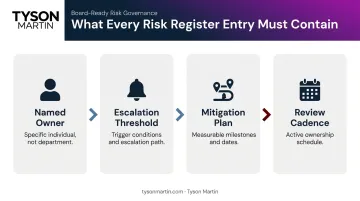
The risk register is the operational instrument of ownership. When it lists departments instead of individuals, accountability disappears at the exact moment you need it.
Connecting Ownership to Risk Appetite
The board-approved risk appetite defines the boundaries within which risk owners operate. Without that connection, ownership is nominal — owners don't know when to escalate or what decisions they're authorized to make independently.
Tying the two together means:
- The appetite statement defines what "unacceptable" looks like (maximum downtime, data loss thresholds, regulatory exposure)
- Each risk owner knows the escalation trigger tied to those thresholds
- Escalation requirements specify who gets notified, in what timeframe, and with what information
When these elements are documented before pressure hits, decisions move faster. When they're not, incidents become improvised, and that's where governance fails publicly.
Testing Whether Ownership Is Real
Documents don't make ownership real. Tested behavior does. Simulate an incident or escalation scenario and observe:
- Does the right person step forward?
- Is the escalation chain followed?
- Is decision authority clear?
If ownership only holds in normal conditions but dissolves under pressure, governance has been documented, not built.
That gap is exactly what tabletop exercises are built to expose. Tyson Martin's 60-minute executive sessions walk teams through simulated crises, force real decisions, and surface the gaps in authority and coordination that only appear when the scenario gets complicated.
Common Risk Governance Failures That Leave Boards Exposed
Most governance failures aren't dramatic. They're structural — and they've been there long before the incident that exposes them.
The Three Most Common Structural Failures
Ambiguous decision rights. No documented authority for who can accept, transfer, or escalate a specific risk. When security conflicts with speed and nobody can say "yes," "no," or "not yet," programs stall. Exceptions pile up. Accountability blurs.
Ownership assigned to committees. Committees deliberate; they don't own. When the answer to "who is accountable for this risk?" is "the risk committee" or "we all share it," nobody acts when it matters. Named individual ownership is the only ownership that functions during an incident.
Governance designed to satisfy audit, not to function. Organizations pass audits while remaining one click away from a bad day. Policies exist, charters are in place, committees meet — but none of it has ever been tested in a realistic scenario.
The Risk Noise Problem
Boards receiving voluminous reports with hundreds of indicators and no clear signal face a specific governance failure: they can't make decisions because they can't find the decision. This isn't a board problem — it's a reporting design problem.
Effective governance defines what the board needs to know, not everything risk management knows. That means cutting vanity metrics in favor of measures tied to actual business exposure:
- Out: patch totals, blocked attack counts, alert volume
- In: unresolved control gaps on critical systems, time to contain high-impact incidents, overdue fixes tied to regulated data
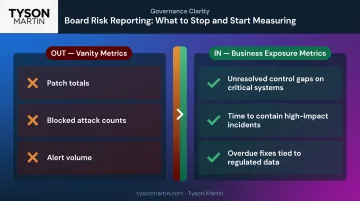
That shift converts risk reporting into genuine oversight.
The Gap Between Policy and Practice
Many organizations have documented governance structures that have never been tested in a real scenario. The gap between what the policy says and what people actually do under pressure is only visible through exercises — incident simulations, escalation drills, board-level tabletops.
Governance maturity requires that testing. A risk charter nobody has read under pressure is a filing artifact — and an untested escalation path is just a diagram. Organizations that exercise their governance structures, adjust based on what breaks, and repeat that cycle are the ones where oversight holds when it counts.
Frequently Asked Questions
Frequently Asked Questions
Why is risk governance important?
Risk governance connects risk decisions to strategy, creates accountability, and ensures the board has the oversight it needs to protect the organization. Without it, risk management is uncoordinated, escalation paths are unclear, and boards can't distinguish between busy work and actual risk reduction.
Why is risk ownership important?
Named ownership prevents accountability gaps and ensures a specific person has both the responsibility and authority to act on a risk. Vague or collective ownership — "IT handles it" — means no one acts when it matters.
What is the difference between risk governance and risk management?
Governance sets the authority structure, policies, and accountability framework. Risk management executes within it. Governance must come first; management without governance lacks direction, escalation paths, and board-level visibility into what actually needs a decision.
What are the Three Lines of Defense in risk governance?
The first line (business operations) owns and manages risk daily. The second line (risk and compliance) provides oversight, sets policy, and challenges first-line owners. The third line (internal audit) delivers independent assurance — separate from, and accountable to, the board.
What should the board's role be in risk governance?
The board approves risk appetite, receives clear and consolidated risk reporting, holds management accountable for governance execution, and acts on escalated risk issues. It does not manage risk — but it provides the oversight that makes management accountable for managing it well.
How do you assign risk ownership effectively?
Name a specific individual — not a team — document their authority to act, set the escalation threshold for board or committee involvement, and test ownership through scenario exercises. If the owner can't be identified in 30 seconds, the structure has a gap.