Introduction
A vendor suffers a breach. Regulators call. The board asks: "Did we know about this risk?" And no one has a clean answer.
That moment isn't just a risk management failure — it's a governance failure. The assessments may have existed. The questionnaires may have been sent. But without a governance layer defining who owns decisions, who monitors thresholds, and who escalates to the board, the process produces data without accountability.
According to KPMG's 2024 board oversight research, 75% of companies experienced a major business disruption caused by a third party in the last three years. Yet many organizations still conflate having a vendor assessment process with having actual governance.
This guide covers four areas: the distinction between governance and management, the core risk categories every program must address, what a governance framework looks like structurally, and the steps boards and executives need to build one that holds up under scrutiny.
TLDR:
- Third-party risk governance is the structural layer above TPRM — it defines who decides, who escalates, and who reports to the board
- Four categories demand governance attention: cybersecurity, operational/concentration, compliance, and reputational risk
- A governance framework needs ownership, tiering criteria, escalation thresholds, and board-ready reporting
- Most organizations have TPRM processes in place — few have the governance layer that makes those processes accountable
- Technology supports governance — it doesn't substitute for defined ownership and decision rights
What Is Third-Party Risk Governance — And How Is It Different from TPRM?
Third-party risk governance is the set of policies, structures, decision rights, and oversight mechanisms an organization uses to ensure third-party risks are identified, managed, and reported at the appropriate levels — including the board.
Third-party risk management (TPRM) is the operational process: vendor assessments, due diligence questionnaires, periodic monitoring. Governance is the layer above it that answers the harder questions:
- Who owns the TPRM process?
- What standards apply across business units?
- At what risk level does a finding require management action versus board awareness?
- Who makes the call when a critical vendor fails an assessment?
Why Governance Breaks Down
Organizations build TPRM processes and assume governance comes with them. It rarely does. The result is a familiar pattern:
- Unclear ownership across procurement, IT, legal, and business units
- Inconsistent standards applied to similar vendors in different divisions
- Risk information that reaches the right desk only after something goes wrong
Regulators have noticed — and they're holding boards directly accountable. Key frameworks now name specific owners:
- OCC Bulletin 2023-17 assigns the board ultimate responsibility for third-party risk oversight and holds senior management accountable for execution
- NIST CSF 2.0 requires that supply chain risk management processes be identified, established, monitored, and improved by named stakeholders
- DORA Article 5 requires financial entities to designate a senior management member specifically responsible for overseeing ICT third-party risk exposure
The consequences of gaps are concrete. In 2024, the Federal Reserve and Arkansas State Bank Department ordered Evolve Bank & Trust to strengthen board oversight of its fintech partner relationships after exam findings on risk management and compliance.
The distinction matters: TPRM tells you what the risks are. Governance determines who acts on them, at what threshold, and who answers for the outcome.
The 4 Core Third-Party Risks Every Governance Program Must Address
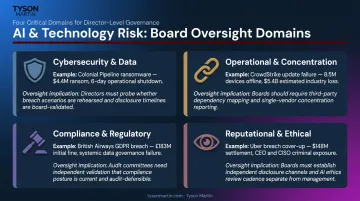
Most programs underperform for the same reason: they treat cybersecurity as the only risk worth governing. A mature program defines risk appetite and oversight mechanisms across all four domains.
| Risk Domain | Representative Failure | Board Oversight Implication |
|---|---|---|
| Cybersecurity & Data | MOVEit exploitation (600+ breaches) | Vendor access controls, breach notification |
| Operational & Concentration | CrowdStrike update (8.5M devices, $380M Delta impact) | Vendor concentration limits, continuity plans |
| Compliance & Regulatory | SAP FCPA settlement ($220M+) | Accountability flows upstream to the contracting org |
| Reputational & Ethical | VW supply chain forced-labor violation | Board must show it acted on available information |
Cybersecurity and Data Risk
This covers risks from a third party's access to systems, networks, or sensitive data — breaches, ransomware propagating through vendor infrastructure, unauthorized data access.
The Verizon 2024 Data Breach Investigations Report found that 15% of breaches involved a third party — a 68% increase year-over-year. The 2023 MOVEit exploitation by CL0P is the clearest recent illustration: a single vulnerability in a widely-used file transfer tool spawned approximately 600 breaches across organizations that had no direct exposure to the original vulnerability.
This is the category regulators scrutinize most heavily and the one that most frequently triggers board-level questions.
Operational and Concentration Risk
Operational risk arises when a third party fails to deliver — due to financial instability, geographic disruption, or simple outage. Concentration risk is the more specific problem: when too many critical functions depend on a single vendor, one failure cascades everywhere.
The July 2024 CrowdStrike faulty update affected 8.5 million Windows devices globally. Delta Air Lines alone reported approximately 7,000 canceled flights over five days, with direct revenue impact of $380 million. A single vendor update halted a major airline's operations for nearly a week. That is concentration risk in practice.
Gartner research from 2023 found 62% of risk executives identified cloud concentration risk as a significant concern, and third-party viability was the top emerging risk for the second consecutive quarter.
Compliance and Regulatory Risk
This category covers the regulatory exposure that flows from a third party's practices — GDPR violations, HIPAA non-compliance, FCPA concerns, DORA requirements for financial services.
The critical point: regulatory accountability flows upstream. Under GDPR Article 82, each controller or processor involved in a processing failure may be held liable for the entire damage. The organization remains on the hook even when the third party is at fault.
FCPA enforcement illustrates the stakes. In 2024, SAP paid over $220 million to resolve foreign bribery investigations, with DOJ remediation measures requiring elimination of SAP's third-party sales commission model globally.
Reputational and Ethical Risk
This covers third-party conduct that reflects on the contracting organization — labor practices, environmental violations, fraud, or public controversy. In 2024, thousands of Volkswagen Group vehicles were held at U.S. ports because a Chinese subcomponent was found to violate anti-forced-labor laws — a reputational and operational problem that originated several tiers deep in the supply chain.
Boards are increasingly accountable for ESG-related third-party exposure. When a vendor scandal surfaces, the question isn't just what it cost — it's whether the board knew the risk existed and what it did about it.
What a Third-Party Risk Governance Framework Includes
A governance framework converts a TPRM process into a governed program. It defines the "what, who, and how" of third-party risk oversight — not just what questionnaires to send.
Governance Structure and Ownership
The framework starts with a named primary owner — commonly the CISO, CRO, or a dedicated TPRM function — and a cross-functional working group with defined roles for procurement, legal, IT, and business units.
A RACI model (Responsible, Accountable, Consulted, Informed) is a practical tool for mapping ownership across functions. The goal is eliminating the condition where everyone assumes someone else owns the risk decision.
Risk Appetite and Vendor Tiering
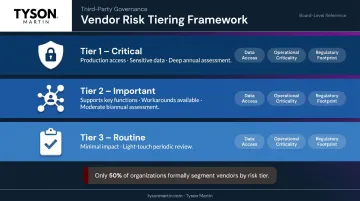
The framework must translate risk appetite into concrete tiering criteria. A standard three-tier model:
| Tier | Risk Level | Typical Profile | Assessment Depth |
|---|---|---|---|
| Tier 1 | Critical | Production access, sensitive data, revenue-critical | Deep, annual minimum |
| Tier 2 | Important | Supports important functions, workarounds available | Moderate, biannual |
| Tier 3 | Routine | Minimal business impact | Light-touch, periodic |
Tiering decisions factor in: data access type, operational criticality, fourth-party exposure, financial stability, and regulatory footprint.
The gap here is significant. Deloitte's 2023 TPRM survey found only 50% of organizations formally segment their third-party population by risk — and 32% don't segment at all.
Escalation Thresholds and Decision Rights
Escalation thresholds are the most commonly missing element in programs that have solid assessments but weak governance. Without them, every vendor finding becomes a real-time debate — teams either escalate everything or nothing.
Well-designed escalation criteria map specific triggers to defined response owners and timelines:
- Vendor breach confirmed → designated incident owner notified within X hours, board committee notified within Y
- SLA failure above threshold → business owner and TPRM lead convene within Z days
- Financial distress signal → concentration risk review triggered immediately
- Assessment failure at Tier 1 vendor → escalated to CISO/CRO with remediation plan required before next renewal
When these thresholds are defined before an incident, response teams make decisions faster — authority is already settled.
Reporting and Board Visibility
Board-ready third-party risk reporting is not a vendor catalog. It should include:
- Trend data across multiple quarters, not point-in-time scores
- Concentration risk summary — which vendors are single points of failure and what the fallback plan is
- Top vendor risks by tier with owner and remediation status
- What changed since the last reporting period
Management-level and board-level reporting serve different purposes. Management gets operational detail; the board gets risk posture, trends, and decisions required.
Reports that look comprehensive but don't enable defensible decisions are a form of information theater. Experienced regulators and auditors recognize the difference quickly.
Policy and Contractual Standards
Governance without contractual enforcement is a gap regulators will flag. The framework must be codified in a TPRM policy and reflected in vendor contracts, including:
- Right-to-audit clauses
- Data protection agreements
- Incident notification timelines and requirements
- SLA standards with defined consequences
- Fourth-party/subprocessor change notification provisions
OCC 2023-17 identifies these contract elements explicitly as components of third-party risk management. GDPR Article 28 requires processor contracts to include subprocessor authorization, audit support, and breach notification obligations to the controller.
Who Owns Third-Party Risk Governance?
Ownership varies by organization size, industry, and maturity — but the answer is never "everyone." Ambiguous ownership is functionally the same as no ownership.
Common Functional Owners
- CISO — common when cybersecurity risk is the dominant concern
- CRO — common in financial services with mature enterprise risk functions
- General Counsel — common when compliance and contractual risk drive the program
- Dedicated TPRM function — found in high-volume regulated environments
Deloitte's 2023 survey found 48% of organizations acknowledged a need to strengthen executive leadership in managing and governing third-party relationships. That gap exists even in organizations with established TPRM processes.
The Board's Specific Role
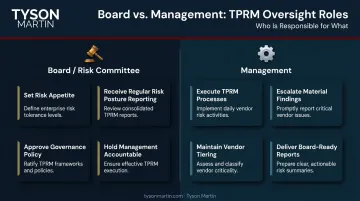
The board — or its audit/risk committee — doesn't manage TPRM day-to-day. Its oversight responsibilities are distinct:
- Set and periodically review risk appetite for third-party relationships
- Receive regular reporting on risk posture and material changes
- Approve the governance policy
- Hold management accountable for execution
Meaningful board oversight means asking specific questions: Which Tier 1 vendors have open critical findings? What is the concentration risk across our cloud providers? Have escalation thresholds been tested? Passive acknowledgment of a quarterly report is not oversight.
When There's No Clear Internal Owner
Organizations in leadership transitions, rapid growth, or regulatory scrutiny frequently face a governance ownership gap — no clear internal owner with both the authority and expertise to build or mature the program. Tyson Martin works with boards and executive teams in exactly these situations — establishing decision rights, building inspection-ready reporting, and delivering a 90-day governance plan with named owners, without waiting on a permanent hire to get started.
Building Your Third-Party Risk Governance Program
Seven Foundational Steps
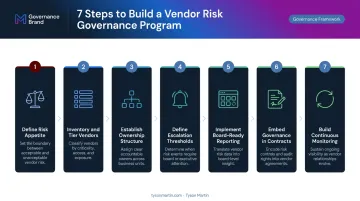
- Define and document risk appetite for third-party relationships — what level of exposure is acceptable by category?
- Inventory and tier the vendor population by criticality — keep the critical tier to 10–30 vendors, not a catalog of 120
- Establish ownership and a governance structure with clearly assigned roles across procurement, legal, IT, and business units
- Define escalation thresholds and decision rights in writing — who accepts risk, who approves exceptions, who escalates to the board and when
- Implement a reporting cadence with board-ready dashboards — quarterly board views, monthly executive views, event-driven updates for material changes
- Embed governance requirements into vendor contracts and procurement workflows — right-to-audit, breach notification, subprocessor disclosure
- Build continuous monitoring into the program — not just periodic point-in-time assessments
Governance Before Technology
Organizations frequently implement TPRM software before establishing governance structures. The tool amplifies the program — but without defined ownership, tiering criteria, and escalation paths, automation accelerates an ungoverned process.
KPMG's 2025 TPRM report found 77% of businesses struggle to maintain a fit-for-purpose TPRM operating model — which means the majority of organizations with TPRM tools still lack the governance layer those tools require to produce defensible decisions.
Platforms work best when organizations already have clarity on what matters most and who owns decisions. Get the governance structure right first — then the technology has something useful to automate.
Accelerating When Time Is Short
Organizations undergoing leadership transitions, M&A activity, regulatory examination, or post-incident reviews often need to compress the governance build-out timeline. An interim or fractional executive with a specific mandate to establish decision rights, inspection-ready reporting, and a 90-day governance plan with named owners can deliver that structure without the delay of a permanent hire.
A compressed build typically runs on two milestones:
- Day 30: A single usable vendor inventory with tier assignments, baseline controls and evidence requirements by tier, and a preliminary contract gap analysis
- Day 60: Escalation thresholds defined and a board-ready dashboard operational
Frequently Asked Questions
What is the third-party risk governance framework?
A third-party risk governance framework is the set of policies, structures, roles, and oversight mechanisms that define how an organization manages and reports on third-party risks. It specifies who owns decisions, what thresholds trigger escalation, and how the board receives assurance that risks are actually being managed — not just assessed.
What are the four core third-party risks?
The four core categories are cybersecurity/data risk, operational and concentration risk, compliance and regulatory risk, and reputational/ethical risk. A mature governance program defines risk appetite and oversight mechanisms for each — not just the cybersecurity dimension.
How does third-party risk governance differ from third-party risk management?
TPRM is the operational process of assessing and monitoring vendors. Governance is the structural layer that defines who owns that process, how risks are escalated, and how leadership is held accountable for outcomes. Without governance, TPRM has no defensible structure when a regulator or board demands accountability after an incident.
Who should own third-party risk governance in an organization?
Ownership varies but typically sits with the CISO, CRO, or General Counsel, with the board or audit committee holding oversight responsibility. The key is that ownership is explicitly assigned — not assumed — and documented in a formal governance structure.
How often should a board review third-party risk governance?
Most frameworks call for annual board-level review of policy and risk appetite, with quarterly operational reporting on risk posture. More frequent updates are warranted after a significant vendor incident, a new critical vendor relationship, or a material shift in concentration risk.