

Introduction
Most enterprises have a risk appetite statement somewhere. It lives in a governance binder, gets referenced in the annual ERM report, and satisfies a compliance checkbox. Then a real decision lands — a major acquisition, a cloud migration, a regulatory inquiry — and nobody pulls it out.
That gap between documented and functional risk appetite is where ERM programs lose credibility. According to the 2025 State of Risk Oversight report from the NC State ERM Initiative, only 23% of organizations formally discuss risk management information when the board discusses the strategic plan — and just 11% say their ERM processes provide a genuine strategic advantage.
Those numbers point to a structural problem, not a documentation problem.
COSO's 2020 guidance, Risk Appetite — Critical to Success, addresses this directly. It gives boards and executive teams a framework for making risk appetite operational — connected to strategy, embedded in governance, and visible at the moment decisions get made. This article breaks down what that looks like in practice.
Key Takeaways
- COSO defines risk appetite as the types and amount of risk an organization will accept in pursuit of value — an enterprise-wide standard, not a departmental one.
- Risk appetite (strategic, enterprise-level) and risk tolerance (operational, measurable) are different things — conflating them creates governance blind spots.
- Outside financial services, only about one-quarter of organizations have formally articulated their risk appetite.
- Effective appetite statements pair qualitative philosophy with quantitative thresholds and escalation triggers.
- Cyber risk needs its own appetite sub-statement that drives investment decisions — not the other way around.
What Is Risk Appetite? The COSO Definition and Why It's Intentionally Broad
COSO defines risk appetite as "the types and amount of risk, on a broad level, an organization is willing to accept in pursuit of value."
The phrase "on a broad level" is intentional. Risk appetite has to work across strategic planning, day-to-day operations, compliance obligations, and emerging threats simultaneously. It cannot be scoped to a single business unit or risk category without losing its governance function.
A definition narrow enough to cover only financial exposure — or only cyber risk — breaks down the moment a cross-cutting decision reaches the boardroom.
This is why COSO frames risk appetite as a leadership responsibility rather than a compliance artifact. The COSO guidance positions it as a critical link between forming strategy and realizing performance: the choice of strategies and objectives requires an understanding of the appetite for risk. That is a board-level conversation, not a risk management deliverable.
A few things risk appetite is not worth clarifying upfront:
- Appetite reflects the organization's mission, values, and strategic ambitions at a point in time — it changes as those things change, so treat it as a living position, not a fixed number.
- Banking regulators drove early adoption, but every enterprise — healthcare, retail, technology, manufacturing — carries strategic, operational, reputational, and cyber exposures that require the same disciplined framing.
- Risk appetite is not a standalone GRC exercise. It belongs inside strategy-setting and performance management, not appended after strategy is already set.
Organizations that treat it as a compliance deliverable end up with a statement that satisfies an auditor but never guides a decision. The resulting document checks a box while leadership makes consequential risk decisions without a common reference point.
Risk Appetite vs. Risk Tolerance: A Distinction That Changes How Boards Govern
These two terms are often used interchangeably. That's a governance mistake with predictable consequences.
Risk appetite is set at the enterprise level. It reflects how much uncertainty the organization will accept in pursuit of its strategy. It guides direction.
Risk tolerance defines the acceptable variation around a specific objective. It's narrower, more measurable, and operationally applied. It triggers escalation when crossed.
A concrete example: a company might maintain a moderate appetite for strategic acquisitions, accepting uncertainty about integration costs and market reception in exchange for growth potential. That same company might hold zero tolerance for a data breach that triggers regulatory penalties, meaning any exposure in that category requires immediate escalation regardless of probability.
Why the Distinction Matters for Boards
When boards conflate the two, governance breaks down in predictable ways:
- Management escalates tactical variances that should stay at the operational level, flooding the board with noise
- Genuinely strategic threats don't reach the board because they weren't recognized as appetite-level issues
- Audit committee agendas fill up with monitoring detail rather than strategic direction
Well-functioning boards use risk appetite to shape strategic direction and delegate tolerance-level monitoring to management with defined escalation triggers. The board sets the appetite; management manages within it and escalates when tolerances are breached.
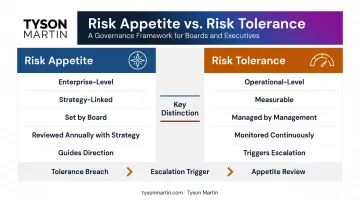
Cadence is the other dimension that separates these two concepts. Risk appetite is reviewed with strategy — annually, or when the business shifts materially. Risk tolerances require continuous monitoring. That difference in rhythm should be built directly into how audit committee agendas are structured and how often board reporting cycles surface each type of information.
The Six COSO Principles Every Board Should Know
COSO's guidance organizes risk appetite governance around six principles. Taken together, they address both the conceptual and operational failures that keep risk appetite statements from doing useful work.
Principle 1 — Risk appetite is not a separate framework. It must be woven into strategy-setting, objective-setting, and performance management. Organizations that treat it as a standalone GRC exercise produce statements that sit in a binder and never influence a real decision.
Principle 2 — Risk appetite and risk tolerance are different. COSO calls this out explicitly because many organizations collapse the two and lose governance clarity at the board level. The distinction isn't semantic — it determines what gets reported where and who owns the response.
Principle 3 — Risk appetite applies beyond financial services. Banking regulators drove widespread adoption, but the need is universal. The NC State ERM Initiative's 2025 report found that except for financial services organizations, only about one-quarter of organizations have formally articulated their appetite for taking risks. Healthcare systems, retailers, and technology companies carry substantial cyber, reputational, and strategic exposure — yet most still lack the disciplined framing banks have been required to apply for years.
Principle 4 — Risk appetite is at the heart of decision-making. A well-defined appetite doesn't just describe acceptable risk — it tells leaders when a decision is even necessary. When a proposed action falls clearly within appetite, it can be delegated. When it approaches or exceeds appetite, it escalates to the board.
This is how decision rights get clarified: not through org charts, but through appetite thresholds.
Principles 5 and 6 — Risk appetite is more than a metric, and it increases transparency. The most valuable application is forward-looking: tying appetite to strategy for future decisions rather than treating it as a backward-looking compliance review.
Transparency is the governance payoff. A well-communicated appetite statement lets stakeholders, auditors, and regulators see what risks the organization knowingly accepted — and why. Under SEC cybersecurity disclosure rules, that level of documented intentionality is increasingly expected.
Key Components of an Effective Risk Appetite Statement
A risk appetite statement that actually works needs more than aspirational language. It requires structure.
Core Structural Elements
Any effective statement should include:
- Coverage across strategic, operational, financial, compliance, reputational, and cyber risk — at minimum
- Qualitative language that describes the organization's philosophy and cultural stance toward risk in each category
- Quantitative thresholds — maximum acceptable downtime, loss limits, fraud exposure per period, or compliance variance ranges
- Escalation triggers that specify when a risk moves from management monitoring to board-level review
- Named ownership for each category, including who monitors it and who keeps the statement current
Neither element works without the other. Qualitative language sets direction; quantitative thresholds make that direction actionable when decisions need to be made under pressure.
What a Well-Formed Statement Covers
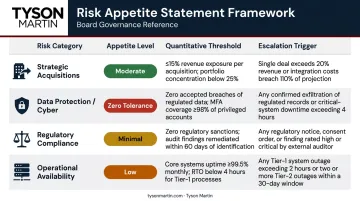
Effective statements specify both where the organization will accept uncertainty and where it will not. A working reference structure looks like this:
| Risk Category | Appetite Level | Quantitative Threshold | Escalation Trigger |
|---|---|---|---|
| Strategic acquisitions | Moderate | Integration cost variance ≤15% | >15% variance or regulatory flag |
| Data protection / cyber | Zero tolerance | Zero unauthorized access events | Any confirmed unauthorized access |
| Regulatory compliance | Minimal | Zero material violations | Any regulatory inquiry or finding |
| Operational availability | Low | <4 hours unplanned downtime/month | Any breach of SLA |
Governance Accountability
The statement must define who owns each risk category, what monitoring mechanisms are in place, and what triggers board-level review. Without that governance accountability embedded in the document itself, it stays an aspiration.
Assign a specific owner responsible for keeping it current. Appetite that isn't reviewed drifts — and a statement that no longer reflects strategy offers false confidence at exactly the moment it matters most.
Making Risk Appetite Operational at the Board Level
Documentation is the easy part. The hard part is getting risk appetite into the actual decisions that boards and executives make every week.
Closing the Paper-to-Practice Gap
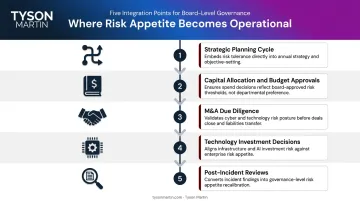
Only 30% of organizations integrate risk exposure into capital allocation decisions, according to the NC State 2025 report. That means most boards approve budgets without systematically asking whether the implied risk posture aligns with stated appetite. The integration points that matter most:
- Strategic planning cycle
- Capital allocation and budget approvals
- M&A due diligence
- Technology investment decisions
- Post-incident reviews
Risk appetite doesn't become operational through annual ERM reports. It becomes operational when it shows up in those conversations with defined thresholds that shape the outcome.
Structuring Board Oversight Around Appetite
Appetite thresholds should determine what gets reported at the board level versus what stays with management. This creates a stable reporting cadence: the board sees trend-level risk posture relative to appetite, not a flood of operational detail that buries strategic signals.
Key Risk Indicators (KRIs) are the mechanism that makes this visible. A well-designed board dashboard shows whether current exposure is within, approaching, or exceeding appetite thresholds — with trend data. A board that sees threshold status and trend data can make decisions. A board that receives reports can only acknowledge them.
Cyber Risk Appetite Deserves Its Own Sub-Statement
Cyber is where many boards lack confidence, and where the gap between stated appetite and actual governance is widest. NIST Cybersecurity Framework 2.0 requires that risk appetite and tolerance statements be established, communicated, and maintained (Govern outcome GV.RM-02). NACD's board-level cybersecurity guidance goes further, calling for cyber risk appetite to be expressed quantitatively, in financial terms where possible.
A cyber risk appetite sub-statement should address:
- Data protection thresholds: what exposure is acceptable and what triggers breach notification
- System availability limits: maximum downtime by system criticality tier
- Vendor exposure: which third parties require active review and at what frequency
- Security investment boundaries: the uncertainty threshold that justifies committing additional resources
The key point: the cyber appetite statement should drive security investment decisions. When organizations let security investment determine appetite rather than the other way around, they've inverted the governance structure.
Boards working through leadership transitions, M&A activity, or regulatory scrutiny often need this infrastructure built quickly and built to hold. Tyson Martin works with boards and executive teams on exactly this: drafting the risk appetite statement, building the escalation ladder, and establishing the governance cadence that keeps both current.
Common Pitfalls That Undermine Risk Appetite Programs
Most risk appetite programs fail in predictable ways. Three patterns account for the majority of breakdowns.
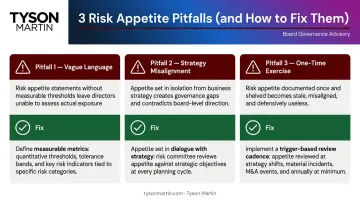
Pitfall 1 — Vague language that nobody can act on. Terms like "moderate" or "low" are common in appetite statements and nearly useless without definition. Without measurable anchors, "moderate appetite" means something different to every person in the room. Replace vague descriptors with concrete metrics:
- Hours of acceptable downtime
- Dollar loss limits per incident
- Compliance variance ranges
- Incident count thresholds
The NACD's cyber risk oversight guidance is direct on this: appetite should be defined as clearly, objectively, and measurably as possible.
Pitfall 2 — Misalignment between appetite and actual strategy. When the board approves a growth strategy that implicitly requires higher risk tolerance than the stated appetite allows, the ERM program loses credibility fast. People notice when the official appetite and the actual decisions don't match.
Appetite must be set in dialogue with strategy — not layered on top after strategic decisions are already locked in. This is why COSO ties appetite directly to strategy-setting rather than treating it as an after-the-fact governance requirement.
Pitfall 3 — Treating risk appetite as a one-time exercise. The risk landscape — regulatory requirements, cyber threats, competitive dynamics — changes faster than annual review cycles. An appetite statement that made sense eighteen months ago may not account for a new regulatory environment, a material acquisition, or an emerging threat category.
Governance ownership of the review must be explicitly assigned, with defined triggers supplementing the scheduled annual review: major strategic change, a significant risk event, or a new regulatory development.
Frequently Asked Questions
How does COSO define risk appetite?
COSO defines risk appetite as "the types and amount of risk, on a broad level, an organization is willing to accept in pursuit of value." The definition is intentionally broad to apply enterprise-wide — across strategic, operational, financial, compliance, and cyber risk domains — rather than to a single business unit or risk category.
What is the difference between risk appetite and risk tolerance?
Risk appetite is the enterprise-level, strategy-linked statement of how much uncertainty the organization will accept. Risk tolerance sets specific operational limits within each risk category — when a tolerance threshold is crossed, it triggers escalation. Appetite guides strategic direction; tolerance monitors execution against it.
Who is responsible for setting risk appetite in an organization?
Risk appetite is typically defined by senior leadership — the CEO, CRO, and CISO — and formally approved by the board of directors. Input from key business leaders ensures the statement reflects both governance expectations and operational realities. Approval sits with the board. Day-to-day monitoring and escalation are management's responsibility.
What makes a risk appetite statement actually usable?
Usable statements combine qualitative language (describing the organization's philosophy toward risk) with quantitative measures (specific thresholds and escalation triggers). They're integrated into planning and reporting processes, not stored separately, and assign clear ownership for monitoring and annual review.
How does risk appetite apply to cyber and technology risk?
Organizations should maintain a distinct cyber risk appetite sub-statement that defines acceptable exposure for data protection, system availability, and how much reliance the organization places on third parties. That statement should drive security investment decisions — defining what the organization will and won't accept before determining how much to spend, not the reverse.
How often should a risk appetite statement be reviewed?
Most organizations review appetite at least annually alongside strategic planning. Effective governance also includes trigger-based reviews when major strategic changes, significant risk events, regulatory shifts, or M&A activity occur. Both the cadence and the named owner of that review belong in the statement — not in a separate policy document that rarely gets read.