
Introduction: Why Risk Appetite Without KRIs Is Just a Policy Document
Most boards have a risk appetite statement. The problem: it lives in a governance document reviewed once a year, not the decisions made every week.
According to Gartner, 42% of organizations still don't have a formal risk appetite statement at all. For those that do, the gap between what the document says and how decisions actually get made is often wider than leadership realizes.
The pattern repeats: escalations surprise the board. Thresholds exist on paper but no one references them between audits. Risk acceptance happens by default because no one defined who gets to accept what — and the fastest team wins, not the most defensible one.
This guide covers:
- The definitions that actually matter (and the ones that get misused)
- The five levels of risk appetite and what each one requires operationally
- How Key Risk Indicators translate appetite into measurable, real-time signals
- What separates a framework that holds up in real incidents from one that only passes audits
Written for board members, audit and risk committee chairs, CISOs, CEOs, and executives responsible for making defensible risk decisions.
Key Takeaways
- Risk appetite = what you choose to accept; risk capacity = the ceiling you cannot breach and survive; risk tolerance = the operational band in between, where KRIs live
- The five appetite levels (Averse → Minimal → Cautious → Open → Eager) should be assigned per risk category, not applied enterprise-wide
- Effective KRIs are forward-looking, threshold-linked, and trigger a defined action — not just a notification
- The board sets appetite → management sets tolerance thresholds → teams select KRIs → results feed board reporting with clear status signals
- Without defined escalation triggers, KRI dashboards become history lessons rather than governance tools
Understanding Risk Appetite: Definitions and Key Distinctions
Three terms get used interchangeably in most risk conversations. They shouldn't. Each serves a different decision-maker and operates at a different level of the organization. Here's how each one works.
Risk Appetite
NIST defines risk appetite as "the types and amount of risk, on a broad level, an organization is willing to accept in its pursuit of value." The Institute of Risk Management (IRM) puts it similarly: the amount and type of risk an organization is willing to take to meet its strategic objectives.
The key word is willing. Appetite is a choice. It's the boundary the board approves that guides decision-making across the enterprise — not a number, but a declared position on how much uncertainty is acceptable in pursuit of strategy.
In practice, appetite should be expressed in plain business terms. Not "we have moderate appetite for cyber risk" but "our customer portal must be restored within 6 hours of a major outage" or "we will not accept incidents affecting regulated customer data without immediate board notification."
Risk Tolerance
Tolerance is the acceptable variation around the stated appetite — the operational band within which the business can flex before triggering review or escalation. NIST defines it as the degree of uncertainty acceptable to an organization.
This is where KRI thresholds live. When tolerance is breached, something has to happen: a review, an escalation, a documented exception.
Risk Capacity
Capacity is the hard ceiling. The Financial Stability Board defines it as the maximum level of risk an institution can assume given current resources before breaching constraints imposed by capital, regulatory requirements, or operational capabilities.
The distinction matters most under pressure:
- Appetite = what you choose to accept
- Tolerance = how much deviation you can absorb before acting
- Capacity = what you can survive before the business is threatened
Putting the Three Together
A single cybersecurity example shows how these layers work:
| Layer | Owner | Example Statement |
|---|---|---|
| Appetite | Board | "Low appetite for incidents affecting customer data" |
| Tolerance | Management | "Critical patches applied within 7 days; escalate if below 95% coverage" |
| Capacity | Compliance/Legal | "A breach exceeding X records triggers regulatory filing and exceeds our risk ceiling" |
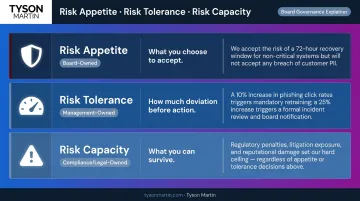
Without all three defined, risk acceptance happens by default rather than by decision. In practice, IT, security, legal, and business leaders each assume someone else has made the call — until an incident surfaces the gap and it's too late to close it cleanly.
The 5 Levels of Risk Appetite Explained
Most risk frameworks recognize a spectrum of appetite levels that allow boards to assign different positions to different risk categories rather than adopting a single enterprise-wide stance. HM Treasury's 2021 Risk Appetite Guidance Note — one of the more authoritative published taxonomies — defines five levels:
| Level | Description | Typical Application |
|---|---|---|
| Averse | Near-zero tolerance; will not accept this risk | Regulatory violations, safety-critical failures |
| Minimal | Will only accept risk where unavoidable | Data privacy, financial reporting accuracy |
| Cautious | Prefer low-risk options; will accept limited risk with strong controls | Third-party vendor risk, operational change |
| Open | Willing to take measured risks for proportionate reward | Technology modernization, market expansion |
| Eager | Actively seeks higher risk for maximum return | Strategic innovation, new market entry |
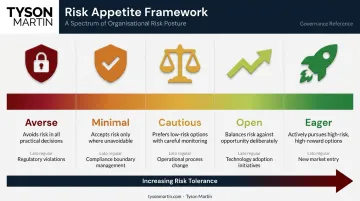
Note: IRM practice materials use "Hungry" rather than "Eager" for the fifth level. Both appear in professional usage — HM Treasury's term is the more formally documented of the two.
Why Differentiated Appetite Matters
A single organization might reasonably hold all five positions simultaneously:
- Averse for regulatory non-compliance
- Minimal for customer data confidentiality
- Cautious for third-party vendor exposure
- Open for technology investment
- Eager for new product development
That range is what makes an appetite statement actionable. A single enterprise-wide position — "we have moderate risk appetite" — gives a management team no guidance when deciding whether to delay a critical patch, onboard a new vendor, or move forward with an AI deployment.
When the board has approved differentiated appetite levels by risk category, every escalation and exception decision has a reference point. Without it, management fills the gap with assumptions — and assumption-driven decisions are how boards end up surprised by incidents they thought were being managed.
Key Risk Indicators: What They Are and Why They Matter
KRIs vs. KPIs vs. Lagging Indicators
ISACA defines KRIs as metrics capable of showing that the enterprise is, or has a high probability of being, subject to a risk that exceeds defined risk appetite. They are early-warning signals — the dashboard warning light, not the crash report.
KPIs and KRIs answer different questions:
- KPIs ask: "Are we hitting our targets?" — they measure performance against business goals
- KRIs ask: "Are we taking the right amount of risk?" — they measure proximity to appetite boundaries
That distinction also applies within the KRI program itself. Lagging indicators confirm what happened; leading indicators warn before it does. A complete KRI program needs both:
- Leading indicators: Early warning signals that risk exposure is moving — for example, percentage of unpatched critical vulnerabilities, number of failed third-party audits, volume of privileged account exceptions
- Lagging indicators: Confirmation signals that show realized exposure — number of incidents exceeding defined severity levels, time-to-contain breaches, compliance findings past remediation date
The Four Characteristics of an Effective KRI
A metric earns a place in a board-level risk report only if it meets four criteria:
- Measurable — can be tracked consistently with clear definitions
- Timely — available before the risk materializes, not after
- Linked to a specific risk boundary — connected to a defined appetite statement
- Threshold-triggered — a specific action or escalation is required when the threshold is crossed
That fourth criterion is the dividing line. A metric that produces awareness but no decision is operational reporting, not governance.
A Concrete Cyber Risk KRI Example
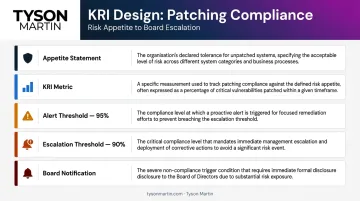
Patching compliance illustrates how a well-designed KRI works in practice. CISA's Binding Operational Directive 22-01 establishes that 42% of exploited CVEs are used on day zero, and 75% within 28 days — which sets the context for why patching windows are a meaningful board-level concern.
| KRI Component | Definition |
|---|---|
| Appetite statement | Low appetite for disruption of critical business systems |
| KRI metric | Percentage of critical assets with current patching compliance |
| Alert threshold | Below 95% coverage triggers management review |
| Escalation threshold | Below 90% coverage triggers CISO remediation plan within 48 hours |
| Board notification | If not resolved within defined SLA, board notification required with documented response |
The Volume vs. Signal Problem
The most common failure in KRI programs is confusing quantity of metrics with quality of signal. Dashboards fill up with green indicators while actual exposure climbs. Management teams report activity — patches attempted, trainings completed, alerts reviewed — without reporting whether those activities are keeping the organization inside its appetite boundaries.
The fix isn't more metrics — it's fewer, better ones. Effective board-level KRI programs use a stable set of indicators that show trend, not trivia. If a metric can't answer "in appetite or out of appetite," it belongs in an operational dashboard, not a board risk report. That's the filter Tyson Martin applies when helping boards distinguish signal from noise in their risk reporting.
How Risk Appetite and KRIs Connect in Practice
The governance chain looks clean on paper. In practice, it fractures at every handoff:
Board sets appetite → Management converts appetite into tolerance thresholds → Risk and security teams select KRIs → KRI results feed board reporting with clear status signals
Cascading Appetite Through the Organization
An enterprise-level appetite statement only works if it reaches the teams making day-to-day decisions. "Low appetite for regulatory non-compliance" at the board level needs to translate into concrete department-level KRIs:
- Overdue compliance training rate (target: below 2% of staff)
- Open regulatory findings past remediation date (target: zero past 30 days)
- Third-party vendor audit exceptions outstanding (target: none unresolved past 60 days)
When every level of the organization sees the same risk boundary expressed in metrics they can act on, appetite stops being abstract policy and starts functioning as operational guidance.
The Three-Tier Escalation Model
For KRIs to mean anything, threshold breaches must trigger predefined responses. Tyson Martin uses a green/amber/red structure in his board reporting frameworks:
- Green — Within appetite; no action required beyond routine monitoring
- Amber — Approaching threshold; triggered by worsening trend over two reporting cycles, a near miss, or a rising exception count. Management review required.
- Red — Threshold breached or repeated breach; board notification required with documented root cause, containment plan, and date for return to appetite
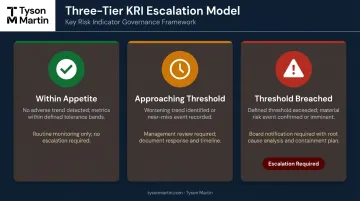
The amber/red triggers must be defined before an incident, not improvised during one. Pre-defined responses are what separate governance from reaction.
What Happens When the Connection Breaks
The Federal Reserve's 2023 review of Silicon Valley Bank's collapse found that the board and management failed to manage risks, and that supervisors had identified weaknesses before the failure. The data was visible. The governance response wasn't.
When appetite lives in a policy document and KRIs live in a separate spreadsheet, neither informs the other. Boards get surprised by incidents that were visible in the data weeks earlier — because no one had defined the point at which data required a decision.
Building and Maintaining a Risk Appetite Framework
Five Core Steps
Engage leadership to align appetite with strategy — Start with what the business cannot afford to lose: revenue continuity, data integrity, regulatory standing, customer trust. Translate each into a plain-language harm statement before writing a single threshold.
Define the risk categories that matter — Identify the principal risk areas relevant to the organization's model and regulatory environment. Common categories: cybersecurity, third-party/vendor risk, regulatory compliance, operational resilience, AI and technology risk.
Write measurable appetite statements per category — Each statement should include a specific threshold, not just a directional preference. "Low appetite for data incidents" is not measurable. "Critical patches applied within 7 days on crown-jewel systems; any breach affecting regulated data escalates within 24 hours" is.
Establish KRIs and thresholds mapped to each statement — Select one to two leading indicators and one lagging indicator per risk category. Prioritize quality over coverage. A board-level dashboard of 8–12 stable metrics tells a more useful story than 40 metrics updated inconsistently.
Define escalation and exception processes before you need them — Who gets notified at amber? What's required at red? Who can accept a risk exception at each level, and for how long? These decisions cannot be made well under incident pressure.
Review Cycle and Triggers
Risk appetite should be formally reviewed at least annually. Out-of-cycle reviews are warranted when:
- New leadership joins at CEO, board, or risk committee level
- M&A activity changes the organization's risk profile or regulatory obligations
- Regulatory shifts alter compliance requirements or enforcement posture
- Material incidents reveal that stated appetite didn't match actual behavior or tolerance
An appetite statement written for a different business context provides false assurance. Revenue model changes, new AI use cases touching sensitive data, and completed cloud migrations all shift the organization's actual risk profile. The thresholds need to reflect that reality.
Governance Ownership
Clear ownership is what prevents frameworks from degrading after the initial build:
- Board — Approves the appetite framework and sets appetite levels; reviews KRI trend data at minimum quarterly
- Senior Management — Operationalizes appetite through tolerance thresholds and KRI selection; owns escalation response
- Risk and Compliance Teams — Monitors KRIs, maintains exception logs, ensures governance mechanics convert appetite into documented decisions
- Internal Audit — Validates that the framework is being followed, not just that it exists on paper
During leadership transitions and M&A activity, internal ownership of the framework is most likely to be in flux — which is precisely when governance continuity matters most. Board advisors can provide independent oversight during these gaps to keep escalation paths and decision rights intact.
Frequently Asked Questions
What are the 5 levels of risk appetite?
The five levels, per HM Treasury's 2021 guidance, are Averse, Minimal, Cautious, Open, and Eager (some practice frameworks use "Hungry" in place of Eager). Organizations assign different levels to different risk categories rather than adopting a single enterprise-wide position — a company might be Averse on regulatory compliance while being Open on market expansion.
How do you evaluate risk appetite?
Evaluation involves comparing current risk exposure — measured through KRIs and incident data — against the stated appetite boundaries. This is typically conducted through board or committee review at defined intervals, with results used either to confirm the framework is working or to trigger a reset of thresholds and escalation protocols.
What is the difference between risk appetite and risk tolerance?
Risk appetite is the board-level declaration of how much risk the organization is willing to accept. Risk tolerance is the operational band around that position — how far the business can flex before triggering a review. KRI thresholds live at the tolerance level and are owned by management, not the board.
What are Key Risk Indicators and how do they differ from KPIs?
KRIs are forward-looking metrics that signal whether risk exposure is approaching or exceeding appetite thresholds. KPIs measure performance against business objectives. KRIs ask "are we taking the right amount of risk?" — KPIs ask "are we hitting our targets?" Both belong on a board dashboard, but they answer fundamentally different questions.
How often should a board review its risk appetite?
Formally, at least annually — and whenever strategy, leadership, or the regulatory environment shifts materially, or following a significant incident. KRI trend data should reach the board quarterly at minimum, with immediate escalation when a metric crosses a predefined threshold.