

That's the gap this article addresses. You'll find a clear definition, real examples across key risk domains, the components that separate an actionable statement from a governance artifact, and the mistakes that quietly undermine most of them.
Key Takeaways
- A risk appetite statement defines how much and what types of risk your organization will accept — by domain, not as a single blanket position
- Appetite, tolerance, and capacity are three distinct concepts — boards and management need to track each one independently
- Effective statements combine qualitative direction with measurable KRI thresholds — one without the other is incomplete
- OCC Appendix D requires covered banks to maintain both qualitative and quantitative components with annual board approval
- Most statements fail for the same reasons: vague language, no escalation triggers, and documents that never get updated
What Is a Risk Appetite Statement?
A risk appetite statement (RAS) is a formal, board-approved declaration of the level and type of risk an organization is willing to accept in pursuit of its strategic objectives. It is not a compliance artifact produced for an auditor. It's a decision-making tool — one that should guide choices at every level, from capital allocation to vendor onboarding to incident response.
The Institute of Risk Management defines risk appetite as "the amount of risk that an organisation is willing to seek or accept in the pursuit of its long term objectives." That framing matters: appetite is about pursuit, not just avoidance.
An effective RAS covers multiple domains simultaneously — cyber, financial, operational, compliance, and reputational — with explicit appetite levels assigned to each. A single blanket statement covering the whole organization tells management nothing useful.
Risk Appetite vs. Risk Tolerance vs. Risk Capacity
These three terms are frequently used interchangeably. They shouldn't be.
| Term | What It Means | Who Owns It |
|---|---|---|
| Risk Appetite | The level and types of risk the board is willing to pursue | Board |
| Risk Tolerance | The measurable deviation from appetite that triggers escalation or action | Management |
| Risk Capacity | The absolute maximum risk the organization can absorb before it can no longer function | Board + Finance |
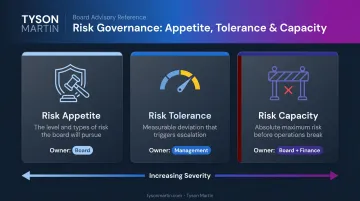
The Basel Committee's 2015 corporate governance principles define risk capacity as "the maximum amount of risk a bank is able to assume given its capital base, risk management and control capabilities as well as its regulatory constraints." Appetite is the board-approved position chosen within that boundary — not at it.
Appetite defines the boundary the board has chosen. Tolerance defines how close to that boundary operations can run before escalation is required. Capacity is the point beyond which the business breaks.
An RAS without defined tolerances gives management no signal. Conflating appetite with capacity eliminates the safety margin entirely.
Why Risk Appetite Statements Matter to Boards
Without a defined RAS, every risk decision defaults to individual judgment. That judgment varies by department, business unit, and who happens to be in the room. Boards that lack a formal RAS can't provide meaningful oversight — they can only react after the fact.
The Strategic Alignment Argument
A well-constructed RAS ties risk-taking directly to business objectives. That means the organization can pursue growth or innovation in specific areas while maintaining hard stops elsewhere. The contrast is intentional:
- High appetite for new market entry or product innovation
- Moderate appetite for operational change and technology modernization
- Low appetite for cyber incidents affecting customer data
- Zero appetite for regulatory non-compliance or financial misreporting
That specificity is what makes the statement useful. Without domain-level differentiation, every risk decision gets treated the same.
What Regulators Actually Require
Regulatory expectations vary significantly by sector. The OCC's Appendix D to 12 CFR Part 30 is the clearest mandate: covered banks must maintain a written risk appetite statement with both qualitative components and quantitative limits, with board or risk committee review and approval at least annually.
Beyond banking, regulatory expectations follow a consistent pattern — boards must own the risk threshold, even when a formal RAS isn't explicitly named:
- Federal Reserve SR 21-3: Boards must "review, approve, and periodically monitor the firm's strategy and risk appetite"
- FFIEC: Ties information-security management directly to board-approved risk thresholds
- OMB Circular A-123: Applies comparable governance requirements to federal agencies
- SEC cybersecurity rules (2023): Requires disclosure of board oversight processes for material cyber risks — but stops short of mandating a formal RAS
- HIPAA: Requires risk analysis and risk management, not an enterprise appetite statement
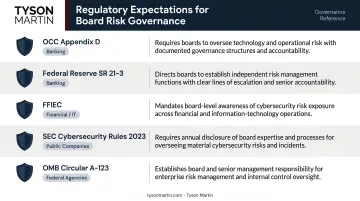
The explicit requirement differs by sector. The governance expectation does not.
Risk Appetite Statement Examples
Appetite posture should be domain-specific — and it should vary by organization. A fintech may carry high appetite for operational change and near-zero tolerance for fraud loss. A hospital system maintains zero appetite for patient safety risk while accepting moderate exposure to technology innovation risk. The same domain can look very different across industries.
The examples below show how that variation plays out in practice — use them as a reference point, not a template.
Cybersecurity Risk Appetite
"The organization maintains low appetite for unauthorized access to customer personally identifiable information or core financial systems. We require continuous monitoring of all production environments, zero-trust architecture for privileged access, and a security review gate before any new technology is deployed. A confirmed unauthorized access event involving customer PII triggers immediate board notification, regardless of data volume."
KRI examples:
- Time to detect and contain incidents
- Percentage of privileged accounts with active MFA
- Critical vulnerability remediation time on crown-jewel systems
Financial and Compliance Risk Appetite
"The organization accepts moderate risk in pursuit of investment and revenue growth targets, consistent with approved capital allocation guidelines. It maintains zero appetite for regulatory violations, material financial misreporting, or actions that would compromise our operating licenses. Any identified compliance breach is escalated to the audit committee chair within 24 hours of confirmation."
KRI examples:
- Open regulatory findings by severity
- Time to remediate audit issues
- Percentage of controls tested per quarter
Operational and Reputational Risk Appetite
"The organization maintains low operational risk appetite, defined as a maximum of 6 hours of unplanned downtime for customer-facing systems before escalation to the executive team. Reputational risk appetite is very low — any public incident generating press coverage or customer complaint volumes exceeding baseline triggers a board review within 48 hours."
KRI examples:
- Mean time to restore critical services
- Number of critical vendor gaps without current assurance
- Failed backup restore tests on crown-jewel systems
The IRM's 2017 Risk Appetite Statements report shows how real organizations operationalize these statements:
- British Land tied each principal risk to quarterly KRI monitoring, giving the board a consistent cadence for oversight
- Worldpay Group supplemented qualitative statements with principal-risk metrics across eight categories — pairing narrative with numbers
- Marks and Spencer framed their RAS as "an expression of the type and amount of risk the company is prepared to take," a definition that's deliberately broad enough for strategy but specific enough to drive consistent decisions at the management level

Key Components of an Effective Risk Appetite Statement
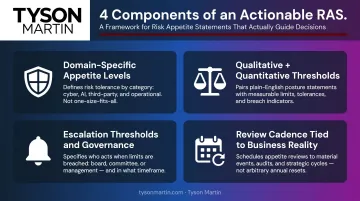
Most risk appetite statements are incomplete, not inaccurate. Four components separate an operational RAS from a document that sits in a policy folder and gets cited during audits.
1. Domain-Specific Appetite Levels
The RAS must name each risk domain the organization faces and assign a defined appetite level to each:
- Cyber / technology
- Financial
- Operational
- Compliance
- Third-party / vendor
- Reputational
- Strategic
"We are risk-aware" is not a usable statement. "We maintain low appetite for cyber risk, defined as any unauthorized access to customer PII" is.
2. Qualitative Direction Plus Quantitative Thresholds
OCC Appendix D requires both qualitative components and quantitative limits for covered banks. The same logic applies to any organization with material technology or financial exposure. Qualitative language sets the directional stance; quantitative metrics operationalize it.
Examples of quantitative thresholds:
- Maximum customer portal downtime: 6 hours before executive escalation
- Maximum fraud loss from digital channels: $50,000 per quarter before board notification
- No more than 2 critical suppliers operating without current security assurance evidence
- Critical vulnerability remediation on crown-jewel systems: within 72 hours of confirmation
Thresholds like these give management a clear line between normal operations and a required escalation — and give the board something to verify rather than accept on faith.
3. Escalation Thresholds and Governance Structure
Escalation triggers are what make thresholds enforceable. Every threshold needs two levels:
- Amber: Worsening trend over two consecutive cycles, or a near-miss event
- Red: Threshold breach or repeat violation
Each trigger must define who gets notified, within what timeframe, and what information must be included in the first update. Without defined notification requirements, escalation stalls — or gets shaped by whoever has the most access to leadership when the incident breaks.
4. Review Cadence Tied to Business Reality
The RAS should be reviewed at minimum annually, with additional reviews triggered by:
- M&A activity or significant business model changes
- Material cyber incidents or regulatory inquiries
- New AI use cases or major technology migrations
- Leadership transitions
For high-velocity categories like cyber, quarterly deep dives on specific themes — identity, vendor exposure, recovery posture — are more appropriate than a single annual pass. An RAS that hasn't been revisited since the business acquired a new entity or launched a new product line is already misaligned.
How to Build a Risk Appetite Statement: A Step-by-Step Approach
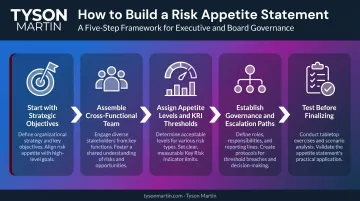
The process doesn't require months of committee work. A structured workshop can produce a workable first version in two to six weeks.
Step 1 — Start with strategic objectives, not risk categories. Before naming any risk domain, articulate what the organization is trying to achieve and what it cannot afford to lose. Risk appetite is downstream of strategy, not parallel to it. Crown-jewel identification — the systems and data that would stop the business — comes before any appetite label.
Step 2 — Assemble the right cross-functional team. The RAS should not be written by the CISO alone. The working group typically includes representation from:
- CEO or board sponsor
- COO (operational continuity)
- General Counsel (legal exposure, notification obligations)
- CFO or finance lead (financial thresholds)
- CTO or IT lead (technical context)
- Business unit leaders with material risk exposure
For organizations without in-house governance expertise, an independent board advisor or fractional CISO can facilitate the process and keep it moving. The facilitator's job is to push toward specific choices — not generic positions — and surface the real appetite that already exists but hasn't been stated.
Step 3 — Assign appetite levels and define measurable KRI thresholds. For each domain, agree on an appetite level, then define the KRI that signals when tolerance is being approached. For example: in third-party risk, flag when more than 15% of critical vendors are overdue on security reviews. This is the step most organizations skip — and without it, the RAS cannot be monitored.
Step 4 — Establish governance, ownership, and escalation paths. For each risk domain, define three things:
- Who owns it and is accountable for staying within appetite
- Who monitors the associated KRIs and at what frequency
- What the escalation path looks like when amber or red thresholds are hit
Map these to board reporting cadence — monthly dashboard reviews, quarterly deep dives, and immediate notification protocols for threshold breaches.
Step 5 — Test before finalizing. A tabletop exercise is the most reliable validation mechanism. Walk the leadership team through a ransomware event, a third-party breach, or a regulatory inquiry. A statement that works in a document but collapses in a scenario exercise is not ready for board approval. At minimum, run one executive tabletop before the RAS is formally adopted.
Common Mistakes That Undermine Risk Appetite Statements
Vague, Untestable Language
"We are risk-averse" and "we take a balanced approach" give no actionable guidance. A manager facing a real decision — whether to launch a product feature before a security review is complete, or whether to accept a vendor contract without current SOC 2 evidence — cannot consult that language and know where the boundary is.
Every section of the RAS must be specific enough to answer a real question. Consider the difference:
- Directional but not usable: "We maintain low appetite for cyber risk."
- Usable: "We maintain low appetite for cyber risk, defined as maximum 6 hours of customer portal downtime and zero unauthorized access to PII without immediate board notification."
Treating It as a Static Document
Many organizations file the RAS after board approval and don't revisit it until the next audit cycle. The business changes continuously: cloud migrations, AI deployments, M&A, and new revenue models all shift actual exposure without touching the document. When cyber risk is involved, annual-only review cycles leave significant gaps. Quarterly monitoring against KRIs, combined with event-driven reviews, keeps the RAS current rather than archival.
No Escalation Thresholds or Accountability
Without defined breach points, no one is responsible for acting when risk exposure climbs. Management doesn't know when to escalate. The board receives updates that describe past events rather than prompting current decisions.
A metric without a threshold is a history lesson. Clear escalation triggers are often the most dangerous gap in an otherwise reasonable RAS, and they're precisely what fails first during an actual incident.
Frequently Asked Questions
What is a risk appetite statement?
A risk appetite statement is a formal, board-approved document that defines the level and type of risk an organization is willing to accept in pursuit of its strategic objectives. It functions as the foundational guide for risk-related decision-making across all levels — from capital allocation to vendor onboarding.
What is a risk appetite statement example?
A technology company might state: high appetite for product innovation, low appetite for unauthorized access to customer data, and zero appetite for GDPR non-compliance. Effective examples are domain-specific and tied to measurable thresholds — not single blanket positions.
What is the difference between risk appetite and risk tolerance?
Risk appetite is the strategic stance — the level of risk the board is willing to pursue. Risk tolerance is the operational guardrail: the specific measurable deviation that triggers escalation before the appetite limit is breached.
Who should approve a risk appetite statement?
The board of directors holds ultimate approval authority, typically informed by recommendations from the risk or audit committee and senior leadership — including the CISO, CFO, and General Counsel. For covered banks, OCC Appendix D requires board or risk committee review and approval at least annually.
How often should a risk appetite statement be reviewed?
At minimum annually, with additional reviews triggered by M&A activity, leadership transitions, new market entry, material incidents, or regulatory changes. For high-velocity categories like cyber, quarterly KRI monitoring is the more defensible cadence.
What is zero risk appetite and when does it apply?
Zero risk appetite means the organization will not accept any exposure in a specific area — typically applied to regulatory non-compliance, patient safety violations, or unauthorized access to sensitive customer data. It's a hard boundary, not a negotiating position against business opportunity or growth targets.