
Introduction
Most board risk reports fail before anyone reads the second page. They arrive dense with vulnerability counts, compliance percentages, and risk register summaries that directors weren't hired to decode — and boards have started saying so.
The 2026 standard is different. Boards expect answers to three questions, fast: What is our current risk posture? What changed since the last meeting? What decisions require board action today? Everything else belongs in an appendix.
What follows is a practical guide to meeting that standard — covering the structural shifts driving it, what every 2026 template must include, and the reporting mistakes that quietly erode board confidence.
Key Takeaways
- Boards want what changed, not a full re-listing of every known risk
- The most credible reports separate board decisions from what management already owns
- Cyber and AI risk have moved from IT concerns to primary board oversight responsibilities
- SEC cybersecurity disclosure rules and the EU AI Act have made directors personally accountable for risk oversight gaps
- Plain-English framing, stable metrics, and forward-looking scenarios outperform dense dashboards
How Board Expectations Around Risk Reporting Have Shifted in 2026
The core shift is this: boards no longer want a risk inventory. They want a risk posture with a direction of travel. The guiding principle for 2026 reporting is trend, not trivia — show movement, not just status.
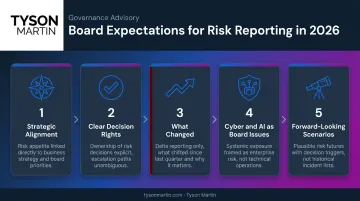
Five expectations now define what good board risk reporting looks like.
Expectation 1: Strategic Alignment Over Compliance Categories
Directors want each top risk connected to a strategic objective or revenue outcome, not filed under a label like "operational" or "compliance."
NACD's 2024 guidance identifies the core reporting gap as insufficient information on "the aggregated and correlated impacts of dynamic risks on strategy and performance." Risk categories have become a crutch — boards want business context, not taxonomy.
Expectation 2: Clear Decision Rights
Boards want to know exactly what requires their approval versus what management owns. Reports that blur this line slow meetings and create confusion. When decision rights are explicit, directors arrive knowing what they're there to decide — and the agenda moves faster.
Expectation 3: What Changed, Not What Exists
Directors increasingly ask why they're reviewing the same risks quarter after quarter with no meaningful update. The 2026 standard opens with a "since last report" summary that shows movement: which risks have escalated, which have been mitigated, and what's newly emerged. If a risk hasn't changed, it gets one line in an appendix — not a dedicated section.
Expectation 4: Cyber and AI as Board-Level Issues
These are no longer IT matters. Cybersecurity was the most selected board agenda issue in NACD's Q4 2024 survey, chosen by 46% of respondents. On AI, 36% of directors characterized it as carrying equal risk and opportunity for their organizations. Both belong in the board report, framed in business impact terms.
Expectation 5: Forward-Looking Scenarios
WEF's 2025 Global Cybersecurity Outlook found that 62% of high-resilience organizations provide boards regular updates on incidents, trends, vulnerabilities, and risk predictions. Boards want at least one or two scenario narratives — "if X happens, here is the likely business impact and our current readiness" — not just a log of what already went wrong.
What Every Board Risk Report Template Must Include in 2026
Experienced board advisors and governance frameworks — including NACD's 2026 Cyber Risk Oversight guidance and COSO ERM — converge on the same core components. Here's what belongs in every board risk report, and why.
Executive Summary and Risk Posture Statement
The first page must answer three questions in plain English:
- What is our current risk posture?
- What has changed since the last briefing?
- What decisions or approvals does the board need today?
This framing — applied in Tyson Martin's board advisory work — replaces multi-page risk narratives with a concise, decision-ready opening. A director who reads only this page should be able to engage meaningfully in the board discussion. Visuals here (a heat map or KRI trend chart) improve retention and orient the room before discussion starts.
Top Risks Dashboard with Movement Indicators
Keep the list to 5–7 top risks, not an exhaustive register. For each risk, include:
- A one-line plain-English description
- A likelihood/impact rating
- A status indicator: escalating, stable, or improving
- A named business owner (not just "the CISO")
- A brief mitigation summary
Movement indicators (arrows or color-coded trends) are far more useful to boards than static snapshots. The question boards are actually asking: is this getting better or worse?
Key Risk Indicators (KRIs) Tied to Risk Appetite
KRIs give the board a quantifiable signal of whether risk exposure sits within or outside board-approved thresholds. NACD's 2026 guidance specifies that dashboards should show current exposure against board-approved risk appetite. Reporting should be at least quarterly, with clear escalation criteria when thresholds are breached.
Examples of board-level KRIs (drawn from NACD guidance) include:
- Quantified risk exposure by business unit
- Number and severity of incidents over time
- Mean time to detect and contain incidents
- Critical vendor assurance coverage rate
Replace vague appetite language like "low" or "moderate" with specific numbers: hours of acceptable downtime, dollars of acceptable fraud loss per quarter, maximum number of critical vendors operating without current security assurance.
Emerging Risks and Forward-Looking Scenarios
This is the board's early warning section. Include 2–3 emerging threats with brief scenario analysis:
- What it is — one-sentence description
- Realistic business impact if it materializes — revenue, operations, regulatory exposure, or reputation
- Current readiness level — honest assessment, not a reassurance
AI-driven fraud, supply chain concentration risk, and emerging regulatory requirements belong here. NACD explicitly calls for scenarios, war-gaming, and quantitative stress-testing as part of mature board risk oversight.
Decisions Required and 90-Day Action Plan
Every report must close with a clear action block. The structure Tyson Martin recommends:
- The top risks that could change business outcomes this quarter
- The specific decision being requested (approve, fund, accept, pause, or exit)
- The consequences of doing nothing
The 90-day plan that follows should list each action with four required fields:
- Named owner (a role, not a committee)
- Due date
- Cost range
- Proof of closure (test results, access review evidence, or a completed milestone)
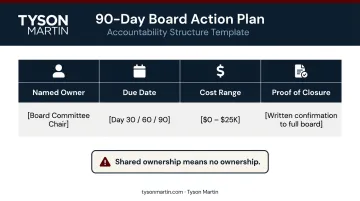
Shared ownership means no ownership. Each item needs one accountable leader.
What's Driving These Elevated Board Expectations
Regulatory and Legal Accountability
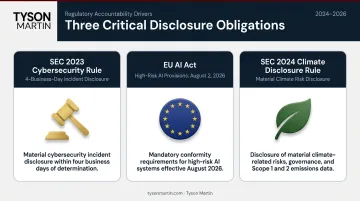
Board risk oversight has become legally consequential — not just best practice. Three rules now place specific, documentable accountability on directors:
- SEC 2023 Cybersecurity Rule: Registrants must describe board oversight of cybersecurity threats and disclose material incidents on Form 8-K within four business days of determining materiality.
- EU AI Act: Most high-risk AI provisions apply from August 2, 2026, creating governance obligations for any organization with EU exposure.
- SEC 2024 Climate Disclosure Rule: Requires disclosure of climate-related risks that could materially impact strategy, operations, or financial condition.
Investor and Proxy Scrutiny
Glass Lewis's 2024 U.S. Benchmark Policy Guidelines state directly that following cyberattacks causing significant shareholder harm, Glass Lewis will closely evaluate the board's oversight, response, and disclosures. The same guidelines flag AI governance transparency as an area of increasing investor expectation. Poor board risk reporting isn't just a governance gap — it's a voting-risk factor.
Declining Tolerance for Static Quarterly PDFs
Boards increasingly have access to real-time dashboards and AI-powered GRC tools. Their tolerance for receiving the same static PDF four times a year — with no movement indicators and no scenario framing — has dropped sharply. The bar has moved, and the organizations that haven't updated their reporting format are visible.
Common Mistakes That Undermine Board Risk Reports
Mistake 1: Overloading with Technical Detail
Reports that present vulnerability counts, patch percentages, or raw security metrics without business context force directors to do translation work they weren't hired to do. Every metric must be converted to a business impact statement before it appears in the board report. Technical details belong in appendices.
Mistake 2: Repeating Stable Risks Without New Information
Boards disengage when every cycle restates the same risks with no meaningful update. Apply a "what changed" filter before writing. If nothing has changed for a risk, summarize it in a single line in an appendix — don't give it full report space that displaces what actually moved.
Mistake 3: Failing to Separate Board Decisions from Management Actions
Listing every risk response without separating what the board must approve from what management handles creates confusion and extends meetings. Every report needs a clearly labeled section: what the board is being asked to decide, with specific options and the consequences of inaction. Everything else belongs in the management layer.
How to Structure and Present Your Board Risk Report for Maximum Impact
Lead with the One-Page Executive Summary Every Time
Boards often skim before meetings. The one-page summary must stand alone. A director who reads only that page should understand the current posture, what changed, and what the board needs to decide. One heat map or KRI trend chart on this page does more for engagement than three pages of narrative.
Use a Stable, Consistent Format Every Cycle
Boards build pattern recognition over time. A report that changes structure each quarter forces directors to reorient rather than analyze. Lock in a format — same section headers, same metric definitions, same risk appetite thresholds — and let the content evolve within a consistent container.
When directors can predict the structure, they spend meeting time on the risk itself — not on decoding a new layout. That's where trust is built.
Calibrate Depth to Board Composition
A board with a CISO or technology director can absorb more technical framing than one composed primarily of financial or operational directors. Assess the audience before each cycle.
A board advisor can help leadership teams calibrate depth and tone to the specific governance context — so the report lands as credible, not inaccessible.
Prepare a Verbal Narrative to Accompany the Written Report
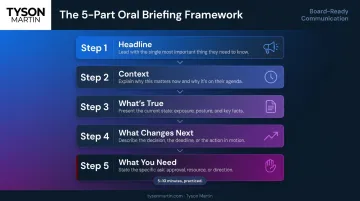
The written report is a reference document. The oral briefing is where boards engage. Tyson Martin recommends a simple verbal structure:
- Headline — the single most important thing the board needs to know
- Context — why it matters now
- What's true — current state, no jargon
- What changes next — expected movement by the next cycle
- What you need — a clear decision ask
Keep the technical setup brief. Slow down on the decision ask. Use concrete nouns — customer portal, payroll system, factory line — rather than security posture scores. A 5–10 minute verbal summary, practiced, is worth more than an additional 10 slides.
Frequently Asked Questions
What should be included in a board risk report?
The core components are an executive summary with risk posture, a top risks dashboard with movement indicators, KRIs tied to board-approved risk appetite, emerging risks with scenario analysis, and a clear decision and action block — each connected to business impact, not technical detail.
How is a board risk report different from a management risk report?
A management risk report tracks operational detail across the full risk register. A board risk report surfaces only what directors need for oversight — the top risks, what changed since the last briefing, and what requires board-level decision or approval. The board view exists to drive decisions, not to document evidence.
How often should a board risk report be presented?
Most boards receive risk reports quarterly, aligned to regular meeting cycles. Highly regulated organizations or those facing active threats should also receive interim updates when significant incidents, material regulatory changes, or rapidly escalating risks emerge.
What do boards expect in a cyber risk report in 2026?
Boards want current cyber posture in plain English, what changed since the last briefing, whether exposure sits within board-approved risk appetite, and what specific decisions or investments require board action. Technical metrics belong in appendices — business impact belongs in the main report.
How do you present risk to a board without technical jargon?
Convert every risk metric to a business impact statement before it appears in the report — frame it in terms of revenue, operations, regulatory exposure, or reputation. Technical details, raw data, and security-tool outputs belong in a management supplement or appendix.
How long should a board risk report be?
The main report should be no more than 5–8 pages, with a standalone one-page executive summary at the front. Full risk registers, raw KRI data, incident logs, and vendor assessment details belong in appendices that directors can reference if needed but aren't required to read in full.